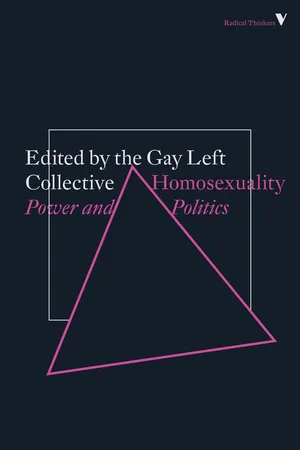
After the leading organizations of radical sexual politics - the Gay Liberation Front and the Gay Marxist Group - imploded or dissolved, the Gay Left Collective formed a research group to make sense of the changing terrain of sexuality and politics writ large. Its goal was to formulate a rigorous Marxist analysis of sexual oppression, while linking together the struggle against homophobia with a wider array of struggles, all under the banner of socialism.
This anthology combines the very best of their work, exploring masculinity and workplace organizing, counterculture and disco, the survivals of victorian morality and the onset of the HIV/AIDS crisis.
- 224 pages
- English
- ePUB (mobile friendly)
- Available on iOS & Android
eBook - ePub
About this book
Information
1
Capitalism and the Organisation of
Sex
JEFFREY WEEKS
In Western capitalist countries, sex is securely established on His (and it is “His”) throne, Master of all He surveys. Moralists rant about its excesses, revealing in every bead of sweat their obsession with it. Liberals, rejoicing in the “ending” of ancient hypocrisies, revel in its pleasures. Sex, far from being denied by capitalism, has been exalted. Sex oils the wheels of advertising. Endless page threes sell tawdry newspapers. Sex envy is the beginning and end of personal relations. Sex has launched a thousand ships and ruined a million families. Sex has become the truth of our being, the key to our deepest secrets.
Socialists are faced with a complex problem. The sexual radical movements gained their initial impetus from the conviction that the “system” dominated by hypocrisy/puritanism denied various forms of sexual expression: female sexuality and homosexuality in particular. This in turn was theoretically related to the “need” for capitalist society to repress certain types of sexuality to secure its even functioning. The problem is to square this conviction with the active promotion of sexuality, indeed the explosive emergence of sexuality, in capitalist society over the past generation. Theories such as Marcuse’s “repressive desublimation” have in fact proved totally inadequate as explanations. Instead we have to look at the forms of sexuality which have emerged as central to its capitalist organisation: the “sexually alluring”, “liberated” woman who graces Cosmopolitan, the swinging, self-confident affluent homosexual male who lives in the pages of The Advocate. What we are witnessing is the creation of new sexual types which are potentially as limiting as the old stereotypes (the sexless “lady” of some nineteenth-century textbooks, the degenerate pervert of twentieth-century psychiatrists). They are models which are based on confirming sex just as the old ones denied it, but both reveal a central factor in modern cultures. What has happened is that a tendency that has always been there in bourgeois cultures has assumed a new strategic position, and we have become a sex-positive culture of sorts. But, and it is a major but, this positiveness is only being applied to certain types of behaviour, in certain ways. And in asking why this is so we might find an answer to a wider but more mysterious question: why capitalism and sexuality are so inextricably linked.
For most writers in the socialist tradition the relationship between capitalism and sexual oppression, although seen as complex, has nevertheless been treated as unproblematic. Engels wrote that true sex life had been distorted by commodity production but would flourish on a higher plane under socialism: “Monogamy, instead of collapsing, (will) at last become a reality”. Contained in this (apart from an implicit heterosexual bias) are two concepts which have actually been a bar to any proper socialist evaluation of sexual oppression. The first is an assumption that sex is a natural force with direct effects on the individual and the body politic. The second is the assumption that this sexuality is channelled or directed straight forwardly and with intentionality through the nuclear family, in the interests of capitalism.
A number of assumptions have classically been made about the nature of sexuality, assumptions current both in traditionalist and left thought (and particularly evident in the writings of the Freudian left: Reich, Fromm, Marcuse). They also have the undoubted strength of appearing as commonsensical: in this view sex is conceived of as an overpowering, instinctual force, whose characteristics are built into the biology of the human animal, which shapes human institutions and whose will must find an outlet, either in the form of direct sexual expression or, if blocked, in the form of perversion or neuroses. Krafft Ebing expressed an orthodox view in the late nineteenth-century when he described sex as a “natural instinct” which “with all-conquering force and might demands fulfilment”. The clear supposition here is that the sex drive is basically male in character, with the female perceived as a passive receptacle. More sophisticated versions of what William Gagnon and John Simon have termed the “drive reduction” model recur in twentieth-century thought. It is ambivalently there in part of Freud’s work, though the careful distinction he draws between “instinct” and “drive” has often been lost, both by commentators and translators. It is unambiguously present in the writings of many of his self-defined followers. As G. R. Taylor wrote in his neo-Freudian interpretation of Sex in History:
The history of civilisation is a history of a long warfare between the dangerous and powerful forces of the id, and the various systems of taboos and inhibitions which man has erected to control them.1
Here we have a clear notion of a “basic biological mandate” that presses on, and so must be firmly controlled by the cultural and social matrix. What is peculiar about this model is that it has been adopted by marxists who in other regards have firmly rejected the notion of “natural man”. With regard to homosexuality, the instinctual model has either seen it as a more or less pathological deviation, a failure of socially necessary repression, or as the effect of the morally restrictive organisation of sexual morality, which is how it appears in the works of Wilhelm Reich; or more romantically, but nevertheless still ahistorically, as the “great refusal” of sexual normality, which is how Marcuse seems to present it.
Against this William Gagnon and John Simon have argued in their book Sexual Conduct that sexuality is subject to “socio-cultural moulding to a degree surpassed by few other forms of human behaviour”, and it is in using this insight that socialists can most fruitfully explore the question of sexual oppression. A number of recent writers have taken up elements of this notion, and together they have posed formidable challenges to our received notions of sexuality.
The first consequence is a rejection of sex as an autonomous realm, sexuality as a natural force with specific effects, a rebellious energy which is controlled by the “social”. In the work of Gagnon and Simon it seems to be suggested that nothing is intrinsically sexual, or rather that anything can be sexualised. In Jacques Lacan’s return to Freud, desire is created as a consequence of the child’s entry into patriarchal meanings at the Oedipal moment. In the recent work of Michel Foucault, The History of Sexuality, sexuality is seen as a historical apparatus, and “sex”, far from having a life and history of its own, is a “complex idea that was formed within the deployment of sexuality”.
Foucault’s work is particularly relevant here because he quite clearly sees the notion of sexuality as itself an ideological construct, a product of particular historical circumstances. The notion of “sexuality” organises and unifies the various possibilities for pleasure of the body: it plays upon “bodies, organs, somatic localisations, functions, anatamo-physiological systems, sensations, and pleasures”2 which have no intrinsic unity or “laws” of their own. In other words, our culture has developed a notion of sexuality linked to reproduction and genitality and to “deviations” from these, which have denied us (openly at least) the full enjoyment of the bodily pleasures that are potentially available to us.
The second consequence which derives from questioning the existence of a self-evident biological sexuality is that we have to question the traditional notions of “repression” of sexuality. Far from society repressing (or conversely liberating) sexuality, its main tendency lies in organising and inventing forms of sexual definition, categorisation, and hence regulation. Gagnon and Simon have written:
To earlier societies it may not have been a need to constrain severely the powerful sexual impulse in order to maintain social stability or limit inherently anti-social force, but rather a matter of having to invent an importance for sexuality.3
If this is indeed the case, we must begin to think much more in terms of the various forms of social definition of sexuality and their social conditions of existence rather than try to speak in terms of “capitalism” oppressing “sexuality” as if there could be a simple relationship between the two. A major insight which both the theoretical tradition represented by Gagnon and Simon and the school of thought represented by Michel Foucault have in common is a recognition that a major way in which sexuality is regulated is through the process of categorisation and the imposition of a grid of definition upon the various possibilities of the body and the various forms of expression that “sex” can take. This in turn should direct our attention to the various institutions and social practices which perform this role of organisation, regulation, categorisation: various forms of the family, but also legal regulation, medical practices, psychiatric institutions and so on, all of which can be seen as products of the capitalist organisation of society, but all of which at the same time have a relative autonomy within the capitalist system and from the ruling class. The infinite possibilities of the human child at birth are gradually narrowed, organised and controlled as the s/he becomes subjected to the class- and gender-defined social order.
The rejection of an “essentialist” view of sexuality in turn challenges the orthodox model of the nuclear family as the sole locus of the oppression of sexuality in general and homosexuality in particular. For example, male homosexuality has been seen as a threat to the ensemble of assumptions about male sexuality, and a perceived challenge to the male heterosexual role within capitalism. As Mike Brake has put it:
In Britain sexual intercourse has been contained within marriage which has been presented as the ultimate form of sexual maturity … the heterosexual nuclear family assists a system like capitalism because it produces and socialises the young in certain values … the maintenance of the nuclear family with its role-specific behaviour creates an apparent consensus concerning sexual normalcy.
So that,
Any ambiguity such as transvestism, hermaphrodism, trans-sexuality, or homosexuality is moulded into “normal” appropriate gender behaviour or is relegated to the categories of sick, dangerous, or pathological. The actor is forced to slot into patterns of behaviour appropriate to heterosexual gender roles.4
While there is a great deal of truth in this argument, it does assume a simple functional fit between the needs of capitalism and the organisation of sexuality. In particular it makes two crucial assertions. First, it assumes some sort of intentionality on the part of the ruling class to control sexuality in this way. Secondly, it assumes a one-to-one fit between intention and actual effect. The problem is we can neither assume the first, particularly on the basis of very complex historical evidence, nor can we accept the second. The assumption generally made is that the nuclear family acts as a funnel for the control of the sexuality of the working class in the interests of the capitalist class. The problem here is that the nuclear family form was in fact essentially a product of the bourgeoisie, not of the working class. Where the working class adopted, as it has increasingly in the twentieth century, a similar family form, it is much more as an adaptation to its own particular circumstances (the organisation of work patterns, the move towards consumerism, the lowering of the birth rate) rather than as a simple acceptance of the bourgeois model. If this is so, then it is difficult to see how the nuclear family could possibly be the preordained institution for the ruling class’s regulation of sexual behaviour. What this suggests is that rather than talking about a single form of sexual organisation, or indeed oppression, we must begin to think in terms of specific class organisations of sexuality and specific class forms of family and domestic organisation, each with their own specific social origins within the capitalist mode of production. Concepts of sexuality are not only culturally specific but are also class and gender specific.
Two tendencies in particular can be detected. The first, taking a clear form from the middle of the eighteenth century, is the increased stress within bourgeois ideology on the monogamous, heterosexual family as the basic unit of society. The switch is from a family model which stressed lineage, reproduction of the family traditions, and hence the necessary emphasis on choosing the right partner from the right family, to one which stressed individual choice, based on emotional attraction. In ideology at least the cement of the family was sex love, hedged though this was in material reality by preoccupations over property, by the inequality between men and women, and buttressed as it inevitably was by the double standard of morality. The effect of this stress which had its origins both in economics (the separation of women from social labour), in ideology (an increased emphasis on the difference between men and women and the social construction of masculinity and femininity), and politically (with the family throughout the nineteenth century being seen as an essential stabilising factor, the antidote to public tension, the private haven of peace and tranquillity) was an intensification of emotional bonding within the nuclear family. The effect of this was increased dependence of the wife economically, the changing definitions of her sexuality which was, while not denied, always seen in terms of male sexual needs, and the intensified emotional investment in children of the family. It was this family model which the leading evangelists of the bourgeoisie sought to export to the emergent working classes as a necessary element in respectability and social stability, though with limited initial success.
The second tendency associated with this was the emergence of new sexual categorisations in the course of the nineteenth century which were sustained by various social, legal, medical, religious practices: the masturbating child, the hysterical woman, the perverse adult, the congenital prostitute, the degenerate, the homosexual. At the very end of the nineteenth century there is indeed an explosion of sexual categorisations associated with sexologists like Krafft Ebing, Albert Moll, Havelock Ellis, Magnus Hirschfeld, all of whom sought to define the variations of sexual behaviour and to explore their causes. The point is that once sexuality was given priority as a necessary and central element in pair bonding, so the forms of sexual expression became more and more a matter of concern. This sexual categorisation has in turn to be associated with other social definitions which were emerging in recognisably modern forms at the same time, for example the emergence of the concept of adolescence, the redefinition of the significance of housework, the social concern with the status and redefinition of the role of motherhood at the beginning of this century, which in turn can be related to wider social needs, fear of national decline, the development of eugenics, concern with the imperial race and so on. The construction of the model of the heterosexual family and the complexly developing categorisations of behaviour and types, indeed the construction of new social beings, is one of the most characteristic but least recognised products of the way in which capitalism, complexly refracted through the whole of society, was creating new types of person to fill new social responsibilities and needs.
It is in this context that the regulation of homosexual behaviour has to be understood. Homosexuality as a complete experience has never been fully accepted in any type of society, although various forms of homosexual behaviour have been integrated into cultural norms. This has usually been organised in one of two forms: either in terms of institutionalised, and temporary, relations between older men and adolescent boys (such as in ancient Greece), or through the creation of a social role for “passive” men (and in some cased active women) who adopted all the characteristics of the opposite sex. The West perhaps has been almost alone in tabooing all forms of homosexual behaviour, though the taboos have varied throughout time and among different classes. The sodomy laws were the main source of the legal regulation of homosexual behaviour in Britain and throughout Western Europe and later North America. They were formally very severe, usually carrying the death penalty (as was the case in England until 1861), but were probably more effective in their grandeur and the terror they evoked than in their actual practical application. What is absent in Western concepts of homosexuality until the nineteenth century is any clear notion of a homosexual social role or homosexual identity. The word homosexuality itself was not invented until the 1860s and had very little general usage before the 1880s/1890s, even among specialists and small bands of self-defined homosexuals. What was controlled by the law, and indeed by public opinion much more effectively, was types of behaviour. What were punished and excoriated were acts, not persons. From the nineteenth century, however, what we see being defined, indeed created, in social science is a type of person; what is being condemned is not so much the activity but the state of mind. The sodomite, as Michel Foucault put it, was a temporary aberration; the homosexual belongs to a species.
From the second part of the nineteenth century, both in Britain, Germany, the USA and elsewhere, we see the emergence of new legal controls on male homosexual behaviour which had the effect of defining the narrow line between permissible and impermissible behaviour. Associated with this was the development of new ideological regulations and practices, particularly medical and psychiatric ones. These were practices and institutions that defined and in defining helped to create types of behaviour, types of persons. These definitions took changing forms from “degeneration” to “congenital madness”, to unfortunate anomalies, to hereditary sicknesses, which became the regular mode of discussion for homosexuality until the 1960s.
The increasing concern and detailed manipulation and regulation of sexual behaviour has to be seen as a product of a double concern: with the life (and especially the sexual life) of the individual, a necessary concomitant of the emergence of bourgeois society; and with the life of the species, a concern with population which itself is a result of the vast demands made upon the social order by the development of industrial capitalism. The organisation of sex...
Table of contents
- Cover Page
- Halftitle Page
- Title Page
- Copyright Page
- Contents
- Introduction
- 1. Capitalism and the Organisation of Sex
- 2. The Struggle for Femininity
- 3. Sexuality: Regulation and Contestation
- 4. What Changed in the Seventies?
- 5. The Ideology of GLF
- 6. The Politics of Tea and Sympathy
- 7. The Politics of Autonomy
- 8. Bringing It All Back Home: Lesbian Feminist Morality
- 9. Sects and Sexuality: Trotskyism and the Politics of Homosexuality
- 10. New Politics – Old Struggles
- 11. Lesbian, Socialist, Feminist
- 12. Two Steps Forward, One Step Back
- 13. Horrific Practices: How lesbians were presented in the newspapers of 1978
- 14. The Politics of Gay Culture
- 15. Here, who are you calling a lesbian? Some thoughts on lesbians in literature
- 16. Gay Activism
- 17. Right to Rebel
- Notes on Contributors and Gay Left Collective
- Index of Names and Titles
Trusted by 375,005 students
Access to over 1.5 million titles for a fair monthly price.
Study more efficiently using our study tools.
Frequently asked questions
Yes, you can cancel anytime from the Subscription tab in your account settings on the Perlego website. Your subscription will stay active until the end of your current billing period. Learn how to cancel your subscription
No, books cannot be downloaded as external files, such as PDFs, for use outside of Perlego. However, you can download books within the Perlego app for offline reading on mobile or tablet. Learn how to download books offline
Perlego offers two plans: Essential and Complete
- Essential is ideal for learners and professionals who enjoy exploring a wide range of subjects. Access the Essential Library with 800,000+ trusted titles and best-sellers across business, personal growth, and the humanities. Includes unlimited reading time and Standard Read Aloud voice.
- Complete: Perfect for advanced learners and researchers needing full, unrestricted access. Unlock 1.5M+ books across hundreds of subjects, including academic and specialized titles. The Complete Plan also includes advanced features like Premium Read Aloud and Research Assistant.
We are an online textbook subscription service, where you can get access to an entire online library for less than the price of a single book per month. With over 1.5 million books across 990+ topics, we’ve got you covered! Learn about our mission
Look out for the read-aloud symbol on your next book to see if you can listen to it. The read-aloud tool reads text aloud for you, highlighting the text as it is being read. You can pause it, speed it up and slow it down. Learn more about Read Aloud
Yes! You can use the Perlego app on both iOS and Android devices to read anytime, anywhere — even offline. Perfect for commutes or when you’re on the go.
Please note we cannot support devices running on iOS 13 and Android 7 or earlier. Learn more about using the app
Please note we cannot support devices running on iOS 13 and Android 7 or earlier. Learn more about using the app
Yes, you can access Homosexuality by Gay Left Collective in PDF and/or ePUB format, as well as other popular books in Social Sciences & Gender Studies. We have over 1.5 million books available in our catalogue for you to explore.