One of the crucial challenges in the energy sector is the efficient capture and utilisation of CO2 generated from fossil fuels. Carbon capture and storage technologies can provide viable alternatives for energy intensive processes, although implementation of large-scale demonstrators remains challenging. Therefore, innovative technologies are needed that are capable of processing CO2 emission from a wide range of sources, ideally without additional fossil energy demand (e.g. solar driven or overcoming the limits of photosynthesis). This book covers the most recent developments in the field of electrochemical reduction of CO2, from first-principle mechanistic studies to technological perspectives. An introduction to basic concepts in electrochemistry and electrocatalysis is included to provide a background for newcomers to this field. This book provides a comprehensive overview for researchers and industrial chemists working in environmental science, electrochemistry and chemical engineering.
eBook - ePub
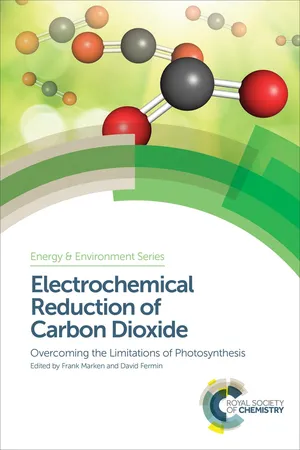
Electrochemical Reduction of Carbon Dioxide
Overcoming the Limitations of Photosynthesis
- 271 pages
- English
- ePUB (mobile friendly)
- Available on iOS & Android
eBook - ePub
Electrochemical Reduction of Carbon Dioxide
Overcoming the Limitations of Photosynthesis
About this book
Information
Chapter 1
Introduction to the Eletrochemical and Photo-electrochemical Reduction of CO2
a School of Chemistry, University of Bristol, Bristol BS8 1TS, UK;
b Department of Chemistry, University of Bath, Bath BA2 7AY, UK
* Email: [email protected]; [email protected]
1.1 Introduction to the (Photo-)Electrochemical Reduction of CO2
The scale of the challenge in carbon dioxide conversion is enormous, with 35 gigaton of anthropogenic CO2 generated by fossil fuel combustion/consumption every year. The average percentage of CO2 in the atmosphere had risen to 403.38 ppm by September 2017 according to the data released by the National Oceanic and Atmospheric Administration of the US Department of Commerce,1 with serious effects expected on global warming, climate patterns, sea levels, biodiversity, food production, human displacement, and so forth. There is a global consensus that immediate action must be taken to halt the relentless increase in atmospheric carbon dioxide levels, with the Global Apollo programme being a prime example of international initiatives being undertaken.2 In addition to the ever growing number of installations of renewable energy sources in different areas of the planet, there are great opportunities in “recycling”3,4 carbon dioxide with biochars,5 by absorption,6 or by electrolysis powered by photovoltaic, wind, tidal, hydro-electric, salinity gradient energy, or the so-called “blue energy” systems.7 Although CO2 sequestration has also been proposed,8 mimicking natural photosynthesis represents the most attractive but also scientifically challenging avenue.
In the context of artificial photosynthesis, links can be established between catalytic,9 electrochemical, and photo-electrochemical conversion of atmospheric CO2, as schematically illustrated in Figure 1.1. Taking inspiration from nature, integrating functional units at the nanoscale capable of (i) capture solar light, (ii) CO2 accumulation, and (iii) selective reduction to products can lead to new technologies that can be widely deployed for local mitigation of carbon emission. There are also integration approaches for “semi-artificial photosynthesis”, for example employing PS1 and PS2 apparatus extracted from cells and immobilised onto electrode surfaces. Although synergistic effects can be envisaged from such “nano-integrated” systems, such level of structural complexity currently rarely achieves high efficiency or stability. The electro-reduction of CO2 is a tough problem so why combine this with the added complexity of an integrated solar cell? Why not just use conventional solar electricity without integration? So far, there are no technological developments that enable answering this question unambiguously. However, there is a large community of scientists, including those contributing to this book, that identifies a direct and selective path of CO2 to a valuable carbon structure as one of the grand challenges in the path towards a low carbon economy.

Figure 1.1 Schematic depiction of carbon dioxide accumulation, energy harvesting, and catalytic reduction of CO2 into products at three levels of nano-integrated artificial photosynthesis.
This book primarily focuses on electrochemical conversion of CO2, establishing correlation between the nature of the catalysts and the electrode potential. Figure 1.1 sketches how the potential bias (input energy) can be provided by solar energy either via photovoltaic solar cells,10 or by direct photo-generation of carriers at the electrocatalytic site.11 These two approaches, illustrated by Figures 1.1A and B, respectively, represent two different levels of nano-integration. The third level (Figure 1.1C) involves the integration of CO2 capture moieties directly to the catalysts active site in a combined unit. Depending on the catalyst properties, a variety of products can be generated directly (in situ), or by a separate process exploiting, for example, the formose reaction12,13 to build up carbohydrates from formaldehyde. A large number of approaches has been presented in the literature for generating higher added value compounds based on various electrochemical reactors,14 homogeneous catalysts15,16 or inorganic photosynthetic sites.17 Independently of the approach used for providing the driving force for CO2 reduction, investigating the properties of the catalytic sites by (spectro)-electrochemical techniques provides extremely valuable mechanistic information. Some of the most recent developments in spectro-electrochemical tools are reviewed in Chapters 8–10.
Numerous reviews18–20 and authoritative books21–23 have been published on the topic of CO2 reduction and electrocatalysis at electrode surfaces. The high symmetry of the carbon dioxide molecule has often been cited as a key contributor to the activation barrier, with a price in energy often paid by applying a high overpotential (excess potential with respect to the thermodynamic reduction potential). More recent studies, based on the so-called “scaling relations” formalism, point to the fact that the binding energy of intermediate species in multi-electron transfer reactions correlate in a linear fashion, resulting in large overpotentials for a variety of metals.24–26 Azofra and Sun elaborate on this point in Chapter 6. At the fundamental level, a number of strategies reviewed in this book focus on breaking the challenge posed by this “scaling relation”.
From the thermodynamic point of view, the reduction of CO2 to give useful hydrocarbons should occur under mild conditions, as summarised by eqn (1.1)–(1.5), and the corresponding Pourbaix diagrams27 (see Figure 1.2). Thermodynamic data for organic media linking to aqueous media have also been reported.28 Reduction to elemental carbon, and indeed nano-carbon products, is only accessible in molten salts and at high temperature.29 The reversible potential for the CO2/CO redox system (eqn (1.1)) has been elegantly confirmed by experiment (at pH 7) with enzyme-laden electrodes.30CO+H2O ⇄ CO2+2 H+(aq)+2 e−


Figure 1.2 Pourbaix d...
Table of contents
- Cover
- Title
- Copyright
- Contents
- Chapter 1 Introduction to the Eletrochemical and Photo-electrochemical Reduction of CO2
- Chapter 2 Bio-inspired and Bio-electrochemical Approaches in CO2 Reduction Catalysis
- Chapter 3 Copper Catalysts for the Electrochemical Reduction of Carbon Dioxide
- Chapter 4 Single-crystal Surfaces as Model Electrocatalysts for CO2 Reduction
- Chapter 5 Homogeneous M(bpy)(CO)3X and Aromatic N-heterocycle Catalysts for CO2 Reduction
- Chapter 6 DFT Modelling Tools in CO2 Conversion: Reaction Mechanism Screening and Analysis
- Chapter 7 Electrocarboxylation in Ionic Liquids
- Chapter 8 IR Spectro-electrochemistry and Group-6 α-diimine Catalysts of CO2 Reduction
- Chapter 9 Probing CO2 Reduction Intermediates Employing in situ Spectroscopy and Spectrometry
- Chapter 10 Surface-selective and Time-resolved Spectro-electrochemical Studies of CO2 Reduction Mechanisms
- Subject Index
Trusted by 375,005 students
Access to over 1.5 million titles for a fair monthly price.
Study more efficiently using our study tools.
Frequently asked questions
Yes, you can cancel anytime from the Subscription tab in your account settings on the Perlego website. Your subscription will stay active until the end of your current billing period. Learn how to cancel your subscription
No, books cannot be downloaded as external files, such as PDFs, for use outside of Perlego. However, you can download books within the Perlego app for offline reading on mobile or tablet. Learn how to download books offline
Perlego offers two plans: Essential and Complete
- Essential is ideal for learners and professionals who enjoy exploring a wide range of subjects. Access the Essential Library with 800,000+ trusted titles and best-sellers across business, personal growth, and the humanities. Includes unlimited reading time and Standard Read Aloud voice.
- Complete: Perfect for advanced learners and researchers needing full, unrestricted access. Unlock 1.5M+ books across hundreds of subjects, including academic and specialized titles. The Complete Plan also includes advanced features like Premium Read Aloud and Research Assistant.
We are an online textbook subscription service, where you can get access to an entire online library for less than the price of a single book per month. With over 1.5 million books across 990+ topics, we’ve got you covered! Learn about our mission
Look out for the read-aloud symbol on your next book to see if you can listen to it. The read-aloud tool reads text aloud for you, highlighting the text as it is being read. You can pause it, speed it up and slow it down. Learn more about Read Aloud
Yes! You can use the Perlego app on both iOS and Android devices to read anytime, anywhere — even offline. Perfect for commutes or when you’re on the go.
Please note we cannot support devices running on iOS 13 and Android 7 or earlier. Learn more about using the app
Please note we cannot support devices running on iOS 13 and Android 7 or earlier. Learn more about using the app
Yes, you can access Electrochemical Reduction of Carbon Dioxide by Frank Marken, David Fermin, Frank Marken,David Fermin in PDF and/or ePUB format, as well as other popular books in Physical Sciences & Environmental Science. We have over 1.5 million books available in our catalogue for you to explore.