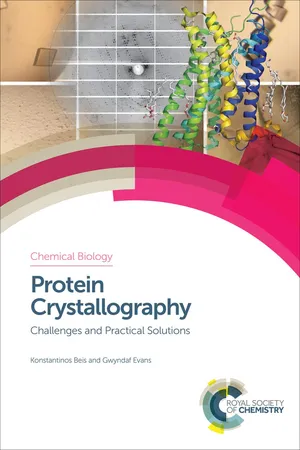
Protein crystallography has become vital to further understanding the structure and function of many complex biological systems. In recent years, structure determination has progressed tremendously however the quality of crystals and data sets can prevent the best results from being obtained. With contributions from world leading researchers whose software are used worldwide, this book provides a coherent approach on how to handle difficult crystallographic data and how to assess its quality. The chapters will cover all key aspects of protein crystallography, from instrumentation and data processing through to model building. This book also addresses challenges that protein crystallographers will face such as dealing with data from microcrystals and multi protein complexes. This book is ideal for both academics and researchers in industry looking for a comprehensive guide to protein crystallography.
eBook - ePub
Protein Crystallography
Challenges and Practical Solutions
- 228 pages
- English
- ePUB (mobile friendly)
- Available on iOS & Android
eBook - ePub
Protein Crystallography
Challenges and Practical Solutions
About this book
Information
CHAPTER 1
Practical Approaches for In Situ X-ray Crystallography: from High-throughput Screening to Serial Data Collection
a Swiss Light Source, Paul Scherrer Institute, CH-5232 Villigen, Switzerland
b Membrane Structural and Functional Biology Group, Schools of Medicine and Biochemistry and Immunology, Trinity College, Dublin, Ireland
*Email: [email protected]
*Email: [email protected]
1.1 Introduction
1.1.1 What Exactly Is In Situ?
In macromolecular crystallography (MX), in situ data collection refers to a diffraction measurement performed on crystals where and as they grow. In other words, the crystals are not harvested individually from their growth environment, as is typically done in standard MX with a harvesting loop. Thus, in the in situ experiment, the original growth medium and the crystallization compartment remain in place surrounding the crystal during interrogation with the X-ray beam. By contrast, both are removed or minimized in classical loop harvesting protocols to increase diffraction signal-to-noise ratio (SNR) by minimizing background scattering. In the strictest embodiment of an in situ experiment, the crystal growth plate or chamber must remain hermetically sealed from the moment the crystallization experiment is set up and data collection must be done at growth temperature. However, many so-called in situ measurements are made under conditions departing to varying degrees from this limiting definition.
A few examples illustrate the extent to which the in situ label has been used. Jet sample delivery developed at X-ray free electron laser (XFEL) facilities has been considered an in situ-like method. In this case, microcrystals remain suspended in the mother liquor or the lipid cubic phase (LCP) where they grew. However, these samples have been transferred between syringes and reservoirs, sometimes filtered, and finally extruded under pressure into an X-ray chamber that is sometimes under vacuum. These post-growth handling steps accompanied by variations in pressure and temperature can mean that data is collected under conditions that are far removed from in situ. Several methods, sometimes presented as in situ methods, include a mother liquor removal step, such as the Crystal Direct approach1 (see Section 1.2) and several XFEL solid support sample preparation methods, where the mother liquor is blotted2 or sucked away3 to help position crystals into ordered wells. This mother liquor removal distinguishes these preparation methods from in situ experiments.
In this chapter, after a general introduction to in situ experiments (Section 1.1), we will cover the different in situ setups and the evolution of the field, following a historical perspective. In situ experiments date back to the period where X-ray capillaries were used to grow crystals by microdialysis and interface diffusion methods, in order to avoid the difficulties of transferring grown crystals into capillaries for data collection.4 However crystal movement in the capillary often made the technique impractical.5 In the 1990s, García-Ruiz and coworkers formalized gel-acupuncture methods to collect data on in situ counter-diffusion grown crystals in capillaries without any post-growth transfer, at room temperature and under cryogenic conditions.4,5 In 2004, Jacquamet, Ferrer and coworkers demonstrated the first in situ capable automated setup at a synchrotron beamline, where SBS-format crystallization plates were placed in the beam by a robot arm.6 The automated handling of SBS-format plates has spread in many synchrotron facilities as well as to laboratory X-ray instruments since then (Section 1.2), benefiting in particular the field of virus crystallography.7 An intense period of development of in situ-specific setups started in parallel, towards format reduction, microfluidic and on-chip systems (Section 1.3). The latest phase of development has seen the emergence of in situ experiments optimized for serial crystallography and compatible with data collection at cryogenic temperature (Section 1.4).
1.1.2 Goals of In Situ Experiments
In situ methods can be used for a variety of purposes at different stages of a project. In the phase of optimizing crystallization conditions, in situ screening can help distinguish between protein and salt or small molecule crystals, as a complement to UV fluorescence and second-order harmonic generation techniques.8 The unique advantage of X-ray screening is the direct access to data collection-relevant information such as diffraction quality, space group and unit cell, which are not provided by optical techniques. In situ screening can therefore help to identify genuine protein crystal hits, to find the best diffracting crystal form in the case of polymorphs, or in the search of different space groups,9 and to diagnose for loss of diffraction quality due to crystal manipulation and/or cryo-cooling. In situ screening can help increase the efficiency of the protein-to-structure pipeline by enabling diffraction-based identification of best conditions and ligand binding state. This is especially valuable for drug discovery applications involving ligand screening.10,11
In situ experiments are not limited to screening and optimization. In some projects they are used for final data collection and structure solution. This is the case for crystals that cannot be handled with a loop (crystal degradation upon opening of the well or during harvesting) or flash-cooled in liquid nitrogen, e.g. in virus crystallography,7 or for very small crystals, such as virus and in meso-grown membrane protein crystals, where harvesting hundreds of crystals for serial crystallography is time-consuming and may not be practical (see Section 1.4). Due to limitations in the tolerable X-ray dose at room temperature and geometrical constraints imposed by some crystallization containers, it is almost impossible to collect a complete data set from a single crystal in certain in situ setups, as is usually done in standard cryo-crystallography. Accordingly, partial data sets from several crystals must be combined as practiced in micro- and serial crystallography.12 Depending on the sample type, data collection can be performed either using a multi-crystal approach or using serial crystallography methods.13 In the multi-crystal approach, a few partial data sets covering significant angular wedges from a few crystals are merged together. The sorting and merging of data sets are generally performed manually or semi-manually by the crystallographer. In the serial approach, large numbers of small wedges or even still images from many crystals are assembled, which requires automation in data set processing, selection and merging. The serial approach derives from serial femtosecond crystallography (SFX) data collection, where only still images are collected on thousands of randomly oriented small crystals.14,15 In synchrotron-based serial data collection, wedges of typically a few degrees are collected on each crystal. In both cases, data collection of a complete data set relies on the varied or random orientation of crystals for adequate sampling of reciprocal space. Preferential orientation of the crystals on the plate or well surface is therefore to be minimized or compensated for by tilting the sample support during X-ray data collection.
With in situ methods, unnecessary manipulation of crystals by harvesting is avoided. However, harvesting is not always detrimental: clear cases where post-growth treatments such as dehydration increase the diffracting quality have been reported.16 Methods for controlled dehydration and other post-growth treatments in in situ plates have been developed.17 Another characteristic of manual harvesting is the introduction of a possible source of irreproducibility in the experiment, since two crystals are rarely harvested exactly in the same way, even by the same person. This is less of an issue with in situ methods.
Historically, in situ measurements are performed mainly at room temperature (RT) (see Section 1.2). RT data collection is often deemed biologically more relevant. Further, it enables the probing of conformational landscapes, time-resolved studies and chemical reactions in the crystals. Measurements at RT usually result in lower crystal mosaicity. In certain cases, such as with virus crystals, RT data collection is the only option due to crystal fragility and sensitivity to cryo-cooling. Recent developments with thin-film samples (see Section 1.4.1) offer the possibility to perform flash-cooling of in situ samples and to collect data under cryogenic conditions. Cryo-treatment is not compliant with the strict definition of in situ, but low temperature (100 K) data collection has significant advantages that include a 50- to 100-fold increase of the tolerable dose. Further, cryo-cooled samples are easily stored and transported.
1.1.3 Challenges of In Situ Methods
Here we list the challenges related to in situ experiments, of which users should be aware when selecting a particular method and planning experiments. The first and foremost challenge...
Table of contents
- Cover
- Title
- Copyright
- Foreword Protein Crystallography: Faster, Smaller, Stronger
- Contents
- Chapter 1 Practical Approaches for In Situ X-ray Crystallography: from High-throughput Screening to Serial Data Collection
- Chapter 2 Delivery of GPCR Crystals for Serial Femtosecond Crystallography
- Chapter 3 The Mesh&Collect Pipeline for the Collection of Multi-crystal Data Sets in Macromolecular Crystallography
- Chapter 4 Radiation Damage in Macromolecular Crystallography
- Chapter 5 Data Quality Analysis
- Chapter 6 Structure Determination at Low-resolution, Anisotropic Data and Crystal Twinning
- Chapter 7 Structure Determination and Refinement of Large Macromolecular Assemblies at Low Resolution
- Chapter 8 Crystallography with X-ray Free Electron Lasers
- Subject Index
Trusted by 375,005 students
Access to over 1.5 million titles for a fair monthly price.
Study more efficiently using our study tools.
Frequently asked questions
Yes, you can cancel anytime from the Subscription tab in your account settings on the Perlego website. Your subscription will stay active until the end of your current billing period. Learn how to cancel your subscription
No, books cannot be downloaded as external files, such as PDFs, for use outside of Perlego. However, you can download books within the Perlego app for offline reading on mobile or tablet. Learn how to download books offline
Perlego offers two plans: Essential and Complete
- Essential is ideal for learners and professionals who enjoy exploring a wide range of subjects. Access the Essential Library with 800,000+ trusted titles and best-sellers across business, personal growth, and the humanities. Includes unlimited reading time and Standard Read Aloud voice.
- Complete: Perfect for advanced learners and researchers needing full, unrestricted access. Unlock 1.5M+ books across hundreds of subjects, including academic and specialized titles. The Complete Plan also includes advanced features like Premium Read Aloud and Research Assistant.
We are an online textbook subscription service, where you can get access to an entire online library for less than the price of a single book per month. With over 1.5 million books across 990+ topics, we’ve got you covered! Learn about our mission
Look out for the read-aloud symbol on your next book to see if you can listen to it. The read-aloud tool reads text aloud for you, highlighting the text as it is being read. You can pause it, speed it up and slow it down. Learn more about Read Aloud
Yes! You can use the Perlego app on both iOS and Android devices to read anytime, anywhere — even offline. Perfect for commutes or when you’re on the go.
Please note we cannot support devices running on iOS 13 and Android 7 or earlier. Learn more about using the app
Please note we cannot support devices running on iOS 13 and Android 7 or earlier. Learn more about using the app
Yes, you can access Protein Crystallography by Konstantinos Beis, Gwyndaf Evans, Konstantinos Beis,Gwyndaf Evans in PDF and/or ePUB format, as well as other popular books in Biological Sciences & Biochemistry. We have over 1.5 million books available in our catalogue for you to explore.