![]()
CHAPTER 1
Thioxanthone Photoinitiators with Heterocyclic Extended Chromophores
NURCAN KARACAa,b, NUKET OCALa, NERGIS ARSU*a AND STEFFEN JOCKUSCH*c
a Department of Chemistry, Yildiz Technical University, Davutpasa Campus, Istanbul 34210, Turkey;
b Yalova University, Central Research Laboratory, Yalova 77200, Turkey;
1.1 Introduction
For many decades, photopolymerization has been the basis for commercial applications in coatings, adhesives, dental composites, inks, printing plates, and microelectronics.1,2 The key ingredient in these photopolymerization formulations is the photoinitiator.3 A good match of the absorption spectrum of the photoinitiator with the light source is of major importance. In the past, photo-curing tools with light sources emitting in the near-UV spectral region (350–400 nm) have dominated. For that reason, most commercially used photoinitiators are tailored to the near-UV spectral region. For example, thioxanthone-based photoinitiators show some of the best light absorption properties in the near-UV spectral region and are therefore widely used.4 However, UV light penetration of pigmented coatings and composite materials is poor and can lead to incomplete curing, especially for thicker layers. Shifting the initiator absorbance and light source into the visible, blue spectral region has been shown to improve the light penetration problem. In addition, recent progress in the development and mass production of blue LEDs has made these low-cost, highly energy efficient light sources attractive in photo-curing tools, which has increased the demand for blue-light absorbing photoinitiators.
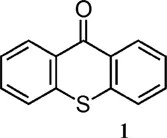
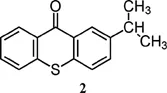
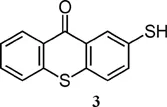
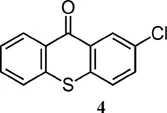
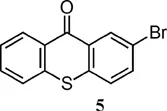
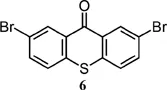
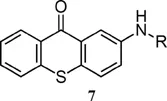
Bathochromatically shifted absorption of thioxanthone can be achieved with appropriate substituents. Table 1.1 lists such examples, including thioxanthone derivatives, that have been used as photoinitiators for polymerization. Only small bathochromic shifts were observed for most substituents. Dibromination (6) shifts the absorption by ∼15 nm while the triplet energy and photoreactivity remains high.5 A much larger bathochromic shift was observed with amino substituents (7). However, amino substitution alters the thioxanthone photoreactivity.
Table 1.1 Thioxanthone derivatives with electron-donating substituents: Absorption maximum at the longest wavelength peak (λmax) and molar absorptivity (ε).
| Thioxanthone derivative | λmax (nm) | ε at λmax (M−1 cm−1) |
| 380 (benzene)6
381 (DMF)5 | 6600 (benzene)6
6328 (DMF)5 |
| 386 (benzene)6 | 6900 (benzene)6 |
| 383 (THF)7 | 3857 (THF)7 |
| 388 (benzene)6 | 6700 (benzene)6 |
| 388 (DMF)5 | 4941 (DMF)5 |
| 396 (DMF)5 | 5234 (DMF)5 |
| 438 (THF)8 | 4470 (THF)8 |
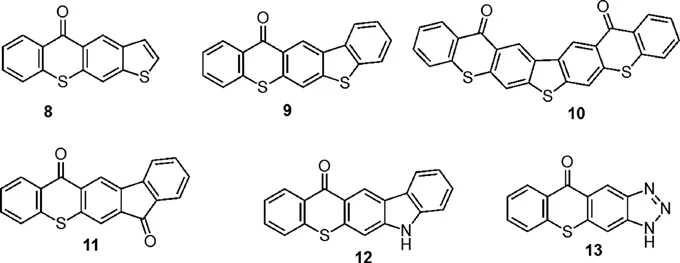
In this chapter, we explore heterocyclic extended thioxanthone derivatives, which shift the absorption bathochromically more significantly than simple substitutions. The structures are shown in Scheme 1.1. We discuss their photophysical properties, photoreactivity and the mechanisms to initiate polymerization.
Scheme 1.1 Heterocyclic extended thioxanthones.
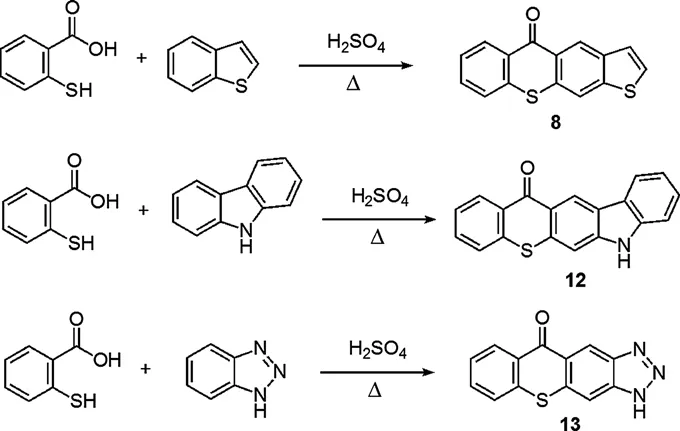
Heterocyclic extended thioxanthones are synthetically accessible by the condensation reaction of thiosalicylic acid with heterocyclic compounds such as benzothiophene, dibenzothiophene, carbazole and benzotriazole in the presence of concentrated H2SO4. Examples are shown in Scheme 1.2.9–12
Scheme 1.2 Synthesis of heterocyclic extended thioxanthones.
1.2 Photophysical Properties of Heterocyclic Extended Thioxanthones
The absorption spectra of thioxanthone and heterocyclic extended thioxanthones are shown in Figure 1.1. The spectra reveal that the cyclic extension causes major bathochromic shifts of up to 100 nm in addition to large variations in molar absorptivities. Extension of thioxanthone with thiophene (8) has little impact on...