Thirteen true stories about xenophobia and belonging in Johannesburg
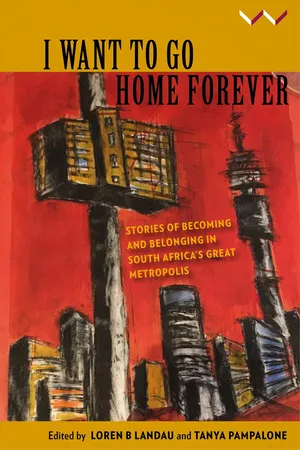
Generations of people from across Africa, Europe and Asia have turned metal from the depths of the earth into Africa's wealthiest, most dynamic and most diverse urban centre, a mega-city where post-apartheid South Africa is being made. Yet for newcomers as well as locals, the golden possibilities of Gauteng are tinged with dangers and difficulties.
Chichi is a hairdresser from Nigeria who left for South Africa after a love affair went bad. Azam arrived from Pakistan with a modest wad of cash and a dream. Estiphanos trekked the continent escaping political persecution in Ethiopia, only to become the target of the May 2008 xenophobic attacks.
Nombuyiselo is the mother of 14-year-old Simphiwe Mahori, shot dead in 2015 by a Somalian shopkeeper in Snake Park, sparking a further wave of anti-foreigner violence. After fighting white oppression for decades, Ntombi has turned her anger towards African foreigners, who, she says are taking jobs away from South Africans and fuelling crime. Papi, a freedom fighter and activist in Katlehong, now dedicates his life to teaching the youth in his community that tolerance is the only way forward.
These are some of the thirteen stories that make up this collection. They are the stories of South Africans, some Gauteng-born, others from neighbouring provinces, striving to realise the promises of democracy. They are also the stories of newcomers, from neighbouring countries and from as far afield as Pakistan and Rwanda, seeking a secure future in those very promises.
The narratives, collected by researchers, journalists and writers, reflect the many facets of South Africa's post-apartheid decades. Taken together they give voice to the emotions and relations emanating from a paradoxical place of outrage and hope, violence and solidarity. They speak of intersections between people and their pasts, and of how, in the making of selves and the other they are also shaping South Africa. Underlying these accounts is a nostalgia for an imagined future that can never be realised. These are stories of forever seeking a place called 'home'.
eBook - ePub
I Want to Go Home Forever
Stories of becoming and belonging in South Africa's great metropolis
- 260 pages
- English
- ePUB (mobile friendly)
- Available on iOS & Android
eBook - ePub
I Want to Go Home Forever
Stories of becoming and belonging in South Africa's great metropolis
About this book
Trusted by 375,005 students
Access to over 1.5 million titles for a fair monthly price.
Study more efficiently using our study tools.
Information
1
A BED OF HIS OWN BLOOD
Nombuyiselo Ntlane
AGE WHEN INTERVIEWED: 42
BORN: Block 4, Snake Park, Soweto, Johannesburg, South Africa
INTERVIEWED IN: Block 8, Snake Park, Soweto, Johannesburg, South Africa
INTERVIEWED BY: Eliot Moleba
PHOTOGRAPHED BY: Oupa Nkosi
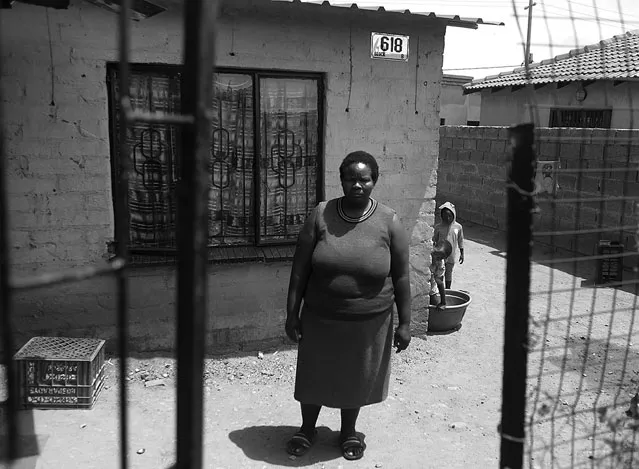
Nombuyiselo Ntlane is the mother of Siphiwe Mahori, a 14-year-old who was shot dead on 19 January 2015 by Sheik Yusuf, a Somalian shopkeeper in Soweto. The murder triggered a wave of lootings and xenophobic attacks that made national headlines, attracting the attention of prominent political figures such as Winnie Mandela, who visited the family in the aftermath. Ntlane lives with her husband Daniel Mahori, their two children, a cousin and three grandchildren in a small three-roomed house. Ntlane and Mahori live in one bedroom, their oldest son lives in the other bedroom and the rest of the children share a big couch in the area that serves as a living room and kitchen. Both are unemployed and survive by renting three one-roomed shacks in their backyard to a South African family and two Mozambican families; 14 people live in the yard, which is the size of the 18-yard box of a football pitch.
I’m a mother of four children. I gave birth to my first son on 25 June 2000. When he arrived, we named him Siphiwe, which means ‘gift’, because his father had always wanted a son. This is why he saw him as our gift from the Lord. As part of the gift, we were happy that our son belonged to the born-free generation. Unlike when we were born, this was a good time to bring life into this world because black people were free and no longer living under apartheid. We were no longer going to be called kaffirs, we were no longer going to be called names.
Before this, if a baas called you something, you were afraid to say anything back but now things are different. We have the right to speak our mind. You can go wherever you want, anytime you want. It is our time to be free. And we wanted our Siphiwe to enjoy the opportunities of our freedom.
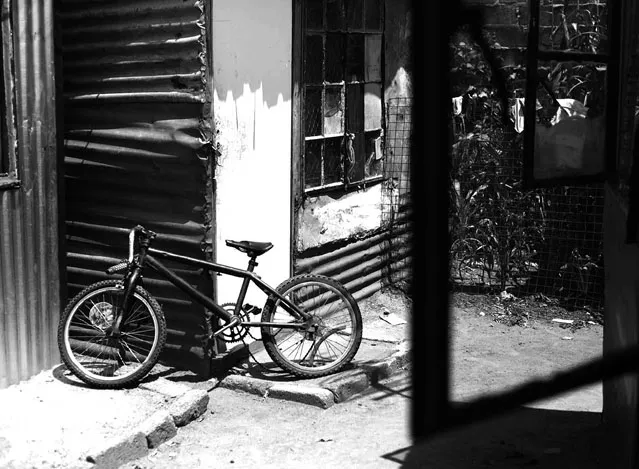
Growing up, Siphiwe didn’t like to talk much. He was quiet like his father. He loved bicycles, especially fixing them. He loved working with his hands. He had faith in his hands because he could do everything for himself. Even in school, he was interested in learning about building construction and electric wiring.
At the end of the year he asked me to buy him bricks and cement so that he could show me what he was learning at school. I had only bought the cement and was going to buy bricks but it ended just like that; he didn’t show me what his life was holding for him. He wanted to build a wall to make our front fence. He promised us that he would build that wall. He was telling me that when he was looking at this house, that it was not built properly.
‘How do you know, my child?’ I would ask.
He would say, ‘This house was not built properly because when you build it’s not supposed to be two fingers like this. You see, if you can fit two fingers like this [measuring the cement between the bricks] you know it’s not done properly. Look at other places, you can’t even fit one finger. I will show you when I build my own house how a house is built because in school we are taught that when you build like this, you are doing it correctly and when you are doing it like this, you are doing it wrong.’
I could see that the work he did in school was really good. I always told him it was good that he knew what is right and what is wrong. Now the children he used to fix bicycles for miss him because the person they used to hang out with, someone they used to laugh with, is no longer here. Even when his father fixed the car, he would help him because he wanted to know how to do it himself so that he doesn’t struggle tomorrow. I guess you can say he was a mechanic.
But there was an evil force out there who could see that tomorrow this child could be wealthy so it is better to remove him. And then it removed him. But we say it’s okay. It is only the Lord who knows.
I SENT HIM TO BUY A COLD DRINK, NOT TO DIE
On that day I had sent him, I had sent him to the spaza shop to buy a cold drink. It was in the evening of 19 January 2015; I think it was after 7 pm. My husband and I were watching a soccer game. I remember that the children were sleeping because they had just returned from playing outside, so they were exhausted. We wanted to drink some Coke, so we called Siphiwe who was still playing soccer outside on the street with his friends. When we called him, he came running. That’s the kind of son he was. We had taught him to always listen to his elders. He was very cheerful when he left the house. And then after that, after a short while, around ten minutes later, I heard a child screaming at the gate:
‘Mme wa Siphiwe! Mme wa Siphiwe! Siphiwe is shot!’
‘Hao, Siphiwe is shot? Where did they shoot him?’ I asked.
‘The shop at the top!’ they said.
We still didn’t know what had happened when my husband and I rushed to see him. We didn’t even know if there was hope that Siphiwe was going to survive because we live at a distance from the shop, and it must have taken a long time for the children to run to the house to call us and then run back with us.
When we finally arrived, at first we couldn’t see him because there was a big crowd of people around him. Many people were just looking in. I think no one really understood what they were supposed to do to save his life.
We found him sleeping on a bed of his own blood. Some people called the ambulance and they said it was on the way. We also called the ambulance and they said it would be on the way. In the meantime, we tried to protect him, to close the bullet wound with something. We used this red jersey I’m wearing; his father pressed it against the wound to close it or slow down the bleeding. We wanted to protect his blood. He was bleeding too much, losing too much blood.
You see, the way the blood was coming out so fast, it was coming out like it was being pumped out. It was gushing out. And we tried to close it but it was already too late. The jersey was drenched and soaking wet with blood; it was more red. And we still tried and tried and tried. We called the ambulance again. We called many, many times. We phoned and phoned and phoned and they just said we are coming – but over 20 minutes later, we were still waiting for them. And then when we saw the police, we stopped them and asked if they could help us because my child was laying there and now he had lost a lot of blood. And so the police hurried to the police station to bring the ambulance. His father told him that help was coming. You could see that Siphiwe wanted to say something; we could see his lips moving like he was trying to talk but no voice came out. His father held him and told him that he was going to be alright. But while we were waiting for the police to fetch the ambulance, my child had lost a lot of blood … he gave up. It was the end, just like that. So I thought if maybe had we found help in time, my child was supposed to be alive because doctors would have known what to do. But they arrived late.
Today I still can’t understand how he was shot at the shop at the top when I sent him to the other shop. I still don’t understand. I suspect the reason he was shot there could be because there might have been some kind of a fight at the other shop. There are kids who smoke nyaope, and they are often found arguing with makula. The nyaope boys loot their stores. They take things from their stores and run away, then makula chase after them and whenever they catch them that’s when they return whatever they took. You know, it must have been something like that.
So when my child left the house he must have seen what was happening there is not right and then maybe he must have decided to go to buy the Coke at the other shop. Maybe the shop owner told himself or thought that my son was another member of the nyaope boys who wanted to steal from the shop.
In the past, there were also lootings and xenophobic attacks that took place in other parts of Johannesburg, and maybe he thought they were beginning to spread to Snake Park. Perhaps the shop owner thought that he was under some kind of an attack by the people outside. But my son wasn’t the person who came with those things, he was just a person who came to buy a cold drink. In fact, he was in front of the entrance so it should have been obvious that he was a person who came to buy. But the shop owner shot a bullet through the door and then it happened that my child was the one who was hit … I sent him to buy a cold drink, not to die.
And then my child lost his life just like that. We lost our gift.
DENIED OUR DAY IN COURT
The investigating officer who handled our case told us to wait for the court updates from him. He said he would let us know when the court proceedings began. But he never contacted us, so we never really knew what was happening.
As far as we have heard from other people, Sheik Yusuf stayed in police custody until his bail application was heard early in February 2015 at the Protea Magistrate’s Court. The police officer didn’t tell us about the bail hearing, so we couldn’t attend it. We were told Yusuf defended himself by saying that my child was there to rob them. I even read somewhere that he said the gun they used to shoot my son was a gun that he brought with him. I don’t know if Siphiwe even knew how to hold a gun. They said that he dropped it in their shop and then they took it and shot him with it. I think he was saying this to protect himself so that the judge could see him as a victim and be lenient. And maybe that’s why Yusuf was granted bail of R2 000 for his freedom. R2 000? That is the price of freedom. But what about the life of my child? How can they grant him bail? He killed a young child who still had a lot of time ahead of him, a time to be a child and grow up to discover what he wants to do with his life or learn what life holds for him out there.

My son was a child. It was not even like you could say that person was a thief, he was a child of 14 years. I don’t think that you, as you are, can be mugged by a child of 14 years.
I was hurt a lot by the court.
To make matters worse, during the court proceedings, while we were heartbroken by what this man did to us and our child, the court didn’t ask to hear from us, as parents of the child. They didn’t call us, which means everything that was said by the shop owner, whether true or not, to them it was right. They should have called us, as parents of the child, and asked us questions to verify that when this person says this and that, is it true? But they failed to call us to ask. They denied us our day in court so that we can also speak for ourselves and our son. I think they believed everything the shop owner told them to be the truth.
For example, I don’t deny that before the funeral, the elders of the shop owner came to the house and they asked for forgiveness. They accepted that what their relative did was wrong. They didn’t like it either, as business owners. So they left some money. It was R15 000. When they got to court, they said it was R30 000, which was a lie.
You see, when it came to things like these we should have at the very least been called to the court to tell our side of the story. They needed to ask us directly whether this person had really left that much money or not. But they failed to ask us. Everything that came from him was right, including his lies. In the end, they set him free.
And wherever Yusuf is, I don’t know how he feels, I don’t know if he feels proud of what he did to Siphiwe, to kill a child, a 14-year-old boy and then say it was nyaope when my child did not smoke nyaope. Or even cigarettes, he didn’t smoke them. He was still a child. He listened to everything I said to him because he knew he was still a child. When I said, ‘Siphiwe, this is wrong,’ he knew it. And when I said, ‘Siphiwe, this is right,’ he knew it too. He was a child who, if you could see him, you would see that this is a child who was well behaved. He was everyone’s child in our street. If you sent him somewhere, he would run and return with the message.
It is painful what happened to us and my son.
The family were so far removed from the court proceedings that when asked what the verdict of the case was, Ntlane couldn’t answer. All she read or heard about the case was from news reports that said Sheik Yusuf was a free man.
WE WILL NOT ASK FOR HIS HEAD
One of the earliest memories of being happy as a child is my mother’s love. She was a kind and quiet person who didn’t lik...
Table of contents
- Cover
- Halftitle Page
- Title Page
- Copyright Page
- Dedication
- Contents
- Foreword
- Preface
- Maps
- Introduction
- 1 A bed of his own blood: Nombuyiselo Ntlane
- 2 This country is my home: Azam Khan
- 3 On patrol in the dark city: Ntombi Theys
- 4 Johannesburg hustle: Lucas Machel
- 5 Don’t. Expose. Yourself: Papi Thetele
- 6 The big man of Hosaena: Estifanos Worku Abeto
- 7 Do we owe them just because they helped us? Kopano Lebelo
- 8 Love in the time of xenophobia: Chichi Ngozi
- 9 This land is our land: Lufuno Gogoro
- 10 Alien: Esther Khumalo
- 11 One day is one day: Alphonse Nahimana
- 12 I won’t abandon Jeppe: Charalabos (Harry) Koulaxizis
- 13 The induna: Manyathela Mvelase
- Timeline
- Glossary
- Selected place names
- Contributors
Frequently asked questions
Yes, you can cancel anytime from the Subscription tab in your account settings on the Perlego website. Your subscription will stay active until the end of your current billing period. Learn how to cancel your subscription
No, books cannot be downloaded as external files, such as PDFs, for use outside of Perlego. However, you can download books within the Perlego app for offline reading on mobile or tablet. Learn how to download books offline
Perlego offers two plans: Essential and Complete
- Essential is ideal for learners and professionals who enjoy exploring a wide range of subjects. Access the Essential Library with 800,000+ trusted titles and best-sellers across business, personal growth, and the humanities. Includes unlimited reading time and Standard Read Aloud voice.
- Complete: Perfect for advanced learners and researchers needing full, unrestricted access. Unlock 1.5M+ books across hundreds of subjects, including academic and specialized titles. The Complete Plan also includes advanced features like Premium Read Aloud and Research Assistant.
We are an online textbook subscription service, where you can get access to an entire online library for less than the price of a single book per month. With over 1.5 million books across 990+ topics, we’ve got you covered! Learn about our mission
Look out for the read-aloud symbol on your next book to see if you can listen to it. The read-aloud tool reads text aloud for you, highlighting the text as it is being read. You can pause it, speed it up and slow it down. Learn more about Read Aloud
Yes! You can use the Perlego app on both iOS and Android devices to read anytime, anywhere — even offline. Perfect for commutes or when you’re on the go.
Please note we cannot support devices running on iOS 13 and Android 7 or earlier. Learn more about using the app
Please note we cannot support devices running on iOS 13 and Android 7 or earlier. Learn more about using the app
Yes, you can access I Want to Go Home Forever by Loren Landau,Tanya Pampalone,Eliot Moleba,Nedson Pophiwa,Ryan Lenora Brown,Oupa Nkosi,Caroline Wanjiku Kihato,Thandiwe Ntshinga,Ragi Bashonga,Duduzile Ndlovu,Greta Schuler,Suzy Bernstein,Tanya Zack,Kwanele Sosibo, Loren B Landau,Tanya Pampalone,Loren Landau, Loren B Landau, Tanya Pampalone in PDF and/or ePUB format, as well as other popular books in Social Sciences & Emigration & Immigration. We have over 1.5 million books available in our catalogue for you to explore.