Reimagines the American 19th century through a sweeping interdisciplinary engagement with oceans, genres, and time
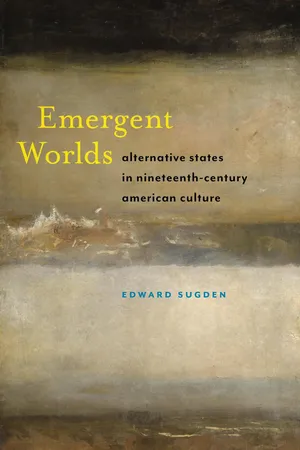
Emergent Worlds re-locates nineteenth-century America from the land to the oceans and seas that surrounded it. Edward Sugden argues that these ocean spaces existed in a unique historical fold between the transformations that inaugurated the modern era—colonialism to nationalism, mercantilism to capitalism, slavery to freedom, and deferent subject to free citizen. As travellers, workers, and writers journeyed across the Pacific, Atlantic, and Caribbean Sea, they had to adapt their political expectations to the interstitial social realities that they saw before them while also feeling their very consciousness, particularly their perception of time, mutate. These four domains—oceanic geography, historical folds, emergent politics, and dissonant times—in turn, provided the conditions for the development of three previously unnamed genres of the 1850s: the Pacific elegy, the black counterfactual, and the immigrant gothic.
In telling the history of these emergent worlds and their importance to the development of the literary cultures of the US Americas, Sugden proposes narratives that alter some of the most enduring myths of the field, including the westward spread of US imperialism, the redemptionist trajectory of black historiography, and the notion that the US Americas constituted a new world. Introducing a new generic vocabulary for describing the literature of the 1850s and crossing over oceans and languages, Emergent Worlds invokes an alternative nineteenth-century America that provides nothing less than a new way to read the era.
- 256 pages
- English
- ePUB (mobile friendly)
- Available on iOS & Android
eBook - ePub
About this book
Trusted by 375,005 students
Access to over 1.5 million titles for a fair monthly price.
Study more efficiently using our study tools.
Information
1
Transition States in the Chaotic Pacific, 1812–1848
The Loom of Time
This chapter begins on the deck of a fictional ship bound to well-known Pacific whaling grounds at some point between a hotly disputed US presidential election and a particularly bloody battle of the First Afghan War. On board this vessel, in the midst of a hazy oceanic calm of the sort that would often settle upon crews while at sea, a US maritime worker, by the name of Ishmael, weaves a mat with one of the transnational labor force, Queequeg, with whom he has developed a particularly close relationship.1 Lulled by the heat and the somnolent ebbing rhythms of the tide and of his chosen act of work, Ishmael’s distracted mind turns toward thoughts about time. As he watches the webbing and threads of the mat he is in the process of making emerge from the complicated set of warps and woofs that make up the loom, he reflects on how what he is doing might be analogous to the structure of history as a whole. “It seemed,” he writes, “as if this were the Loom of Time, and I myself were a shuttle mechanically weaving and weaving away at the Fates. There lay the fixed threads of the warp subject to but one single, ever returning, unchanging vibration, and that vibration merely enough to admit of the crosswise interblending of other threads with its own. This warp seemed necessity; and here, thought I, with my own hand I ply my own shuttle and weave my own destiny into these unalterable threads.”2 Keeping in mind narratives concerning the development of historical consciousness in the nineteenth century, two things to note appear here. The first is just how accommodating this imagined historical frame is to Ishmael: this white middle-class male can weave his own destiny, which is to say his identity organized transversely across time, with ease into larger and tangled webs of history and, resultantly, speak of the future with certainty, characterizing it as “unalterable.” The second is to recognize the larger historical dynamic at play, the sort of vision of time that Ishmael propounds here. This is a relentlessly teleological vision of the passing of time, one in which a progressive providence, fate, or guiding angel, call it what you will, organizes a developmental schema of history in which separate elements combine to create a certain, fated future.
For scholars interested in how, during the nineteenth century, the nation-state seemingly emerged as the dominant organizing principle for societies, such a setup will doubtlessly appear familiar. Ishmael’s flight into metaphysical analogy has significant overlaps with the sort of historiographical claims that antebellum nationalists were making for the United States, particularly insofar as such claims pertained to the importance of the west and the Pacific Ocean for the fledgling state. Famously, John L. O’Sullivan envisioned the inevitable spread of the United States westward and across the Pacific as divinely mandated by what he would come to term “Manifest Destiny,” a force that would allow his country to become “the great nation of futurity.”3 Less famously, but equally important, advocates for increased oceanic exploration and trade, such as Jeremiah Reynolds, a man now known, if at all, for providing some of the source material for both Moby-Dick (1851) and Edgar Allan Poe’s The Narrative of Arthur Gordon Pym (1838), perceived that the fate of the United States was inextricably bound up with that of the commercial future of the Pacific. Taking a typically triumphalist tone in an address he made to Congress (which would soon after be published as a book in its own right), Reynolds argued for the urgency of the US government taking a tangible interest in the Pacific, be it through supporting trade or commissioning an exploring expedition.4 Surveying the ever-increasing hold that the US whaling industry had in the region, he told of how “wonders exceeding the prodigies of ancient times have been the result” of the commercial growth and prophesied that “for the seven of olden time we can show an hundred, and these are but the earnest of our future achievements.”5
Both of these men see, then, with Ishmael, a single already-determined future in the oceanic west, one in which the US nation expands outward, either across land or into the Pacific Ocean, to morph into its inevitable spatial form and so become the economic and political leader of the world. In this sense, they place geographical expansion in inverse proportion to historical possibility, for, as the United States moves westward through the continent and into the Pacific, the number of possible futures that might occur accordingly diminishes. The argument they are making is that each advance made westward brings the United States closer to its predetermined historical fate.6 The Pacific acts something like a historical chronometer: it marks the receding distance of the United States from its already certain future, an oceanic avatar that gives a local habitation and a name to the forward-moving tides of progress.
Theoretically speaking, such a setup is well described by theorists of nationhood and early globalization such as Benedict Anderson and Anthony Giddens.7 As I outlined in the introduction, these critics posit a determining link between transformations in the perception of time, the beginnings of the nation-state, and an interconnected world market in goods. For both, the most salient feature of modernity is a sudden homogenization of time that forced citizens of given national spaces to sense their connection and fealty to people with whom they shared nothing but a quirk of geography. As Anderson famously put it, a new form of “simultaneity” emerged, one that was “transverse, cross-time, marked not by prefiguring and fulfillment, but by temporal coincidence, and measured by clock and calendar.”8 So, within this critical matrix, as Ishmael weaves the loom, he shuts down the potential for there to be any more than a single fate either for himself or for the nation of which he was still notionally a part while at sea. The loom acts as a figure for a shared national history, a web of threads in which the acts of individual citizens combine to work toward the progressive development of the United States’ emergence as a global superpower.
Literary critics with a stake in describing how Americans engaged with the Pacific in this era have for the most part agreed with this Anderson-derived paradigm. They have conceded, with a mix of anger and sadness, the totalizing grasp that the historically specific iteration of Anderson’s work, Manifest Destiny, had over the Pacific. In the name of critiquing the emergent imperial energies of the United States, scholars such as Hsuan Hsu, Paul Lyons, Rob Wilson, and Stuart Banner have explored the means by which Manifest Destiny shaped how antebellum Americans engaged with the region, sweeping away with its seemingly relentless advance the testimonies of Pacific Islanders and other local peoples.9 To do so, they invoke a number of treaties, wars, and commercial developments. These include the Oregon Treaty (1846), the United States’ victory in the Mexican-American War (1848), the gold rush and the subsequent incorporation of California and the rest of the west, the Perry Expedition, and the Treaty of Kanagawa (1854).10 These events are used to demonstrate the various ways in which Americans of this era saw the region through the lens of an already-ratified providential destiny: their histories of the region emphasize how the ideology of Manifest Destiny conditioned antebellum citizens to view the colonization of the Pacific by US forces, and the subsequent establishment of their own nation-state there, as inevitable. So for Hsu, given the intense commitment to western expansion, “as the western boundary of the continent, the Pacific became a privileged site and symbol of the notion that America was Europe’s successor as the protagonist of world history.”11 Similarly, for Lyons, the Pacific was a space where the United States “could constitute itself through expansion.”12 Such ideas, of course, have a long genealogy and reproduce the narrative established by Frederick Jackson Turner in the waning light of the nineteenth century, where, in his frontier thesis, the end of the American continent is tantamount to the end of American history. So, to zero in, once more, on Ishmael at the Loom of Time, these critics would cast him as just another representative of Manifest Destiny, replicating the historical logic that facilitated the expansion of the United States through the western regions and into the Pacific.
But, in spite of the intellectual verve and political sophistication of these accounts, we should be cautious to endorse such a reading fully. Recent works in the “temporal turn” in nineteenth-century American literary studies have directed us to look with suspicion at antebellum invocations of a shared national time. As Lloyd Pratt eloquently puts it, when discussing print culture in particular, “Despite its often well-articulated wish that the nation share a consistent experience of time around which its members might unite, the available evidence contradicts the idea that this experience of national simultaneity actually came to pass.”13 For Pratt, and others who share this hermeneutic, invocations of a shared national time played a brazenly ideological role, serving to solidify gender, racial, and national categories that did not in fact yet exist. What this means is that when we see incidents like that of Ishmael at the Loom of Time, rather than taking them at their word, we ought instead to interrogate them to see what they mask. We must look instead, then, for the sort of fissures, discontinuities, contingencies, and chronologies that might be embedded in such moments and that work, contrary to the logic of the inevitable emergence of a glorious nation, to reveal alternative visions for the organization of history and of community that might otherwise have been rendered invisible.
And so it is with the Loom of Time. Rather than leaving us only with Ishmael’s fated history, the passage continues, directing us to alternative historical and political configurations for the United States, ones that accepting the precepts of Manifest Destiny as total in the Pacific region have left buried. The passage abruptly shifts focus by veering away from Ishmael and zoning in on Queequeg, the Pacific worker whose relationship with Ishmael opens up a series of questions about the precise nature of “contact,” be it sexual, economic, or imperial, between white American laborers and their transnational counterparts on board ships. Indeed, Queequeg would have been an instantly recognizable figure to those citizens who had cast their lot with the oceans, a member of a well-known international workforce, as whaling and other trading vessels were full of other Pacific Islanders who, as Matt K. Matsuda puts it, “joined whaling and sealing crews and signed on for fur trapping, voyaging from their homes to the Americas, around the north and south Pacific, and across the ocean in search of goods for the South China Sea.”14 But Queequeg is a special case, for in coming aboard the Pequod, in laboring at the mat with Ishmael, he introduces an inescapable element of randomness into American history, an element that centrifugally enlarges the potential outcomes of the collision between different cultures within the Pacific. This element is termed “chance.”
As Queequeg’s “sword” strikes against the “woof” of the loom, it generates different shapes for the final fabric, Ishmael’s tapestry of time if you like, meaning that the end result of their shared labors cannot be predicted with any degree of certainty. Rather than the mat, Ishmael’s equivalent to the time-space continuum, taking on an already known and predetermined form, there is in fact no way of anticipating the shape it will take because of Queequeg’s seemingly random incursions:
Meantime, Queequeg’s impulsive, indifferent sword, sometimes hitting the woof slantingly, or crookedly, or strongly, or weakly, as the case might be; and by this difference in the concluding blow producing a corresponding contrast in the final aspect of the completed fabric; this savage’s sword, thought I, which thus finally shapes and fashions both warp and woof; this easy, indifferent sword must be chance . . . chance, though restrained in its play within the right lines of necessity, and sideways in its motions modified by free will, though thus prescribed to by both, chance by turns rules either, and has the last featuring blow at events. (215)
Queequeg’s sword striking the warp and woof is an incredibly important moment for critics of the first half of the nineteenth century in the US Americas. As it lazily and randomly glances against the loom, it reshapes the structure of American history, allowing for the existence of a plurality of counternarratives and alternative historical formations, which actively claim a stake in the figuration of a suddenly contingent US culture. It not only gestures toward a series of suppressed narratives about Pacific life, those associated with contingency and chance, but also, more radically, alters the very composition and structure of the historical frame through which we might understand such counternarratives. The mat itself changes in shape, not only the threads within it. The image throws the notion that midcentury Americans believed in a single, monadic future for their nation, particularly insofar as it pertained to the Pacific, into disarray. Instead, the shifting permutations of the mat upon its encounter with historical chance alert us to the fact that a number of possible futures encroached on and fashioned their conceptualizations of their nation’s fate in the west, the Pacific, and, indeed, beyond.
The Chaotic Pacific
The Loom of Time provided the initial spur to my research for this chapter. I wondered whether, in the eerily representative way that Melville often has, one could extract a wider theoretical and historical universe from the cues that he provides in this short fragment of Moby-Dick. Initially I was interested in asking what appeared to be a simple pair of questions: First, how might we account for this sudden, unexpected efflorescence of “chance” onto the deck of the Pequod? Second, might “chance” take a number of forms in the nineteenth-century world to become something like a more cogent, totalizing historical or cultural logic?15 These questions only opened up further ones, which, again, were preempted by the testimony given in the Loom of Time. I found myself drawn to the historical and spatial context that Melville invoked here, the oceanic world of the Pacific whaling trade route. Was “chance,” or whatever we might call this flare of historical discontinuity, somehow linked to this particular world-historical geographical context? Or even, more precisely, did it evolve in conjunction with the working space that was the deck of the ship? Moreover, how might it interact with the other cues that Melville provides: the eroticized cross-racial relationship between migrant laborers, say? Or the particularly languorous nature of the task being carried out on board? Then there was the compelling question of literary form and technique here. Was it meaningful that the Loom of Time takes place within the subformal mode of the fragment, awkwardly appended to the start of a chapter and at cross-purposes to the ostensible plot of the book? Similarly, was Melville’s use of literary analogy, that astonishing capacity of his suddenly to transform the ordinary into the metaphysical, important, and did it speak to some wider truth about the oceanic worlds of the era? With these questions in mind, I set out into the Pacific archive. What I found was that, within the Loom of Time, Melville had archived in a concentrated, crystallized form an entire universe, one whose history had yet to be told.
This chapter therefore takes a world-historical perspective to analyze the context to which the Loom of Time alludes: namely, the dynamic Pacific Ocean world prior to 1848. I make the case that we can best read this ocean in this particular epoch as a self-sustaining cultural ecosystem. Which is to say that, in the same way that many histories take, say, the nation, the region, the border, or whatever, as the central unit that generates culture, what I suggest here is that we can see in the Pacific Ocean a coherent, if uneven, social unit, with its own unique and linked histories, forms, spaces, and models for citizenship. What I term the “Pacific 1848” acts as its historical threshold as it marks the moment that this Pacific Ocean cultural system became rationalized: with the comparatively unexpected incursion of the United States onto the west coast, the attendant creation of a militarized imperial apparatus, the establishment of a global economy centered around the port of San Francisco, and the discovery of gold, which concentrated Pacific oceanic capital upon North American shores, a previously dynamic, fluid, and vibrant ecosystem hardened into a more ossified form. However, in the years prior to 1848, there raged a vast and systemic uncertainty that created a heightened capacity for historical speculation or, if you want, a certain intensified receptivity to “chance.” This was a realm in which, for a number of reasons, political life seemed particularly rife with potentiality, with the capacity for sudden jarring social change and structural reformulation. To use a metaphor that draws on an image with which nineteenth-century Americans who visited the Hawaiian Islands would have been familiar, the Pacific was like the as-yet-unhardened magma of a recently erupted volcano: a territory in the process of formation rather than one that had solidified into its stable form.
The chapter follows certain central concepts that shaped and emerged from this shifting world and considers how they in turn contributed to the development of American literary culture. Underpinning my approach is an attempt to explore how the larger systemic conditions of the Pacific, whether of history, of genre, or of geography, played out on the local scale in representations of felt experience in a formally diverse set of texts. First up is the “transition state,” a concept that simultaneously describes an oceanic world in the midst of a number of as-then-incomplete systemic transformations, particularly that between Spanish colonialism and the US nation-state, and a disorienting state of time consciousness that emerges from living and working within such historical folds. “State” then refers to a geopolitical form, as in a political “state,” and a psychological one, as in “state” of mind. Living within the various “transition states” of the Pacific engendered a heightened capacity for the speculative among the international cast of explorers, laborers, travelers, and writers who make up my archive.
Continuing in this world-historical mode, I explore the relationship between space, time, and politics in the pre-1848 Pacific. There existed in this era a parallelism between conceptualizations of particular exemplary spaces and potentially revolutionary political forms. Through looking at the climatic, cartographical, and geological figurations of Pacific space, I argue that this was an era in which what I term “transitional geography” reigned. This designation refers to the seemingly widespread ...
Table of contents
- Cover
- Title Page
- Copyright Page
- Contents
- Introduction: Interstitial States in the Oceanic Nineteenth Century
- 1. Transition States in the Chaotic Pacific, 1812–1848
- 2. Suspended States in the Long Caribbean, 1791–1861
- 3. Threshold States in the Immigrant Atlantic, 1789–1857
- Coda: Ishmael in the Water
- Acknowledgments
- Notes
- Index
- About the Author
Frequently asked questions
Yes, you can cancel anytime from the Subscription tab in your account settings on the Perlego website. Your subscription will stay active until the end of your current billing period. Learn how to cancel your subscription
No, books cannot be downloaded as external files, such as PDFs, for use outside of Perlego. However, you can download books within the Perlego app for offline reading on mobile or tablet. Learn how to download books offline
Perlego offers two plans: Essential and Complete
- Essential is ideal for learners and professionals who enjoy exploring a wide range of subjects. Access the Essential Library with 800,000+ trusted titles and best-sellers across business, personal growth, and the humanities. Includes unlimited reading time and Standard Read Aloud voice.
- Complete: Perfect for advanced learners and researchers needing full, unrestricted access. Unlock 1.5M+ books across hundreds of subjects, including academic and specialized titles. The Complete Plan also includes advanced features like Premium Read Aloud and Research Assistant.
We are an online textbook subscription service, where you can get access to an entire online library for less than the price of a single book per month. With over 1.5 million books across 990+ topics, we’ve got you covered! Learn about our mission
Look out for the read-aloud symbol on your next book to see if you can listen to it. The read-aloud tool reads text aloud for you, highlighting the text as it is being read. You can pause it, speed it up and slow it down. Learn more about Read Aloud
Yes! You can use the Perlego app on both iOS and Android devices to read anytime, anywhere — even offline. Perfect for commutes or when you’re on the go.
Please note we cannot support devices running on iOS 13 and Android 7 or earlier. Learn more about using the app
Please note we cannot support devices running on iOS 13 and Android 7 or earlier. Learn more about using the app
Yes, you can access Emergent Worlds by Edward Sugden in PDF and/or ePUB format, as well as other popular books in Literature & North American History. We have over 1.5 million books available in our catalogue for you to explore.