How a pioneering merchant blended religion and business to create a unique American shopping experience
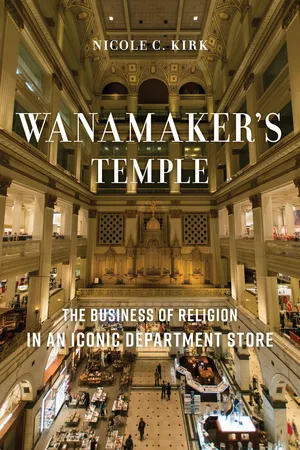
On Christmas Eve, 1911, John Wanamaker stood in the middle of his elaborately decorated department store building in Philadelphia as shoppers milled around him picking up last minute Christmas presents. On that night, as for years to come, the store was filled with the sound of Christmas carols sung by thousands of shoppers, accompanied by the store's Great Organ. Wanamaker recalled that moment in his diary, "I said to myself that I was in a temple," a sentiment quite possibly shared by the thousands who thronged the store that night.
Remembered for his store's extravagant holiday decorations and displays, Wanamaker built one of the largest retailing businesses in the world and helped to define the American retail shopping experience. From the freedom to browse without purchase and the institution of one price for all customers to generous return policies, he helped to implement retailing conventions that continue to define American retail to this day. Wanamaker was also a leading Christian leader, participating in the major Protestant moral reform movements from his youth until his death in 1922. But most notably, he found ways to bring his religious commitments into the life of his store. He focused on the religious and moral development of his employees, developing training programs and summer camps to build their character, while among his clientele he sought to cultivate a Christian morality through decorum and taste.
Wanamaker's Temple examines how and why Wanamaker blended business and religion in his Philadelphia store, offering a historical exploration of the relationships between religion, commerce, and urban life in the late nineteenth and early twentieth century and illuminating how they merged in unexpected and public ways. Wanamaker's marriage of religion and retail had a pivotal role in the way American Protestantism was expressed and shaped in American life, and opened a new door for the intertwining of personal values with public commerce.
- 288 pages
- English
- ePUB (mobile friendly)
- Available on iOS & Android
eBook - ePub
About this book
Trusted by 375,005 students
Access to over 1.5 million titles for a fair monthly price.
Study more efficiently using our study tools.
Information
1
Retail Reform
On a May evening in Philadelphia in 1914, the carriage carrying Russell Conwell and John Wanamaker crawled along a three-mile parade route linking Conwell’s Broad Street home to the Academy of Music, the home of the city’s symphony orchestra. A large crowd had gathered along the street to celebrate the lawyer turned Baptist minister, founder of Temple University, and first president of the Samaritan Hospital.1 On this night, Conwell would present his wildly popular lecture “Acres of Diamonds” for the five thousandth time to an eager audience of three thousand.2 Providing the introductory remarks for this grand occasion was Conwell’s fellow philanthropist and friend of more than thirty years, John Wanamaker.
Before moving to Philadelphia in 1882, Conwell had gained fame as an orator on the Chautauqua circuit and speaking at churches. He had delivered “Acres of Diamonds” across the country to eager audiences who wanted to reconcile their Protestant theology with their changing economic circumstances. The growth of commerce and industry opened the way not only to financial security but to affluence. A growing middle class needed a new way to think about money unencumbered by Protestantism’s negative interpretation of wealth.
In “Acres of Diamonds,” Conwell advanced the surprising message that seeking wealth was neither a sign of greed nor the root of evil. Instead, it was a godly pursuit. He passionately told his listeners, “I say that you ought to get rich, it is your duty to get rich. . . . Because to make money is to honestly preach the Gospel.”3 He spoke plainly of the advantages of money, linking it to the prosperity of churches and reminding audiences, “Money is power, and you ought to be reasonably ambitious to have it. You ought because you can do more good with it than you could without it.” Indeed, money supported evangelism, he pointed out: “Money printed your Bible, money builds your churches, money sends your missionaries, and money pays your preachers, and you would not have many of them, either, if you did not pay them.” Money underwrote the church and its outreach.
Conwell’s lecture marked a startling transformation in tone among Protestants. He promoted the accrual of riches as a reform tool, which he claimed Jesus would wholeheartedly approve. Speaking of assumptions that piety and affluence were mutually exclusive, he pointedly told his audiences that to say “‘I do not want money,’ is to say, ‘I do not wish to do any good to my fellowmen.’” He instructed his followers to pursue prosperity in an honest, morally upright way. And he warned them, “It is an awful mistake” to believe that you have to be “awfully poor in order to be pious.”4 You could be pious and rich. A strong work ethic combined with moral living would be rewarded by God. Becoming wealthy demonstrated God’s approval and allowed one to do more of God’s work. This idea, which would later become known as the “prosperity gospel,” was part of a larger movement that emphasized individualism and the “self-made man,” and altered the relationship between business and Christianity in the late nineteenth and early twentieth centuries. Material goods played a key role in Conwell’s message—prosperity was expressed by accumulation and quality of goods. It was natural for Wanamaker and other prosperity gospel adherents to turn to aesthetics as an expression of God’s blessing and as an educational tool.
John Wanamaker epitomized Conwell’s gospel.5 Although Conwell was a Baptist and Wanamaker was a Presbyterian, they shared a theological perspective that spanned denominational divides. Conwell’s concept of money and wealth provided Wanamaker and other Protestant entrepreneurs a much-needed positive interpretation of their dizzying success and helped him make sense of how to be deeply religious and prosperous at business. It also explained why he spent his money both to purchase luxury goods and to build institutions that served the poor.
Wanamaker never grew tired of Conwell’s “Acres of Diamonds.” He published dozens of editions of the speech at his printing press. The lecture helped him make sense of his world and he wanted others to learn it. It bridged the worlds of religion and commerce. For the six thousandth delivery of the lecture, Conwell gave the speech at the store’s radio station. Wanamaker’s treasured religious philosophy of material wealth radiated from the store for hundreds of miles.
“A Country Boy”
It is hard to say how much Wanamaker and his biographers embellished the details of his early life. His version of the story emphasized how hard work, moral fortitude, and Christian devotion resulted in social mobility and impressive economic success. He cast himself as a “self-made man” straight from a Horatio Alger novel.6 His early biographers, many of them friends and admirers, perpetuated this image with their laudatory accounts produced shortly after his death in 1922.
During his life, Wanamaker presented his biography—long used as part of the advertising for the store—to help establish the moral character of his department store.7 His personal stories emphasized his hardworking, religiously devout brickmaking family and the simplicity of living among the riverside marshes and farms of Philadelphia in an unexpected juxtaposition of country and city life.8 The virtues of hard work, mutual support, loyalty, and sacrifice, mixed in with familial devotion, served as signposts of Wanamaker’s character.
Born to Nelson and Elizabeth Wanamaker in the summer of 1838, the first year of a crushing economic depression that gripped the nation, John Wanamaker was the oldest boy of six children and was named after his grandfather.9 His father and grandfather before him were brickmakers, sharing a small brickyard in the South Philadelphia neighborhood of Grays Ferry.10 His mother, Elizabeth, the daughter of a local farmer and described as a descendent of French Huguenots, was a deeply religious woman who “communed with God, and to this end, she was regular and diligent in her readings and devotions.”11 Her uncle ran the local inn, the Kochersperger Hotel.12 Grays Ferry sat between South Street and the Schuylkill River on one side and the Delaware River on the other. In the early and mid-nineteenth century, it was home to various light industries, including leather tanning, lime burning, lumber, and fertilizer and chemical companies. Of the nine Philadelphia brickmakers listed in the McElroy Business Directory of 1859, six of them made their home in Grays Ferry, in part because of the high clay content in the soil—an essential element for making bricks.13 The area also was home to a number of small farms and the impressive Naval Home, a hospital for disabled veterans modeled after a Greek temple in Athens.14
A marshy rural area, Grays Ferry was sparsely populated compared to bustling downtown Philadelphia. It formed one of the many “island” neighborhoods that made up American cities in the early nineteenth century.15 Perhaps not surprisingly, Wanamaker liked to call himself “a country boy” and liked to recount childhood memories of fishing, catching frogs, and frolicking with friends among the fields and marshes.16 However, the extent of his modest upbringing remains uncertain. Wanamaker mentions that his birth took place in a house on a small farm initially belonging to his mother’s family. His adult descriptions of his childhood home were thoroughly Victorian—the home was a bright and cheery oasis ruled by his devoted mother. In a store advertisement, he sweetly described it as “a little white house with its green shutters and a small garden of marigolds and hollyhocks.” It is most likely that the Wanamakers were decidedly working middle-class, although unstable in their social ranking.17
One of the challenges of living in Grays Ferry was its lack of schools. At best, a child’s formal schooling was occasional in the mid-nineteenth century. Families frequently relied on their children to provide labor on farms and in family businesses, making regular school attendance challenging. A lack of accessible schools compounded the problem. At the age of ten, John received his first taste of organized education when a small schoolhouse was set up at the edge of his family’s brickyard for the neighborhood children.18 However, the schoolmaster meted out blows with his spelling lessons, making John’s schoolhouse experiences stressful.
Over two winters starting in 1847, Trinity Lutheran Church surveyed the Grays Ferry neighborhood for the establishment of a mission Sunday school. During this period, churches started mission Sunday schools to serve poor urban areas and provided moral education and lessons in reading and writing rooted in the Bible.19 A local farming family, the Landreths, offered an empty house for the school, and one of the workers from the church, John A. Neff, became its superintendent. John Wanamaker’s father, Nelson Wanamaker, and his grandfather, John Sr., a longtime Methodist lay preacher, volunteered to teach Sunday school classes. Later in life, he claimed “the Sunday School as the principal educator of my life” and the Bible as the source for “knowledge not to be obtained elsewhere, which established and developed fixed principles.”20 Wanamaker also kept busy at the family business, where he turned bricks to dry in the yard with his brothers.
Grays Ferry did not remain bucolic. The fields and marshes Wanamaker fondly recalled gave way to increasing industrialization, pushing out longtime residents. The routing of new rail lines through other parts of the city isolated Grays Ferry from the wave of new economic development springing up in Philadelphia.21 Competition increased as larger brickyards swallowed up small, family-run businesses. Racial tensions grew between workers as opportunities for work became competitive. Long an abolitionist, John Sr. employed free and formerly enslaved African Americans in his brickyards despite protests and sporadic attacks by white workers.22 Unemployed men started gangs, and young local ruffians began roaming the streets to stir up mischief.23 By 1850, John Sr. looked for an escape for his extended family from the deteriorating area and struck upon the idea of moving to Indiana to be near his father’s family. Nelson and Elizabeth followed with their five children, moving into a homesteader log cabin on an isolated farm of about 250 acres located seven miles from Leesburg, Indiana.24 But homesteading through Indiana’s harsh winters offered a harder life than Grays Ferry. John Sr.’s sudden death sealed the fate of the pioneer adventure. The Wanamaker family returned to Philadelphia, buying back the old business to take up brickmaking once more, first living in Grays Ferry and later moving to a home on Lombard Street, closer to the center of town.25
Upwardly Mobile
John Wanamaker grew up in a swiftly changing country. At the point his family headed to Indiana to improve their fortunes, other Americans left their homes searching for new opportunities. Some moved west to try their luck at homesteading, farming, or getting rich in one of the gold rushes. Others made their way to cities lured by steady jobs and paychecks, leaving the fickleness of agriculture and small-town life behind.
Philadelphia bustled with growth and activity throughout the nineteenth century. By the late nineteenth century, it served as a publishing, finance, and manufacturing hub.26 The city had experienced rapid development earlier than other cities.27 Its growth spurt began in the antebellum period and continued through the early part of the twentieth century, making it one of the wealthiest and largest cities in the country by 1920.28
It was a religious center for the nation as well. Not only did Philadelphia remain an anchor for the Quakers, but it was also the home of the mother diocese of the Episcopal Church, the birthplace of the African Methodist Episcopal Church, and one of the first places Catholics openly worshipped in the American colonies.29 The first presbytery in the United States started in the city, making it a center for Presbyterianism. Two major synagogues were established in the eighteenth century, giving Judaism an early foothold that allowed it to prosper in the city. Later, Philadelphia became the headquarters for a number of national religious organizations, agencies, and boards.30 And like other major American cities, Philadelphia experienced the complex problems and conflicts of rapid urban growth.
An embrace of innovative technology and transportation spurred Philadelphia’s expansion.31 Situated on two rivers with ocean access, the city augmented its transportation system with the construction of a series of canals. The arrival of railroads connected Philadelphia and New York with a growing network of cities on the Eastern Seaboard. Philadelphia was especially adept at constructing an urban transportation infrastructure.32 The establishment of a streetcar system allowed urban workers to live farther afield and increased the city’s footprint. Telegraph wires went up in 1845 and quickly expanded. The emergence of Philadelphia’s industrial center in the 1850s led to a remarkably diverse set of industries and businesses, including heavy manufacturing, steel, textile production, pharmaceuticals, and chemicals. Cheaper transportation meant cheaper consumer goods, ...
Table of contents
- Cover
- Title Page
- Copyright Page
- Dedication
- Contents
- List of Figures
- Introduction
- 1. Retail Reform
- 2. Moral Architecture
- 3. Christian Cadets
- 4. Sermons on Canvas
- 5. Christian Interiors
- Conclusion
- Acknowledgments
- Notes
- Selected Bibliography
- Index
- About the Author
Frequently asked questions
Yes, you can cancel anytime from the Subscription tab in your account settings on the Perlego website. Your subscription will stay active until the end of your current billing period. Learn how to cancel your subscription
No, books cannot be downloaded as external files, such as PDFs, for use outside of Perlego. However, you can download books within the Perlego app for offline reading on mobile or tablet. Learn how to download books offline
Perlego offers two plans: Essential and Complete
- Essential is ideal for learners and professionals who enjoy exploring a wide range of subjects. Access the Essential Library with 800,000+ trusted titles and best-sellers across business, personal growth, and the humanities. Includes unlimited reading time and Standard Read Aloud voice.
- Complete: Perfect for advanced learners and researchers needing full, unrestricted access. Unlock 1.5M+ books across hundreds of subjects, including academic and specialized titles. The Complete Plan also includes advanced features like Premium Read Aloud and Research Assistant.
We are an online textbook subscription service, where you can get access to an entire online library for less than the price of a single book per month. With over 1.5 million books across 990+ topics, we’ve got you covered! Learn about our mission
Look out for the read-aloud symbol on your next book to see if you can listen to it. The read-aloud tool reads text aloud for you, highlighting the text as it is being read. You can pause it, speed it up and slow it down. Learn more about Read Aloud
Yes! You can use the Perlego app on both iOS and Android devices to read anytime, anywhere — even offline. Perfect for commutes or when you’re on the go.
Please note we cannot support devices running on iOS 13 and Android 7 or earlier. Learn more about using the app
Please note we cannot support devices running on iOS 13 and Android 7 or earlier. Learn more about using the app
Yes, you can access Wanamaker's Temple by Nicole C. Kirk in PDF and/or ePUB format, as well as other popular books in History & North American History. We have over 1.5 million books available in our catalogue for you to explore.