- 256 pages
- English
- ePUB (mobile friendly)
- Available on iOS & Android
eBook - ePub
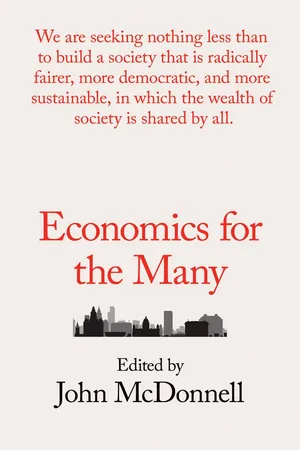
Economics for the Many
About this book
Economics for the Many, edited and with an introduction by Shadow Chancellor of the Exchequer John McDonnell, features contributions from the participants in his New Economics conferences, including Barry Gardiner, Ann Pettifor, Prem Sikka, and Guy Standing. It covers topics from housing, public ownership, and fairer international trading systems to industrial policy for the twenty-first century and how to tackle tax avoidance and regional imbalances. Together, the essays in this volume lay out a vision for a new economics, one that works for the many, not the few.
Trusted by 375,005 students
Access to over 1.5 million titles for a fair monthly price.
Study more efficiently using our study tools.
Information
1
Democratising Economics
in a Post-truth World
The Dominance of Economics in the Political Sphere
Whichever definition of democracy one subscribes to, it is a political exercise that involves input from citizens into the decision-making processes of society. Yet when it comes to the discipline of economics, individuals do not have the necessary means at their disposal to participate effectively in discussion of the subject in the public sphere. As well as making an already non-functioning democracy worse, it has also supported the rise of ‘post-truth’ narratives to gain popular support and credibility. To help alleviate this problem, we need a more democratic economics – to transform the subject from a barrier to a bridge for people to engage in critical, grounded and informed political debate.
The importance of economics in the political sphere is clear. Elections, for many the high point of the democratic calendar, often feature commitments to help the economy as central facets of party campaigns. Indeed, elections are often won or lost on how the public perceives the state of the economy. In the UK, historically we have tended to see a change in government when the economy seems to be in crisis, and conversely when the economy is thought to be doing well most often the party in government stays for a subsequent term.
During his successful bid to become US president in 1992, Bill Clinton coined the phrase ‘it’s the economy, stupid’, singling out the economy as an issue of incredible importance to voters. Although one of three phrases James Carville (then Clinton’s chief political strategist) had developed to keep the Democrats’ campaign on message, ‘it’s the economy, stupid’ is the one that is remembered. The slogan has gone on to become an unofficial mantra for winning elections on both sides of the Atlantic.
The explicit focus on the economy in the political sphere is actually a fairly new phenomenon. ‘The economy’ as an entity was not mentioned in the winning manifesto of any UK political party before 1950. Of course, facets of the economy were discussed (e.g. wage levels and gross domestic product [GDP]) before this time, but ‘the economy’ as a concept in itself did not prominently feature in political life. Fast forward to the 2015 UK general election, and ‘the economy’ was the most discussed issue in the media, after the election itself. The winning Conservative manifesto mentioned it fifty-nine times, Labour’s manifesto thirty-three times, and the Liberal Democrats’ a staggering sixty-six.
The political world’s focus on the economy has led to most policy commitments being justified in terms of their effect on it.1 In other words, the economy has been given semi-sacrosanct status; all policies must pay homage to it in their rationale for existence. This applies both to policies that we would see as obviously relating to the economy (e.g. quantitative easing) and to those whose success we may not want to see measured in traditional economic indicators (e.g. mental health policy).
Furthermore, at the national level the perceived state of a nation’s economy is widely recognised as the primary measure by which to judge a country’s success internationally. Most popular of these indicators is GDP, a somewhat arbitrary indicator that is not internationally standardised. The UK, for example, includes prostitution and illegal drugs in its GDP, whereas France does not.
The debate on the limits of heterodox economics is not for this chapter, but what I believe the above demonstrates is the dominance that economics and ‘the economy’ have within the political sphere. By extension, therefore, we would hope that economic decisions are made with input from citizens. If we aspire to a functioning democracy, people should be able to contribute to the creation of the economy they would like to inhabit. As Ha-Joon Chang wrote, this is imperative if ‘we are not to become victims of someone else’s decisions’.2
Our Economic Literacy Problem
To take ownership over the economic decisions that affect us all, we should have the ability to voice our opinions on how our economy is structured. As economics and the economy are such critical components of public life, we should have the capability to assess how well the economy is doing and understand the discussion that is taking place. This is far from the case; the way in which economics is presented in the public sphere at present is inaccessible to the majority of our society, leading to the situation of a paradoxically marginalised majority.
Research from Economy, an organisation campaigning for understandable economics, has shown that only 12 per cent of the UK public feel that those in politics and the media talk about economics in a way that they understand.3 Of the 12 per cent, perception of understanding is even starker in lower-income families. For people in the lowest income bracket (C2DE), only 7 per cent find economics accessible (15 per cent in higher-income brackets – ABC1). If we interpret this as revealing that only 12 per cent of the population understands economic statements on anything from the deficit to our export industry, for 88 per cent of the country such concepts mean little.
Given economics’ reputation as a male-dominated subject, Economy’s research actually showed there is no significant difference in perception of understanding between the sexes. Interestingly, perceptions of understanding also do not differ according to political allegiance. However, UKIP voters were most likely to state that they felt economics in the media was inaccessible.
When it comes to financial literature, recent YouGov research reveals that young adults are least likely to have a handle on it, with just 8 per cent of UK eighteen- to twenty-four-year-olds admitting to having a ‘high understanding’, compared to at least 20 per cent of older age groups.4 To apply this to a specific economic concept, the Organisation for Economic Cooperation and Development (OECD) has recently found that only 38 per cent of the UK public understands what inflation is.5
Perhaps unsurprisingly given our understanding levels, there is also a severe lack of trust when the economy is discussed, and there is a widespread belief that economic information is not reliable or trustworthy. Further Economy research revealed that only 3 per cent of the UK population felt that discussion and information about the economy around election time was completely honest and trustworthy.6 This drops to 1 per cent of respondents in the north of England.
This research shows that we have a serious economic literacy problem. In effect, inaccessible economics has been left open only to those with a specialist education, power and privilege. This power imbalance leaves the UK with a very unhealthy relationship between citizens and decision makers, often with the poorest, youngest and minorities suffering the worst consequences of this. Producing better economists is not enough to fix this problem; to build a sustainable, just and democratic society we need a general public that is able to engage with economic discussion, scrutinise economic decision makers and articulate what it needs from the economy.
We can also see that alongside these appallingly low levels of understanding, trust and reliability when it comes to economics, political apathy is at an all-time high. This year the Edelman Trust Barometer found that only 11 per cent of the UK would say the system is working for them.7 Simultaneously, support for democracy, both nationally and internationally, remains consistently high at over 90 per cent.8
As a nation, we have switched from having low political apathy and high trust in institutions, into a state of high distrust and an opinionated population. In other words, in 2017 people actively support democracy in theory, but detest the reality. If the system continues on this trajectory, how stable can we expect our future to be?
With economics dominating the political landscape, demystifying economic language to educate its audience on how the economy works and where they fit in is a critical step to help mitigate this derision. The subject urgently needs to transform from an alienating omnipresence into a conduit for voices to be heard; a means through which people can be empowered to shape the economy into one that better serves them.
Post-truth Narratives: Austerity and Brexit
Poor economic literacy contributes to a democratic deficit. This means that the degree to which people can understand the forces significantly affecting their lives is severely limited. More than this, it understandably puts people off engaging with the democratic process. Engagement, in any form, requires reason or inspiration. However, perhaps most pertinently, given the ‘post-truth’ era we now find ourselves in, it leaves space for economic falsehoods to quickly gain popular support. The austerity narrative and the Brexit campaign have both capitalised on this.
The extension of citizens’ not understanding the forces that are shaping the economy around them is that they are unlikely to change. If we think about some of the major economic problems facing the UK today, such as growing inequality and falling productivity levels, how likely is the public to call for change if people do not fully understand the matters at hand? The harsh reality of many of these issues is that it is often not in the interests of the political establishment to remedy them. We can only expect change to come from a mass movement which is informed, motivated and armed with a good understanding of the situation.
Being unable to link your individual circumstances to the wider structural forces at play is a major barrier to their changing. Some polling around the 2017 general election found that over half of voters didn’t feel they understood the impact of the economic policies presented.9 When the impact of policies is not understood, the incentive to engage and change the policies is absent. These findings echoed another YouGov poll conducted at the time of the EU referendum, which found that those who did not vote were three times more likely to state that they have ‘zero’ understanding of what is being said about the economy in the media.10
To allow citizens to input into the creation of the economy they would like to see, we need understanding, trust and by extension reason to engage. We currently have little of any, and live in a climate ripe for post-truth narratives to gain popular support. As people’s ability for critical economic analysis is low, the skills needed to verify and fact-check political slogans is missing. Taking the austerity programme and the Brexit campaign as examples, we can see this in action.
THE AUSTERITY STORY
Since 2010, the austerity story has been the dominant political narrative in Britain. It has been used to justify huge public spending cuts, the denationalisation of industries and tax rises. Presented as a rational, sensible programme, the austerity story has been incredibly successful in convincing millions that there is no realistic economic alternative to help the country. Moreover, many voters support austerity in spite of their opinion of the government implementing it; it has been accepted as an economic necessity removed from the political context it is presented in.
The Public Interest Research Centre, the New Economics Foundation (NEF), the New Economy Organisers Network and the Frameworks Institute have done some excellent work on unpacking the austerity story into seven frames that underpin it.11 Many of the frames, which have persuaded so many, have little economic truth behind them. However, they have capitalised on public ignorance of the economic reality and been delivered powerfully through the media and public communications. On the latter, undeniably the delivery of the austerity story has been impressive. It has been consistent and simple and tapped into very human values and emotions.
The first two frames that the NEF identified as underpinning the austerity story are:
1.Dangerous debt: the most important economic issue the UK faces is the size of public sector debt, caused by excessive public spending.
2.Britain is broke: the UK’s public finances are like an individual household, which has spent all its money.
Both of these frames are at best not facts but ideological viewpoints, and at worst complete untruths. The ‘dangerous debt’ frame asserts debt to be inherently dangerous (and not as an intrinsic feature of all Western working economies), and also blames excessive public spending for its existence. It points to the previous Labour government as the sole creators of public finance difficulties, overlooking the global financial crash that affected all major national economies.
The ‘Britain is broke’ frame again exploits the lack of public understanding of the difference between a household and a national budget. National finances are completely different to a household’s – debt is taken on by each in completely different ways, and by extension has different consequences. The financially strapped household cannot issue bonds, raise taxes or print its own money to help alleviate its problems. Moreover, issuing household debt does not have the benefit of providing a national short-term economic stimulus, or improving productivity in the long term.
To defeat the austerity story, the left needs to present a coherent, factual and appealing alternative. In tandem, improved economic literacy will also provide people with the tools to be able to more critically assess the validity of the frames that austerity is presented through. Inaccurate metaphors, for example the national budget being comparable to a household’s, will be less easily accepted as people are better able to scrutinise slogans. More than this, economic literacy gives people the faculties to create an alternative, viable economic story – one that produces a more just, sustainable and fair society.
BREXIT
Both sides of the EU referendum campaign were badly fought. A combination of an incredibly short time to campaign (four months, compared to a year for the Scottish referendum) and a great deal of uncertainty on both sides resulted in two campaigns that had inconsistent, nebulous and bombastic claims as their flagship offering. In both camps there were many visions of what the UK’s future, either in or out of the European Union, would be.
One of the most famous pro-Brexit slogans, famously stuck onto a bus and driven up and down the country, was ‘We send the EU £350 million a week … let’s fund our NHS instead’. The message implied that should we leave the EU, £350 million would be diverted directly into the NHS. As the UK did vote to leave the European Union, and this message and the ‘Brexit Bus’ were given a lot of media coverage, it is clear that millions accepted and approved of the statement.
This is another example of a post-truth economic narrative gaining widespread support. The net contribution the UK gives the EU is a disputed figure (even within the Brexit camp) – for one, the £350 million figure does not include the instant rebate we receive.12 Regardless of the figure, it required an astounding level of audacity to suggest that the contribution could be seamlessly redirected into the NHS. It was knowingly audacious too – just an hour after the leave vote was confirmed, Nigel Farage admitted that it was a ‘mistake’ to suggest this money could be redirected to the NHS.
Yet for millions this slogan was to a certain extent lauded and applauded as a credible vision for Brexit Britain. As with austerity, I am not suggesting that the sole reason these narratives have such resonance with the country is down to a lack of economic literacy. However, with the means to assess spurious economic statements more accurately, we all may be a little slower in accepting them.
Post-truth narratives exist on all sides of the political spectrum. Parties and movements of all descriptions are keen to garner support for their ideas, often by using whichever methods they believe will have the most traction. In a fraught political landscape, with much to play for, ideas need be communicated powerfully, loudly and quickly. What is sometimes lost in this is accuracy, highlighting ‘the perils of leaving economics to the experts’.13 Economics, as inextricably linked to politics, needs to become more democratic – so every citizen has an equal stake in deciding what our economy looks like in the future.
Towards a More Democratic Economics
A democratic economics is an economics that is a public dialogue. It is a discipline that people and c...
Table of contents
- Cover Page
- Halftitle Page
- Title Page
- Copyright Page
- Contents
- Introduction
- 1. Democratising Economics in a Post-truth World
- 2. Labour’s Fiscal Credibility Rule in Context
- 3. Rising to the Challenge of Tax Avoidance
- 4. To Secure a Future, Britain Needs a Green New Deal
- 5. Fair, Open and Progressive: The roots and Reasons behind Labour’s Global Trade Policy
- 6. ‘De-financialising’ the UK Econo my: The Importance of Public Banks
- 7. Better Models of Business Ownership
- 8. Beyond the Divide: Why Devolution Is Needed for National Prosperity
- 9. Democratic Ownership in the New Economy
- 10. A New Urban Economic System: The UK and the US
- 11. Debt Dependence and the Financialisation of Everyday Life
- 12. Platform Monopolies and the Political Economy of AI
- 13. A New Deal for Data
- 14. Rethinking Economics for a New Economy
- 15. Public Investment in Social Infrastructure for a Caring, Sustainable and Productive Economy
- 16. Rentier Capitalism and the Precariat: The Case for a Commons Fund
- List of Contributors
- Notes
Frequently asked questions
Yes, you can cancel anytime from the Subscription tab in your account settings on the Perlego website. Your subscription will stay active until the end of your current billing period. Learn how to cancel your subscription
No, books cannot be downloaded as external files, such as PDFs, for use outside of Perlego. However, you can download books within the Perlego app for offline reading on mobile or tablet. Learn how to download books offline
Perlego offers two plans: Essential and Complete
- Essential is ideal for learners and professionals who enjoy exploring a wide range of subjects. Access the Essential Library with 800,000+ trusted titles and best-sellers across business, personal growth, and the humanities. Includes unlimited reading time and Standard Read Aloud voice.
- Complete: Perfect for advanced learners and researchers needing full, unrestricted access. Unlock 1.5M+ books across hundreds of subjects, including academic and specialized titles. The Complete Plan also includes advanced features like Premium Read Aloud and Research Assistant.
We are an online textbook subscription service, where you can get access to an entire online library for less than the price of a single book per month. With over 1.5 million books across 990+ topics, we’ve got you covered! Learn about our mission
Look out for the read-aloud symbol on your next book to see if you can listen to it. The read-aloud tool reads text aloud for you, highlighting the text as it is being read. You can pause it, speed it up and slow it down. Learn more about Read Aloud
Yes! You can use the Perlego app on both iOS and Android devices to read anytime, anywhere — even offline. Perfect for commutes or when you’re on the go.
Please note we cannot support devices running on iOS 13 and Android 7 or earlier. Learn more about using the app
Please note we cannot support devices running on iOS 13 and Android 7 or earlier. Learn more about using the app
Yes, you can access Economics for the Many by John McDonnell in PDF and/or ePUB format, as well as other popular books in Economics & Economic Policy. We have over 1.5 million books available in our catalogue for you to explore.