In the aftermath of major violent events that affect many, we seek to know the 'truth' of what happened. Whatever 'truth' emerges relies heavily on the extent to which any text about a given event can stir our emotions – whether such texts are official sources or the 'voice of the people', we are more inclined to believe them if their words make us feel angry, sad or ashamed. If they fail to stir emotion, however, we will often discount them even when the reported information is the same. Victoria Carpenter analyses texts by the Mexican government, media and populace published after the Tlatelolco massacre of 2 October 1968, demonstrating how there is no strict division between their accounts of what happened and that, in fact, different sides in the conflict used similar and sometimes the same images and language to rouse emotions in the reader.
eBook - ePub
The Tlatelolco Massacre, Mexico 1968, and the Emotional Triangle of Anger, Grief and Shame
Discourses of Truth(s)
- 288 pages
- English
- ePUB (mobile friendly)
- Available on iOS & Android
eBook - ePub
The Tlatelolco Massacre, Mexico 1968, and the Emotional Triangle of Anger, Grief and Shame
Discourses of Truth(s)
About this book
Trusted by 375,005 students
Access to over 1.5 million titles for a fair monthly price.
Study more efficiently using our study tools.
Information
1
Introduction: ‘2 October Is Not Forgotten’

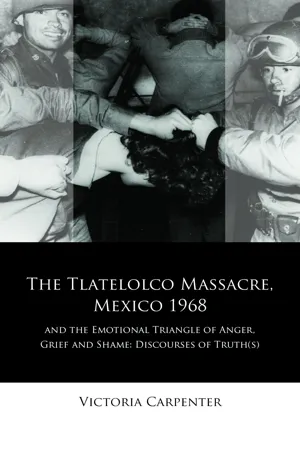
It was a Monday like any other Monday. I was in my office, getting ready to teach an Advanced Spanish class to my final-year students. The topic was ‘Absent Texts and Political Turmoil’ and the case study was a massacre of a student demonstration in Mexico City, known as the Tlatelolco massacre, on 2 October 1968. Having gathered excerpts from Elena Poniatowska’s La noche de Tlatelolco, poems by Rosario Castellanos, Isabel Fraire and Jaime Sabines about the horror of the massacre and the apathy afterwards, and a couple of newspaper articles with statements from the government officials blaming the students and their parents for what had happened, I was putting together a presentation to start the lesson. A photograph of a student held down by smiling soldiers; a layout of the Plaza of the Three Cultures; a pile of shoes left behind by the demonstrators running for their lives – all the necessary attributes to describe a nightmarish evening in a quiet residential neighbourhood. To round the presentation off, I searched for a high-resolution image of the monument erected in the plaza by the families of the victims of the massacre on 2 October 1993, twenty-five years after that night.
The image stood out against the dark blue background of the PowerPoint slide. At the bottom of the monument, lines from Rosario Castellanos’s poem ‘Memorial de Tlatelolco’ reminded the audience that the newspapers and the government tried to erase the event from the collective memory, denying it had ever happened and going about their business as usual the next day. There were names chiselled out in granite. Men and women, young and old, listed in no particular order. I wrote the names down and, as any meticulous researcher would do when there is a bit of free time available, plotted a graph of ages and noted the gender balance. And I counted the names – there were twenty. I tried to remember where I saw the figure of twenty before. Not in a book; not in a journal article; not in an eyewitness account released outside the state-controlled press and publishing circuit. It was in a newspaper, splashed across the front page: ‘Veinte muertos, 75 heridos y 400 presos’ (‘Twenty Dead, Seventy-Five Wounded and 400 Arrested’).1 The paper was Excélsior, Mexico City’s largest daily newspaper; the date on the front page – 3 October 1968. Staring at the image on the screen, I read Rosario Castellanos’s familiar line at the bottom of the monument: ‘los periódicos / dieron como noticia principal / el estado de tiempo’ (‘the newspapers / featured the weather report’).2 The two pieces of information jarred – the number of victims was the one reported by the newspapers (at least, one of them), which were supposed to ignore what had happened. The monument – a text from the public discourse – displayed the information it should have rejected as inaccurate or an outright lie. It looked like there was no black-and-white division in the way the story of the massacre was told. Both sides talked about it; at least one side used the other’s information. Who told the right story? Was there one? This was when the idea for this book emerged.
The aim of the book is not to question whether the Tlatelolco massacre happened – it did; or whether the Mexican government was responsible for it – it was. What happened in the Plaza of the Three Cultures in the Tlatelolco district of Mexico City on 2 October 1968 was a violent unprovoked attack on a peaceful demonstration – and this study is not denying or downplaying this well-established fact. Nor is this study trying to whitewash the reputation of those responsible for the massacre. It does, however, carry out a comparative analysis of the way the massacre was presented, analysed and reacted to in the two apparently opposing discourses: the state (represented by the statements of the government officials, presidential addresses and the press coverage, which has for many years been considered the product of ‘la prensa vendida’ (‘sold out press’),3 and the public (represented by the texts written outside the government and media rhetoric). There is an agreement among critics and academics that the public discourse opposes the state discourse, but, as we shall see, in some cases the texts from the public discourse follow ‘the party line’ and endorse the views expressed originally by the government figures. There are also instances when the two discourses deliver the same facts but use different language to do so.
Harris notes that neither discourse is internally consistent or coherent; instead of a homogenous state or public discourse, there are multiple discourses attributed to various groups on both sides.4 While I agree with Harris’s affirmation regarding the fragmentation of both state and public discourses, there are common characteristics uniting these fragments into definable, albeit disjointed, entities of the Tlatelolco state discourse and the Tlatelolco public discourse. Furthermore, intrinsic fragmentation of the two discourses does not prevent them from creating similar narratives, as we shall see in the main body of the study. We will use the similarities within and between the discourses to identify a knowledge archive of the images and facts that is then propagated by the texts presenting analyses and emotional reactions to the massacre. Emotional charge in these texts may be either an inherent part of the narrative (for example, a testimonial of a survivor) or a political rhetoric trying to evoke emotions. This presents a certain methodological challenge when addressing the sincerity of these emotions. However, the authors’ intentions and attitudes will not form part of the analysis, since the study is focused upon the text itself, rather than its originator. In short, we concentrate on the representation of the massacre in texts, rather than the analysis of individual authors’ participation in the events.
This book does not aim to answer the questions ‘what happened in Tlatelolco’ or ‘who is responsible’ – there are enough studies trying to do so.5 Nor will it take up the Herculean task of examining all texts written about 2 October 1968 in Mexico and beyond from 1968 to the present day. It will focus on the texts produced by the state and public discourse in Mexico immediately after the massacre and up to the end of Luis Echeverría’s presidency. The choice of the cut-off date is self-explanatory: Echeverría’s role in the massacre, although denied by the Mexican state, is well known.6 He was Interior Secretary during Gustavo Díaz Ordaz’s presidency and then took the presidential office in 1970, so it would be fitting to include the texts spanning his time in office from 1968 till 1976. And by keeping the geographical spread to Mexico, the study will remain focused on its aim: to examine the way the Tlatelolco massacre was portrayed in the contemporary state and public discourses in order to determine whether the purpose of the texts produced by them is to ‘tell the truth’ or to achieve some other goal, which may have little to do with an accurate representation of the events of 2 October 1968. I propose to explore in more detail the relationship between affect and the collective memory to determine how the massacre is presented immediately after it happened and what of that representation remains (and in what form) as more narratives emerge.
To begin, we shall review the events between July and October 1968 to understand the context of the massacre. Then, we shall consider the nature of the Mexican state discourse, especially the part of it which is distributed to the general public. Finally, we shall present a short overview of the public discourse texts analysed in this study, summarising the plots where necessary and reviewing the body of critiques for the main contributions.
Summer of 1968: The Stand-off
In the summer of 1968, as Mexico was getting ready for the XIX Olympic Games, the stage was set for a major display of the revolutionary values put to practice in the country born of violence and political and social turmoil. The Partido Revolucionario Institucional, or PRI (Revolutionary Institutional Party), and the country’s president Gustavo Díaz Ordaz (representing the PRI, as eight presidents had done in succession between 1929 and 1964) were working on the image of Mexico as a shining example of what can be achieved by making the revolutionary ideals a reality. ‘Everything Is Possible in Peace’ was penned as the slogan for the upcoming Olympic Games; the new Olympic Stadium, built near the main campus of the Universidad Nacional Autónoma de México (UNAM, National Autonomous University of Mexico) in the Ciudad Universitaria (University District) in the capital, was a masterpiece of modern architecture and art. Mexico was ready to receive well-deserved accolades from visitors from around the globe. But all was not well in this haven of democracy.
A number of strikes and protests by university students and academics, teachers, doctors and railroad workers tested the government’s resolve to protect the appearance of Mexico as the country where freedom rules. The PRI was fighting a losing battle trying to remain in power and in charge, as it had been seeing itself since it became the country’s ruling party in 1929 as the National Revolutionary Party. The strikers’ attempts at opening a dialogue with the government failed repeatedly and on 23 July 1968, the campus of Vocational School No. 5 was occupied by the granaderos (riot police). A rather questionable reason given for the attack was a supposed altercation between two gangs taking place on the school grounds; the police and granaderos were sent in to disperse the troublemakers. Three days later, the Instituto Politécnico Nacional (IPN, National Polytechnic Institute) and the Federación Nacional de Estudiantes de Tecnología (FNET, National Federation of Engineering Students) held a protest march; there was another demonstration in the city to commemorate the fifteenth anniversary of Fidel Castro’s forces’ attack on the Moncada barracks. Both demonstrations were dispersed by the granaderos because the government saw these gatherings as a security threat – not because of the danger they posed to the general public, but because they threatened to tarnish the gleaming image of the country ready for the Olympic glory.
As weeks went by, the tension between the students and the government grew, with the latter using more and more force to keep the students from organising further demonstrations and marches.7 By August, it became clear to many involved in the movement that a more organised approach would work better and the Consejo Nacional de Huelga, or CNH (National Strike Council) was put together. There was no single leader to follow; the Council consisted of around forty students from different universities and preparatory schools. Among these were Raúl Álvarez Garín, Sócrates Campos Lemus, Luis González de Alba, Gilberto Guevara Niebla, Marcelino Perelló and other names we shall see repeatedly in the course of this study. The Council’s main goals were to substantiate the movement with a series of political demands and to lead the movement in a coherent, cohesive way, with representatives in universities and schools across the country.8 The Council was first brought together in a meeting between the Coalición de Padres de Familia (Coalition of Parents), representing the families of the students involved in (and sympathetic to) the movement and the Coalición de Profesores de Enseñanza Media y Superior (Association of University and College Teachers), in a meeting on 1 August. If it worked well, the Council had an excellent opportunity to present a cogent well-organised opposition to the government’s attempts to discredit the student movement and dismiss it as random skirmishes between local gangs.
The nature and membership of the Coalition of Parents are rarely discussed. In the novel Regina, its origins are briefly narrated: in late July 1968, at a meeting with the parents of students who had been taking part in the demonstrations, Félix Hernández Gamundi called for collaboration between parents and students and Román Herrero responded with a proposal ‘que de inmediato fue aceptada – de que se integrase una “Coalición de padres de familia”, la cual debía coordinar las actividades de todos los padres que en apoyo de sus hijos se solidarizasen con el Movimiento’ (‘that it should be accepted immediately, so that a “Coalition of Parents” should be formed to coordinate the actions of all the parents showing solidarity with the movement in support of their children’).9 In most studies, the coalition’s leading role in the demonstration on 27 August 1968 is noted but not examined in detail.10 It appears that all the mentions of the coalition’s role in the demonstration are based on the following sentence from Monsiváis’s essay: ‘A lo largo de la ruta, del Museo de Antropología al Zócalo, encabezada por la Coalición de Padres de Familia y Maestros, los contingentes han extremado su afán competitivo’ (‘All the way from the Museum of Anthropogy to the Zócalo, led by the Coalition of Parents and Teachers, the groups have stepped up their competitive effort’). Soon, however, the parents left the coalition (and later took a rather avid pro-government stance), while the academics set up the Coalición de Maestros (Coalition of Further and Higher Education Teachers).11
On 4 August 1968, the CNH sent its demands to the government:
1.Libertad a los presos politicos;
2.Destitución de los generales Luis Cueto Ramírez y Raúl Mendiolea, así como también del teniente coronel Armando Frías;
3.Extinción del Cuerpo de Granaderos …;
4.Derogación del artículo 145 y 145 bis del Código Penal Federal (delito de Disolución Social) …;
5.Indemnización de las familias de los muertos y a los heridos … desde el viernes 26 de julio en adelante;
6.Deslindamiento de responsabilidades de los ‘actos de represión y vandalismo’ por parte de las autoridades a través de la policía, granaderos y Ejército.
(1.Free political prisoners;
2.Remove Generals Luis Cueto Ramírez and Raúl Mendiolea and Lieutenant Colonel Armando Frías from their positions of power;
3.Disband the Granadero Corps …;
4.Repeal Articles 145 and 145bis (the law of sedition) of the Federal Penal Code ...
Table of contents
- Cover
- Half Title
- Series Editors
- Title
- Copyright
- Dedication
- Contents
- List of Tables
- Series Editors’ Foreword
- Acknowledgements
- 1 Introduction: ‘2 October Is Not Forgotten’
- 2 And All This Happened to Us’: Events of the Night of 2 October in the State and Public Discourses
- 3 Affect and Reason: Analysis of the Massacre in the State and Public Discourses
- 4 Unfortunate and Sad Fate’: Emotional Reaction to the Massacre in the State and Public Discourses
- 5 Conclusion: The Symbolic Value of ‘2 October Is Not Forgotten’
- Notes
- Bibliography
Frequently asked questions
Yes, you can cancel anytime from the Subscription tab in your account settings on the Perlego website. Your subscription will stay active until the end of your current billing period. Learn how to cancel your subscription
No, books cannot be downloaded as external files, such as PDFs, for use outside of Perlego. However, you can download books within the Perlego app for offline reading on mobile or tablet. Learn how to download books offline
Perlego offers two plans: Essential and Complete
- Essential is ideal for learners and professionals who enjoy exploring a wide range of subjects. Access the Essential Library with 800,000+ trusted titles and best-sellers across business, personal growth, and the humanities. Includes unlimited reading time and Standard Read Aloud voice.
- Complete: Perfect for advanced learners and researchers needing full, unrestricted access. Unlock 1.5M+ books across hundreds of subjects, including academic and specialized titles. The Complete Plan also includes advanced features like Premium Read Aloud and Research Assistant.
We are an online textbook subscription service, where you can get access to an entire online library for less than the price of a single book per month. With over 1.5 million books across 990+ topics, we’ve got you covered! Learn about our mission
Look out for the read-aloud symbol on your next book to see if you can listen to it. The read-aloud tool reads text aloud for you, highlighting the text as it is being read. You can pause it, speed it up and slow it down. Learn more about Read Aloud
Yes! You can use the Perlego app on both iOS and Android devices to read anytime, anywhere — even offline. Perfect for commutes or when you’re on the go.
Please note we cannot support devices running on iOS 13 and Android 7 or earlier. Learn more about using the app
Please note we cannot support devices running on iOS 13 and Android 7 or earlier. Learn more about using the app
Yes, you can access The Tlatelolco Massacre, Mexico 1968, and the Emotional Triangle of Anger, Grief and Shame by Victoria Carpenter in PDF and/or ePUB format, as well as other popular books in History & 20th Century History. We have over 1.5 million books available in our catalogue for you to explore.