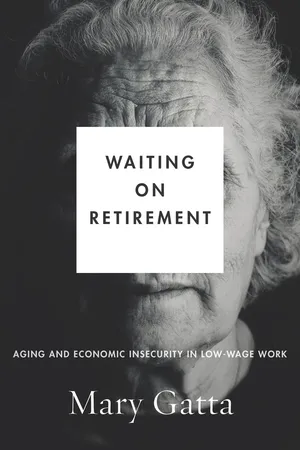
America is witnessing a retirement crisis. As the labor market shifts to the gig economy and new strains restrict social security, the American Dream of secure retirement becomes further out of reach for up to half of the population. In Waiting on Retirement, Mary Gatta takes the case of restaurant workers to examine the experiences of low-wage workers who are middle-aged, aging, and past retirement age. She deftly explores the many factors shaping what it means to grow old in economic insecurity as her subjects face race- and gender-based inequities, health hazards associated with their work, and the bitter reality that the older they get the fewer professional opportunities are available to them. More importantly, Gatta demonstrates that these problems are pervasive, as more industries adopt the worst workplace practices of service work. In light of these trends, we must consider the devastating effects on already vulnerable Americans because, as Gatta contends, this crisis does not need to be inevitable. Taking as a model the small percentage of "good" restaurant jobs that exist, she ultimately offers incisive commentary on what can be done to stave off this bleak future.
- 184 pages
- English
- ePUB (mobile friendly)
- Available on iOS & Android
eBook - ePub
About this book
Trusted by 375,005 students
Access to over 1.5 million titles for a fair monthly price.
Study more efficiently using our study tools.
Information
Publisher
Stanford University PressYear
2018Print ISBN
9781503607408
9780804799959
Edition
1eBook ISBN
9781503607415
CHAPTER 1
The New Normal
The United States is facing an imminent grim reality: more and more American workers are not able to retire. They are often too young to die but too poor not to work. By focusing on the experiences of low-wage workers as they are stare down the retirement pike as well as current retirees as they try to maintain economic security, this book investigates the potentially catastrophic nature of that reality. The analysis is framed not only in terms of what their lived experiences mean for their own economic security but also what this suggests about the economic future for all of us. So much of our national dialogue is focused on how economic insecurity impacts working families’ daily experiences and not how it impacts their ability to save. Many people cringe as they hear horrific stories of working Americans having to decide between food and medicine, accruing massive credit card debt, working multiple shifts without any control over their schedule, going to work sick because they will be fired if they don’t come in, commuting on several bus lines for hours to get to their minimum-wage job because they can’t afford a car, and losing their homes to live among the growing population of the employed homeless. These scenarios indicate a serious economic and moral crisis, but Americans are not prepared for the crisis to come when these individuals are no longer employed.
The unfortunate reality is that we do not have to wait thirty years to get a glimpse of this upcoming crisis. Today many Americans are living without the savings needed to be secure during their working years and beyond. Many of these workers have spent their lives in traditionally low-wage work and did not have enough income to save. Increasingly, middle-wage workers find themselves in a similar economic situation. In 2016, the Federal Reserve found that 47 percent of Americans could not cover an emergency expense of $400.1 While this savings gap is distressing, the lack of a savings reserve becomes even more significant as one ages. In 2015, Wider Opportunities for Women (WOW)2 found that more than 50 percent of elderly individuals and couples lacked basic economic security in their retirement. Although these folks worked for years—many of which spanned booming economic times—along with having retirement savings of some sort, their economic reality is far from rosy. And while the situation for current retirees is alarming, the picture is even worse for those who are approaching retirement age. In 2015, a stunning 35 million Americans—26 percent of our workforce—earned less than $10.55 an hour3 toiling in the growing low-wage jobs offered by our nation’s hospitality centers, retail stores, and child care and health care systems. Not only do these positions pay little, they tend to not offer retirement savings plans or health care benefits.
What could the future look like? Economist Teresa Ghilarducci grimly predicts that by 2050 there could be 25 million poor elderly Americans. Her back-of-the-envelope estimate is based on the Organisation for Economic Co-operation and Development (OECD) measure of impoverishment and the aging baby boomer population. To put her estimate in perspective, in 2010 an alarming 8.9 million elderly Americans were living in poverty. According to Ghilarducci’s estimate, elder poverty will increase by 180 percent over the next forty years. If the projections bear out by midcentury, the number of American seniors living in poverty will be at unprecedented levels. Ghilarducci suggests that a portion of the increase is related to the aging boomer population—by 2050 the elderly population will have increased by 106 percent4—however, that doesn’t account for all of the increase. Instead, the surge in poverty is not just about the increased number of older Americans; it is much more tied to the weak retirement system and labor market inequities in the United States.
So many Americans are depending on social security as their main, and often only, source of guaranteed income in retirement—yet many have anxieties that even that income will not be available to them at the level they would need. Joseph Coleman, summarizing the trends in American retirement patterns, highlights the ever-concerning notion that social security is estimated to be able to pay workers full benefits only for the next two decades, unless a major reform is implemented. After that, payouts are expected to drop to 75 percent as the trust fund runs dry.5 Social security, however, is just part of the picture. The increased number of workers with defined contribution plans and the corresponding decrease in the number of workers with defined benefit pension plans contributes to the economic insecurity we are facing. He finds that in 1975, close to 60 percent of private-sector workers had defined benefit pensions—which translated into guaranteed benefits upon retirement. Today, many Americas rely on 401(k)-type accounts to supplement their social security income. This shift from traditional pensions has increased economic insecurity and widened retirement gaps across race, ethnicity, gender, marital status, and education. Yet not only have defined benefit plans shifted to defined contribution plans, but the risk in saving for one’s retirement has been transferred to the individual.6 Of course, this shift to individual risk is not just part of our retirement system; the same is true for education and health care, along with other aspects of our lives.
But this was not always the case. In 1933 the passage of President Franklin Roosevelt’s New Deal created the Social Security Act and the Wagner-Peyser Act, both of which ensured that workers had access to old-age insurance and unemployment insurance. The programs were expanded and enhanced under President Lyndon Johnson’s Great Society agenda in 1964. Through social insurance programs including disability insurance, Medicare, and Medicaid, workers were protected from many macroeconomic changes. In addition, many workers had secure jobs, good wages, health and disability insurance, and pension benefits. Indeed, the goals of many initiatives from the New Deal to the Great Society and beyond have been to make work “pay”—to assist individuals by providing skill training, educational opportunities, wage protections, and opportunities to collectively bargain and enable them to provide themselves and/or their families with the security necessary for day-today living. What this translates to is improving workforce preparedness of low-skilled workers, enabling low-wage workforce avenues of mobility (the ability to move up, retain jobs, and be promoted), practices that demonstrate care for workers and preempt worker difficulties, and access to higher education and vocational training. In addition, social insurance programs such as social security, disability, and health care help provide income and support when a worker can no longer work. These programs, along with an expanding economy, helped a generation of Americans attain economic security.
However, the New Deal social gains have been progressively chipped away over the decades. Union membership, once a route to security, has steadily declined largely because the legal and political environment prevents private-sector workers from freely exercising their right to join a union. As a result, in 2015 only 11 percent of the American workforce was unionized,7 meaning fewer workers have access to collectively bargained benefits including retirement and health care. The economic results are dire. In 2016, Economic Policy Institute (EPI) researchers found that the effect of union decline on nonunion wages translates into millions of lost dollars for American workers and their families. In 2013 approximately 40.2 million private-sector men and 32.9 million private-sector women were working full-time, were not senior managers, and did not belong to a union. To put this into monetary terms, the union decline has contributed to a total decline in weekly income of $2.1 billion for non-union workers.8
Coupled with the decline of unions, Americans have increasingly been asked to prepare for and plan for their retirement themselves, while dealing with a decreased social safety net during their work lives. This neoliberal political ideology views dependency as a negative attribute and, as Marianne Cooper states, “celebrates risk and uncertainty as self-reliance.”9 The New Deal social contract—which had as its cornerstone that individuals had clear social rights—was replaced with a free-market approach that minimizes the role of government in individuals’ lives. Through this policy shift, individuals found themselves moving away from defined benefit to defined contribution plans. Employers no longer had long-term liabilities, and workers had to make their own choices regarding how much and how to save for their futures within the free market. And individuals had to then live with the results of these choices—whether they were good or bad—and the gambles have not turned out great for many workers. As Coleman notes: “Employees preoccupied with paying today’s bills have not focused on distant retirement; enrollment is lacking; participants don’t put enough money into the accounts and they don’t invest as wisely as pension-account managers. And then, of course, something like the Great Recession can come along and wipe out investments just as participants are about to embark on retirement.”10
But even as precarious as defined contribution plans can be, many Americans still don’t even have a plan. A 2015 Government Accounting Office (GAO) report found that nearly 29 percent of American households with members who are age 55 or older have neither retirement savings nor traditional pension plans, regardless of whether they spent their careers in low-wage or middle-wage jobs. And for those nearing retirement who do have some savings, it is woefully inadequate. The median amount of savings for all households with individuals who are 55 to 64 years old is $104,000 and just $148,000 for households with members who are 65 to 74 years old. According to the report this translates to roughly a projected annuity of $310 or $649 a month, respectively—nowhere near enough to survive anywhere in the United States. And among all working households, almost half (45.3 percent) have no retirement savings accounts. This reality is quite jarring when we look across age groups, particularly those close to traditional retirement age. Forty-five percent of workers who are 35 to 44 years old have no retirement savings; this is also the case for 43 percent of workers who are 45 to 54 years old and 40 percent of those who are 56 to 64 years old.11 Without a safety net or personal savings, many hardworking Americans will find themselves struggling even more as they age.
Must this grim scenario bear out? Not necessarily. Barbara Butrica and Eric Toder asked this question almost a decade ago. They found that without savings or access to defined contribution plans or pensions, the answer is quite often yes. However, they suggest that the answer is not always a simple yes. Using the Urban Institute’s Dynamic Simulation of Income Model (DYNASIM), they projected that nearly two thirds of baby boomers with low earnings between ages 22 and 62 will end up with low incomes at retirement, but more than one third will defy the odds and escape poverty in old age. This latter group will be able to move up the income ladder in two main ways—continuing to work into older age or living with other individuals (often adult children) who help support them financially. And this difference in income is projected to be a significant amount of income—boomers who escape poverty as they age are projected to have an additional $8,400 in income coming from work earnings and $4,900 coming from co-resident income. In contrast, social security income—a major source of income for older adults—will be the same for all low-wage workers.12 So a possible way to address poverty is just to not stop working or be fortunate enough to find others to share your living expenses.
However, this neoliberal perspective offers little wiggle room for individuals. Sadly, while it is promising that there are routes out of poverty, the routes Butrica and Toder found are solely based on individual responses—people must work longer or find family to live with. This is not always a possibility. Health gives out and one cannot work longer. This is especially true in the many physically demanding jobs that make up the low-wage labor market. While it may be easier to continue sitting at a desk and working at a computer as an older person, it is much harder in other jobs. Many low-wage jobs are physically intense positions that often involve standing for eight to twelve hours a day, working multiple shifts that disrupt sleeping patterns, and carrying large loads (be it patients, children, boxes, or trays of food). Over time these physical demands take a toll, leading to long-term medical problems that only magnify as one gets older. Ironically, the older Americans who most need to continue earning money as seniors are those who are least able to do so. And not everyone has family to live with to help share expenses. Of course, depending on individuals to find their own ways out of poverty is not something new in the United States. Our American Dream mentality is predicated on pulling oneself up by one’s bootstraps, and our public-welfare policies have drastically migrated from a social understanding of welfare to a personal responsibility framework that blames individuals’ lack of discipline and work for their current economic state.13 As long as we focus on individual response (work more, save more, live with family), we do not have to address the larger structural constraints (low incomes in working years mean lower social security payments and ability to save). The decreased social safety net has had a drastic impact on economic security, and even low-wage workers who can save typically lack access to good retirement vehicles since many employers do not offer plans.
Inequality in the Low-Wage Labor Market
Since retirement is directly tied to labor market experiences, we cannot examine one without the other. Marianne Cooper has demonstrated that while retirement anxiety is felt across social class, the concern is most acute for those toiling each day in our low-wage labor market.14 Low pay creates an economic insecurity that is just part of the challenge for workers in low-wage jobs. The low-wage job market is also characterized by a lack of health benefits and pensions, little control over one’s hours, shift work that is often outside standard work hours, and little opportunity for advancement. This market has often been a trap for single mothers and women entering work after welfare reform. Women comprise 60 percent of the low-wage labor market, and they are employed in occupations such as retail sales, assistant positions, child care, waitressing, cashiering, fast food, bartending, home health care, housekeeping, and package handling. Indeed, as Joel Handler and Yeheskel Hasenfeld found when they examined the entire female labor force, close to one third of female workers are in the low-wage labor market (as opposed to one fifth of men) and earn less than $25,000 annually. In addition, low-wage work is just difficult to escape. While there is movement in and out of low-wage jobs, two thirds of those who moved to better-paying jobs returned to low-wage work, with women in particular exiting and then returning.15 Of course, women are not evenly distributed in low-wage work. Instead gender intersects with race, ethnicity, and class to marginalize groups of women within low-wage work. Sociologist Evelyn Nakano Glenn’s classic work in the 1990s found that white women tend to be in service jobs that are in the “public’s eye” and require the most interactions and emotional labor; women of color are overrepresented in “dirty back room” jobs such as housekeeping and kitchen work.16
In her ethnographic account of luxury hotel work, sociologist Rachel Sherman found similar patterns today. She noted that hotel work is divided into two main categories: interactive and noninteractive. Interactive or “front-of-the-house” work consists mainly of intangible emotional labor, while “back-of-the-house,” noninteractive work mainly involves physical labor. Sherman goes on to note that interactive workers are usually white (with the exception of bellhops and door attendants, who provide more physical work and are usually men of color), and back-of-the-house workers are typically people of color and immigrants. In addition, Sherman found wage differences with eac...
Table of contents
- Cover
- Copyright
- Title Page
- Series Page
- Dedication
- Contents
- Acknowledgments
- Prologue
- 1. The New Normal
- 2. The Fast Money Trap
- 3. Aging in Low-Wage Work
- 4. Retiring in a Coffin
- 5. Crisis or Come Together
- Methodological Appendix
- Notes
- References
- Index
- Series List
Frequently asked questions
Yes, you can cancel anytime from the Subscription tab in your account settings on the Perlego website. Your subscription will stay active until the end of your current billing period. Learn how to cancel your subscription
No, books cannot be downloaded as external files, such as PDFs, for use outside of Perlego. However, you can download books within the Perlego app for offline reading on mobile or tablet. Learn how to download books offline
Perlego offers two plans: Essential and Complete
- Essential is ideal for learners and professionals who enjoy exploring a wide range of subjects. Access the Essential Library with 800,000+ trusted titles and best-sellers across business, personal growth, and the humanities. Includes unlimited reading time and Standard Read Aloud voice.
- Complete: Perfect for advanced learners and researchers needing full, unrestricted access. Unlock 1.5M+ books across hundreds of subjects, including academic and specialized titles. The Complete Plan also includes advanced features like Premium Read Aloud and Research Assistant.
We are an online textbook subscription service, where you can get access to an entire online library for less than the price of a single book per month. With over 1.5 million books across 990+ topics, we’ve got you covered! Learn about our mission
Look out for the read-aloud symbol on your next book to see if you can listen to it. The read-aloud tool reads text aloud for you, highlighting the text as it is being read. You can pause it, speed it up and slow it down. Learn more about Read Aloud
Yes! You can use the Perlego app on both iOS and Android devices to read anytime, anywhere — even offline. Perfect for commutes or when you’re on the go.
Please note we cannot support devices running on iOS 13 and Android 7 or earlier. Learn more about using the app
Please note we cannot support devices running on iOS 13 and Android 7 or earlier. Learn more about using the app
Yes, you can access Waiting on Retirement by Mary Gatta in PDF and/or ePUB format, as well as other popular books in Social Sciences & Sociology. We have over 1.5 million books available in our catalogue for you to explore.