Robert D. Denham pursues his quest to uncoverthe links between Northrop Frye and writers and otherswho directly influenced his thinking but about whomhe did not write an extensive commentary.
The first chapter is about Frye's reading of Patanjali, the founder of the philosophy of Hindu yoga, whilethe second, discusses cultural mythographerGiambattista Vico, literary history and poetic language.
The focus of Frye's criticism was the verbal arts, but he also had an abiding interest in both the visualarts and music; hence Frye's admiration of J.S. Bach.The essay on Tolkien examines the tendency in literaryhistory to return from irony to myth, as well as the rolethat Tolkien played in Frye's fiction-writing fantasies.
In subsequent chapters, Denham explores Frye'spreference for romance and his critique of realism, which run parallel to the views of Oscar Wilde, and theirstrong shared convictions about the centripetal thrustof art, and about criticism being as creative as literature.Frye's appreciation for Whitehead's conceptof interpenetration in Science in the Modern World became a key feature of Frye's speculations about thehighest reaches of literature and religion. Frye is clearlyindebted to Martin Buber, particularly his influentialmeditation I and Thou. Aristotle, an important influenceupon Frye, was partially filtered through R.S. Craneand his The Languages of Criticism and the Structureof Poetry. Finally, the relationship between Fryeand his Oxford tutor Edmund Blunden are explored, while the last is an essay on Frye and M.H. Abramson how Frye's critical project might be vieweddeveloped in Abrams's The Mirror and the Lamp. This book is published in English.
-
Robert D. Denham poursuit son examen d'écrivains et autres influences qui ont marqué l'éminent critique Northrop Frye, mais sur lesquels celui-ci n'avait pas consacré de réflexions très développées.
Le premier chapitre porte sur la lecture que fait Frye de Patanjali, le fondateur de la philosophie du yoga hindou, et le deuxième, sur le mythographe culturel Giambattista Vico, l'histoire littéraire et le langage poétique.
Frye s'intéressait aux arts visuels et à la musique et Denham approfondit l'influence de J.S. Bach sur Frye. Le chapitre sur Tolkien porte sur la tendance en histoire littéraire de passer de l'ironie au mythe, mais aussi sur l'ascendant de Tolkien sur la fiction fantaisiste de Frye.
Dans les chapitres suivants, Denham explore la préférence de Frye pour le romantique et sa critique du réalisme, qui trouvent écho chez Oscar Wilde, de même que leur conviction, partagée, de l'importance de l'art, et de la critique comme étant aussi créative que la littérature. L'admiration de Frye pour le concept d'interpénétration présenté dans le Science in the Modern World de Whitehead est devenue un élément clé des réflexions de Frye sur la portée de la littérature et de la religion.
Denham explore aussi le lien entre Frye et Martin Buber, dont la méditation I and Thou l'a beaucoup inspiré, et celui entre Frye et R.S. Crane, qui parle beaucoup d'Aristote dans son ouvrage The Languages of Criticism and the Structure of Poetry. Le chapitre 9 explore la relation entre Frye et son tuteur d'Oxford, Edmund Blunden, alors que le dernier chapitre porte sur Frye et M.H. Abrams, et notamment sur le projet critique de Frye compris à la lumière du cadre sur la théorie critique développé par Abrams dans The Mirror and the Lamp. Ce livre est publié en anglais.
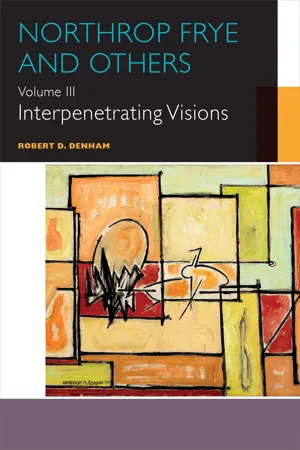
- 260 pages
- English
- ePUB (mobile friendly)
- Available on iOS & Android
eBook - ePub
About this book
Information
Subtopic
Literary CriticismIndex
Literature1
Frye and Patanjali
When T. S. Eliot was working toward a doctorate in philosophy at Harvard, he studied Sanskrit for two years under Charles Rockwell Lanman. In After Strange Gods Eliot reports that he then spent “a year in the mazes of Patanjali’s metaphysics” which left him “in a state of enlightened mystification” (39). Frye never studied Sanskrit, but one of the flirtations he had with Eastern religion was with Patanjali, the founder of the Hindu yoga philosophy. Frye owned and annotated the fourth edition of Dvivedi and Sastri’s The Yoga-Sutras of Patanjali. Little is known about Patanjali. Whether or not he is the same Patanjali who wrote a celebrated commentary on Panini’s grammar is uncertain. He appears not to have authored the Yoga-Sutras but to have compiled them. The date of the sutras is unknown, but scholars think the compilation occurred sometime between the second century BCE and the fourth century CE—a wide window of more than half a millennium. Although Eliot speaks of the metaphysics of the Yoga-Sutras, Patanjali was interested not so much in metaphysics as in spiritual freedom gained through physical practices. Frye had more than a passing interest in the Yoga-Sutras.
THE EIGHT-FOLD PATH
A sutra, which literally means a thread, is an aphorism. The literal meaning comes from the fact that the sutras were written on palm leaves, which were sewn together with thread. There are 196 of Patanjali’s Yoga-Sutras, arranged in four sections. The famous eight-fold path, also known as the eight limbs of yoga, is set down in sutra 29 of section 2. Here are three concise translations of that sutra, along with one that contains a transliteration of the Sanskrit:
Forbearance, Observance, Posture, Regulation of breath, Abstraction, Contemplation, Absorption and Trance, are the eight accessories of Yoga. (Dvivedi, 51)
Self-restraints, fixed observances, posture, regulation of breath, abstraction, concentration, contemplation, trance, are the eight parts (of the self-discipline of Yoga). (Taimni, 203)
The eight limbs of yoga are: the various forms of abstention from evil-doing (yama), the various observances (niyamas), posture (asana), control of the prana (pranayama), withdrawal of the mind from sense objects (pratyahara), concentration (dharana), meditation (dhyana and absorption in the Atman (Samadhi). (Prabhavananda and Isherwood, 97)
In the 1940s Frye set out to follow Patanjali’s eight-fold path, devoting a number of pages of one of his notebooks “to codify[ing] a program of spiritual life” for himself (CW 13: 32). He does not get beyond the fourth stage—pranayama, the control of breathing—but he outlines in some detail what he proposes to do in the first three stages—yama (withdrawal from negative habits), niyama (concentration and proper timing), and asana (meditative exercises and postures) (CW 13: 32–7). What follows is Frye’s outline of the first four steps and how they relate to his physical and psychological states. For such a cerebral person as Frye, all of the attention he pays to Patanjali’s focus on the body may seem somewhat curious or at least unexpected. I quote Frye’s notebook entries here at the beginning at some length to show the seriousness of his detailed self-analysis:
YAMA
First is the stage I call Yama, the attempt to deal with the personal devil, the perverse imp who is the false self made by habit into an active homunculus or poltergeist. This is a negative stage of withdrawal, of breaking the bad habit, a stage of no pleasure, much priggishness, constant self-inspection & censorship, innumerable defeats, & above all, by itself completely useless. It’s the stage of cleansing the temple & driving out the demons, & is, according to Jesus, not only useless but dangerous, by itself, that is.
A weak body & a hypertrophied development of it (I am an intellectual chiefly because I was born cerebrotonic) led me through an unhappy adolescence into a state of chronic irritability, a neurotic fear of being bullied by vulgarity, and a deeply-rooted “sissy” complex. The result is a constant sense of spinsterish outrage fostered by panic & laziness, & fended off only by a relatively comfortable life. Here again is the perverse imp: I dislike a noisy radio not because of it but because of a personal resentment directed at the vulgarity of the person operating it. When I am told the irritating things that most people dwell with most of the time, excessive irritation is inspired in me because the creator of that irritation blends into a resentful memory of the bully I ran away from & wish to hell I’d beaten up. (I never scored a victory, as many children do, & in fact never rose to an occasion: cowardice was bred in me, as it is regularly, by premature, over-active & perverse imagination.) There’s no point in detailing confessions, I find: self-knowledge can do without that; but a habit of suppressing irritability & of resisting irritating stimuli (brooding over a slight or a bad review) is the first stage of Yama, & will give what I think is a natural cheerfulness a chance to emerge. A strict mental censorship over sterile & harmful fantasies has to be established.
Irritability with me is both mental & physical. A very hypertrophied love of reading & study (much of which is less genuine than it seems) breeds indolence. A habit of incessant masturbation in adolescence has left me with a lazy, disorganized & ineffectual rhythm of behavior, & the same hypertrophy has made me very ignorant of practical things. I’m unhandy, & shrink from taking the time to learn to be handy, which would be defensible if so much of my study time weren’t wasted through centrifugal dissipation of energies & masturbation-substitutes of which solitaire is a current bondage. I am shy & downcast & often associate serenity with a blinkered withdrawal from experience (genuine withdrawal, the pratyahara or fifth stage, is away out of my reach as yet).1 The shyness with anyone, especially any man, of forceful personality, is a regular effect of self-abuse. It breeds in me masochistic fantasies of gross social errors & insults & ridiculous behavior which often, even when attributed to others, makes me cringe & wince physically, grimace or, if alone, shout & talk out loud. It also makes me sensitive of hurting others to an absurd extent, absurd because it’s not really kindliness but just fear. Sudden neurotic fears (e.g. of putting letters in the wrong envelopes) may be a special thing, as I suspect it’s partly hereditary. A habitual relaxation of the body, untwisting feet, relaxing shoulders, regularizing breathing, stopping the excessive bodily heat which is another by-product of self-abuse & the nervous jerking rhythms of speech, walking (including a good deal of scampering) & various nose & teeth-pickings, seems indicated. Behind all this is the hypertrophied cringing from the dull job, linked with neurotic aversions to dirt, etc. The fight against this latter will have to be reasonable & theoretical at first.
I can understand why devils are usually conceived as a swarm, but to reduce them to definite number (seven traditionally) is a stage in advance, & to make that number one is still another step. I believe in the real (i.e. the mental & present) existence of Poe’s perverse imp. Nothing else accounts for my going into a pub by myself or reading a detective story (what on earth have I to do with reading for relaxation?) or any other form of an inconspicuous consumption of time. It’s easy enough to catch the imp in operation. I hear a clock tick. If I will not to hear it tick, perversity instantly appears. It may also show itself in retiring to the superego, negative moral virtue being the usual scholar’s mate of this priggish stage, but that worries me less at my age than it would have done earlier. The chief thing is to turn a river into the shit, & not try to pretend it isn’t shit but something dignified like baser impulses. Misplaced erotic fantasies which have so obvious an origin have to come out, dearly as I love them. Outward habits don’t need change: people who are, for instance, preoccupied with their diet usually keep on being preoccupied with their diet. The thing to stop is Ugolino cannibalism: biting my nails & fiddling with substitutes for my penis. The essence of the phase is self-detachment & self-observation: withdrawing the censor to watch the saturnalia, & when possible to guide it, but not leaving a superegocentric Angelo in charge.2 The interest of the better self in the worse one should be humorous & interested, like a sensible mother, not thrashing the imp like an ascetic, or whimpering & nagging like a religious hypochondriac, or blustering and producing equally childish tantrums of self-hatred, but always trying to keep open the possibility of a wiser view, & never wholly possessed by the karma-soul, even in its charming & coaxing moods. The incessant observation of the naughty child by God is a reality here, & dries up the sources of passion. At least I hope it does: but to the Selfhood novelty & repetition are the same thing. (CW 13: 33–5)
NIYAMA
Niyama, the second stage, is the positive aspect of this, without which the Yama stage is a useless & impossible one. The characteristics of it have been outlined earlier in this book; its key ideas are concentration and timing. By timing I mean what I meant earlier about hitting a middle course between the (Rajas) panicky, flustered, irritable, scratching & scampering rhythm, the kind that predominates when I’m shopping for something unfamiliar, and the (Tamas) dawdling, mooching, yammering, time-wasting & activity I go in for when confronted by a dull job or even a pleasant one.3 Concentration is an essential part of this. No matter how much I really want to read or write, the part of me that uses those activities as dopes gets restless, walks around, picks up another book with an intense but obviously phony interest, goes out to a restaurant or a pub to “withdraw,” or “relaxes” with some other damned foolishness (it’s real inertia, so it doesn’t want real relaxation like exercise). Of course it really does take time for my job to take shape, & not even the greatest mystics are immune from long stale “dark night” periods. But when the imp (well, it’s not really his fault) breaks down & admits what the job is, I should no longer allow myself to be confused by the impossibility of reading everything at once.
I’m proud of my ability to swivel easily from work to distraction, to find ideas crystallizing on streetcars or restaurants, to be relatively undisturbed by yelling children, & the like. I think this ability really is valuable, & should be developed, but concentration when alone should be developed too, as long as no resentment at being interrupted affects me. If I can’t always get the sort of thing I used to get with coffee & solitude at 2 a.m., I should get as near it as possible, as often as possible. I find too that concentration & a sense of efficiency in work increase the general competence & assurance of all the rest of my activity: I’m never so confused in behavior as when I think I am thinking & ain’t.
Timing in ordinary behavior is a difficult problem and requires constant vigilance, & even vigilance doesn’t prevent diverging into panic or laziness. Practice in it should begin with the simplest things: walking, even breathing, but above all speaking. I scamper less in walking than I used to do, but I still scamper a lot in speech. From there I think I can build up a reserve of assurance that should, as Patanjali says, tranquillize my surroundings.4 I have a tendency to take my physical slightness very literally: I think men do tend to estimate one another’s weights & govern their conversations accordingly. Also I’m conscious in any dispute that most men can lick me & I have occasionally wondered if the Japs weren’t right in thinking that to possess a knowledge of ju-jitsu is essential to maintain the ascendancy of a cultured aristocracy. And if this is a childhood regression, it is still true that the folklore of capitalism continually encourages similar childhood regressions in others. The essence of will power, as far as its outward manifestations are concerned, is a habitual withdrawn calm combined of course with a sharply focussed vision of what one wants. I know that at times my mind is “noisier” than at others, as I say, & I must learn my own techniques for keeping it quiet.
This is yammer. The interference of the true with the false self is, though highly desirable, a tentative & blundering business, as its first real test—making a decision—soon shows. One has to relax & let the divine spark have air to burn, a careful analysis of failures without stewing. I should build up a habit of masterful & rapid reading of difficult books; learn to listen to music when I want to & turn it off when I don’t; try to build up a do-ye-next-thynge attitude to any work; planning a day without worrying if the plan is upset except through my laziness; controlling fantasy & checking brooding & worrying; keeping the body relaxed & controlled at all times; study timing of conversation & rhythms of speeches. The purely negative checks of Yama are like the first man who tried to sweep the interpreter’s parlour.5 (CW 13: 35–6)
ASANA
Asana, the third stage, is connected in Yogi with exercises & postures of meditation. As a great deal of experience seems to be behind these, I suppose they should be investigated, particularly those that go after nervous constipation. Learning to dance, piano lessons, speaking lessons & a summer with a swim every day would be more immediately relevant. My curious difficulty in standing still without great fatigue should be investigated. The point is that no sharp line can be drawn between mental & physical attainment of relaxed & rhythmic concentration. However, I think of this as the expenditure of effort made possible by the preceding stages: it should attain its climax when I’m doing the Guggenheim.6 (CW 13: 36–7)
On the fourth stage, pranayama or breathing, Frye writes, “I find it advisable to change the ‘lean’ of my breath, as I often catch myself breathing in for a long time, which I think is a symptom of laziness and timidity. We’re told that the heartbeat comes under control in later stages, perhaps the adjustment of heart & lungs rhythms is the basis. Ascetic practices are said to be useful in breaking up habit: I should think it more essential to build up habits, & get rid rather of physical fears & phobias”7 (CW 13: 37).
In these confessions it is not so much that Frye wants to reveal everything about his psychic life but rather to arrive at some physical and emotional equilibrium. He yearns for moments of withdrawal and concentrated attention, times when he can turn off what he later calls the incessant babble of the drunken monkey in his mind (CW 5: 161, 326; CW 6: 481). He looks to Patanjali for almost purely personal reasons, feeling that the Yoga-Sutra provides sound advice on how to cleanse the temple of his own psyche, to overcome the timidity and irritability of his cerebrotontic self, to repair the weakness of his body, to defeat inertia, to establish a proper, relaxed rhythm in his life. Alas, he makes his way through only half of the eight stages (“genuine withdrawal, the pratyahara or fifth...
Table of contents
- Cover
- Title Page
- Copyright Page
- Dedication
- Contents
- Introduction
- Abbreviations
- 1. Frye and Patanjali
- 2. Frye and Giambattista Vico
- 3. Frye and J. S. Bach
- 4. Frye and J. R. R. Tolkien
- 5. Frye and Oscar Wilde
- 6. Frye and Alfred North Whitehead
- 7. Frye and Martin Buber
- 8. Frye and R. S. Crane
- 9. Frye and Edmund Blunden
- 10. Frye and M. H. Abrams
- Notes
- Works Cited
- Index
Trusted by 375,005 students
Access to over 1.5 million titles for a fair monthly price.
Study more efficiently using our study tools.
Frequently asked questions
Yes, you can cancel anytime from the Subscription tab in your account settings on the Perlego website. Your subscription will stay active until the end of your current billing period. Learn how to cancel your subscription
No, books cannot be downloaded as external files, such as PDFs, for use outside of Perlego. However, you can download books within the Perlego app for offline reading on mobile or tablet. Learn how to download books offline
Perlego offers two plans: Essential and Complete
- Essential is ideal for learners and professionals who enjoy exploring a wide range of subjects. Access the Essential Library with 800,000+ trusted titles and best-sellers across business, personal growth, and the humanities. Includes unlimited reading time and Standard Read Aloud voice.
- Complete: Perfect for advanced learners and researchers needing full, unrestricted access. Unlock 1.5M+ books across hundreds of subjects, including academic and specialized titles. The Complete Plan also includes advanced features like Premium Read Aloud and Research Assistant.
We are an online textbook subscription service, where you can get access to an entire online library for less than the price of a single book per month. With over 1.5 million books across 990+ topics, we’ve got you covered! Learn about our mission
Look out for the read-aloud symbol on your next book to see if you can listen to it. The read-aloud tool reads text aloud for you, highlighting the text as it is being read. You can pause it, speed it up and slow it down. Learn more about Read Aloud
Yes! You can use the Perlego app on both iOS and Android devices to read anytime, anywhere — even offline. Perfect for commutes or when you’re on the go.
Please note we cannot support devices running on iOS 13 and Android 7 or earlier. Learn more about using the app
Please note we cannot support devices running on iOS 13 and Android 7 or earlier. Learn more about using the app
Yes, you can access Northrop Frye and Others by Robert D. Denham in PDF and/or ePUB format, as well as other popular books in Literature & Literary Criticism. We have over 1.5 million books available in our catalogue for you to explore.