Declining access to fresh water is one of the twenty-first century's most pressing environmental and human rights challenges, yet the struggle for water is not a new cause. The 8, 800-kilometer border dividing Canada and the United States contains more than 20 percent of the world's total freshwater resources, and Border Flows traces the century-long effort by Canada and the United States to manage and care for their ecologically and economically shared rivers and lakes. Ranging across the continent, from the Great Lakes to the Northwest Passage to the Salish Sea, the histories in Border Flows offer critical insights into the historical struggle to care for these vital waters. From multiple perspectives, the book reveals alternative paradigms in water history, law, and policy at scales from the local to the transnational. Students, concerned citizens, and policymakers alike will benefit from the lessons to be found along this critical international border.
eBook - ePub
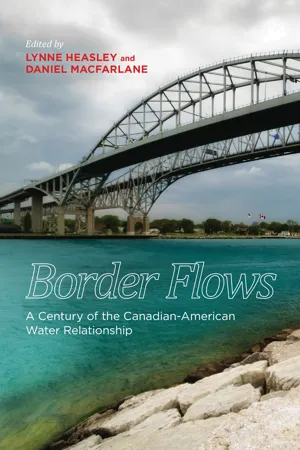
Border Flows
A Century of the Canadian-American Water Relationship
- 352 pages
- English
- ePUB (mobile friendly)
- Available on iOS & Android
eBook - ePub
About this book
Information
PART ONE
Finding the Border:
Political Ecologies of Water Governance and Tenure
Openings
Political Ecologies on the Border
Dave Dempsey
“Pollution doesn’t respect political boundaries.”
Anyone who has worked on water pollution issues in the last several decades has heard this refrain, or something like it, countless times. The repetition of words can rob them of meaning, so it is appropriate to stop and to look at and listen to this use of language more closely. Doing so can tell us a great deal about water diplomacy across borders—especially as seen through the lens of a political practitioner. For the fact is that governance systems still very much respect boundaries.
In actual governance, the ideal and the achievable always collide, with the latter holding the power. That pollution does not respect boundaries leads theoretically to an imperative to remove or transcend those boundaries, but the reality is that the centuries-old construct of national sovereignty continues to dominate societal attitudes and public policy. Still, there is some reason to believe in movement toward a sweeping change in transboundary water management. The recent historical record offers some support for this trend—but with limits. The trajectory of Great Lakes agreements among states and provinces over time is an example.
In the mid-1980s, as elected officials in the Great Lakes region found it in their political and in the public interest to cooperate and undertake joint initiatives to conserve the lakes, public health advocates observed that the Great Lakes states and Ontario had varying methodologies for determining fish-consumption health advisories in their respective Great Lakes waters for sport and subsistence anglers.1 A lake trout contaminated with a certain level of PCBs, for example, might trigger an advisory recommending limited or no consumption in one of the Great Lakes states, while it might be deemed safe for more frequent eating if it swam into the waters of another state or Ontario. The health advocates argued that the jurisdictions should agree on a methodology that would result in similar if not identical advisories, reducing public confusion while providing health advice of comparable caution. The governors of the Great Lakes states agreed and in 1986 set their health experts to work devising a common methodology. Ontario also participated.
Toiling arduously and in good faith, the states and Ontario conferred for seven years before producing their agreement, Protocol for a Uniform Great Lakes Sport Fish Consumption Advisory.2 The result was a narrowing, but not the elimination, of differences among the jurisdictions in determining contaminant thresholds for the issuance of fish-consumption advisories. Using their best professional judgment, the experts found validity in a common methodology with enough jurisdiction-specific twists to yield slightly different results. Sovereign insistence on those twists overrode the objective of strict uniformity. Today, the advisories continue to differ, although not as widely as before.3
This episode illustrates lessons about issues that arise from the shared waters of the Great Lakes but are often applicable to waters along the entire border. Namely, political jurisdictions sharing boundary waters can and will, when prodded at the right moment in history by the right people, quickly strive to communicate about their water-related management differences; less quickly, but still genuinely, attempt to coordinate and perhaps arrive at compatible management approaches; and most slowly, if at all, come to agreement on a single, codified, enforceable management approach in which all governmental jurisdictions subscribe to uniform standards and share decision making across boundaries. This last tends to happen only when a common threat is perceived and no significant constituency at home opposes such an approach. In the end, managing the public’s expectations about what can realistically be accomplished—and allaying any public fears about surrendering sovereignty—is as important as managing the shared resources themselves.
These realities have characterized public policy and governance affecting more than the Great Lakes. While globally unique, the Great Lakes are just one part of a U.S.-Canada border that is approximately 40 percent water.4 Fish and pollutants in all of these waters also fail to recognize political boundaries. And typically, sovereignty has trumped any notion of unified management all along this watery boundary. But as chapters in this section attest, the future of water governance affecting shared waters may be less fixed than the past. A changing physical and social climate and a changing vision of boundary waters themselves support a hypothesis of continued evolution.
Indeed, climate already appears to be fostering shared problem solving in two watersheds straddling the U.S.-Canada border. In both the Red River–Lake Winnipeg and Lake Champlain–Richilieu River basins, toxic organisms have added urgency to the problem of coordinated water governance. Cyanobacteria (popularly known as blue-green algae) are apparently on the increase in these watersheds because of the interaction of nutrient pollution and climate change. These microorganisms pose risks to human health5 that are significant enough to warrant nonbinding transboundary action plans for cleanup in both basins.6 If these plans fail, new legal instruments may follow.
This is the pattern of more than a half century of innovation in the Great Lakes Basin. In the last sixty years, Great Lakes states and provinces and the U.S. and Canadian federal governments have been relatively nimble in responding to common threats to the lakes with consultation and coordination mechanisms and institutions. They move especially fast when catastrophe appears imminent and the public clamours for government action—as when populations of lake trout crashed in the late 1940s and when transfers of water from the Great Lakes to the arid West seemed likely in the 1980s. This crisis-and-response pattern accounts for, among other things, the 1955 U.S.-Canada Convention on Great Lakes Fisheries and the 1985 Great Lakes Charter among the eight Great Lakes states, Ontario, and Quebec (the latter of which is discussed in chapter 1).
Although the convention has treaty status and the charter is a good-faith agreement, they are alike in that they emphasize consultation and common effort without committing the parties to hard-and-fast regulatory efforts, let alone even the mildest infringements of sovereignty, perceived or real. Thus, they reflect an acknowledgment of common interest and, to a lesser extent, the need for common stewardship while guarding sovereign freedom of action.
Established by the 1955 convention, the Great Lakes Fishery Commission has proven to be remarkably effective in meeting its primary charge: suppressing and controlling populations of the destructive, non-native sea lamprey. But it has provided other benefits. The commission has successfully brought together state and provincial fishery managers to agree on a compatible fishery management plan and fish community objectives for each lake.7 With less success but equally genuine intentions, the commission has promoted interjurisdictional, binational consultation on aquatic habitat conservation. There has never been a credible call for a single Great Lakes fisheries management agency or policy; Ontario and the states retain control of their respective fisheries (although these are in fact a single resource). The commission goes as far as it needs or anyone in the field wants it to go.
The 1985 Great Lakes Charter was the product of its time—the dawn of modern concern about water diversions from the lakes, when fear of water claims by southwestern U.S. states—with their growing populations and political clout—began to mount. An interstate compact, while probably desirable, was not politically feasible in the context of the early and mid-1980s. That left no meaningful alternative to a common statement of purpose and principle and a resolve to coordinate across boundaries and improve in-state and in-province water management. Even that was dicey in Michigan, where a leading sportsman’s organization attacked the charter for implying there might, someday, be a diversion that could pass muster and urged that the state not become party to the agreement. The charter went as far toward common management as politics would allow.
Transboundary water agreements—and many major governmental initiatives generally—face another political problem. Whether for a statute, a charter, or a compact, the signing ceremony gets fanfare but implementation suffers from neglect. Compatible, let alone uniform, water management flags. Sunshine is the best disinfectant, but the execution of transboundary water management agreements has often occurred in shadow. In addition to political pressures that may drive a jurisdiction not to impose or enforce a strict regulatory decision, there is a question of funding for water resource programs, especially for mundane data collection and monitoring—particularly vexatious in a time of scarce government dollars. But as Noah Hall and Peter Starr convincingly argue in chapter 1, there is reason to be cautiously optimistic that implementation of the 2008 water management compact among the Great Lakes states, and a parallel agreement involving the same states, Ontario, and Quebec, will be more transparent than its predecessors.
Some decisions that could affect boundary waters are, and are likely to remain, the prerogative of one nation. At this writing, controversy rages over the proposed siting of a deep geologic repository for the disposal of low- and medium-level radioactive waste from nuclear reactors close to the Lake Huron shoreline at Kincardine, Ontario.8 The repository would be at least two thousand feet below the surface, lie within a mile of Lake Huron, and store up to 200,000 cubic metres of waste. Citing the risk of a release into the Great Lakes, opponents are especially outspoken on the U.S. side—but also belated, as their outcry arose well after the siting process began. The U.S. critics complain that the Canadian siting process was not well publicized in the United States.
The early lack of transboundary communication is striking. A step toward better communication is a new clause of the U.S.-Canada Great Lakes Water Quality Agreement as updated in 2012.9 Article VI, Notification and Response, provides in subsection (c) that the governments “shall notify each other, through the Great Lakes Executive Committee, of planned activities that could lead to a pollution incident or that could have a significant cumulative impact on the Waters of the Great Lakes,” specifically mentioning “the storage and transfer of nuclear waste or radioactive materials” as one such activity. Nothing beyond notification is required or provided for. Sovereignty tops shared decision making. This is reminiscent of the charter. Still, the possibilities of future innovation cannot be dismissed.
The chapters in this section, in different ways, underscore that human constructs affecting border flows evolve, generally for the benefit of both the waters and the people who enjoy and use them. But the chapters also sketch inherent tensions between even the “evolved” constructs and sustainable human and water regimes. The result is not a linear march forward toward an arbitrary notion of “progress,” but zigzag routes that may or may not lead to a single destination.
As Hall and Starr observe in their chapter, titled “A Citizen’s Legal Primer on the Boundary Waters Treaty, International Joint Commission, and Great Lakes Water Management,” adoption of pioneering legal principles addressing binational water management between Canada and the United States reaches back over a century to Article IV of the 1909 Boundary Waters Treaty. But as they also note, those rudimentary principles could come to fruition only with the passage of time and increasing human sensitivity to the indivisibility of shared waters. What they describe as a survey of the legal waterscape of water management agreements between the United States and Canada is a necessary and engaging history, documenting an unfolding of law in tandem with an evolution of ecosystem science. The authors make a critical observation about the historic innovation of the 2008 Great Lakes Compact among the states and the parallel agreement also including Ontario and Quebec: that the two agreements take into account the entire Great Lakes hydrologic system in a way “that still respects state autonomy and sovereignty.” The authors also strike a hopeful note regarding a growing accent on environmental protection and citizen participation in Great Lakes transboundary management.
First popularized in the 1970s, the concept and image of a single natural water system indifferent to human-made international boundaries has claimed a large beachhead. But in chapter 2, “Treaties, Wars, and Salish Sea Watersheds: The Constructed Boundaries of Water Governance,” Emma S. Norman and Alice Cohen pose difficult questions that arise from this view. To what extent will the borders defined by European-derived constructs yield to governance that respectfully accommodates Indigenous lifeways and traditional knowledge? And is the superficially “natural” watershed governance model complicated by implicit human assumptions? These questions and their alternative answers are a...
Table of contents
- Table of Contents
- List of Figures
- Acknowledgments
- INTRODUCTION
- Negotiating Abundance and Scarcity: Introduction to a Fluid Border
- PART ONE
- Openings
- A Citizen’s Legal Primer on the Boundary Waters Treaty, International Joint Commission, and Great Lakes Water Management
- Treaties, Wars, and Salish Sea Watersheds: The Constructed Boundaries of Water Governance
- Contesting the Northwest Passage: Four Far-North Narratives
- PART TWO
- Openings
- Dam the Consequences: Hydropolitics, Nationalism, and the Niagara–St. Lawrence Projects
- Quebec’s Water Export Schemes: The Rise and Fall of a Resource Development Idea
- Engineering a Treaty: The Negotiation of the Columbia River Treaty of 1961/1964
- PART THREE
- Openings
- Lines That Don’t Divide: Telling Tales about Animals, Chemicals, and People in the Salish Sea
- Resiliency and Collapse: Lake Trout, Sea Lamprey, and Fisheries Management in Lake Superior
- PART FOUR
- Openings
- Finding Our Place
- Afterword
- Keeping Up the Flow
- Further Reading
- Contributors
- Index
Trusted by 375,005 students
Access to over 1.5 million titles for a fair monthly price.
Study more efficiently using our study tools.
Frequently asked questions
Yes, you can cancel anytime from the Subscription tab in your account settings on the Perlego website. Your subscription will stay active until the end of your current billing period. Learn how to cancel your subscription
No, books cannot be downloaded as external files, such as PDFs, for use outside of Perlego. However, you can download books within the Perlego app for offline reading on mobile or tablet. Learn how to download books offline
Perlego offers two plans: Essential and Complete
- Essential is ideal for learners and professionals who enjoy exploring a wide range of subjects. Access the Essential Library with 800,000+ trusted titles and best-sellers across business, personal growth, and the humanities. Includes unlimited reading time and Standard Read Aloud voice.
- Complete: Perfect for advanced learners and researchers needing full, unrestricted access. Unlock 1.5M+ books across hundreds of subjects, including academic and specialized titles. The Complete Plan also includes advanced features like Premium Read Aloud and Research Assistant.
We are an online textbook subscription service, where you can get access to an entire online library for less than the price of a single book per month. With over 1.5 million books across 990+ topics, we’ve got you covered! Learn about our mission
Look out for the read-aloud symbol on your next book to see if you can listen to it. The read-aloud tool reads text aloud for you, highlighting the text as it is being read. You can pause it, speed it up and slow it down. Learn more about Read Aloud
Yes! You can use the Perlego app on both iOS and Android devices to read anytime, anywhere — even offline. Perfect for commutes or when you’re on the go.
Please note we cannot support devices running on iOS 13 and Android 7 or earlier. Learn more about using the app
Please note we cannot support devices running on iOS 13 and Android 7 or earlier. Learn more about using the app
Yes, you can access Border Flows by Lynne Heasley, Daniel Macfarlane in PDF and/or ePUB format, as well as other popular books in History & North American History. We have over 1.5 million books available in our catalogue for you to explore.