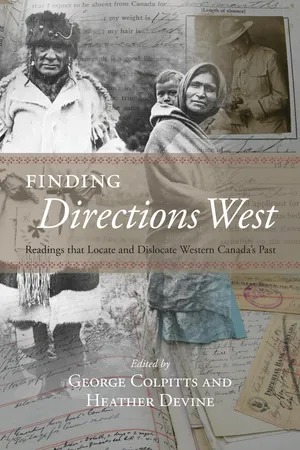
In the past, Western Canada was a place of new directions in human thought and action, migrations of the mind and body, and personal journeys. This book anthology brings together studies exploring the way the west served as a place of constant movement between places of spiritual, subsistence and aesthetic importance. The region, it would seem, gained its very life in the movement of its people. Finding Directions West: Readings that Locate and Dislocate Western Canada's Past, showcases new Western Canadian research on the places found and inhabited by indigenous people and newcomers, as well as their strategies to situate themselves, move on to new homes or change their environments to recreate the West in profoundly different ways. These studies range from the way indigenous people found representation in museum displays, to the archival home newcomers found for themselves: how, for instance, the LGBT community found a place, or not, in the historical record itself. Other studies examine the means by which Métis communities, finding the west transforming around them, turned to grassroots narratives and historical preservation in order to produce what is now appreciated as vernacular histories of inestimable value. In another study, the issues confronted by the Stoney Nakoda who found their home territory rapidly changing in the treaty and reserve era is examined: how Stoney connections to Indian agents and missionaries allowed them to pursue long-distance subsistence strategies into the pioneer era. The anthology includes an analysis of a lengthy travel diary of an English visitor to Depression-era Alberta, revealing how she perceived the region in a short government-sponsored inquiry. Other studies examine the ways women, themselves newcomers in pioneering society, evaluated new immigrants to the region and sought to extend, or not, the vote to them; and the ways early suffrage activists in Alberta and England by World War I developed key ideas when they cooperated in publicity work in Western Canada. Finding Directions West also includes a study on ranchers and how they initially sought to circumscribe their practices around large landholdings in periods of drought, to the architectural designs imported to places such as the Banff Centre that defied the natural geography of the Rocky Mountains. Too often, Western Canadian history is understood as a fixed, precisely mapped and authoritatively documented place. This anthology prompts readers to think differently about a region where ideas, people and communities were in a constant but energetic flux, and how newcomers converged into sometimes impermanent homes or moved on to new experiences to leave a significant legacy for the present-day.
eBook - ePub
Finding Directions West
Readings that Locate and Dislocate Western Canada's Past
- 276 pages
- English
- ePUB (mobile friendly)
- Available on iOS & Android
eBook - ePub
Finding Directions West
Readings that Locate and Dislocate Western Canada's Past
About this book
Information
3
J.Z. LaRocque: A Métis Historian’s Account of His Family’s Experiences during the North-West Rebellion
of 1885
of 1885
Heather Devine
Introduction
Between 1867 and 1885, the Métis and their First Nations allies were the only Indigenous groups in the country to openly defy the newly established Canadian government. Under Prime Minister Sir John A. Macdonald, the fledgling government set out to secure the vast region of Western Canada in order to establish its dominion sea to sea, and to keep the region from falling into American hands. The Canadian annexation of Western Canada began with the purchase of Rupert’s Land from the Hudson’s Bay Company in 1869, a real estate transaction complicated by the refusal of the Métis people of Red River to allow their homeland to be sold. The Métis resistance to the actions of the Canadian government, which included the takeover of Fort Garry and the forced negotiation of land, religious, and language rights for the Métis, resulted in the creation of Manitoba. The eventual acquisition of the entire region of Rupert’s Land, followed by the negotiation and signing of a series of numbered treaties with the tribal groups in what is now Manitoba, Saskatchewan, and Alberta, served to make these large areas of land available for agricultural settlement.
The government’s failure to deliver on promises of land tenure to the Métis, followed by its failure to keep its treaty promises to the Blackfoot and Cree people now on reserves, resulted in a short but bloody uprising known as the Northwest Rebellion of 1885.1 The revolt was successfully suppressed by the Canadian government, and the leader of the uprising, Louis Riel, was hanged for treason in November 1885. A series of changes to the Indian Act – most of them punitive – were made to prevent similar uprisings from taking place again. The Métis were issued scrip, a certificate payable to the bearer, for either agricultural land or cash, in recognition and extinguishment of their Aboriginal rights. Consequently, the remaining arable lands in the West were officially opened to agricultural settlement.
Life for the Métis after 1885 was difficult. Some of the Métis had troubles claiming and keeping their scrip, and by the turn of the twentieth century, these people were homeless, with no means of survival in the agricultural settlements that quickly sprang up. Some landless Métis chose to rely on hunting and gathering to survive, and soon migrated to isolated regions farther to the north and west where they could continue their traditional way of life.
But many of the Métis descendants of buffalo hunters and traders who had occupied the northern plains for generations chose to remain in the southern regions of Western Canada, despite widespread prejudice and discrimination due to their race, their religion, and their French and Indigenous languages. Moreover, the dominant historical narratives of the day branded the Métis as traitors to Canada, an impulsive, improvident, even violent people who had chosen to follow a madman.2
Between 1885 and 1914, an estimated three million people emigrated to Canada, and most of these immigrants were destined for Western Canada.3 The pressure to gain access to arable land soon resulted in widespread discrimination against anyone who was foreign or non-white, did not speak English as their mother tongue, or practised Roman Catholicism. The Indians on reserves were largely ignored by the white population, as the punitive policies of the Indian Act severely restricted their movements off the reserve.4
By the 1920s and 1930s, a new, pathological Métis identity had entered the public consciousness, largely due to the economic and social marginalization that had accelerated since the collapse of the world economy in 1929. The Métis (colloquially referred to as “half-breeds”) were considered to be a failed people, whose racial and cultural characteristics rendered them unfit to compete successfully in the New West. Their lack of formal education made it difficult for them to get permanent employment, and for those Métis unfortunate enough to be indigent, there was no free access to medical services or schooling. They populated the ditches beside the major roads, and led a precarious existence based on seasonal farm labour, handouts, some hunting and gathering, and petty crime. The transformation of the once-proud Métis into “The Road Allowance People” was complete – or almost complete.5
But there were other Métis who had avoided the fate of their less fortunate kin. It is often overlooked, or simply unacknowledged, that some Métis people had the resources necessary to weather the transition from a frontier to a settled society. These individuals, often part of officer families from the Hudson’s Bay Company, or descended from the numerous families of independent traders in the region, had managed to establish small homesteads and secure title to their land. Some of these people also possessed a degree of formal education, and set out to adapt to the new economic reality forced upon them. Others had managed to establish kin and commercial relationships with the new arrivals, or maintained the remnants of older ties rooted in the fur trade society that once dominated the region. In order to function successfully in the racially charged, post-frontier environment of Western Canada, the “Respectable Métis,” as they were sometimes called, chose to downplay their mixed ancestry publicly.6 If they spoke Michif or Cree or Saulteaux or French, they did so at home, with their relatives and friends. Some also quietly chose not to pass along these languages to their children, as they were no longer considered useful skills. The beaded clothing, the kinnikinnick, and the buffalo guns were tucked away under beds, in boxes and trunks, and in closets. The songs and stories of the past remained in the minds and hearts of the old people, to be shared on special occasions like Le Jour D’An (New Year’s Day). Their children went to school, became adults, and intermarried with their non-Métis neighbors.
Over time, the external trappings of Métis culture and heritage had been suppressed so profoundly that by the late twentieth century, it appeared as if the diverse Métis communities scattered throughout the southern regions of Western Canada had completely vanished from the landscape.7 In fact, they had not. As interest in Métis culture and heritage grew after the centenaries of the 1869 and 1885 Métis uprisings, a new generation of researchers would revisit the historical documents of the nineteenth century, looking for information that would shed light on the lives of previously neglected racial and gender minorities, and provide usable data for the political and legal battles following the patriation of Canada’s Constitution in 1982.8
Across Western Canada and into the northern United States, various cultural organizations and projects were launched to compile and preserve Métis folklore and music.9 But what also emerged was a large body of both published and unpublished work, some written by Métis people themselves, some written by people who lived and worked alongside the Métis. These published works were not in the form of school textbooks or scholarly, “academic” histories. Instead they thrived in a largely neglected genre of literature – the field of vernacular history.10
Vernacular history: A definition
What is vernacular history? Recent scholarship by Western Canadian historian Lyle Dick sets out to introduce the term “vernacular history,” to define the characteristics of this genre, and to provide a framework for examining non-academic sources of historical information in order that they might take their rightful place within a broader, more inclusive conception of what academics define as “historiography.”11
The origin of the term “vernacular history” is partially rooted in existing definitions of “vernacular literature” and “vernacular architecture.” Vernacular literature, by and large, refers to any literature written in the everyday speech of the common people. In terms of European literature, vernacular literature was any written work that was not expressed in Latin. Vernacular architecture is the term used to describe buildings that are built using local, traditional techniques and materials, and are not designed by professional architects.
The term “vernacular history” as discussed by Lyle Dick, is “grassroots historical practice in North America in the nineteenth and twentieth centuries.”12 Like vernacular literature and vernacular architecture, vernacular history is a product of the common people, in that it tends to be composed of information collected from, and compiled by, citizens of local communities.
Vernacular historians have ranged from community historians to individual scholars to so-called history buffs, and their practice has assumed many forms, from informal pioneer reminiscences to highly crafted works of scholarship, exemplifying varying levels of talent, experience, and imagination.13
The authors of these grassroots histories may incorporate information from secondary historical sources produced elsewhere but tend to rely on their own personal experiences; original documents and interviews; creative works, such as spoken word, music poetry and visual art; and objects and ephemera collected directly from community residents.
Vernacular histories may follow some research and publication conventions, such as the third-person style of writing, citation of sources, or even formal consent forms for inclusion of personal information, but this is not always deemed necessary, or even desired, by its practitioners.
One of the major criticisms of vernacular history is that it may not display the much-vaunted objectivity of academic writing:
Vernacular authors have often not displayed scholarly detachment; their writing has tended to be informed by direct experience and animated by a passionate involvement with their subjects of study.14
Another shortcoming of vernacular narratives, according to Dick, is that they are “dialogic” in the Bahktinian sense, in that the narrative may change over time according to the nature of the audience and their interaction with, and response to, the author’s account. This fluidity of content in some vernacular accounts means that they lack logical coherence, which undermines their credibility as trustworthy sources of information.15
During the course of the twentieth century, historical production became a discrete academic specialty, and history as written by professional scholars was privileged over vernacular history in terms of its overall validity and credibility. As a result, vernacular history became marginalized and eventually discredited as a source of reliable information about the past.16
Dick goes on to note that while vernacular historians “share the common experience of operating outside dominant discourses of power and authority,” this does not mean that vernacular narratives necessarily go against the prevailing dominant historical viewpoints.17 Community historians who share the same worldview and value systems as professional scholars are often happy to incorporate perspectives that reinforce their own opinions, even to the point of excluding credible data that challenge the validity of the prevailing historical scholarship. As a result, the vast majority of local community histories produced prior to the 1970s demonstrate a relentlessly homogeneous portrait of Western Canada, where the narrative of the past starts with the appearance of the first homesteader and goes on to feature the family biographies of subsequent arrivals – all presented in alphabetical order according to surname.
More recently Lyle Dick has revisited the topic of Western Canadian vernacular history, this time focusing on the writing of early Manitoba history. His rationale for this examination is to refute the common assumption that Western Canadian historiography is a product of the period after the creation of Manitoba and after the founding of history as an academic specialty. Instead, he argues that there were vernacular h...
Table of contents
- Front Matter
- Illustrations
- Acknowledgments
- Introduction: Migration and Transformation in the Canadian West
- Spatial Deployments to Synchronic Witnessing: Reiterations of Contact in Museum Spaces
- Discombobulated Remnants?: Preserving LGBTTTIQ Histories1
- J.Z. LaRocque: A Métis Historian’s Account of His Family’s Experiences during the North-West Rebellion of 1885
- Colonizer or Compatriot?: A Reassessment of the Reverend John McDougall
- Exploring the “Thirteenth” Reason for Suffrage: Enfranchising “Mothers of the British Race” on the Canadian Prairies
- “Develop a Great Imperial Race”: Emmeline Pankhurst, Emily Murphy, and Their Promotion of “Race Betterment” in Western Canada in the 1920s
- “The Country Was Looking Wonderful”: Insights on 1930s Alberta from the Travel Diary of Mary Beatrice Rundle
- A Blueprint for Range Management: The Anderson Grazing Rates Report of 1941
- Mountain Capitalists, Space, and Modernity at the Banff School of Fine Arts
- Bibliography
- Contributors
- Index
Trusted by 375,005 students
Access to over 1.5 million titles for a fair monthly price.
Study more efficiently using our study tools.
Frequently asked questions
Yes, you can cancel anytime from the Subscription tab in your account settings on the Perlego website. Your subscription will stay active until the end of your current billing period. Learn how to cancel your subscription
No, books cannot be downloaded as external files, such as PDFs, for use outside of Perlego. However, you can download books within the Perlego app for offline reading on mobile or tablet. Learn how to download books offline
Perlego offers two plans: Essential and Complete
- Essential is ideal for learners and professionals who enjoy exploring a wide range of subjects. Access the Essential Library with 800,000+ trusted titles and best-sellers across business, personal growth, and the humanities. Includes unlimited reading time and Standard Read Aloud voice.
- Complete: Perfect for advanced learners and researchers needing full, unrestricted access. Unlock 1.5M+ books across hundreds of subjects, including academic and specialized titles. The Complete Plan also includes advanced features like Premium Read Aloud and Research Assistant.
We are an online textbook subscription service, where you can get access to an entire online library for less than the price of a single book per month. With over 1.5 million books across 990+ topics, we’ve got you covered! Learn about our mission
Look out for the read-aloud symbol on your next book to see if you can listen to it. The read-aloud tool reads text aloud for you, highlighting the text as it is being read. You can pause it, speed it up and slow it down. Learn more about Read Aloud
Yes! You can use the Perlego app on both iOS and Android devices to read anytime, anywhere — even offline. Perfect for commutes or when you’re on the go.
Please note we cannot support devices running on iOS 13 and Android 7 or earlier. Learn more about using the app
Please note we cannot support devices running on iOS 13 and Android 7 or earlier. Learn more about using the app
Yes, you can access Finding Directions West by George Colpitts, Heather Devine in PDF and/or ePUB format, as well as other popular books in Storia & Storia nordamericana. We have over 1.5 million books available in our catalogue for you to explore.