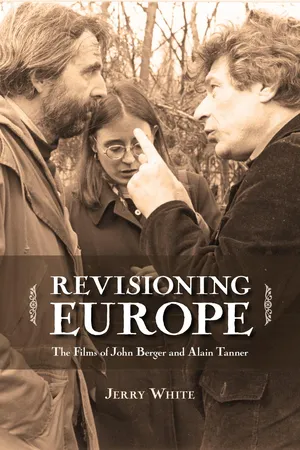
Revisioning Europe: The Films of John Berger and Alain Tanner, is among the few existing English-language discussions of the films made by British novelist John Berger and Swiss film director Alain Tanner. It brings to light a political cinema that was unsentimental about the possibilities of revolutionary struggle and unsparing in its critique of the European left, and at the same time optimistic about the ability of radicalism - and radical art - to transform the world. Jerry White argues that Berger and Tanner's work is preoccupied with ideas that were both central to the Enlightenment and at the same time characteristically Swiss. Translations of previously unpublished essays by both John Berger and Alain Tanner are included as appendices.
- 254 pages
- English
- ePUB (mobile friendly)
- Available on iOS & Android
eBook - ePub
About this book
Information
Introduction
“The subject is European, its meaning global.” – John Berger,
A Seventh Man (7)
What constitutes political cinema? What debt does it owe simply to politics, or simply to cinema? How can its formal patterns really reflect political concerns? The 1970s were dominated by such debate among film critics and theoreticians, a lot of whom were strongly hostile to narrative, to say nothing of pleasure, and a lot of whom were under the spell of Bertolt Brecht. A lot of that is, in retrospect, easily caricatured as quaint, and these sorts of questions have faded from the main stream of Film Studies (at least in English and French). But two people active in these ’70s debates never succumbed to pious, over-simplified equations of narrative identification or visual pleasure with oppression. They were neither film theorists nor film critics, although throughout their work they evince a keenly acute sense of the philosophical and aesthetic stakes of cinema and politics. They worked together only briefly, but the films they made together offered a vision of a political cinema whose rigour and accessibility remains, in many ways, unmatched. “They make one of the most interesting film-making teams in Europe today” Vincent Canby wrote in the New York Times on 2 October 1976.
I am talking, of course, about the English writer John Berger and the Swiss filmmaker Alain Tanner. The most well-known of their collaborations, La Salamandre (1971), Le Milieu du monde (1974), and Jonas qui aura 25 ans en l’an 2000 (1976), are crucial parts of postwar European cinema and deserve a central place in its history. No doubt that the struggles that these films evoked and, in their small way, participated in, are by and large over. But Berger and Tanner’s work still needs to be recovered and re-explained in terms of a world cinema that has, in the last decades, been as transformed as the political landscape of Western Europe. I want to argue in this book that the films they made together offered a vision of a political cinema that was unsentimental about the possibilities of revolutionary struggle, unsparing in its critique of the failures of the European left, but still optimistic about the ability of radicalism, and radical art as well, to transform the world.
I will examine each film, and both artists, in their turn, but some elements run throughout the discussion. The first is that these films, like the work Berger and Tanner did on their own, are both forward-looking and historically aware. The second is that the films are aesthetically innovative while still remaining close to conventions of narrative filmmaking. In this way they are actually defined by a richly complex dialectic between conservative and progressive elements, on the level of both form and content. And thus we arrive, I believe, at the nub of the matter. These films are seminal because they embody a considered and tentative experimentalism, forgoing polemics in favour of argument. This rigour, and this humility, is what points the way forward for political cinema. The fact that the political cinema of the last decades shows little sign of this sensibility makes it no less urgent to think of Berger and Tanner’s work as a viable path for political cinema to follow.
By way of introduction I want to explain a few important historical and theoretical elements that frame that argument about the nature of the political cinema these two artists created together. I will talk briefly about the “Nouveau cinéma suisse” in the context of similar “New Waves” of the 1960s. I will also sketch out the landscape of 70s theorizing about cinema and political action. I want to do this because it would be very easy to place these three films in contexts like these, and I think that’s a bit too simple. These films are defined by a complex combination of narrative convention and innovation; while Berger and Tanner do a lot of what 70s theorists saw as aesthetically progressive, they never fully abandoned cinematic conventions such as narrative, identification, etc. Their work together is preoccupied with the inherent tension between collective action and individual liberty, and this is a conundrum that is, not to put too fine a point on it, seminally Swiss. Another aspect of their work that is seminally Swiss is their tendency to see the mountains not as some repository of timeless values but as a politically unstable border zone. This has a lot to do with the “separatist” conflict in Jura that strongly marked Swiss politics in the 1960s and 70s, and I will explain the way that they both implicitly and explicitly engage with that conflict. I will also try to place their work in the context of Switzerland by offering an analogy between Berger, Tanner, and two important figures of two different generations of Swiss literature: Charles-Ferdinand Ramuz (Switzerland’s most celebrated French-language writer of the first half of the twentieth century) and Jacques Chessex (who came to be synonymous with the explosion of creativity in French-speaking Switzerland starting in the 1960s). That tension between individual liberty and collective responsibility was a central conundrum of the Enlightenment as well, and that is finally what I want to point out about Berger and Tanner. They are heirs to what Tzvetan Todorov has recently elegized as “L’Esprit des Lumières.”
The fact that you can fit Berger and Tanner’s work into “70s counter-cinema” and “Nouveau cinéma suisse” but that you also need to do more to really understand the work is at the heart of the kind of political cinema they were trying to build. They didn’t seek to reject the political discourse that emerged in the wake of the 1968 strikes. They understood that the radicals of that period were, at their best moments, richly aware of the ideological and political importance of form and the potential that cinema and its allied arts had to serve as agents of social transformation. Indeed, Berger and Tanner sought to avoid the leftist pieties that marked 1968 while still building on its radical and largely unachieved possibilities. Similarly, I don’t believe that their films constitute a rejection of Swiss culture. Very much the opposite is true, despite what both Berger and Tanner have said in print and to me personally. I believe that their films show that they saw what was radical in Switzerland’s distinctive political culture, and I also believe that they understood how those distinctive qualities could be built that into their vision of a renewed European left. My verb there is key. Berger and Tanner were not nostalgic, nor were they cynics, nor were they pious scolds. Through the films they made together, and throughout the work they have done individually, they have tried to be builders.
Not nouvelle, and only partly nouveau
Although it is not a particularly well-known movement within the world of anglophone film studies, the flowering of cinema in 1960s and ’70s French-speaking Switzerland did create a certain amount of excitement in the francophone world. This excitement was generated as much by the films of the movement as by the ways in which it changed the institutional situation of Swiss cinema, especially in French-speaking Switzerland. Martin Schaub, in his history L’Usage de la liberté: le nouveau cinéma suisse 1964-1984, recalls that during this period imported (mostly Hollywood, although some German and French) films accounted for 98.7 per cent of the films shown in Switzerland in 1960 and 99.8 per cent in 1964. He says that “it seems to me essential to recall the colonization which had a hold on all of the media of this period; just as elsewhere, it dominated music, fashion, and even literature” (8).1 Tanner was a key part of the first sustained challenge to this cinematic imperialism, although the films that he actually made during this period are different in important ways from the work of his contemporaries.
Aside from Tanner, the best known members of “Le nouveau cinéma suisse” are probably Claude Goretta and Michel Soutter. Goretta had known Tanner when they had both lived in England during the 1950s, and the two had made a film together – the semi-vérité short Nice Time (1957)2 – which had been an important part of Britain’s “Free Cinema” movement. Goretta went on to make feature films, including Le Fou (1969) and L’Invitation (1971), as well as Jean-Luc Persecuté (1966), an adaptation of the Ramuz novel. He now is a widely respected figure in Swiss cinema. That’s also true of Soutter, who began by making a well-received short in 1965 called Mick et Arthur, a jaunty piece that owes a lot to Godard’s À bout de souffle. He followed that with 1971’s feature Les Arpenteurs, a much more downbeat work about a mysterious woman and her hapless suitors, one whose subject matter shares a lot with Berger and Tanner’s La Salamandre, released the same year and also starring Jean-Luc Bideau. Les Arpenteurs became one of the signature works of the moment.
Like a lot of the “New Waves” of the 1960s, much of the Nouveau cinéma suisse was strongly influenced by France’s Nouvelle Vague of the 1950s and 60s. This is most true of Soutter, whose films are very much about the restlessness of youth and the pleasures of alternating between improvization and alienation in a way that would be very familiar to François Truffaut or to the Jean-Luc Godard of the early 1960s. But this is not true of Tanner’s films, which are quite different from the work of the French New Wave. When La Salamandre was released in 1971, Tanner recalled in an interview with Guy Braucourt that when he showed his first feature-narrative film Charles mort ou vif (1969) to French audiences, “it was received as an ‘incredibly exotic’ film!” (7).3 Part of this, no doubt, is easily ascribable to the actors’ accents. But a more important element of this “exotic” quality has to do with the fact that the film’s characters, when faced with the alienation of bourgeois society, retreat not to a café in a hipster metropolis like Paris but to the Jura mountains, a territory whose politics and history are genuinely distinctive, genuinely unstable, and generally unknown to people outside of Switzerland. I will return to the matter of Jura, and of the “esprit jurassien” that I think is hiding just below the surface of Tanner and Berger’s work together, in due time. Suffice it to say for now that there is a great deal in Tanner’s films that is at odds with the nouvelle vague sensibility, and among his contemporaries, he is the least influenced by that most famous of French-language film movements. Tanner recalled to Christian Dimitriu how his time in 1958 Paris was basically unpleasant:
For me it was a bit of a shock to live in Paris after London. The generosity and warm friendship of my London circle was all over. In Paris it was everyone for themselves and knives drawn. It was a closed world, and more and more the New Wave was, for me, who had come out of a very politicized community, a bit too “right wing anarchist.” I worked a bit on the Cahiers du cinéma but everyone was on their guard. (99)4
To see the Cahiers group cast as “anarchistes de droite” certainly goes against a lot of main-line, especially English-language histories of the period. But the fact is that Cahiers group were very slippery politically. Richard Brody’s recent biography of Godard, for instance, is fairly explicit about the sometimes frighteningly reactionary elements of the young Jean-Luc, going so far as to recall how as a child in WWII Switzerland he “cheered on the advances of the German army and lamented its reversals” (6), and how the novelist interviewed by the Jean Seberg character in À bout de souffle is named for the right-wing philosopher and novelist Jean Parvulesco, who Brody calls “his Geneva friend” (62). Hélène Logier has followed this Parvulesco connection up in great detail, chronicling the essays on the New Wave that Parvulesco wrote for the Falangist film magazine Primer Plano during the Franco era, essays that argued that the New Wave’s films were “profondément imprégnés d’idéaux d’extrême droite,” profoundly impregnated by the ideals of the extreme right (130). She wrote that in one essay Parvulesco published in 1960, “According to him, the members of the New Wave were impregnated by an ‘intellectual fascism.’ Their philosophy was nihilism. They put the mentality of youth up on the screen, having a great love of freedom and fascinated by death, violence, and crazy love.… He felt that the films of the New Wave were anti-conformist, anti-communist, anti-democratic and anti-socialist” (134).5 John Hess argued something similar (although slightly more gentle) about the entire Cahiers group of the 1950s in his massive critique of their legacy (published in the first two issues of the radical American film magazine Jump Cut), writing that “La politique des auteurs was, in fact, a justification, couched in aesthetic terms, of a culturally conservative, politically reactionary attempt to remove film from the realm of social and political concern, in which the progressive forces of the Resistance had placed all the arts in the years immediately after the war” (19). André Bazin’s role as a wise father figure trying to instil some reason into his passionate young charges is well known, but there is a political aspect to this as well. Bazin was, after all, a Jacques-Maritain-inflected left Catholic, a Personalist, and a lot of his attempts to counter some of the cinephilic-auteurist enthusiasm in the pages of the magazine clearly evince a strong trace of the spiritually inflected left politics that defined the work of Maritain and his fellow travellers (that said, Hess sees Personalism as part of the problem when it comes to the politics of the 1950s Cahiers). Putting this in more generational than explicitly political terms, upon the 1972 release of his Retour d’Afrique Bernard Weiner pointed out in t...
Table of contents
- Introduction
- Berger and Tanner before “Berger and Tanner”
- La Salamandre
- Le Milieu du monde
- Jonas qui aura 25ans en l’an 2000
- Conclusion
- “Télé-Aphorismes”
- “VeRS Le Milieu du monde”
- Bibliography
- Sourcesfor the Films on Video
Trusted by 375,005 students
Access to over 1.5 million titles for a fair monthly price.
Study more efficiently using our study tools.
Frequently asked questions
Yes, you can cancel anytime from the Subscription tab in your account settings on the Perlego website. Your subscription will stay active until the end of your current billing period. Learn how to cancel your subscription
No, books cannot be downloaded as external files, such as PDFs, for use outside of Perlego. However, you can download books within the Perlego app for offline reading on mobile or tablet. Learn how to download books offline
Perlego offers two plans: Essential and Complete
- Essential is ideal for learners and professionals who enjoy exploring a wide range of subjects. Access the Essential Library with 800,000+ trusted titles and best-sellers across business, personal growth, and the humanities. Includes unlimited reading time and Standard Read Aloud voice.
- Complete: Perfect for advanced learners and researchers needing full, unrestricted access. Unlock 1.5M+ books across hundreds of subjects, including academic and specialized titles. The Complete Plan also includes advanced features like Premium Read Aloud and Research Assistant.
We are an online textbook subscription service, where you can get access to an entire online library for less than the price of a single book per month. With over 1.5 million books across 990+ topics, we’ve got you covered! Learn about our mission
Look out for the read-aloud symbol on your next book to see if you can listen to it. The read-aloud tool reads text aloud for you, highlighting the text as it is being read. You can pause it, speed it up and slow it down. Learn more about Read Aloud
Yes! You can use the Perlego app on both iOS and Android devices to read anytime, anywhere — even offline. Perfect for commutes or when you’re on the go.
Please note we cannot support devices running on iOS 13 and Android 7 or earlier. Learn more about using the app
Please note we cannot support devices running on iOS 13 and Android 7 or earlier. Learn more about using the app
Yes, you can access Revisioning Europe by Jerry White in PDF and/or ePUB format, as well as other popular books in Media & Performing Arts & European History. We have over 1.5 million books available in our catalogue for you to explore.