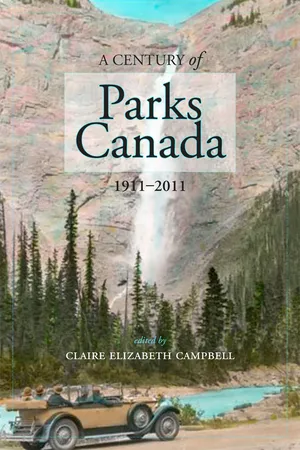
"... a diverse and fascinating array of perspectives on the history of Canada's national parks, illuminating many less well-understood aspects of the evolving place of people in and near these parks." - Stephen Bocking, Professor and Chair, Environmental and Resource Studies Program, Trent UniversityWhen Canada created a Dominion Parks Branch in 1911, it became the first country in the world to establish an agency devoted to managing its national parks. Over the past century this agency, now Parks Canada, has been at the centre of important debates about the place of nature in Canadian nationhood and relationships between Canada's diverse ecosystems and its communities. Today, Parks Canada manages over forty parks and reserves totalling over 200, 000 square kilometres and featuring a dazzling variety of landscapes, and is recognized as a global leader in the environmental challenges of protected places. Its history is a rich repository of experience, of lessons learned - critical for making informed decisions about how to sustain the environmental and social health of our national parks.A Century of Parks Canada is published in partnership with NiCHE (Network in Canadian History and Environment; http://niche-canada.org/).With Contributions By: Ben BradleyGeorge ColpittsOliver Craig-DupontLyle DickE. Gwyn LangemannAlan MacEachernI.S. MacLarenBrad MartinDavid NeufeldRonald RudinJohn SandlosC.J. TaylorBill Waiser
- 458 pages
- English
- ePUB (mobile friendly)
- Available on iOS & Android
eBook - ePub
A Century of Parks Canada, 1911-2011
About this book
Information
[1] “Government bills put through Commons,” Globe (29 April 1911) and “What Parliament has done so far,” Globe (22 May 1911). I would like to thank Alan MacEachern for his comments on an earlier draft of this introduction.
[2] House of Commons, Debates, 9 May 1911, column 8666; An Act respecting Forest Reserves and Parks, Statutes of Canada 1–2 Geo. V., chap. 10.
[3] Department of the Interior, Annual Report for the fiscal year ending March 31, 1912, J.B. Harkin, “Report of the Commissioner of Dominion Parks,” Sessional Paper no. 25 (1913); E.J. Hart, J.B. Harkin: Father of Canada’s National Parks (Edmonton: University of Alberta Press, 2010).
[4] M.B. Williams, Guardians of the Wild (London: Thomas Nelson and Sons, 1936), 138.
[5] Annual Report of the Department of the Interior for the year 1886, Part I: Dominion Lands, Sessional Paper no. 7 (Ottawa, 1887), 9.
[6] Van Horne saw tourist revenue as a way to pay for the astronomical costs of the transcontinental construction project. See, for example, Walter Vaughan, The Life and Work of Sir William Van Horne (New York: Century, 1920) 151, and E.J. Hart, The Selling of Canada: The CPR and the Beginnings of Canadian Tourism (Banff: Altitude, 1983) 7, and “See this world before the next: Tourism and the CPR,” in The CPR West: The iron road and the making of a nation, ed. Hugh A. Dempsey, 151 (Vancouver: Douglas & McIntyre, 1984). Prime Minister John A. Macdonald shared this point of view, telling the House of Commons that a park at the Banff hot springs would “recuperate the patients, and recoup the Treasury.” House of Commons, Debates, 3 May 1887.
[7] House of Commons, Debates, 13 January 1911.
[8] With jurisdiction over the vast federal territories in the northwest, Interior’s portfolios included federal lands, Indian Affairs, the Geological Survey and the Dominion Survey, immigration, leases for homestead lands, timber, ranching, and mining, reclamation and water, the Forest Service, and, from 1911, the Parks Branch.
[9] See Peter Murphy, “‘Following the Base of the Foothills’: Tracing the Boundaries of Jasper Park and its Adjacent Rocky Mountains Forest Reserve,” in Culturing Wilderness in Jasper National Park: Studies in Two Centuries of Human History in the Upper Athabasca River Watershed, ed. I.S. MacLaren, 71–122 (Edmonton: University of Alberta Press, 2007).
[10] Paul Kopas, Taking the Air: Ideas and Change in Canada’s National Parks (Vancouver: UBC Press, 2007), 29; J.B. Harkin, “Report of the Commissioner,” Annual Report of the Department of the Interior, 1919, Sessional Paper no. 25 (Ottawa, 1920), 3–4.
[11] These were Menissawok (1914–30) in Saskatchewan and Wawaskesy (1914–38) and Nemiskam (1915–47) in Alberta, all of which were renamed national parks in 1922. This is the first and last time we see the use of aboriginal names until the creation of Kejimkujik National Park in Nova Scotia in 1968. Also see Jennifer Brower, Lost Tracks: Buffalo National Park, 1909–1939 (Edmonton: AU Press, 2008), for the story of another wildlife preserve (1908–47) that was eventually eliminated.
[12] Williams, Guardians of the Wild, 136–37.
[13] C.J. Taylor, “Legislating Nature: The National Parks Act of 1930,” in To See Ourselves / To Save Ourselves: Ecology and Culture in Canada, ed. Rowland Lorimer et al., 125–37 (Montreal: Association for Canadian Studies, 1991); also Taylor, Negotiating the Past: The Making of Canada’s National Historic Parks and Sites (Montreal: McGill-Queen’s University Press, 1990).
[14] For more on this, see Shaun Fluker, “Ecological integrity and the law: The view from Canada’s National Parks,” Parks for Tomorrow 40th Anniversary Conference, Calgary, Alberta, 8–12 May 2008.
[15] See Alan MacEachern, Natural Selections: National Parks in Atlantic Canada, 1935–1970 (Montreal: McGill-Queen’s University Press, 2001). Another study of the interwar period is Bill Waiser’s Park Prisoners: The Untold Story of Western Canada’s National Parks, 1915–1946 (Calgary: Fifth House, 1995).
[16] Ethan Carr, Mission 66: Modernism and the National Park dilemma (Amherst: University of Massachusetts Press in association with Library of American Landscape History, 2007); Richard West Sellars, Preserving Nature in the National Parks: A History (New Haven, CT: Yale University Press, 1997).
[17] Kopas, Taking the Air, 37–66.
[18] Jean Chrétien, Straight from the Heart (Toronto: Key Porter, 1985), 68.
[19] Catriona Mortimer-Sandilands argues strongly for the nationalist message in park creation and presentation throughout the twentieth century, even after “the ecological turn.” See “The Cultural Politics of Ecological Integrity: Nature and Nation in Canada’s National Parks, 1885–2000,” International Journal of Canadian Studies 39/40 (2009): 161–89. On the System Plan, see the National Parks System Plan, 3d ed. (Hull, QC: Canadian Heritage and Parks Canada, 1997); http://www.pc.gc.ca/eng/docs/v-g/nation/nation1.aspx. The Agency’s stated goal remains to have at least one national park and one national marine conservation area in each of Canada’s terrestrial and marine regions; currently 28 of the 39 terrestrial regions and 3 of the 29 marine regions are represented. See Parks Canada Agency Corporate Plan, 2009/10–2013/14/Agence Parcs Canada plan d’entreprise, 2009–2010 à 2013–2014 (Gatineau, QC: Parks Canada, 2009), 6. http://www.pc.gc.ca/eng/docs/pc/plans/plan2008-2009/sec1/page01.aspx.) (However, in 1989, CPAWS and World Wildlife Canada complicated the neat jigsaw visual by launching an Endangered Spaces campaign, which called for protecting sample landscapes in 350 regions). In 2010, Parks Canada proposed two future parks, both in Eastern Canada: Mealy Mountains, Labrador, as representative of the “East Coast Boreal Natural Region,” and Sable Island, Nova Scotia. In the west, a memorandum of understanding with the province of British Columbia in 2003 enabled Parks to undertake a feasibility study for a park in the “Interior Dry Plateau Region” in the south Okanag...
Table of contents
- Half-Title
- Title
- Copyright
- Governing a Kingdom: Parks Canada, 1911–2011
- M.B. Williams and the Early Years of Parks Canada
- Nature’s Playgrounds: The Parks Branch and Tourism Promotion in the National Parks, 1911–1929
- “A Questionable Basis for Establishing a Major Park”: Politics, Roads, and the Failure of a National Park in British Columbia’s Big Bend Country
- “A Case of Special Privilege and Fancied Right”: The Shack Tent Controversy in Prince Albert National Park
- Banff in the 1960s: Divergent Views of the National Park Ideal
- Films, Tourists, and Bears in the National Parks: Managing Park Use and the Problematic “Highway Bum” Bear in the 1970s
- Hunting, Timber Harvesting, and Precambrian Beauties: The Scientific Reinterpretation of La Mauricie National Park’s Landscape History, 1969–1975
- Kouchibouguac: Representations of a Park in Acadian Popular Culture
- Kluane National Park Reserve, 1923–1974: Modernity and Pluralism
- Negotiating a Partnership of Interests: Inuvialuit Land Claims and the Establishment of Northern Yukon (Ivvavik) National Park
- Archaeology in the Rocky Mountain National Parks: Uncovering an 11,000-Year-Long Story
- Rejuvenating Wilderness: The Challenge of Reintegrating Aboriginal Peoples into the “Playground” of Jasper National Park
- Epilogue
- Appendix A: Canada’s National Parks and National Park Reserves
- Appendix B: National Parks Zoning System, Parks Canada Agency
- Notes on Contributors
- Select Bibliography
- Index
- End Notes
Trusted by 375,005 students
Access to over 1.5 million titles for a fair monthly price.
Study more efficiently using our study tools.
Frequently asked questions
Yes, you can cancel anytime from the Subscription tab in your account settings on the Perlego website. Your subscription will stay active until the end of your current billing period. Learn how to cancel your subscription
No, books cannot be downloaded as external files, such as PDFs, for use outside of Perlego. However, you can download books within the Perlego app for offline reading on mobile or tablet. Learn how to download books offline
Perlego offers two plans: Essential and Complete
- Essential is ideal for learners and professionals who enjoy exploring a wide range of subjects. Access the Essential Library with 800,000+ trusted titles and best-sellers across business, personal growth, and the humanities. Includes unlimited reading time and Standard Read Aloud voice.
- Complete: Perfect for advanced learners and researchers needing full, unrestricted access. Unlock 1.5M+ books across hundreds of subjects, including academic and specialized titles. The Complete Plan also includes advanced features like Premium Read Aloud and Research Assistant.
We are an online textbook subscription service, where you can get access to an entire online library for less than the price of a single book per month. With over 1.5 million books across 990+ topics, we’ve got you covered! Learn about our mission
Look out for the read-aloud symbol on your next book to see if you can listen to it. The read-aloud tool reads text aloud for you, highlighting the text as it is being read. You can pause it, speed it up and slow it down. Learn more about Read Aloud
Yes! You can use the Perlego app on both iOS and Android devices to read anytime, anywhere — even offline. Perfect for commutes or when you’re on the go.
Please note we cannot support devices running on iOS 13 and Android 7 or earlier. Learn more about using the app
Please note we cannot support devices running on iOS 13 and Android 7 or earlier. Learn more about using the app
Yes, you can access A Century of Parks Canada, 1911-2011 by Claire Campbell in PDF and/or ePUB format, as well as other popular books in History & North American History. We have over 1.5 million books available in our catalogue for you to explore.