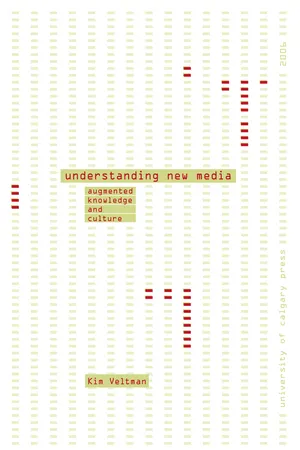
The term "new media" is most often associated with the Internet and the phenomenal technological advances that have taken place in the past decades. In Understanding New Media: Augmented Knowledge and Culture, Kim Veltman looks at these developments and identifies five types of consequences of the networked environment - technological, material, organizational, intellectual, and philosophical. Veltman reviews physical changes (e.g., development of size and speed in computing, wireless communication, agile manufacturing) and argues that the most profound potential changes lie in intellectual and philosophical domains. Unlike technological determinists, Veltman shows that there are at least three differing and sometimes competing goals and visions for new media around the world. Whereas America foresees an information highway, Europe envisions an information/knowledge society and Japan strives clearly for a knowledge society. China and India are playing an increasing role in such visions of the future. These visions are very long-term. For instance, the director of Google has claimed that his (American) vision will take at least three centuries to achieve. Veltman thus reveals a big picture of the digital revolution that is something fundamentally different from simply the introduction of yet another medium to our culture. Information Communication Technologies (ICT) are becoming Universal Convergent Technologies (UCT). This calls for us to rethink McLuhan's brilliant and provocative suggestion that every new medium simply uses the prior mode as its message. It marks a paradigm shift in our relation to all media, to all our senses, all our expressions. The new media are transforming our definitions of culture and knowledge, our ways of knowing, and transcending barriers in ways that will have lasting implications for centuries to come.
- 713 pages
- English
- PDF
- Available on iOS & Android
eBook - PDF
About this book
Information
Subtopic
Feminism & Feminist TheoryIndex
Social SciencesTable of contents
- Cover
- Title Page
- Bibliographic Information
- Quotation
- Dedication
- Contents
- Preface
- Introduction
- Acknowledgements
- Part I Techological Consequences: INVISIBILITY
- 1: Computers
- 2: Mobility
- 3: Miniaturization
- Part II Material Consequences: VIRTUALITY
- 4: Production
- 5: Services
- 6: Institutions
- Part III Organizational Consequences: SYSTEMICITY
- 7: Organizations
- 8: Management
- 9: Learning
- Part IV Intellectual Consequences: CONTEXTUALITY
- 10: Personal Knowledge
- 11: Collaboration
- 12: Enduring Knowledge
- Part V Philosophical consequences: SPIRITUALITY
- 13: Challenges
- 14: Synthesis
- 15: Conclusions
- Epilogue 1: The advent of new players and changes since 2000
- Epilogue 2: Mcluhan in the electronic age
- Appendix 1: Scientific Visualization
- Appendix 2: New fields relating to knowledge organization
- Appendix 3: New Fields Relating to Expert and Intelligent Systems (1942-2002)
- Appendix 4: Just Imagine, By Japp Van Till
- Appendix 5: J.M. Perreault's Relations
- Appendix 6: Syntax, Semantics, and Grammar
- Appendix 7: International Developments
- Appendix 8: Further Reading
- Illustrations
- Abbreviations
- Notes
- Index of Persons and Institutions
- Index of Subjects
Trusted by 375,005 students
Access to over 1.5 million titles for a fair monthly price.
Study more efficiently using our study tools.
Frequently asked questions
Yes, you can cancel anytime from the Subscription tab in your account settings on the Perlego website. Your subscription will stay active until the end of your current billing period. Learn how to cancel your subscription
No, books cannot be downloaded as external files, such as PDFs, for use outside of Perlego. However, you can download books within the Perlego app for offline reading on mobile or tablet. Learn how to download books offline
Perlego offers two plans: Essential and Complete
- Essential is ideal for learners and professionals who enjoy exploring a wide range of subjects. Access the Essential Library with 800,000+ trusted titles and best-sellers across business, personal growth, and the humanities. Includes unlimited reading time and Standard Read Aloud voice.
- Complete: Perfect for advanced learners and researchers needing full, unrestricted access. Unlock 1.5M+ books across hundreds of subjects, including academic and specialized titles. The Complete Plan also includes advanced features like Premium Read Aloud and Research Assistant.
We are an online textbook subscription service, where you can get access to an entire online library for less than the price of a single book per month. With over 1.5 million books across 990+ topics, we’ve got you covered! Learn about our mission
Look out for the read-aloud symbol on your next book to see if you can listen to it. The read-aloud tool reads text aloud for you, highlighting the text as it is being read. You can pause it, speed it up and slow it down. Learn more about Read Aloud
Yes! You can use the Perlego app on both iOS and Android devices to read anytime, anywhere — even offline. Perfect for commutes or when you’re on the go.
Please note we cannot support devices running on iOS 13 and Android 7 or earlier. Learn more about using the app
Please note we cannot support devices running on iOS 13 and Android 7 or earlier. Learn more about using the app
Yes, you can access Understanding New Media by Kim H. Veltman in PDF and/or ePUB format, as well as other popular books in Social Sciences & Feminism & Feminist Theory. We have over 1.5 million books available in our catalogue for you to explore.