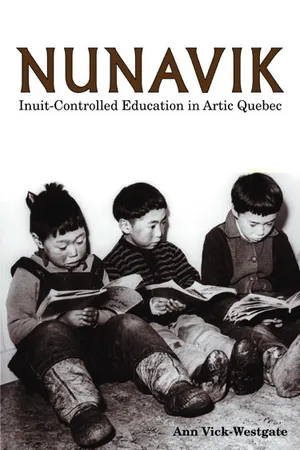
"In the pages of this book, you will read of the efforts of many to fearlessly audit the state of education in Nunavik. To diligently seek improvement of an already good system. To fix what is not necessarily broken so that those who come after us will have it even better than we did. The various tensions and differences of opinion are, to me, not contentious at all. The status quo, however good or excellent, is no place to stay. I think all recognize this." - Zebedee Nungak, from the ForewordAs a history of the development of self-government in education, Nunavik: Inuit-Controlled Education in Arctic Quebec provides Native perspectives on formal education in Nunavik while offering readers a unique view into contemporary Inuit society. This book documents the development of education from the arrival of the first traders and missionaries in the mid-nineteenth century through the creation of the Kativik School Board and the evaluation of its operations by the Nunavik Education Task Force in the 1990s.Nunavik takes a detailed look at the complex debate of the Inuit of Northern Quebec about the purposes, achievements, and failures of the public schools in their communities, the first Inuit-controlled school district in Canada. Participants in these debates included elders who were educated traditionally, their children with a few years of education in mission and government schools, their grandchildren who attended southern high schools or residential schools, and current students and recent graduates of the Kativik schools. Qallunaat (non-Inuit) were also participants, as residents of Nunavik communities, parents of Inuit children, teachers, administrators, and expert consultants.Illustrated with rich historical photographs (many in colour) and maps from the collections of the Avataq Cultural Institute and the Makivik Corporation, Nunavik provides a uniquely Native perspective on school change in indigenous communities.
- 358 pages
- English
- PDF
- Available on iOS & Android
eBook - PDF
About this book
Information
Subtopic
Native American StudiesIndex
Social SciencesTable of contents
- Contents
- Foreword
- Introduction
- 1 Educational Change in an Arctic World
- 2 A History of Nunavik
- 3 Traditional Education and European Impact
- 4 The James Bay and Northern Quebec Agreement
- 5 Kativik School Board: The First 10 Years
- 6 Symposium '85 and Calls For Change
- 7 Launching the Nunavik Educational Task Force
- 8 The Communities Speak Out
- 9 The Education Review Committee Takes Control
- 10 Coming Together: The Task Force Report and the School Board Response
- 11 Conclusion: Indigenous Models for Educational Change
- Appendices
- Bibliography
- Index
Trusted by 375,005 students
Access to over 1.5 million titles for a fair monthly price.
Study more efficiently using our study tools.
Frequently asked questions
Yes, you can cancel anytime from the Subscription tab in your account settings on the Perlego website. Your subscription will stay active until the end of your current billing period. Learn how to cancel your subscription
No, books cannot be downloaded as external files, such as PDFs, for use outside of Perlego. However, you can download books within the Perlego app for offline reading on mobile or tablet. Learn how to download books offline
Perlego offers two plans: Essential and Complete
- Essential is ideal for learners and professionals who enjoy exploring a wide range of subjects. Access the Essential Library with 800,000+ trusted titles and best-sellers across business, personal growth, and the humanities. Includes unlimited reading time and Standard Read Aloud voice.
- Complete: Perfect for advanced learners and researchers needing full, unrestricted access. Unlock 1.5M+ books across hundreds of subjects, including academic and specialized titles. The Complete Plan also includes advanced features like Premium Read Aloud and Research Assistant.
We are an online textbook subscription service, where you can get access to an entire online library for less than the price of a single book per month. With over 1.5 million books across 990+ topics, we’ve got you covered! Learn about our mission
Look out for the read-aloud symbol on your next book to see if you can listen to it. The read-aloud tool reads text aloud for you, highlighting the text as it is being read. You can pause it, speed it up and slow it down. Learn more about Read Aloud
Yes! You can use the Perlego app on both iOS and Android devices to read anytime, anywhere — even offline. Perfect for commutes or when you’re on the go.
Please note we cannot support devices running on iOS 13 and Android 7 or earlier. Learn more about using the app
Please note we cannot support devices running on iOS 13 and Android 7 or earlier. Learn more about using the app
Yes, you can access Nunavik by Ann Vick-Westgate in PDF and/or ePUB format, as well as other popular books in Social Sciences & Native American Studies. We have over 1.5 million books available in our catalogue for you to explore.