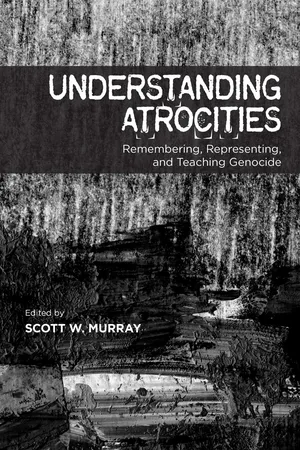
Understanding Atrocities is a wide-ranging collection of essays bridging scholarly and community-based efforts to understand and respond to the global, transhistorical problem of genocide. The essays in this volume investigate how evolving, contemporary views on mass atrocity frame and complicate the possibilities for the understanding and prevention of genocide. The contributors ask, among other things, what are the limits of the law, of history, of literature, and of education in understanding and representing genocidal violence? What are the challenges we face in teaching and learning about extreme events such as these, and how does the language we use contribute to or impair what can be taught and learned about genocide? Who gets to decide if it's genocide and who its victims are? And how does the demonization of perpetrators of atrocity prevent us from confronting the complicity of others, or of ourselves? Through a multi-focused and multidisciplinary investigation of these questions, Understanding Atrocities demonstrates the vibrancy and breadth of the contemporary state of genocide studies.With contributions by: Amarnath Amarasingam, Andrew R. Basso, Kristin Burnett, Lori Chambers, Laura Beth Cohen, Travis Hay, Steven Leonard Jacobs, Lorraine Markotic, Sarah Minslow, Donia Mounsef, Adam Muller, Scott W. Murray, Christopher Powell, and Raffi Sarkissian
- 296 pages
- English
- ePUB (mobile friendly)
- Available on iOS & Android
eBook - ePub
About this book
Information
Table of contents
- Contents
- List of Figures
- Acknowledgements
- Abbreviations
- Introduction
- Atrocity and Proto-Genocide in Sri Lanka
- Finding Global Justice Locally at Sites of Atrocity: The Case for the Srebrenica-Potočari Memorial Center and Cemetery
- Troubling History, Troubling Law: The Question of Indigenous Genocide in Canada
- The Benefits and Challenges of Genocide Education: A Case Study of the Armenian Genocide
- “We Charge Genocide”: A Historical Petition All but Forgotten and Unknown
- “A Tragedy to be Sure”: Heteropatriarchy, Historical Amnesia, and Housing Crises in Northern Ontario
- Remembering Them All: Including and Excluding Atrocity Crime Victims
- Helping Children Understand Atrocities: Developing and Implementing an Undergraduate Course Titled War and Genocide in Children’s Literature
- Thinking About Nazi Atrocities Without Thinking About Nazi Atrocities: Limited Thinking as Legacy in Schlink’s The Reader
- Atrocity, Banality, and Jouissance in Performance
- Contributors
- Index
Trusted by 375,005 students
Access to over 1.5 million titles for a fair monthly price.
Study more efficiently using our study tools.
Frequently asked questions
Yes, you can cancel anytime from the Subscription tab in your account settings on the Perlego website. Your subscription will stay active until the end of your current billing period. Learn how to cancel your subscription
No, books cannot be downloaded as external files, such as PDFs, for use outside of Perlego. However, you can download books within the Perlego app for offline reading on mobile or tablet. Learn how to download books offline
Perlego offers two plans: Essential and Complete
- Essential is ideal for learners and professionals who enjoy exploring a wide range of subjects. Access the Essential Library with 800,000+ trusted titles and best-sellers across business, personal growth, and the humanities. Includes unlimited reading time and Standard Read Aloud voice.
- Complete: Perfect for advanced learners and researchers needing full, unrestricted access. Unlock 1.5M+ books across hundreds of subjects, including academic and specialized titles. The Complete Plan also includes advanced features like Premium Read Aloud and Research Assistant.
We are an online textbook subscription service, where you can get access to an entire online library for less than the price of a single book per month. With over 1.5 million books across 990+ topics, we’ve got you covered! Learn about our mission
Look out for the read-aloud symbol on your next book to see if you can listen to it. The read-aloud tool reads text aloud for you, highlighting the text as it is being read. You can pause it, speed it up and slow it down. Learn more about Read Aloud
Yes! You can use the Perlego app on both iOS and Android devices to read anytime, anywhere — even offline. Perfect for commutes or when you’re on the go.
Please note we cannot support devices running on iOS 13 and Android 7 or earlier. Learn more about using the app
Please note we cannot support devices running on iOS 13 and Android 7 or earlier. Learn more about using the app
Yes, you can access Understanding Atrocities by Scott W. Murray in PDF and/or ePUB format, as well as other popular books in Politics & International Relations & History of Art. We have over 1.5 million books available in our catalogue for you to explore.