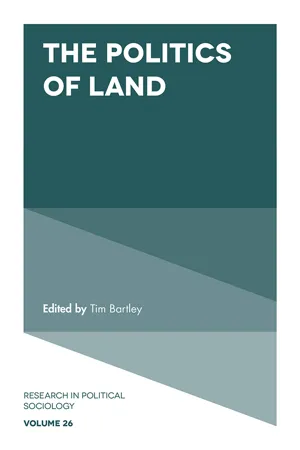
An introductory essay sketches foundations for a political sociology of land and specifies what is unique about land in comparison to other political objects. Chapters are based on highly original qualitative, quantitative, and/or historical analyses to shed light on numerous dimensions of land politics. They include analyses of anti-fracking campaigns, property tax caps, and "green gentrification" in the United States, soil protection regulation in Europe, squatter settlements in Peru, land grabs in peri-urban China and rural Senegal, violent expulsions in Colombia, and the privatization of property rights in Morocco. The volume brings together high quality, peer-reviewed research, opens up novel comparisons, and enriches theories of the state, commodification, and collective resistance.
- 255 pages
- English
- ePUB (mobile friendly)
- Available on iOS & Android
eBook - ePub
The Politics of Land
About this book
The politics of land are vital. They stretch from fights over fracking, gentrification, and taxation to land grabs, dispossession, and border conflicts. And they raise crucial questions about power, authority, violence, populism, and neoliberalism. This volume of Research in Political Sociology seeks to carve out a renewed political sociology of land, bringing together classic questions about the state, commodification, and social change and contemporary studies of contentious land use in various parts of the world.
Trusted by 375,005 students
Access to over 1.5 million titles for a fair monthly price.
Study more efficiently using our study tools.
Information
CAPACITIES
THE STATE’S UNINTENTIONAL PRODUCTION OF TURF-CONTROLLING NEIGHBORHOOD ELITES IN TWENTIETH CENTURY LIMA, PERU
ABSTRACT
Many neo-Weberians adopt the state’s authority-monopolizing aim as their theoretical expectation. Through a case study of the Peruvian state and Lima’s squatter settlements, I provide evidence in support of the opposite contention: that states may unintentionally produce non-state extractive-coercive organizations. During the mid- to late-twentieth century, Lima’s population grew rapidly. Since they had few economic resources, the new urban poor requisitioned public lands and set up dozens of squatter settlements in the city’s periphery. Other researchers have identified several novel political phenomena stemming from such urban conditions. I focus here on the impact of the state. Using secondary and primary data, I examine three periods during which the state applied distinct settlement policies and one in which it did not apply a settlement policy, from 1948 to 1980. I find that when it applied each of the settlement policies, the state produced non-state political authorities – neighborhood elites – who extracted resources from squatters and tried to control neighborhood turf even against state encroachment, and that the state’s non-involvement did not produce them.
Keywords Political sociology; the state; urban politics; squatters; non-state political authority; Peru
INTRODUCTION
Weber bequeathed us with an organizational conception of the state and indicated that these extractive-coercive organizations attempt to monopolize authority within a given territory ([1919] 1946, p. 78, 1978a, p. 54). Reactions have been myriad. Some researchers seek to deny that state organizations have such abilities, highlighting how bureaus and bureaucrats may be incapable or unwilling to toe the line (e.g., Gupta, 1995; Lipsky, 1980). Others grant the power of the state organization but deny that they can monopolize political authority over society, pointing to myriad exceptions to that hypothesis (e.g., Migdal, 1988; Scott, 1998). Meanwhile, an army of neo-Weberians adopt the organizational definition of the state and also take the state organization’s aims as their theoretical expectation.
In this analysis, I also adopt an organizational conception of the state, but I turn the neo-Weberian theoretical expectation on its head. Rather than monopolize political authority, the organization that we call a state may unintentionally generate other land-bound extractive-coercive organizations, not because society is strong enough to resist it or because bureau(crat)s disobey, but as an unintended consequence of the state’s society-shaping attempts themselves. Insistence on the importance of unintended consequences is far from novel to social theory. Insisting on their importance yet again, though, may help make room for an underappreciated kind of sociology of the state (cf. Kohli & Shue, 1994).
Mann (1984, 1993) elaborates the most prominent extension of Weberian state theory. He maintains that the locus of “infrastructural power” – the capacity to logistically implement decisions – shifts back and forth between the state and civil society, and tends to increase, over time. Accordingly, once a policy is adopted and applied, it may create constituencies who demand that it continue (Campbell, 2003, 2012; Pierson, 1993); such policy constituencies represent the state organization’s ability to create a following that applauds its (past) actions and may even prevent it from changing course in the future. In a similar vein, societal actors – such as “private attorneys general” (Novak, 2008, p. 769) or “progovernment militias” (Carey & Mitchell, 2017) – may do “the state’s job” for it. While such pro-state behavior may be surprising or unexpected to researchers, when considered in view of the state’s aims, they are not unintended.
In addition to theorizing infrastructural power, Mann appraised “despotic power”: the ability to compel obedience with no further questions asked. Whereas infrastructural power tended to increase over time (just as Weber thought the state tended to monopolize authority within a territory), Mann (1984, p. 192) observed no discernible over-time pattern with respect to despotic power. However, we may be justified in using Mann’s concepts to posit an additional hypothesis: state attempts to increase infrastructural power may (unintentionally) strengthen societal despotic powers. In what follows, I provide evidence in support of this non-Weberian contention. I show that, in the context of rapid and extensive urban growth, state organization attempts to shape squatter settlements from 1948 to 1980 in Lima, Peru, unintentionally generated neighborhood elites capable of extracting resources from residents based on their (attempted) control of turf.
Over the course of the twentieth century, Latin America saw “great internal migrations” (Germani, 1978, p. 36) in which rural inhabitants flocked to major cities, resulting in massive and unprecedented urban growth. Since they found few remunerative jobs, rather than buy homes, these new urban denizens requisitioned land and formed thousands of squatter settlements, known in Peru during these years as barriadas and pueblos jóvenes. A large literature tries to capture aspects of the phenomenon of overurbanization and the novel political practices and dynamics to which it gave rise. In her comparative research on Santiago, Bogotá, and Lima, Holland (2017) argues that state organizations tolerate the urban poor when they transgress legal codes because this bolsters politicians’ support. In his analysis of shantytown politics in Manila (which also experienced overurbanization), Garrido (2017) demonstrates how the urban poor may support populist leaders whose policies contravene their interests because they perceive them to be sincere. In his study of Menem-era Buenos Aires, Auyero (2000) studies the problem of political intermediation, especially the role of party brokers. Taking a bottom-up approach, his focus is mainly on how and why the urban poor support them. Here, I focus on a similar kind of political intermediaries, whom I call neighborhood elites. I assume the process of urban expansion is a mere background condition in order to train my attention on the role of the state in producing neighborhood elites.
In most squatter settlements throughout Latin America, some kind of neighborhood association was established in order to coordinate residents to resolve local problems and mediate between the new urban poor and the state organization. Many of the major case studies of Latin American urban politics find that such neighborhood associations and their leaders were or are central to the process of politically incorporating the new urban poor (e.g., Álvarez Rivadulla, 2017, Chapter 6; Auyero, 2000, Chapter 3; Azuela, 1989, pp. 85–86, 91, 94, 97–104, 112, 126–27; Castells, 1983, pp. 201; Cornelius, 1975, pp. 135–65, 182–97; de Sousa Santos, 1977, pp. 40–49, 89–90, 103; Dosh, 2010, passim; Eckstein, 1977, Chapter 3; Fischer, 2008, pp. 239–41, 246–52; Gay, 1994, passim; Karst, Schwartz, & Schwartz, 1973, Chapter 6; Ollivier, 2017, Chapter 3; Perlman, 1976, pp. 184–85; Ray, 1969, pp. 59–63, 68–70; Roberts, 1973, pp. 307–30). But for the most part, these works consider neighborhood associations in genetic isolation from the state organization. Ray (1969) and Cornelius (1975) consider them to be a traditional form of political authority grafted into the new urban context. Karst et al. (1973) and de Sousa Santos (1977) conceive of them as alternative legal authorities parallel to state judiciaries. Castells (1983) and Dosh (2010) see them as crucial actors in urban social movements. Gay (1994, pp. 35–60, 101–12) and Álvarez Rivadulla (2017, Chapter 6) show how they can be skillful opportunists who temporarily sell the urban poor’s political support to the politician or party who promises the most for the settlement.
I examine how state interventions into squatter settlements – viz., the application of settlement policies – unintentionally reinforced neighborhood association leaders’ power, making them neighborhood elites. As with other states in the region, successive Peruvian governments responded variously to the phenomenon of overurbanization, cycling through repression, remaining aloof, and trying to shape squatter settlements by applying settlement policies. The Peruvian governments that opted to apply a settlement policy unintentionally generated neighborhood elites, while those who opted for repression or to remain aloof did not. Neighborhood elites were powerful in that they were capable of extracting some resources from the community and of exerting partial control over settlement turf. Although their power never rivaled that of the Peruvian state organization, neighborhood elites did sometimes use their power to oppose it.
THE STATE AS REGIMES
Not all theories of states posit state organizations, much less ones that try to monopolize political authority. But for Weberians, state organizations do. Analogously, this analysis focuses on how such organizations unintentionally generated non-state political authorities. The literature suggests that state organizations manifest as at least three kinds of regimes – patrimonial, liberal, and corporatist – each of which is characterized by a distinct form of political intermediation. According to the neo-Weberian theoretical expectation of the state’s monopolization of political authority, these intermediaries are not supposed to become powers unto themselves.
Patrimonial regimes are based on informal and unequal relationships between political elites, who own and control the land and do not permit of formal-legal rights, and subordinates, who do not, therefore, enjoy such rights. These relationships are typically mediated by honoratiories (Weber, 1978b, pp. 1055–59) who, according to the patrimonial ruler, are supposed to remain his deputies, not become independent authorities. Viewed from the top-down, such arrangements are unencumbered by laws and binding checks and balances (Linz, 1970, p. 255; Weber, 1978b, p. 1006); viewed from the bottom-up, subjects are supposed to deliver rulers “personal, bodily fealty” (Anderson, 1974, p. 409).
Liberal regimes seek to protect or enhance the institution of private property. In Lockean fashion, they may thusly consecrate a mixture of labor and land. Scholars assert that such policies serve to preserve or promote the spontaneous emergence of third-sector organizations or spheres of sociability, which serve as a buffer between the state organization and individuals or families, to preempt the state organization’s domination (Kornhauser, 1959, pp. 62, 78, 123; Putnam, 1993, p. 167). As buffers, such organizations and spheres are not themselves supposed to be sources of political authority.
Corporatist regimes try to systematically integrate all societal interests (deemed worthy) into mutually exclusive, state-approved organizations in exchange for access to public resources (cf. Schmitter, 1974, pp. 93–94). Some assert that this is the foremost way to prevent conflicts between different sectors of society and between society and the state organization (Schmitter, 1981). Like patrimonialism, such regimes are not spontaneous, but rather organized from the top-down; but like liberalism, they try to take account of interests emanating from society so that parts of society do not turn against the regime.
In most of Latin America during the mid- to late-twentieth century, some kind of patrimonialism, some kind of liberalism, or some kind of corporatism obtained. In Peru, each kind of regime controlled the state organization in succession. Due to the context in which they exercised state power, they each produced unintended consequences. These regimes tried to monopolize political authority, to be sure, but they actually generated it. As a result of their interventions, their respective political intermediaries became non-state political authorities unto themselves: neighborhood elites.
NON-STATE POLITICAL AUTHORITY
Neighborhood elites are one kind among a universe of non-state political authorities. As prominent research has found with respect to US street gangs (Sánchez-Jankowski, 1991), the Sicilian mafia (Gambetta, 1993), Latin American guerrillas (Wickham-Crowley, 1987), and Afghani chieftains (Sinno, 2008), neighborhood elites at least...
Table of contents
- Cover
- Editorial Advisory Board
- Title Page
- Copyright Page
- Contents
- About the Authors
- Acknowledgments
- Introduction: Toward a Political Sociology of Land
- Part I Capacities
- Part II Coalitions
- Part III Classification
- Part IV Expulsions
- Index
Frequently asked questions
Yes, you can cancel anytime from the Subscription tab in your account settings on the Perlego website. Your subscription will stay active until the end of your current billing period. Learn how to cancel your subscription
No, books cannot be downloaded as external files, such as PDFs, for use outside of Perlego. However, you can download books within the Perlego app for offline reading on mobile or tablet. Learn how to download books offline
Perlego offers two plans: Essential and Complete
- Essential is ideal for learners and professionals who enjoy exploring a wide range of subjects. Access the Essential Library with 800,000+ trusted titles and best-sellers across business, personal growth, and the humanities. Includes unlimited reading time and Standard Read Aloud voice.
- Complete: Perfect for advanced learners and researchers needing full, unrestricted access. Unlock 1.5M+ books across hundreds of subjects, including academic and specialized titles. The Complete Plan also includes advanced features like Premium Read Aloud and Research Assistant.
We are an online textbook subscription service, where you can get access to an entire online library for less than the price of a single book per month. With over 1.5 million books across 990+ topics, we’ve got you covered! Learn about our mission
Look out for the read-aloud symbol on your next book to see if you can listen to it. The read-aloud tool reads text aloud for you, highlighting the text as it is being read. You can pause it, speed it up and slow it down. Learn more about Read Aloud
Yes! You can use the Perlego app on both iOS and Android devices to read anytime, anywhere — even offline. Perfect for commutes or when you’re on the go.
Please note we cannot support devices running on iOS 13 and Android 7 or earlier. Learn more about using the app
Please note we cannot support devices running on iOS 13 and Android 7 or earlier. Learn more about using the app
Yes, you can access The Politics of Land by Tim Bartley in PDF and/or ePUB format, as well as other popular books in Politica e relazioni internazionali & Politica ambientale ed energetica. We have over 1.5 million books available in our catalogue for you to explore.