Almost fifty years ago, in 1956, three researchers of the University of Zurich, Andrea Prader, Alexis Labhart and Heinrich Willi, first described what is now called the Prader-Willi Syndrome (PWS). The study and the therapy of this syndrome have progressed so rapidly in the past years that the decision was made to share recent advances with the scientific community and to address topics of future research at an international meeting. The results of this meeting are presented in this book. PWS results from a paternally derived deletion or an imprinting defect on chromosome 15. During their first two years of life patients with PWS suffer from muscle weakness, feeding problems and developmental delay. From the age of two years onwards they develop an almost insatiable appetite and suffer from obesity, short stature, hypogonadism and behavior problems. As it is becoming increasingly obvious that PWS is a multisystemic disorder, improving the quality of life of patients and their families requires broad professional support. While growth hormone therapy influences growth and body composition, many other problems such as insufficient satiation, hypoactivity, behavioral difficulties, speech problems and mental retardation remain to be addressed. Parents need psychological support in their daily battle against the eating disorder and the behavioral problems of their child. A comprehensive team approach will yield the best results for both patients and their parents. PWS research may also contribute to basic medical research by providing new insights into the metabolism of obese patients, whose obesity is caused by factors other than PWS. In this way, PWS may be used as a model for obesity.
eBook - PDF
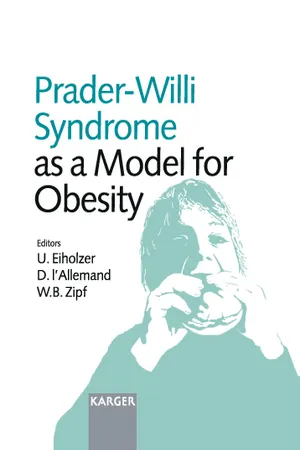
Prader-Willi Syndrome as a Model for Obesity
International Symposium, Zurich, October 2002
- 245 pages
- English
- PDF
- Available on iOS & Android
eBook - PDF
Prader-Willi Syndrome as a Model for Obesity
International Symposium, Zurich, October 2002
About this book
Information
Table of contents
- Contents
- Introduction
- Central Nervous System and Body Weight Homeostasis
- Energy Balance in Prader-Willi Syndrome Compared to Simple Obesity
- Comorbidities or Fundamental Defects of Obesity
- Comprehensive Treatment Approaches
- Epilogue
- Author Index
- Subject Index
Trusted by 375,005 students
Access to over 1.5 million titles for a fair monthly price.
Study more efficiently using our study tools.
Frequently asked questions
Yes, you can cancel anytime from the Subscription tab in your account settings on the Perlego website. Your subscription will stay active until the end of your current billing period. Learn how to cancel your subscription
No, books cannot be downloaded as external files, such as PDFs, for use outside of Perlego. However, you can download books within the Perlego app for offline reading on mobile or tablet. Learn how to download books offline
We are an online textbook subscription service, where you can get access to an entire online library for less than the price of a single book per month. With over 1.5 million books across 990+ topics, we’ve got you covered! Learn about our mission
Look out for the read-aloud symbol on your next book to see if you can listen to it. The read-aloud tool reads text aloud for you, highlighting the text as it is being read. You can pause it, speed it up and slow it down. Learn more about Read Aloud
Yes! You can use the Perlego app on both iOS and Android devices to read anytime, anywhere — even offline. Perfect for commutes or when you’re on the go.
Please note we cannot support devices running on iOS 13 and Android 7 or earlier. Learn more about using the app
Please note we cannot support devices running on iOS 13 and Android 7 or earlier. Learn more about using the app
Yes, you can access Prader-Willi Syndrome as a Model for Obesity by U. Eiholzer,D. l'Allemand,W. B. Zipf, Eiholzer, l'Allemand, Zipf in PDF and/or ePUB format, as well as other popular books in Medicina & Nutrición, dietética y bariatría. We have over 1.5 million books available in our catalogue for you to explore.