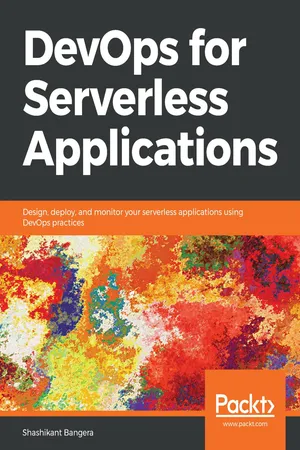
DevOps for Serverless Applications
Design, deploy, and monitor your serverless applications using DevOps practices
- 264 pages
- English
- ePUB (mobile friendly)
- Available on iOS & Android
DevOps for Serverless Applications
Design, deploy, and monitor your serverless applications using DevOps practices
About this book
Set up complete CI and CD pipelines for your serverless applications using DevOps principles
Key Features
- Understand various services for designing serverless architecture
- Build CD pipelines using various cloud providers for your serverless applications
- Implement DevOps best practices when building serverless applications
Book Description
Serverless applications are becoming very popular among developers and are generating a buzz in the tech market. Many organizations struggle with the effective implementation of DevOps with serverless applications. DevOps for Serverless Applications takes you through different DevOps-related scenarios to give you a solid foundation in serverless deployment.
You will start by understanding the concepts of serverless architecture and development, and why they are important. Then, you will get to grips with the DevOps ideology and gain an understanding of how it fits into the Serverless Framework. You'll cover deployment framework building and deployment with CI and CD pipelines for serverless applications. You will also explore log management and issue reporting in the serverless environment. In the concluding chapters, you will learn important security tips and best practices for secure pipeline management.
By the end of this book, you will be in a position to effectively build a complete CI and CD delivery pipeline with log management for serverless applications.
What you will learn
- Explore serverless fundamentals and effectively combine them with DevOps
- Set up CI and CD with AWS Lambda and other popular Serverless service providers with the help of the Serverless Framework
- Perform monitoring and logging with serverless applications
- Set up a dynamic dashboard for different service providers
- Discover best practices for applying DevOps to serverless architecture
- Understand use cases for different serverless architectures
Who this book is for
DevOps for Serverless Applications is for DevOps engineers, architects, or anyone interested in understanding the DevOps ideology in the serverless world. You will learn to use DevOps with serverless and apply continuous integration, continuous delivery, testing, logging, and monitoring with serverless.

Tools to learn more effectively

Saving Books

Keyword Search

Annotating Text

Listen to it instead
Information
Applying DevOps to AWS Lambda Applications
- Manual deployment of a Lambda function
- AWS Lambda with DevOps
- Serverless with CodeStar
- Blue and green deployment with AWS Lambda
- The GitHub and Jenkins pipeline using Serverless Framework
- Setting up Jenkins for a serverless application
- Unit testing a deployed application
- Integrating CloudWatch with ELK
Manual deployment of a Lambda function
https://portal.aws.amazon.com/billing/signup#/start
https://docs.aws.amazon.com/cli/latest/userguide/cli-chap-welcome.html
- Once the AWS account and CLIs are in place, sign in to AWS Console (https://aws.amazon.com/console/), and then we will create an IAM user with the name adminuser by logging into your AWS account then either clicking on the IAM link or searching for the link through the services:

- Then we click on the Users link on the left-hand side, where a new page will open. Then we click on Add User. Add a user with the name adminuser and select both the access type Programmatic access and AWS Management Console access. In the console's Password field, add your custom password, uncheck the Require password reset checkbox, and then click Next:Permissions. Let's create a group by clicking on the Create Group button. We will give the group the name of administrators. Next, let's select the AdminstrativeAccess checkbox to provide full access to the group and then click on Create Group. Now that we have a group created, let's click on Next:Review. Then, we will review the user, which the user have created and has been added to the administrator group. Now click on the Create User button. Once the user is created, we should be able to see the user in the list, as shown in the following screenshot:

- We need to create two buckets in AWS S3. The buckets need to be created through the adminuser login, so let's log in to AWS Console using the new user that we have created. Click on the adminuser and select the Security credentials tab. Next, let's copy the Console URL for logging in, then open it on the new browser tab. Feed in the username and password for the new user that we have created and click on Sign In. Once you are logged in, search for S3 in the AWS Services. Then go to S3 Console Management and click on the Create bucket button, as shown in the following screenshot:


- Once both the buckets are successfully created, we can upload an image for the Lambda function to resize and push to the resized bucket. Let's upload a JPG image into the my-source-bucket76 source. Click on the bucket name, then upload an image to this bucket. This will redirect you to the bucket page. Click on the Upload button and a popup will pop up. Then, select Add files to browse for an image file from the local directory and then upload the image to the S3 bucket.
- The next step is to create a Lambda function and run it manually. Here, we have to first follow three steps to create the deployment package, and then create the execution role (IAM role) and a Lambda function and test them. The deployment package is a ZIP file containing the Lambda function and its dependencies:
- Let's create a deployment package. I will be using Node.js as the language for this practice application, but we can use Java and Python as well (it depends on the developer's preference).
- A prerequisite for creating this deployment package is to ...
Table of contents
- Title Page
- Copyright and Credits
- Dedication
- Packt Upsell
- Contributors
- Preface
- Introducing Serverless
- Understanding Serverless Frameworks
- Applying DevOps to AWS Lambda Applications
- DevOps with Azure Functions
- Integrating DevOps with IBM OpenWhisk
- DevOps with Google Functions
- Adding DevOps Flavor to Kubeless
- Best Practices and the Future of DevOps with Serverless
- Use Cases and Add-Ons
- DevOps Trends with Serverless Functions
- Other Books You May Enjoy
Frequently asked questions
- Essential is ideal for learners and professionals who enjoy exploring a wide range of subjects. Access the Essential Library with 800,000+ trusted titles and best-sellers across business, personal growth, and the humanities. Includes unlimited reading time and Standard Read Aloud voice.
- Complete: Perfect for advanced learners and researchers needing full, unrestricted access. Unlock 1.4M+ books across hundreds of subjects, including academic and specialized titles. The Complete Plan also includes advanced features like Premium Read Aloud and Research Assistant.
Please note we cannot support devices running on iOS 13 and Android 7 or earlier. Learn more about using the app