eBook - ePub
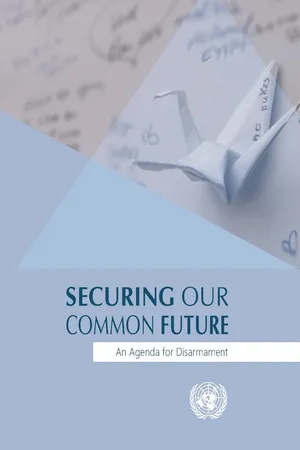
Securing Our Common Future
An Agenda for Disarmament
- 86 pages
- English
- ePUB (mobile friendly)
- Available on iOS & Android
eBook - ePub
About this book
The Secretary-General announced on 24 May 2018 his Agenda for Disarmament, which outlines a set of practical measures across the entire range of disarmament issues, including weapons of mass destruction, conventional arms and future weapon technologies. It seeks to generate fresh perspectives and to explore areas where serious dialogue is required to bring disarmament back to the heart of our common efforts for peace and security.
Information
Part I
THE NEED FOR A NEW DISARMAMENT AGENDA
Why we need disarmament in the 21st Century
The deteriorating international security environment
A NEW COLD WAR
We are on the brink of a new cold war. Unlike the first, which emerged from a world wearied from a devastating global conflict, the second has come during an era of converging global challenges, a more complex international system and diminishing respect for international norms and institutions. At this moment, global military spending and capabilities exceed those seen at any point since the fall of the Berlin Wall.
During the first cold war, major crises directly involving the super-powers centred on episodes of espionage, destabilizing deployments of strategic weapons and shifting spheres of influence. It was an extremely difficult period in our history with many tragic proxy wars and frightening moments. But, in response to near misses, accidents and the spiralling arms race, the powers actively pursued measures to prevent conflict, maintain stability and ease the military burden on their publics. Institutions were established and functioned. Negotiations and lines of communications flourished, even if the processes were often too slow and the results too modest.
The new cold war is increasingly marked by unrestrained arms competition, surreptitious interference in domestic political processes and the increasing pursuit of malicious and hostile acts just below traditional thresholds for the use of force. Multilateral disarmament negotiations have been deadlocked for more than two decades, and bilateral channels have been allowed to stagnate. Limits on major conventional forces have been left aside. No measures are in place to prevent rapid escalation resulting from strategic threats in new domains, including cyberspace and outer space.
INCREASING COMPLEXITY OF INTRA-STATE AND REGIONAL CONFLICT
The re-emergence of strategic tension between the major powers is taking place against a resurgence of civil conflict, after more than two decades of decline. Today’s armed conflicts are more protracted, more lethal for civilians and more prone to regional rivalries and external intervention, including by major powers. They involve a multitude of actors with various motives and means of violence, including low-level insurgents, extremists and terrorists, criminal organizations, well-trained militias and every possible combination of these. Many situations of conflict thus blur the boundaries between violent organized crime, terrorism, and internal and international armed conflict. In all circumstances, the excessive accumulation of arms and inadequate control over their circulation fuel violence.
What these complex conflicts have in common is their increasingly urban nature, the massive loss of civilian life and the destruction of civilian infrastructure. Humanitarian crises are their inevitable result. Armed conflicts are now deadlier for civilians, and the annual number of civilian casualties attributed to armed conflict is at its highest levels in many decades.
A MORE COMPLEX WORLD ORDER
Influence within the international system and the institutions devoted to disarmament were dominated by a bipolar world order for many years. This has changed since the end of the last cold war. The new cold war is not just a matter of relations between two countries, or a clash between incompatible ideologies.
The international system is becoming more multipolar. This entails multiple spheres of power and influence, a growing multiplicity of interests, conflicts and asymmetries. The resulting lack of clarity in power relations has led increasingly to greater unpredictability, fragmentation and at times unilateralism. The diffusion of power results in a multiplicity of regional arms races. Added to this is the increase in the range of significant non-State actors, from the private sector to foundations, which exercise more and more influence over decision-making processes.
This new reality challenges multilateral decision-making and consensus-building. Once, agreement between two powers could serve as the basis for a universal agreement. Today, international governance and decision-making have become more complex as the relative influence of other powers has grown. Consensus has become more elusive, leading to increasing majoritarianism to overcome persistent paralysis. Our disarmament and international security institutions have not kept up with this change, and remain hobbled by archaic rules and practices designed for a simpler time.
THE HUMAN AND ECONOMIC COST OF MILITARIZATION
Increasing militarization is evident in many parts of the world. Global military spending has more than doubled in inflation-adjusted dollars since the end of the cold war. International transfers of major weapons have steadily climbed since the early 2000s. Unrestrained military modernization, procurement and spending is creating distrust, worsening tensions and making peaceful resolutions to conflict harder to achieve.
The economic costs of insecurity are enormous. A 2017 study found that 12.6 per cent of the gross world product was devoted to containing all forms of violence. More than $1.7 trillion was spent on militaries and their equipment. This is vastly disproportionate with contemporary sources of national and human insecurity, which include climate change, terrorism, transnational crime, pandemics, involuntary migration and urban crime and violence. Not only is much of this spending economically unproductive, but excessive military spending by one nation also multiplies throughout the international system, prompting excessive spending elsewhere.
INCREASING RISKS FROM NEW WEAPON TECHNOLOGIES
Scientific and technological advances are diversifying the means and methods of warfare and the ability of non-State actors to carry out attacks, including across international boundaries. While the impacts of armed conflict continue to be largely due to centuries-old technology— namely, bombs and bullets—novel weapon concepts are rapidly emerging. Scientific and technological developments are also creating new risks relating to old technology, lowering barriers to access and opening new potential domains for conflict.
The accelerating development of new weapon technologies is not bad per se. Greater precision and access to timely data can help mitigate harmful impact and protect lives. However, many new weapon technologies raise concerns across a number of interrelated areas.
Current developments have raised serious questions for the maintenance of international peace and security, the upholding of humanitarian principles, the protection of civilians, and the preservation of human, social, political and economic rights. In some cases, our existing international normative, institutional and policy frameworks are sufficient to address these concerns. In others, stronger cooperation, new approaches and better understanding are required.
ERODING RESPECT FOR INTERNATIONAL NORMS AND INSTITUTIONS
Eroding respect for international norms is weakening our international political, security and economic institutions. Many of the fundamental principles developed over the past century to preserve the peace and to safeguard humanity are under strain.
Morally repugnant weapons, long condemned by the conscience of humankind, have been repeatedly used on the battlefield and against civilian populations, as evidenced by the use of chemical weapons in the Syrian Arab Republic. Civilians and the infrastructure they rely upon, including schools and hospitals, have been made the object of attack. Principles, such as distinction and proportionality, developed to protect civilians from the same horrors that befell hundreds of cities during the Second World War are neglected or flouted today. Arms control agreements have been abandoned or disrupted.
Increasingly, our multilateral institutions are under threat. Some countries have resorted to the use of force unilaterally, both when it served their interests and when our international institutions have failed to live up to their responsibilities. Some are increasingly sceptical about multilateralism and seem to prefer isolationism and protectionism.
Each of these developments is a challenge to the principles and purposes of the United Nations, and to the system of collective security created after the Second World War. But these challenges also provide clear indications and opportunities of where we need to redouble our efforts to strengthen the implementation of our collective norms.
LONG-STANDING COMMITMENTS ARE UNFULFILLED
Within this deteriorating international security environment, some major military powers appear to be sceptical of the proven value of engagement, dialogue and negotiations as the best pathway to achieve security. The implementation of internationally agreed obligations are now decades overdue. Negotiations on strategic arms control are stalled and existing instruments are increasingly imperilled. In light of the complexity and rapid development of the new security challenges we face, this is precisely the wrong course.
Progress in disarmament is not an abstract game of numbers. Reductions of inherently dangerous weapons are always important and welcome. But action in disarmament must be understood as a central means for addressing today’s sources of insecurity and violence.
Continued stagnation in the disarmament process will only make the international situation more dangerous. It will increase strains on our existing security institutions, non-proliferation architecture and normative frameworks. The United Nations continues to be the only universal platform to promote and ensure peace and security for all, and the fulfilment of commitments by all States is essential in preserving public trust in its ability to deliver.
Why the United Nations pursues disarmament
Disarmament is at the heart of the system of collective security set out in the United Nations Charter. The purpose of this system was nothing less than the elimination of war as an instrument of foreign policy “to save succeeding generations from the scourge of war”.
This is not a simplistic or utopian vision. The Charter is neither a pacifist document nor an instrument designed ...
Table of contents
- Securing Our Common Future: An Agenda for Disarmament
- Title
- Copyright
- Contents
- Foreword
- Executive summary
- Part I: The Need for a New Disarmament Agenda
- Part II: Disarmament to Save Humanity
- Part III: Disarmament that Saves Lives
- Part IV: Disarmament for Future Generations
- Part V: Strengthening Partnerships for Disarmament
- The Way Forward
Trusted by 375,005 students
Access to over 1.5 million titles for a fair monthly price.
Study more efficiently using our study tools.
Frequently asked questions
Yes, you can cancel anytime from the Subscription tab in your account settings on the Perlego website. Your subscription will stay active until the end of your current billing period. Learn how to cancel your subscription
No, books cannot be downloaded as external files, such as PDFs, for use outside of Perlego. However, you can download books within the Perlego app for offline reading on mobile or tablet. Learn how to download books offline
Perlego offers two plans: Essential and Complete
- Essential is ideal for learners and professionals who enjoy exploring a wide range of subjects. Access the Essential Library with 800,000+ trusted titles and best-sellers across business, personal growth, and the humanities. Includes unlimited reading time and Standard Read Aloud voice.
- Complete: Perfect for advanced learners and researchers needing full, unrestricted access. Unlock 1.5M+ books across hundreds of subjects, including academic and specialized titles. The Complete Plan also includes advanced features like Premium Read Aloud and Research Assistant.
We are an online textbook subscription service, where you can get access to an entire online library for less than the price of a single book per month. With over 1.5 million books across 990+ topics, we’ve got you covered! Learn about our mission
Look out for the read-aloud symbol on your next book to see if you can listen to it. The read-aloud tool reads text aloud for you, highlighting the text as it is being read. You can pause it, speed it up and slow it down. Learn more about Read Aloud
Yes! You can use the Perlego app on both iOS and Android devices to read anytime, anywhere — even offline. Perfect for commutes or when you’re on the go.
Please note we cannot support devices running on iOS 13 and Android 7 or earlier. Learn more about using the app
Please note we cannot support devices running on iOS 13 and Android 7 or earlier. Learn more about using the app
Yes, you can access Securing Our Common Future by United Nations Office for Disarmament Affairs in PDF and/or ePUB format, as well as other popular books in Politics & International Relations & Arms Control. We have over 1.5 million books available in our catalogue for you to explore.