Managers working in today's organizations often focus more on results than on the people who achieve those results. But regularly evaluating the performance of your employees is critical to improving the efficiency and output of your organization. Performance reviews have changed significantly in the past few years. Companies today are looking for the key characteristics, known as competencies, that help the most successful people in their field to be so successful. Managers and employees need to focus on those competencies, especially during performance review discussions. Competency-Based Performance Reviews offers you a new and more effective way to handle performance reviews and to coach your employees to emphasize the knowledge, skills, and abilities that they have and the organization needs. Most sophisticated U.S. and international employers are using competency-based systems to select, interview, and evaluate the performance of employees. Fortune 500 corporations such as American Express, Anheuser Busch, Coca-Cola, Disney, Federal Express, IBM, Johnson & Johnson, and Pfizer are all looking for specific competencies. This book will give you the guidance you need to: — Perform competency-based reviews on your employees. — Help your team get the recognition they deserve in division meetings by providing the evidence to justify higher performance rankings. — Develop your own competencies—and those of your employees. — Coach employees to recognize competency-based accomplishments and advocate for themselves throughout the year. — Write smarter, targeted competency-based accomplishment statements to use on performance review forms. By putting these competency-based performance reviews into practice, managers can strengthen their organziations, their careers, as well as the careers of their employees. Competency-Based Performance Reviews includes sample phrases to use on reviews, as well as sample accomplishment statements to guide employees to improving and writing their own.
eBook - ePub
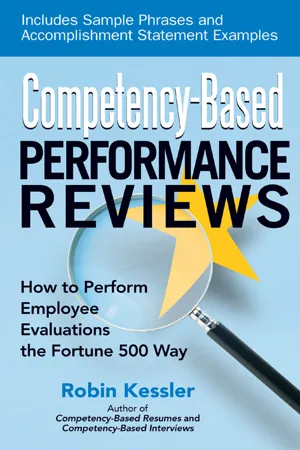
Competency-Based Performance Reviews
How to Perform Employee Evaluations the Fortune 500 Way
- 256 pages
- English
- ePUB (mobile friendly)
- Available on iOS & Android
eBook - ePub
Competency-Based Performance Reviews
How to Perform Employee Evaluations the Fortune 500 Way
About this book
Information
Chapter 1
Understand the Basics of Competency-Based Performance Reviews
Look before, or you’ll find yourself behind.
—Benjamin Franklin
Benjamin Franklin, one of the most talented of the Founding Fathers of the United States, was known as an author, scientist, inventor, politician, printer, political theorist, diplomat, and civic activist. To be as successful as he was, he clearly followed his own advice to really see the opportunities in front of him. Learning how to make competency-based performance reviews work more effectively for you and your team is one of those opportunities.
Why are more organizations using competency-based performance reviews? Competency-based performance reviews are being used more today because they have the potential to help employees focus on achieving their goals in a way that is consistent with the values of their organization. When employees achieve their goals, their organization is more successful. In addition, more organizations are recognizing that managing and developing their employees, or their talent, is more critical than ever before because they are facing a shortage of talented, qualified people.
In 1998, McKinsey & Company consultants published a report called “The War for Talent,” which said that the demand for “smart, sophisticated businesspeople who are technologically literate, globally astute, and operationally agile” would be increasing in the next 20 years at the same time that supply would be decreasing.1
Almost 10 years later, we are clearly seeing significant shortages in engineering, nursing, pharmacy professionals, and many, many other areas. Engineers, geologists, and geophysicists are currently being asked to come out of retirement to work in the oil industry, which does not have enough talent to manage today’s increased workload.
The first Baby Boomers are retiring, with fewer people from Generation X and Generation Y (Millennials) to replace them. In addition, there’s reason to be concerned about the impact of losing more potential talent with deaths and injuries caused by the wars in Iraq and Afghanistan, bombs in the Middle East, civil wars, disease, and unrest worldwide. The demand for the best people, which will always be extremely competitive, is clearly growing internationally, as organizations in countries such as China and India become more technologically advanced, and wealthy enough to pay a higher price for talent.
With the U.S. unemployment rate low, at 4.7 percent (as of November 2007), and the Baby Boom generation heading into retirement, employers from Microsoft Corp. to rural hospitals are worrying about finding enough workers.2 To be more successful and competitive now and in the future, the best organizations are recognizing the situation and putting more effort into attracting and retaining the right people.
Talent Management
Many progressive organizations use the term talent management to describe how they acquire, assess, and develop the people, or talent, in their organizations. Assessing and developing talent in today’s organizations usually includes:

Each element of talent management is important to help organizations attract and retain the people they need to be successful. Some organizations use 360-degree feedback to help provide information from managers, employees, coworkers, customers, and clients to develop their employees, and by others as a key part of their assessment process. Organizations also use the 360-feedback tool to help with succession planning.
Bruce Baehl, human resources manager for Republic National Distributing Company, the second largest U.S. premium wine and spirits distributor, said that 360s are extremely powerful to work with.3 He believes that they are the most effective when they are used as a way to coach and develop employees. He also talked about seeing employees get anxious when they believe 360s are used for other purposes in addition to employee development or performance reviews, and that helping the employees see the value of feedback can be rewarding for them.
Clearly, if you want your employees to trust the process, your organization needs to communicate the purpose of the 360-degree feedback process, and let them know if the results will be considered in determining who may leave the organization in a future downsizing.
The 360-degree feedback is important in the talent management system in most organizations. In this book, we are going to focus primarily on competency-based performance reviews, which can include feedback from others, using a 360 tool, in addition to assessment by the direct managers. In the remainder of this chapter, I’ll explain the most common performance management systems, and then show you some examples of forms from major employers.
The Performance Management Cycle
In their classic book on competencies, Competence at Work, Lyle Spencer and Signe Spencer define a performance-management system as the cycle of managers working with subordinates to:
1. Plan Performance. Define job responsibilities and expectations, and set goals or objectives for a performance period.
2. Coach/Manage. Offer feedback and support, and reinforce development throughout the performance period.
3. Appraise Performance. Formally evaluate performance at the end of the appraisal period.4
The University of California, Berkeley, has a good example of their performance-management cycle, shown in the graphic on page 23.
Notice how similar their three phases—Planning, Check-In, and Assessment—are to the definition provided by Lyle Spencer and Signe Spencer.
Some organizations use a broader definition, which includes how individua...
Table of contents
- Cover Page
- Title page
- Copyright page
- Dedication
- Contents
- Introduction
- Chapter 1 Understand the Basics of Competency-Based Performance Reviews
- Chapter 2 Get Ready for Better Competency-Based Performance Reviews
- Chapter 3 Coach Your Employees Toward Better Performance Reviews
- Chapter 4 Think Differently to Improve Your Coaching
- Chapter 5 Encourage Your Employees to Write Competency-Based Accomplishment Statements
- Chapter 6 Write Strong and Effective 113 Competency-Based Performance Appraisals
- Chapter 7 Set Better Goals and Develop Your Employees
- Chapter 8 Prepare for Better Competency-Based 135 Performance Review Discussions
- Chapter 9 Understand the Legal Issues With Performance Appraisal
- Chapter 10 Manage Different Personalities Toward Better Performance
- Chapter 11 Learn From Competency-Based Performancek Review Case Studies
- Chapter 12 Actively Manage Competency-Based Careers
- Appendix A Examples of Competency-Based Behavioral Questions
- Appendix B Competencies With Competency-Based Accomplishment Statements
- Appendix C State of Michigan Behaviorally Anchored Rating Scales
- Appendix D Improving Advocacy and Inquiry
- Appendix E Selected Legal Principles Relating to Performance Appraisals
- Appendix F Selected U.S. Laws Relating to Performance Appraisals
- Appendix G Common Appraisal Errors
- Notes
- Bibliography
- Index
- About the Author
Trusted by 375,005 students
Access to over 1.5 million titles for a fair monthly price.
Study more efficiently using our study tools.
Frequently asked questions
Yes, you can cancel anytime from the Subscription tab in your account settings on the Perlego website. Your subscription will stay active until the end of your current billing period. Learn how to cancel your subscription
No, books cannot be downloaded as external files, such as PDFs, for use outside of Perlego. However, you can download books within the Perlego app for offline reading on mobile or tablet. Learn how to download books offline
We are an online textbook subscription service, where you can get access to an entire online library for less than the price of a single book per month. With over 1.5 million books across 990+ topics, we’ve got you covered! Learn about our mission
Look out for the read-aloud symbol on your next book to see if you can listen to it. The read-aloud tool reads text aloud for you, highlighting the text as it is being read. You can pause it, speed it up and slow it down. Learn more about Read Aloud
Yes! You can use the Perlego app on both iOS and Android devices to read anytime, anywhere — even offline. Perfect for commutes or when you’re on the go.
Please note we cannot support devices running on iOS 13 and Android 7 or earlier. Learn more about using the app
Please note we cannot support devices running on iOS 13 and Android 7 or earlier. Learn more about using the app
Yes, you can access Competency-Based Performance Reviews by Robin Kessler in PDF and/or ePUB format, as well as other popular books in Business & Gestione delle risorse umane. We have over 1.5 million books available in our catalogue for you to explore.