![]()
PART I
AT TRUST, INC., YOU DON’T
NEED PERMISSION TO...
You cannot get through a single day without having an impact on the world around you. What you do makes a difference, and you have to decide what kind of difference you want to make.
~ Jane Goodall
![]()
CHAPTER 1
Create Your Trust-Pocket
If your actions inspire others to dream more, learn more, do more, and become more, you are a leader.
~ John Quincy Adams
Ebenezer Scrooge is not a typical model for leaders, but he’s a good place to start. Working in his establishment would be the antithesis of a thriving, winning trust-pocket. Still, as self-serving and stone-hearted as Dickens’s character appears, he did get a few things right. Scrooge didn’t profess that Bob Cratchit was his most important asset, or suggest that if Bob worked harder he’d be rewarded. He didn’t claim they were in it together, or that they were both suffering in economic downtimes. Ebenezer Scrooge rendered no unkept promises, offered no dangling carrots, and established no expectations that if deadlines were met, quarterly goals were achieved, or problems were solved, Bob would be rewarded, help would arrive, work-family balance would be restored, or working conditions would improve.
Of course, I’m not suggesting Scrooge’s despicable management style is to be emulated, but our own nightmares await if work trust is not rebuilt. And for those who lead groups, manage teams, or run businesses, there are three insights worth learning from Ebenezer:
1. What Scrooge said and did were in alignment. What plagues work cultures 150 years after Scrooge’s time is our misalignment. What bosses say and what they do are frequently disconnected, fueling distrust, disengagement, and discontent. Most bosses don’t pause long enough to consider their actions through staff lenses, or perceive the unintended consequences occurring when their words and actions differ. But they need to.
2. Scrooge was who he professed to be. No insincere caring. No hollow praise. No hypocrisy. Bob Cratchit understood Scrooge’s management style completely. Today, people still want bosses to be who they profess they are and show up consistently. How else can they judge their boss as good-hearted or manipulating, friend or foe, enabler or scammer? Of course, in this Knowledge Age, the work itself has changed, and people don’t offer today’s golden eggs to Scrooge-like bosses.
3. Scrooge accepted feedback, made self-adjustments, and changed. The transformation of Ebenezer Scrooge from self-serving boss to enlightened man is more harrowing than most workplace “Aha!” moments. And it’s more instant than building authentic trust. But openness to transforming our ways is as powerful today as it was then. And operating with trust currency is transformational for people and results.
If you choose to create your own Trust, Inc. (your thriving trust-pocket) you’ll discover, as did Scrooge, that new ways bring brighter days—in your case, a path of positive impact, with rewards that include genuine relationships, personal growth, and exceptional results, as well as more opportunities, low attrition, and higher well-being.
This chapter offers the basics. Consider it the equivalent of Scrooge’s visitations by the ghosts of the past, present, and future: By the end, he knew what he wanted to do; hopefully, you will too. Here’s your first glimpse of your future:
Trust, Inc. \ noun. \ 1. A thriving pocket of trust (a.k.a. trust-pocket) where passion, engagement, innovation, and great work flourishes. 2. A place where trust currency is made. 3. A work group, requiring no formal approval or permission, that enables authentic trust. 4. A self-created winning culture led by a trusted boss. 5. A business culture operating with sustainable trust currency that regularly pays dividends.
OPERATE WITH TRUST AS A VERB
There are two kinds of people at work: those who function with trust only as a noun (a belief, condition, or state), and those who operate with trust as a verb (the action of making or giving) and a noun (a medium of relationship exchange). Noun people tend to make decisions similar to one of Marissa Mayer’s, CEO of Yahoo: She decided to eliminate “elsewhere” work, requiring everyone to work in the office, giving the perception that Yahoo employees can’t be trusted. To noun people trust means the “reliance on another party (i.e. person, group, or organization) under a condition of risk.”1 So in times of risk, they use strategies in which control trumps trust.
Those who get great results in the new workplace operate with trust as a verb. They understand that trust begets trust. Behavioral scientists at the University of Zurich have confirmed experimentally that “if you trust people, you make them more trustworthy.” And, conversely, “sanctions designed to deter people from cheating actually make them cheat.”2 Whether people work in the office or somewhere else, there are always a few who will exploit the system, but noun people fail to realize that withholding trust reduces the exact behaviors they want and need.
Those who build trust-pockets are verb people. As authors Robert Solomon and Fernando Flores crystallize in their book, Building Trust in Business, Politics, Relationships, and Life, “Trust isn’t something we have, or a medium or an atmosphere within which we operate. Trust is something we do, something we make.”3
Authentic trust (defined in the Introduction) is essential to trust-pockets. Authentic trust is about the relationship and what it takes to create, build, and maintain mutually beneficial working relationships. Authentic trust isn’t a belief about reliability or dependability, nor glue that “makes things possible.” Rather, it’s an active process of relationship building. People who want to enable engagement, innovation, creativity, and great work give authentic trust.
The Making of Trust Currency
You can pay for someone’s time at work, and people will show up and do what they need to do. But you can’t suction ideas, discretionary efforts, and innovative solutions from their minds. That’s where trust currency comes in. It creates the medium of exchange in your trust-pocket.
As a Trust, Inc. leader you need people’s “golden eggs” freely given. Your staff wants things from you too, such as flexibility, meaningful work, personal development, and a culture in which they can show up and do great work. When you make trust currency by giving authentic trust, you render possible what you want and what they want, creating a culture of reciprocity and mutual support. That winning culture is fueled by the exchange of trust, a.k.a. trust currency.
trust currency \ noun. \ 1. Generated by authentic trust; requires ongoing production. 2. Creates the medium of exchange in workplaces for competitive necessities leaders can’t buy with just a paycheck; e.g. intellectual property, discretionary efforts, ideas, innovation, engagement, accountability, commitment. 3. Creates medium of exchange for staff-desired outcomes; e.g. flexibility, creativity, meaningful work, well-being, contribution, learning and personal development, self-motivation. 4. Fuels winning cultures; increases reciprocity and mutual support. 5. Provides tangible and intangible results and relationship dividends.
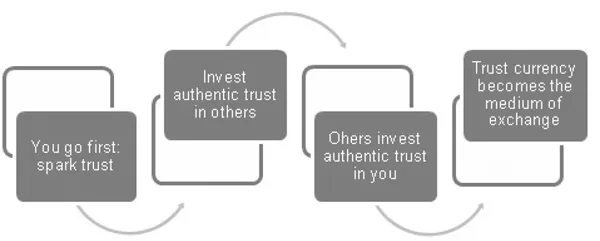
How to make authentic trust, and its resulting trust currency, is the topic of Chapter 6. But, bottom line—you’re the catalyst. As the leader of Trust, Inc., you start the process. Trust starts because you give it. Trust currency is generated as you continue to incrementally give authentic trust, in exchange for things given back to you. It’s not a blank check or an on-off switch, but it is created by specific actions, behaviors, and mutual accountability. Think of investing authentic trust in others and getting dividends in return. Here’s how it works:
REFLECTIVE EXERCISE
You Can See Trust
To start your thinking about behaviors that impact the making of trust currency, consider the 10 behaviors below. Check those that are part of your regular operating style.
You influence more by your actions than your words. You operate as the message, not the messenger, with an alignment between your words and actions.
You’re self-aware. You recognize the impact of your beliefs and actions on others, and are tuned in to others’ needs, strengths, and perspectives.
You give trust first. You realize trust evolves incrementally over time, and the way to start or rebuild trust is to give it in evolving stages.
You use trust-elevating communication techniques. You own your message, actions, and mistakes, and authentically show up in the process.
You bring the best of who you are to your work. You operate from a “best of self” core with characteristics like kindness, compassion, love, tolerance, and integrity.
You want the best for others. You aren’t playing a game in which only one or two people win and the rest don’t. You help make the pie bigger for everyone.
You tell considered stories. You understand that the stories you tell at work are impactful and you choose stories that positively influence the culture and those in it.
You operate with dependable politics. You get things done the right way, with ethics, integrity, and positive intention that builds relationships.
You collaborate, cooperate, consider, and contribute. You value relationships and build lasting ones not only by what you do, but also by how you do it.
You demonstrate competence as your starting point. You do what you say you can and will do, you do it well, and you assist others along the way.
Self-scoring: Consider this your Scrooge-equivalent of glimpsing your present. If you checked 8 or more, you can feel confident you’re using behaviors that will help you with the creation of trust currency. If 7 or less, you’ll find plenty of tips and how-tos in future chapters to increase your probability of producing the trust currency you need.
The bottom line is this: People don’t give their ideas, discretionary efforts, enthusiasm, or best work to people they don’t trust. Be the person they give their trust to and you’ll harness trust-power in your work group—power to enlist the energy, talents, and gifts of individuals, to build teams, and to achieve amazing results.
WINNING TRUMPS WIN
There are two dominant work cultures in organizations: winning cultures and win cultures. Winning cultures operate with trust currency. They’re founded on authentic trust, and fueled by five essentials for sparking and building trust (detailed in Part II). Winning cultures are work environments where passionate people share their talents, collaborate on ideas, go above and beyond, assist the greater whole, and do great work. They’re high-performing and high-energy cultures, where people are engaged contributors. A winning culture is what Trust, Inc. leaders work to create.
winning culture \ noun. \ 1. A place, founded on authentic trust, where people can offer the best of who they are. 2. An environment that fosters and enables trusting relationships, collaboration, teamwork, engagement, integrity, ethics, authenticity, innovation, communication, and great work. 3. A work climate operating with winning at working approaches, a winning philosophy, and organizational values.
By contrast, win cultures lack authentic trust or withhold trust. Fueled by top-down, leader-dictated approaches, getting t...