Ensuring access to affordable, reliable, and sustainable energy is one of the Sustainable Development Goals of the United Nations. Sustainable energy access planning (SEAP) plays a vital role when it comes to ensuring energy access for poor households particularly in Nepal's Pyuthan district. SEAP identifies the needed resources and investments for sustainable energy in the district. This case study, supported by the Asian Development Bank, presents the application of a SEAP framework for developing cost-effective energy plans for Pyuthan district. It also highlights the benefits of access to cleaner energy in terms of social well-being, reduction in the emission of local pollutants and greenhouse gas, and reducing energy inequality.
- 290 pages
- English
- ePUB (mobile friendly)
- Available on iOS & Android
eBook - ePub
About this book
Information
1 Introduction
1.1 Background
Cleaner energy access greatly influences the socioeconomic development of society and country.
The provision of modern fuels for household cooking, electricity for lighting, and energy for running rural industries and microenterprises increases the opportunities for rural people to improve quality of life, productivity, and income generation potential.
In a mountainous country like Nepal, the energy requirement for different energy needs increases with an increase in altitude. As a consequence, cost also increases.
Nepal is one of least developed countries in Asia with per capita gross domestic product in 2016 at $729.5 at current prices (World Bank 2017a). With a Human Development Index of 0.558, Nepal is ranked 144 among 188 countries (UNDP 2016).
More than 81% of the population live in rural areas, where around 25.2% of the population live below the national poverty line (World Bank 2017b and ADB 2017).
Out of the total population, 76% have access to electricity (IEA 2016). Around 97% of the population have access to electricity in the urban area, while 72% have electricity supply in the rural areas (IEA 2016).
In Nepal, 67% of the population are deprived of clean cooking facilities. The main sources of energy in Nepal is traditional biomass including fuelwood accounting for around 80% of total energy consumption (WECS 2014). The total energy consumption of Nepal was 376.3 million gigajoule in Fiscal Year 2011/2012 (WECS 2014). More than 78% of the cooking energy demand in the country is met by fuelwood. Biomass use in traditional cookstoves account for 67% of the total energy consumption of the country.
Pyuthan is one of the economically poor districts of Nepal. As is the case of Nepal as a whole, energy use pattern in the district relies heavily on conventional energies, mostly fuelwood.
Fuelwood accounts for more than 92% of the energy consumption in the residential sector of Pyuthan, followed by agricultural residue (5%). Although the energy resources are abundant, the potential have not been utilized yet (DDC 2012). Only a few of the village development committees (VDCs) have access to microhydro plants and other renewable energy technologies.1 Out of the total households, 28% do not have access to electricity. The “district energy situation report” of Pyuthan said that only 29% of the households are facilitated by electricity supplied from the grid.
The purpose of this study is to analyze the present condition of electrification and energy use scenario in Pyuthan district. The study also aimed to carry out a comprehensive assessment of the options for the provision of sustainable access to cleaner energy services to households in Pyuthan district.
The present case study is a part of the sustainable energy access activity under the Asian Development Bank regional technical assistance program “Enhancing Knowledge on Climate Technology and Financing Mechanisms” to assess the sustainability, cost-effectiveness, and affordability of different options to provide access to cleaner energy at targeted levels at a community and district level and applies the recently developed sustainable energy access planning framework developed under the program.2
1.2 Objectives of the Study
The main objective of this study is to determine sustainable, cost-effective, and climate friendly options to supply energy to the people in individual VDCs and the Pyuthan district as a whole. The specific objectives of the study are:
(i) to assess the present and future levels of total demand for electricity and cleaner energy associated with the different target levels of energy access of the poor households;
(ii) to assess the present and future energy demands of nonpoor households;
(iii) to determine cost-effective clean energy options, taking into consideration spatial distribution of households, local energy resources as well as proximity of the area to the grid connection in case of electricity access;
(iv) to assess financial implications and affordability of poor households to the most cost-effective cleaner energy access options;
(v) to analyze the sustainability of clean energy options to ensure quality and sustainability of the energy access program at the local level; and
(vi) to generate information on the investment required and evaluate benefits of the energy access program in terms of improvement in social well-being, reduction in local level emissions and greenhouse gas, and minimizing energy inequality.
1.3 Plan of the Report
This report consists of 12 chapters. Chapter 2 presents the methodological framework and information on data used in the analysis. Chapter 3 discusses the demographics and energy access status in the district as well as the residential sector energy consumption obtained through field survey. Chapter 4 presents the potential availability of energy resources in the Pyuthan district. Chapter 5 discusses the level of energy poverty in each VDC in the district.
An assessment of the demand of energy or energy services in each VDC of the district is presented in Chapter 6, while an assessment of sustainability of different energy access options is discussed in Chapter 7. Chapters 8 provides information on the additional power generation capacity requirement, its associated total cost, additional investment requirement, and incremental energy access cost of providing access to electricity.
Chapter 9 discusses the cost implications of various cleaner cooking technologies and associated incremental energy access costs for providing access to clean cooking in Pyuthan district.
Different kinds of benefits associated with an access to cleaner energy in the district were analyzed in Chapter 10, while an assessment of the affordability of the poor and other households to electricity and modern cooking options is presented in Chapter 11. Chapter 12 presents the insights and implications for energy access program development and implementation.
2 Methodology and Data
This chapter presents the brief methodological framework and information about the data sources used in this study.
2.1 Methodology
Providing energy access to any particular area or community requires knowledge of the number of households deprived of electricity and level of usage of cleaner forms of fuel for household end use services.
To provide energy access, information about the level of energy poverty, basic minimum energy required, and a comprehensive energy demand assessment of both energy-poor and non-energy-poor households are required.
To provide sustainable energy service access to all, one has to identify economical resources and technology options to be deployed.
Most importantly, one has to identify the level of investment and other cost required to provide a sustainable level of energy services. In an ideal case, energy access solutions should be least expensive and sustainable as well as affordable from the societal viewpoint.
To obtain such prerequisite of providing sustainable clean energy access, this study adopted the methodology presented in the report titled “Sustainable Energy Access Planning: A Framework” (Shrestha and Acharya 2015).
The main objectives of sustainable energy access planning (SEAP) framework are to identify resource and technology options that are cost-effective and sustainable to provide basic energy services to all, and to assess the affordability of using cleaner energy for meeting the basic energy services to energy-poor households.
Based on the SEAP framework, this study considered seven different assessments: energy poverty, demand, resource, cost, sustainability, benefit, and affordability assessments (see Figure 2.1).
Figure 2.1: Elements of the Sustainable Energy Access Planning Framework
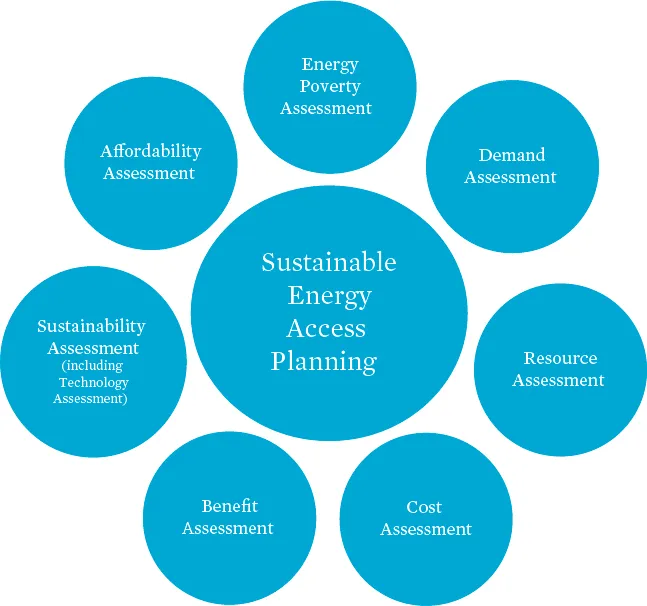
Source: Shrestha and Acharya (2015).
The base year considered for the study was 2014. Apart from 2014, this study carried out assessments for the three snapshot years: 2017, 2022, and 2030. These were chosen for the analysis since Nepal has targeted to graduate from the least developed country to a developing country by 2022 (NPC, 2014) and achieve 100% electrification by 2030.3
According to the SEAP framework, energy poverty assessment involves determination of the size of the energy-poor households in each VDC of the district, which includes households that have no access to cleaner energy sources as well as the households that are currently using inadequate (i.e., below the acceptable minimum) level of basic energy services.
The overall flow of the various assessments of the SEAP framework is presented in Figure 2.2. The first step in the SEAP framework is the determination of the size of the energy-poor households in each VDC of the district (i.e., energy poverty assessment). The households lacking cleaner energy access as well as without basic minimum level of energy services were considered as energy-poor households.
Figure 2.2: Sustainable Energy Access Planning Framework Overall Flow Diagram

Source: Shrestha and Acharya (2015).
The energy poverty assessment also estimates the level of energy consumption of those households in each VDC of the district. This provided the basis for the assessment under an energy access program, thus linking up with the energy demand assessment component of the framework.
The cost assessment mentioned in Figure 2.2 determines the least cost technology and resource options for providing cleaner energy access in 2017, 2022, and 2030 of an energy access program in each village development committee (VDC) of Pyuthan district. It also takes into account the life of the various technology options involved.
For this purpose, the cost assessment requires information on energy demand (obtained from energy demand assessment) as well as the availability of different energy resource options and their economic potential (based on the resource assessment).
Further, the determination of the least cost cleaner energy access options requires information on different sustainable technology options (identified through the sustainability assessment). The objective of cost assessment is to determine the total investment required to provide the least cost set of energy technology options.
Such information will further lead to an assessment of the level of affordability of the energy-poor and thus can be used to determine the subsidy amount and other financial supports needed to make cleaner energy access affordable.
2.2 Data
Pyuthan district has 49 subdistrict level local government units or VDCs.
This study carried out all the assessments as suggested in the SEAP framework at the individual VDC level. The district level assessments are thus based on the aggregation of these VDC-level assessments. The assessments were conducted based on the household survey data in all the 49 VDCs of the district.
The analysis presented in this report is based both on primary and secondary data. The primary data used in this report are based on the sample survey of households in each VDC of Pyuthan district conducted during February to March 2014.
The survey involved 2,744 households out of which 2,330 samples were found to be useful. The number of households surveyed per VDC varied from 35 to 55 across the VDCs in the district.
The secondary data considered in this study are based on publications of different district and national level government agencies including the Alternative Energy Promotion Centre, Central Bureau of Statistics, Nepal Electricity Authority, Biogas Support Programme, Butwal Power Company, Water and Energy Commission Secretariat, and other organizations.
3 Demographic and Energy Profile of Pyuthan District
This chapter ...
Table of contents
- Cover
- Title Page
- Copyright Page
- Contents
- Figures and Tables
- Foreword
- Acknowledgment
- Abbreviations
- Weights and Measures
- Executive Summary
- 1 Introduction
- 2 Methodology and Data
- 3 Demographic and Energy Profile of Pyuthan District
- 4 Energy Resource Assessment
- 5 Energy Poverty Analysis
- 6 Energy Demand Assessment
- 7 Sustainability Analysis of Energy Access Programs
- 8 Cost Assessment and Technology Choice for Electricity Access
- 9 Cost and Technology Assessments of Cleaner Cooking Options
- 10 Benefits of Energy Access Programs
- 11 Affordability of Energy Access Programs and Policy Implications
- 12 Insights and Implications for Energy Access Program Development
- References
- Appendixes
- Footnotes
- Back Cover
Trusted by 375,005 students
Access to over 1.5 million titles for a fair monthly price.
Study more efficiently using our study tools.
Frequently asked questions
Yes, you can cancel anytime from the Subscription tab in your account settings on the Perlego website. Your subscription will stay active until the end of your current billing period. Learn how to cancel your subscription
No, books cannot be downloaded as external files, such as PDFs, for use outside of Perlego. However, you can download books within the Perlego app for offline reading on mobile or tablet. Learn how to download books offline
Perlego offers two plans: Essential and Complete
- Essential is ideal for learners and professionals who enjoy exploring a wide range of subjects. Access the Essential Library with 800,000+ trusted titles and best-sellers across business, personal growth, and the humanities. Includes unlimited reading time and Standard Read Aloud voice.
- Complete: Perfect for advanced learners and researchers needing full, unrestricted access. Unlock 1.5M+ books across hundreds of subjects, including academic and specialized titles. The Complete Plan also includes advanced features like Premium Read Aloud and Research Assistant.
We are an online textbook subscription service, where you can get access to an entire online library for less than the price of a single book per month. With over 1.5 million books across 990+ topics, we’ve got you covered! Learn about our mission
Look out for the read-aloud symbol on your next book to see if you can listen to it. The read-aloud tool reads text aloud for you, highlighting the text as it is being read. You can pause it, speed it up and slow it down. Learn more about Read Aloud
Yes! You can use the Perlego app on both iOS and Android devices to read anytime, anywhere — even offline. Perfect for commutes or when you’re on the go.
Please note we cannot support devices running on iOS 13 and Android 7 or earlier. Learn more about using the app
Please note we cannot support devices running on iOS 13 and Android 7 or earlier. Learn more about using the app
Yes, you can access Sustainable Energy Access Planning by in PDF and/or ePUB format, as well as other popular books in Tecnología e ingeniería & Política medioambiental y energética. We have over 1.5 million books available in our catalogue for you to explore.