This book explores contemporary migration by boat through the intertwined, and under-explored, elements of empirical data, governance and geopolitics, and discourses.
While the migration of people by boat is a long-standing phenomenon, journeys have become more frequent and precarious as states illegalise entry. As migration at sea becomes more common, it has gained attention from a range of actors, including enforcement authorities, political elites, media, and non/inter-governmental organizations. The sea has thus become a space of hope/desperation for migrants as well as conflict over territory and sovereignty, representing wider social debates in and beyond Australia, Canada, the European Union, and the United States. Current literature on migration by boat reflects these debates, primarily concentrating on the humanitarian and legal realities of migration by boat and border enforcement at sea , however, few studies have analysed their empirical relationship. This edited volume aims to fill this gap and thereby address three important, overlapping aspects of these debates.
The first theme will explore data and methods on migration by boat, its discourse, and its enforcement, and in addition identifying appropriate research methodologies and sources to gather these data. The second theme will build upon the first by focusing on the relationship between data on migration by boat and governance and geopolitics of the "border". Building upon the two themes already outlined,the third theme will identify and analyse how elite discourses represent migration at sea.
eBook - ePub
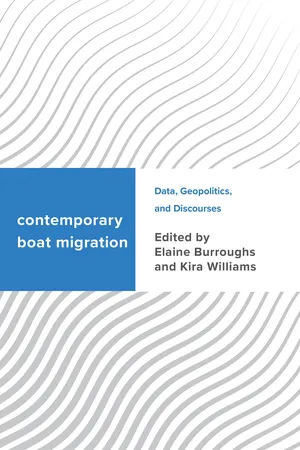
Contemporary Boat Migration
Data, Geopolitics, and Discourses
- 200 pages
- English
- ePUB (mobile friendly)
- Available on iOS & Android
eBook - ePub
Contemporary Boat Migration
Data, Geopolitics, and Discourses
About this book
Information
Chapter 1
Introduction: Challenging Migration Studies through Addressing Critical Gaps in Studying Migration by Boat
Introduction
In recent years, with the fleeing of people from a range of conflict zones and the increased restricted access to areas such as the European Union (EU) and countries like the United States, Canada and Australia, international human migration by boat has become more frequent, sensationalised and precarious. Migration by boat has gained significant attention from a range of actors, including enforcement authorities, political elites, media and non-/inter-governmental organisations. Indeed, this book was written during a turbulent time, in which the topic of migration by boat was presented by many in positions of elite status as a ‘crisis’. The sea has increasingly become a space of hope/desperation for migrants, as well as a place of geopolitical conflict over territory and sovereignty (Mountz 2013).
For these reasons, this edited book aims to explore how migration by boat is researched, the geopolitical focus on it and the way in which it is discursively represented. This collection re-orientates the focus of the current literature on migration by boat – that is, from humanitarian and legal realities (e.g., Carling and Hernandez-Carretero 2011; Gammeltoft-Hansen 2008) to the empirical relationship between data and methodologies, legal regimes and geopolitics and discourses. What also concerns us in this volume is the intertwined relationship between these three distinct elements. The book originated as the result of a paper session where we identified major gaps in studying migration by boat in 2016. The key objective of this collection is to offer a platform for new and established scholars to explore migration by boat through these three under-researched entities.
This chapter briefly outlines what the book is, why we made it, how it addresses current important issues in migration studies, what its wider benefits are and what to expect inside. As previously referred to, it generally studies three crucial, yet understudied, issues in contemporary migration by boat: data and methodology, legal regimes and geopolitics and discourses. We approach these issues using empirically focused, novel methods through specific case studies. The chapters in this volume are interdisciplinary in nature and are drawn from key disciplines in the field of migration studies, including geography, sociology, political studies and linguistics. Furthermore, the contexts examined here emerge from a range of geographical contexts (Europe, Canada and Australia). Although a range of geographical locations are examined, this book does not provide an exhaustive account of the topic of migration by boat. Rather, it explores it through three specific lenses. Furthermore, not only does each chapter examine a specific case in relation to the core topic of migration by boat, each chapter also relates to the other chapters within this book; therefore, although each chapter stands in its own and can be read in this way, the book can also be read as a single interrelated entity that examines migration by boat through the themes of data, geopolitics and discourse.
Three major benefits of the book are its general contribution to studying migration by boat, providing evidence on this issue for contemporary political debates, and, last, in giving critical insight into social theory and human rights law. The book has three sections: section 1 explores data and methodology in two chapters, section 2 uncovers legal regimes and geopolitics in three chapters and section 3 studies discourses on migration by boat in three chapters. We then summarise and build on our general findings in a final chapter.
Origin and History of the Book
We first met and discussed migration by boat and border enforcement in late 2015. We found that the issue’s contemporary relevance and relative deficiency in empirical papers warranted the creation of a paper session to explore these topics, which we led at the American Association of Geographers 2016 annual meeting in Chicago, the United States. At this time, and as further described later in this book, we identified three core topics in studying migration by boat which needed immediate empirical research: data and methodology, legal regimes and geopolitics and discourses. Based on this insightful dialogue between us, the presenters, many of whom are contributors in this volume, and the audience, we agreed to co-edit a volume to address these topics insofar as we could for wider scholarship.
We solicited contributions to this volume based on those three themes. We quickly received proposals not only from those who presented at our panel but also from a number of influential scholars in the field who also saw an urgency for these research projects. We reviewed our accepted proposals, making modifications to more tightly fit them to this book’s themes. It turned out that Rowman & Littlefield International, our ultimate publisher, actively sought submissions like ours for its ‘Challenging Migration Studies’ series. This series challenges migration studies as past scholars have established it; it calls for new theory, methodologies and data to move us beyond policy-oriented frameworks in order to engage the complex changes in the global migration regime. Given our book’s goals of filling and expanding critical gaps in current migration studies literature with respect to migration by boat, we agreed that ‘Challenging Migration Studies’ was a perfect fit and submitted our later accepted proposal to Rowman & Littlefield International.
General Description and Justification of the Book
This is an edited book that focuses on crucial, yet understudied, issues in contemporary migration by boat through three themes: data and methodology, legal regimes and geopolitics and discourses. All contributors approach these issues using empirically focused, novel methods through specific case studies. The book begins by looking at core problems and ways forward in data and methodologies to study migration by boat. It then proceeds to employ examples of these new data and methodologies to empirically study the complex legal regimes and geopolitics of migration by boat. Finally, the book considers how elite and media discourses entangle themselves within these legal regimes and geopolitics using new evidence and approaches.
While the migration of people by boat is a long-standing phenomenon, journeys have become more frequent and precarious as states illegalise entry. As migration at sea becomes more common, it has gained attention from a range of actors. The sea has thus become a space of hope/desperation for migrants as well as conflict over territory and sovereignty (Mountz 2013), representing wider social debates in and beyond Australia, Canada, the EU and the United States (Castles and Miller 1998; Samers 2010). Current literature on migration by boat reflects these debates, primarily concentrating on the humanitarian and legal realities of migration by boat and border enforcement at sea (e.g., Carling and Hernandez-Carretero 2011; Gammeltoft-Hansen 2008); however, few studies have analysed their empirical relationship or systematic connections. This edited volume aims to fill this gap and thereby address three important, overlapping themes of these debates.
The first theme explores data and methodologies on migration by boat, its discourses and its enforcement. It identifies appropriate research methodologies and sources to gather these data (e.g., operations, interceptions, deaths). Current data are missing or insufficient to empirically describe these phenomena; furthermore, availability typically varies by topic and region, and data are gathered in different ways by a wide variety of institutions (e.g., states, universities, think-tanks). Even where data do exist, differences in definitions, recording, power relations, reluctance to report and data destruction hinder aggregation to achieve a larger sample size or wider geographic scale. We must overcome these issues in order to understand migration by boat. We therefore provide novel insights into and propose new methods.
A number of scholars have specifically worked around data issues on human migration at sea (Carling 2007; Weber and Pickering 2011; Williams and Mountz 2016). Think-tanks and NGOs have also contributed to our wider knowledge (e.g., De Bruycker et al. 2013). Although important, these projects typically did not focus on methodological problems, publish their data or contribute to a longer, more sustained research on migration by boat, its discourse or its enforcement. A number of data-focused and sustained projects have also emerged online in the past decade (Border Crossing Observatory 2015; Hutton 2014; Spijkerboer et al. 2015). While these projects have shared their data and information on their use of innovative methodologies online, they have yet to fully publish their methodological details or findings in an academic setting. In bringing together these strands of research, then, this edited book addresses the following critical questions: how can research designs tackle issues of data paucity on migration at sea, especially at larger scales? How do we study secretive and obfuscated research subjects, like migrants at sea and state enforcement operations? What are the findings from projects which have taken on these issues? What can we learn from their methodological innovations and results? We argue that in order to understand the concept of migration by boat, especially its geopolitics and discourses, we require new and improved data and methodologies.
The second theme builds upon the first by focusing on the relationship between data on migration by boat and governance and geopolitics of the ‘border’. A large body of work currently exists which analyses the legal status of international migration at sea and, on a more limited level, its enforcement (e.g., Barnes 2004; Pugh 2004). Only a limited number of scholars have explored the empirical relationship between legal regimes, geographies, geopolitics and migration by boat, its discourse and enforcement (Klepp 2011; Lutterbeck 2006; Mainwaring 2012; Mountz 2010). There is currently a lack of literature which makes a strong connection between empirical work on migration by boat and the legalities and politics of migration. Given our existing literature, what are the more specific relationships between legality, geography and migrant outcomes at sea? How do states, migrants or discourse bring them about in practice? How do these practices work in specific regions or locations, especially those relatively understudied in previous research? Are there broader, empirical connections between these patchworks from which we can learn something new? What are the wider impacts of these conclusions for migration on land or by air?
Building upon the two themes already outlined, the third theme identifies and analyses how elite discourses represent migration by boat. While many authors have examined how migration is broadly represented in elite discourses, few have specifically looked at migration by boat. This small cohort of literature has concentrated on the regions of Australasia (Bogen and Marlowe 2015; Holtom 2013; Kampmark 2007; McKay, Thomas and Blood 2011; O’Doherty and Lecouter 2007; Slattery 2003), Canada (Ashutosh and Mountz 2012) and the EU (Bacas 2013; Bruno 2016; Campesi 2011). Existing research on migration by boat indicates that discourses play an important role in the categorisation of migrants through a particular frame in order to legitimise the governance and geopolitics of human migration at sea. This literature has also shown that these discursive representations can have an impact on public opinion.
This edited book extends current literature on discourses of migration by boat in two key ways. First, we focus on discursive data and methods – that is, discourses from the news media, political outlets and online sources – rather than papers that take a more theoretical approach. We ask: what are the key discourses that construct migration by boat, and what is their function? Second, we extend approaches to discourses of migration by boat by explicitly linking data on human migration at sea (e.g., deaths, apprehensions) and the governance of this type of migration with discursive and visual representations. Key questions include what are the links, if any, between data on migration by boat and discursive representations? What are the relationships between representations of migration by boat and border geopolitical practices?
Key Benefits of the Book
We argue that by addressing this critical yet understudied issue in migration studies, this book has three major benefits. First, the exploration of migration by boat in contemporary society is an under-researched area within migration studies. Of the literature that does exist, it tends to focus on the legalities of the situation; this book therefore addresses three themes that are currently understudied within this topic, namely empirical data and methods, legal regimes and geopolitics and discourses. Most distinctly, this book empirically explores the relationship between these three themes, and bringing these three themes together alone is a novel contribution of this volume. The book therefore addresses a critical gap within migration studies, and also within the study of migration by boat, by offering a number of approaches in undertaking research on migration by boat empirically and utilising novel methods. We aim to contribute to future research on data gathering, analysis and methodologies.
Second, migration by boat is a relevant issue in contemporary politics. Despite heavy interest by policymakers and publics alike, we currently have a notable lack of scientific evidence to support how migration by boat works or how best to respond to it. This book aims to offer scientific evidence to better understand how migration by boat works – in particular in relation to geopolitics and discourses. By offering empirical analysis of discourses of migration by boat, this book explores the linkages between discourses and broader political agendas. There is a continually growing demand for these empirical details, which this book provides in a coherent, logical and critical way.
Third, migration by boat and its enforcement provide critical insight into social theory and human rights law. Due to the extreme violence which occurs in trying to manage movement by boat, what happens to migrants at sea often reveals the power of people, space and politics. A migrant boat at sea quickly becomes a place where social forces, especially geopolitics, converge and can so be better understood. To understand and measure these forces, however, we must combine social theory with improved data and methodologies to adjust to the particular empirical difficulties of studying this often-obfuscated issue. We argue that it is our combination of theory, evidence in case studies and new methodologies which will help create a new agenda to push this much-needed research forward.
Book Contents
We separate the book into three sections, with one section for each theme: data and methodology, legal regimes and geopolitics and discourses. Section 1 contains two chapters which explore data and methodologies for studying migration by boat, its surrounding geopolitics and related state border enforcement. Despite its contemporary relevance, the study of migration by boat currently lacks specialised approaches to understand it. This gap has at least two sources: the difficulty in collecting primary sources of data and the focus of research on applied theory and case studies as opposed to methodology itself.
Scholars in the past two decades in particular have had to design and innovate new ways to study the complex socio-economic, legal, political and spatial dimensions of the phenomena of migration by boat; however, these new and useful methods often become lost because they remain underdeveloped and undershared. Contributors Alison Mountz and Kira Williams therefore explore these new ways forward in addition to pointing out existing data-related and methodological problems. In sum, chapters 2 and 3 help contribute to future research on migration by boat by taking on two strong barriers to current scholarship: data gaps and methodological limitations. In doing so, they help form the basis of further discourse and research.
Section 2 has three chapters which explore the geopolitics and legal regimes surrounding contemporary migration by boat. While section 1 introduced us to and showed issues in studying migration by boat, chapters by Giuseppe Campesi, Paolo Cuttitta and Joanne van Selm decompose its complex political and social realities. Previous work in the field has often shown the consequences of governance institutions on the everyday lives of migrants; however, scholars have yet to contribute a nuanced understanding of the legal regimes and geogra...
Table of contents
- List of Figures and Tables
- 1 Introduction: Challenging Migration Studies through Addressing Critical Gaps in Studying Migration by Boat (Elaine Burroughs and Kira Williams)
- Section One: Data and Methodology
- Section Two: Geopolitics and Legal Regimes
- Section Three: Discourses
- Index
- About the Authors
Trusted by 375,005 students
Access to over 1.5 million titles for a fair monthly price.
Study more efficiently using our study tools.
Frequently asked questions
Yes, you can cancel anytime from the Subscription tab in your account settings on the Perlego website. Your subscription will stay active until the end of your current billing period. Learn how to cancel your subscription
No, books cannot be downloaded as external files, such as PDFs, for use outside of Perlego. However, you can download books within the Perlego app for offline reading on mobile or tablet. Learn how to download books offline
Perlego offers two plans: Essential and Complete
- Essential is ideal for learners and professionals who enjoy exploring a wide range of subjects. Access the Essential Library with 800,000+ trusted titles and best-sellers across business, personal growth, and the humanities. Includes unlimited reading time and Standard Read Aloud voice.
- Complete: Perfect for advanced learners and researchers needing full, unrestricted access. Unlock 1.5M+ books across hundreds of subjects, including academic and specialized titles. The Complete Plan also includes advanced features like Premium Read Aloud and Research Assistant.
We are an online textbook subscription service, where you can get access to an entire online library for less than the price of a single book per month. With over 1.5 million books across 990+ topics, we’ve got you covered! Learn about our mission
Look out for the read-aloud symbol on your next book to see if you can listen to it. The read-aloud tool reads text aloud for you, highlighting the text as it is being read. You can pause it, speed it up and slow it down. Learn more about Read Aloud
Yes! You can use the Perlego app on both iOS and Android devices to read anytime, anywhere — even offline. Perfect for commutes or when you’re on the go.
Please note we cannot support devices running on iOS 13 and Android 7 or earlier. Learn more about using the app
Please note we cannot support devices running on iOS 13 and Android 7 or earlier. Learn more about using the app
Yes, you can access Contemporary Boat Migration by Elaine Burroughs,Kira Williams, Elaine Burroughs, Kira Williams in PDF and/or ePUB format, as well as other popular books in Sciences sociales & Géopolitique. We have over 1.5 million books available in our catalogue for you to explore.