As the financial crisis reached its climax in September 2008, the most important figure on the planet was Federal Reserve chairman Ben Bernanke. The whole financial system was collapsing, without anything to stop it. When a senator asked Bernanke what would happen if the central bank did not carry out its rescue package, he replied,"lf we don't do this, we may not have an economy on Monday."
What saved finance, and the Western economy, was money. Yet it is a highly ambivalent phenomenon. It is deeply embedded in our societies, acting as a powerful link between the individual and the collective. But by no means is it neutral. Through its grip on finance and the debts system, money confers sovereign power on the economy. If confidence in money is not maintained, crises will follow.
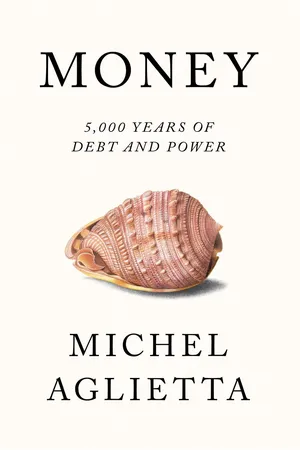
Looking over the last 5,000 years, this book explores the development of money and its close connection to sovereign power. Michel Aglietta mobilises the tools of anthropology, history and political economy in order to analyse how political structures and monetary systems have transformed one another. We can thus grasp the different eras of monetary regulation and the crises capitalism has endured throughout its history.
- 432 pages
- English
- ePUB (mobile friendly)
- Available on iOS & Android
eBook - ePub
About this book
Information
Topic
EconomiaSubtopic
Economia politicaPart I
Money as a Relation
of Social Belonging
Those beliefs that bind us to one another and underpin our lives – God, the nation, justice, law and civic ethics, as well as money – are essential objects for the social sciences. Delving into the knowledge accumulated by the social sciences on these subjects helps shape our questions regarding the human condition, of which these beliefs are a vital part. However, in this quest to better comprehend our experience, few of us would turn to an economics textbook. We would find nothing in its pages to calm our anxieties. It is almost as if economics were not part of society. In economics, there is no notion of the social bond. The only exception is in the concept of equilibrium, where this bond takes the paradoxical form of a complete harmony between individuals and society: as each individual realises her desires independently of others, she contributes to the perfect harmonisation of society. Indeed, the knowledge condensed in these textbooks, which is taught as the absolute fundamentals of economics, presents its fundamental concepts independently of any hypothesis as to the nature of social bonds.
Here, the question of money becomes intriguing. For who could claim that money is not part of economics? It is omnipresent in our daily lives. We are all obsessed by money. When we cannot access it, we are excluded from society, or at least subject to humiliating social palliatives that make our existence a matter of survival rather than living. Yet nothing in economic theory, which conceives of society as a self-sufficient system of markets, guarantees universal inclusion in this system. Market theory stands very far from common sense. It claims that everyone will find a job, but not that the resulting income will allow us to live decently – at least according to any acceptable principle of justice.
Another way to gauge this malaise is by asking what contribution pure economics has made to the question of sustainable development, which is the emerging theme of the twenty-first century. Even to formulate the question demands that we take account of the economic relations between social groups and nations, and the links between the economy and nature. These themes stand outside of the dominant economic theory. But they are nonetheless integral to any pertinent conception of an economy understood as something that exists within society. It is money, defined as a fundamental social bond, that allows us to draw the links between all of these themes. But such links can be drawn only by rejecting economic science’s pretention to be an autonomous discipline.
Let us look back at our own recent experience: namely, the financial crisis and its after-effects, which we are continuing to live through. This has been a crisis of devastating consequences. Yet it cannot be understood or interpreted within the logic of the general equilibrium of markets. For this logic ignores money, reintroducing it only after the fact as a peripheral object that is essentially neutral with regard to the system of ‘real’ economic exchanges. Understanding the current crisis demands that we grasp the relationship between money and finance, which is indeed a strong one. This fundamental interconnection constitutes the basis of this book.
Societies endure over time but can do so only if they are capable of producing and renewing the material bases of social life. It is these bases that capital, as it is normally understood, serves: a set of infrastructures and material means, competences and techniques in service of production. Here, we must take as given a notion that we will later challenge: namely, that there is a substitute for social bonds called ‘the market’. The market determines the prices that ensure a coherent relationship between that which existing capital can produce – a capital principally embedded in business – and the demand from the isolated individuals called ‘consumers’. A market period is the time required between the discovery of equilibrium prices and the actual realisation of exchange. This is, in a sense, a causal time. When the prices that balance producers’ possible supply with consumers’ needs are known, companies know what they have to produce. If the price system is perfectly coherent, then it can be supposed that the conditions of production that transform inputs into products for consumption are entirely objective. These inputs (the use of machines, the employment of a workforce, the consumption of raw materials and intermediate products) are combined according to what we call a function of production. Within a certain time, the supply derived from the production mechanism will meet its demand: this is the period of production and exchange. Hence, to say that production and exchange processes unfold according to a causal time is to say that they unfold in a single direction.
But what happens beyond that? How will capital be renewed? Should it be accrued or not? In short, how will the ‘producers’ invest? If the economy is stationary and all the actors in this economy know it, there is no problem. Economic time is then made up of a succession of identical causal periods. The problem arises when the economy is part of a society that desires change, and the individuals who express these desires are unable to communicate them through social bonds – after all, the conception of market economics assumes that individuals bear no relation with one another. How, then, do producers decide where to invest? Investments require another kind of time: a time of expectation. This future time cannot be the repetition of the past, for the future will be moulded by all manner of innovations. These innovations concern not only methods of producing but also lifestyles and political mutations, which are radically unpredictable. Indeed, innovation is by definition whatever is not part of the ensemble of knowledge issuing from past experience. Hence, this future time can only be subjective, which is to say, it can only be constituted by beliefs. How do these beliefs structure the future by informing decisions in the present?
According to mainstream economic theory, the answer is finance. Finance operates on the basis of the future. This is not to suppose that the future can act causally on its own past – which is to say upon the present. Causality necessarily respects the direction of time. All present action rests on an objective substratum left by the past: actions taken in the present prolong or develop interactions whose origins lie in the past. Conversely, the future has an effect precisely by means of social actors’ beliefs. Yet there exists no objective base that pre-exists these beliefs. For this reason, where beliefs about the future influence present actions, we see an inversion of time. For those societies that do not project themselves into the future through collective action, such an inversion is indispensable if they are to evolve and not simply reproduce an eternal present. But this inversion is heterogeneous to causal time. We might, then, say that the influence exerted by beliefs corresponds to a counterfactual future time.1 If I think that such and such event could take place in the future, then I will act in such and such a way in the present. But if I think that another event could take place instead, then I will act differently. Yet I have no objective basis to distinguish the one possibility from the other. By its very nature, the time of belief is subjective. How does finance remove this indeterminacy, enabling companies to invest in such a way as to satisfy consumers’ future (and thus unknown) desires?
The theory of market economics claims to answer this question by making beliefs into objective facts. In this view, beliefs are not subject to the uncertainty of the future, but rather insights into what will really take place, at least on average. The market then becomes something quite other than a forecaster with every chance of being mistaken – for indeed, no forecaster could claim to be rid of the radical uncertainty of the future. According to this theory, the financial market plays a quite different role: namely, that of the biblical prophet. If this is a ‘real’ prophet and not a usurper, then he will not be mistaken, for he knows the word of God. According to the theory of financial efficiency, the market is an anonymous prophet. He knows the ‘true model’ of the economy and reveals it to all. And if everyone follows him, then his prophecy will indeed be realised, just as the prophet’s word is correct because all those who hear him believe that God is speaking through his mouth. To any reasonable and ‘secular’ individual, this can only appear as absurd. Such a hypothesis also does enormous harm to economics’ supposed scientific character, for it means rejecting what Karl Popper called the principle of falsifiability by experience: the criterion for an experimental science, as opposed to a normative dogma. It bestows upon the market the property of never being wrong, at least on average. Yet by this hypothesis, global systemic financial crises, followed by phases of depression, would be impossible. And the contemporary world has experienced three such crises in eras of so-called financial liberalisation, from 1873 to 1896, from 1929 to 1938, and from 2008 to…? Of course, the efficiency hypothesis does allow room for error. But this error is confined to the supposedly stochastic nature of disturbing events, which are treated as shocks. The efficiency hypothesis allows for only a limited notion of uncertainty, for it supposes that the ‘future states of the world’ are a matter of objective knowledge – and in turn of common knowledge, this knowledge being centralised by finance and incorporated into market prices. In this account, there would be nothing left to do except observe prices on the financial markets, in order to act in accordance with the most complete knowledge – which, as a bonus, is affirmed as ‘true’. We are thus presented with a portrayal of the best of possible worlds.
Let us go further into the events of the crisis that we all remember (because we lived through it). After the collapse of Lehman Brothers, finance in the so-called advanced countries had entered into a process of self-destruction, lacking the capacity to stabilise itself by its own means. Finance itself produced the devastating contagion that was now spreading unopposed. Everything was unfolding as if the counterfactual horizon of the future had disappeared. Financial agents were exclusively driven by immediacy, which is to say, by the exclusive search for money – not in order to kick-start spending, but in order to protect themselves. This is the reason why finance was saved only through the coordinated action of the central banks, or in other words, by money. Economies nonetheless fell into a deep recession, which could be overcome only through an expansionary fiscal policy coordinated at the G20 level, and thus through the power of the state seeking to reconstruct a future at the level of the world economy.
Thinking through such phenomena poses several theoretical demands:
1.The economy is coordinated not by the figure of Equilibrium, but by payment relations which make cumulative and endogenous disequilibria possible.
2.The money that fulfils this coordination is the most general social bond; it is that which relates all the agents of exchange in a market society in which the same form of money is used. Money is thus the most fundamental concept of economics.
3.Money is, nonetheless, ambivalent. It is the desire for money that leads finance into deliria of collective hubris. But it is the power of money that re-establishes order in exchange and restores a counterfactual dimension to the future.
4.The role of state power is decisive in underpinning the monetary, economic and social order. Money is not a creature of the state, nor is it a public authority. It is the fixed point of a coordination process established outside of the knowledge of each person, despite involving the participation of all. The Law, as a constitutional order in democratic societies, nonetheless plays a central role in stabilising and regulating the objectivated form of money, or the system of payments. There are, therefore, organic links between the institution responsible for money (in contemporary societies, the central bank) and the state as an executive power.
Yet, if we are to establish these conclusions, and thus to enter into the secrets of crisis, we also have to provide hypotheses capable of discerning the nature of the money that lies at the heart of the social bond. We can do this only if we challenge the presuppositions of economic theory that render money a peripheral notion without any real impact on this theory’s central message: namely, the proposition of a general equilibrium of the markets. In short, we can only rehabilitate the universally dominant place of money if we challenge the dominant theory of value, for this theory excludes money from the fundamental principle of market coordination.
1
Money Is the Foundation of Value
The challenge for the ‘pure theory of market economics’ is to conceive of a self-sufficient mode of economic coordination. In its view, money has no role in the formation of the equilibrium price system that holds the market economy together. How can it arrive at such a paradoxical conclusion?
THE NATURALIST HYPOTHESIS OF VALUE AND ITS CRITIQUE
What allows goods to be exchanged? According to the dominant theory of value, goods have a common nature – a common substance prior to any exchange – which allows them to be rendered equivalent in when exchanged with one another. This substance is called ‘utility-scarcity’. This is the starting point of Léon Walras’s fundamental work.1 Material or immaterial things are useful to individuals, and they are only available in limited quantities. These two principles are sufficient for a definition of social wealth. Having defined value, Walras shows that the relations of value in exchange are equal to the relations of scarcity.
This is a surprising point of departure when we consider that, contrary to the vulgate of the ‘neoclassical’ economists, Walras was fully conscious of the importance of social relations to economics, and attentive to the actions necessary in order to improve these relations. This definition of value as an objective substance separate from any institutional framing is a deliberate attempt to render ‘pure’ economics autonomous from social relations. Thus, Walras carefully distinguishes the social economy from pure economics, in order to be able to think through this latter on the basis of principles analogous to those of the physical sciences.
This is a starting point with enormous consequences. First of all, the hypothesis that value is a substance is a conceptual abstraction that clashes with our experience of everyday life, in which we constantly see that our desires are moulded by our relations with others. The incongruity of this hypothesis becomes particularly striking when we get to work. Indeed, in capitalist societies, where the huge majority of the population is made up of wage-labourers, work is the principal mode of social belonging. As Amartya Sen has demonstrated,2 the possibility of involving ourselves in labour is our principal means of realising our capacities and life ambitions. Whether our capabilities are realised or not depends essentially on the institutions in which work takes place, which means, first of all, the enterprise. Against the substantial theory of value, we could even maintain that labour is nothing other than a social relation. But in the context of the substantial theory of utility, we can only consider labour as disutility, since it is opposed to leisure, a utility. It follows that individuals’ desires are solely expressed through the negotiation between leisure and labour. According to this reading, individuals’ sole motivation is to escape labour, which they accept only in order to acquire useful goods. ...
Table of contents
- Cover Page
- Halftitle Page
- Title Page
- Copyright Page
- Contents
- Acknowledgements
- Introduction
- Part I: Money as a Relation of Social Belonging
- Part II: The Historical Trajectories of Money
- Part III: Crises and Monetary Regulation
- Part IV: The Enigma of International Currency
- Notes
- Bibliography
- Index
Trusted by 375,005 students
Access to over 1.5 million titles for a fair monthly price.
Study more efficiently using our study tools.
Frequently asked questions
Yes, you can cancel anytime from the Subscription tab in your account settings on the Perlego website. Your subscription will stay active until the end of your current billing period. Learn how to cancel your subscription
No, books cannot be downloaded as external files, such as PDFs, for use outside of Perlego. However, you can download books within the Perlego app for offline reading on mobile or tablet. Learn how to download books offline
Perlego offers two plans: Essential and Complete
- Essential is ideal for learners and professionals who enjoy exploring a wide range of subjects. Access the Essential Library with 800,000+ trusted titles and best-sellers across business, personal growth, and the humanities. Includes unlimited reading time and Standard Read Aloud voice.
- Complete: Perfect for advanced learners and researchers needing full, unrestricted access. Unlock 1.5M+ books across hundreds of subjects, including academic and specialized titles. The Complete Plan also includes advanced features like Premium Read Aloud and Research Assistant.
We are an online textbook subscription service, where you can get access to an entire online library for less than the price of a single book per month. With over 1.5 million books across 990+ topics, we’ve got you covered! Learn about our mission
Look out for the read-aloud symbol on your next book to see if you can listen to it. The read-aloud tool reads text aloud for you, highlighting the text as it is being read. You can pause it, speed it up and slow it down. Learn more about Read Aloud
Yes! You can use the Perlego app on both iOS and Android devices to read anytime, anywhere — even offline. Perfect for commutes or when you’re on the go.
Please note we cannot support devices running on iOS 13 and Android 7 or earlier. Learn more about using the app
Please note we cannot support devices running on iOS 13 and Android 7 or earlier. Learn more about using the app
Yes, you can access Money by Michel Aglietta, David Broder in PDF and/or ePUB format, as well as other popular books in Economia & Economia politica. We have over 1.5 million books available in our catalogue for you to explore.