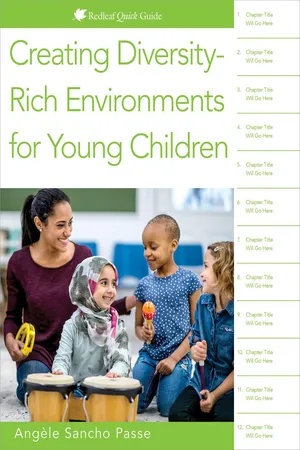
Early childhood educators have the power to help all children learn to respect themselves and others. Creating Diversity-Rich Environments for Young Children is an easy-to-use guide that shows how early childhood professionals can create a positive and inclusive environment for children of all cultures.
The newest addition in the Redleaf Press Quick Guide series includes elements of the National Association for the Education of Young Children's (NAEYC) developmentally appropriate practice and ethical standards, early childhood progress indicators, and best practices in adult learning.
Guides for reflection and planning for educators and cross-cultural competence checklists will be included to further assist educators.
- English
- ePUB (mobile friendly)
- Available on iOS & Android
eBook - ePub
Creating Diversity-Rich Environments for Young Children
About this book
Information
Topic
EducationSubtopic
Classroom ManagementCHAPTER 1:
FRAMEWORKS FOR CREATING
A DIVERSITY-RICH ENVIRONMENT
FRAMEWORKS FOR CREATING
A DIVERSITY-RICH ENVIRONMENT
Advancing Equity in Early Childhood Education (NAEYC 2019)
Recommendations for Everyone: 1, 2, 3, 4, 5, 6
Diversity is all dimensions of culture interacting with each other. We see it in our classrooms with children, families, and colleagues. We see diversity in our own families too. Take the time to think about your classroom and your program. Reflect on the children, families, and colleagues. Write their names in a column and note how they illustrate the list of cultural dimensions you have just read.
Recognizing diversity is seeing the many ways that people understand daily life. Having a diversity-rich perspective as an early childhood educator is being interested in what families do at home with their children. Having an open mind does not mean accepting everything families do as good. Respecting many ways of understanding daily life does not mean ignoring what’s important for children. For example, research says reading is good for children because it increases their vocabulary, and vocabulary is a measure of reading success. If families do not read to children at home, early educators know it is not best practice. However, they should not blame families. Their job is to explain to families why reading is good for children—and make sure to read extra books to children in their program.
Educators often express concerns about their work with diversity: “I don’t know about other cultures,” “I only speak English,” “I am uncomfortable with the idea of LGBTQ,” “I didn’t grow up with people of different races.” We can never know everything there is to know about other people, so we acknowledge that there is not a magic formula. As you learn more about creating diversity-rich environments, you might be worried about how to do it well. You might be afraid of making mistakes. You might not feel simple neutral acceptance of others. But it is a skill that must be learned and worked at. The result is the immense satisfaction of doing a good job.
A big point of honoring diversity is to add to what families do at home and give them ideas and skills to help them feel confident and competent. Families want their children to succeed in the world in which they live. They have high hopes that their children will be able to be good learners, workers, and productive members of society. Children do not just live in the cultural bubble of their families. They also live in the outside world of school and community.
How Children Experience Diversity
Between ages two and five, children develop their sense of self. They become aware of the gender, culture, ethnicity, family differences, disabilities, and economic class of themselves and others. In the presence of people who are different from them, they may say things like “Why is he Black?” “She looks funny.” “Why doesn’t she walk?” “I don’t like him, he is weird.” “Boys can’t play here.” “Girls are weak.” “You can’t have two mommies!” “Muslims are stupid.” These questions and comments are an expression of curiosity or discomfort. The children may be repeating things they have heard others say.
At the same time, young children become aware of biases against aspects of their own identity. With adult guidance, preschoolers can begin to recognize and challenge biases, unfairness, racism, and sexism that affect themselves and others. This is even more reason for creating diversity-rich environments for all children. We want children to develop a strong self-concept. We also want them to respect and interact in positive ways with people who are different from themselves.
Understanding Bias and Discrimination
Bias is an attitude, belief, or feeling that results in and helps justify unfair treatment of a person because of her or his identity. For example, there is evidence that early childhood teachers believe that young Black boys need to be watched more closely than other children (Gilliam et al. 2016), lest they cause trouble in the classroom. That is a bias.
Discrimination is an action by an institution or individual that denies access or opportunity to people based on some aspect of their identity (such as gender, income, or race). Discrimination is regulated by strict laws in the United States. In the case of the Black boys, it means that their access to early childhood programs is open. There is no legal discrimination against them. However, because of the bias described above, these children are targeted for expulsion from programs at rates two to three times higher than other children (Brown and Steele 2015). According to data from the Office of Civil Rights (OCR), Black children make up 18 percent of preschool enrollment but 48 percent of preschool children receiving suspension (OCR 2014). Therefore, even though they have access to education, they are denied the opportunity to learn. The implicit bias of educators affects their experience in a negative way.
Children are at risk of being harmed by the biases of educators in other ways too. Other examples include ignoring the languages of immigrant children; high child-adult ratios that make quality care impossible; being friendlier to children from one culture than another; the persistent education gap between children of color and white children; not providing enough physical activities; ignoring that children live in gay and lesbian families; and using classroom management techniques that are harsher for some children than others. But in all of these examples, there is hope. When educators become aware of their biases, they are more intentional in delivering good education to all children.
Useful Resources and Philosophies
There is a solid body of research and ideas to help educators do a good job with cultural diversity. Every state has developed Early Learning Standards to understand early childhood development. Institutions like the National Association for the Education of Young Children (NAEYC) and the National Black Child Development Institute (NBCDI) provide information and resources. Concepts like cultural pluralism, anti-bias education, cultural guidance, and skilled dialogue are important tools.
An Environment That Helps Black Children Learn
Debra Ren-Etta Sullivan (2016), the author of Cultivating the Genius of Black Children, proposes twelve key elements of the learning environment that will best help Black children learn:
1. Active, engaged, synergetic learning
2. Interactive discourse, discussion, and analysis with an emphasis on verbal “play”
3. Opportunities for creativity, individualism, and embellishment
4. Collective/collaborative activity and problem solving
5. Competitive mental and physical challenges
6. Meaningful, mutually respectful teacher-child relationship
7. Meaningful, mutually respectful connection to family and community
8. Educational empowerment/personal responsibility
9. Opportunities for self-reflection
10. Opportunities for connecting with nature and each other for a higher purpose or a good cause
11. An integrated, connected curriculum
12. A sense of community and belonging (p. 75–76)
Reading this list, you might notice that they are the same expectations promoted by early childhood education environmental assessments like the CLASS, the ELLCO, or the ECERS. They are the same as the principles of Developmentally Appropriate Practice (NAEYC) and many other works that describe quality early childhood education. Many children benefit from these positive teachings, but unfortunately these ideas are less often applied when teaching Black children. When these children are creative, interactive, or physical, their behaviors are likely to be interpreted in a negative way by their teachers. The teachers hold the bias that these children do not have the inherent abilities to do well without stricter direction. They work to curb the creativity, interaction, and physicality by insisting on quiet and passive behaviors. In turn, these unfair requests generate resistance from the children, resulting in a negative cycle. The solution is that all these ideas must be applied for all children, regardless of race. And it must happen all day, every day.
Early Learning Standards
The Early Learning Standards guide educators in understanding child development and design curriculum and activities that best meet the needs of children. Every state has Early Learning Standards as a tool for knowing how children grow in different areas of development: social-emotional, physical, and cognitive skills; language and literacy; arts; and approaches to learning. Before the age of three, children learn about themselves. Then they begin to know about others.
NAEYC Code of Ethical Conduct and Developmentally Appropriate Practices
As a field, we have the guidance of NAEYC, which gives a clear path for doing the right things for children, families, and colleagues in the Code of Ethical Conduct and in the Developmentally Appropriate Practices Model. As the NAEYC Code of Ethical Conduct (2011) states:
We shall not participate in practices that discriminate against children by denying benefits, giving special advantages, or excluding them from programs or activities on the basis of their sex, race, national origin, immigration status, preferred home language, religious belief, medical condition, disability, or the marital status/family structure, sexual orientation, or religious beliefs or other affiliations of their families. (p. 3)
Most importantly, the first item in the NAEYC Code of Ethical Conduct states:
We shall not harm children. We shall not participate in practices that are emotionally damaging, physically harmful, disrespectful, degrading, dangerous, exploitative, or intimidating to children. (2011, 3)
Early educators must reflect on the “harm” aspect of bias, which results in not teaching all children with fairness. It harms children when the following occurs:
• They hear their home language only when the teacher scolds them.
• They are picked last to go to lunch because they were the wiggliest at circle time.
• Expectations are lower because their family is below the poverty line.
• They have two fathers and there are no books about families with two dads on the bookshelf.
• The teacher ignores the multicultural richness of their classroom.
Cultural Pluralism
Janet Gonzalez-Mena describes cultural pluralism as “the notion that groups and individuals should be allowed, even encouraged, to hold on to what gives them their unique identities, while maintaining their membership in the larger social framework.” She adds, “The goal of diversity is unity. Only when we can come together freely, as we are, feeling good about who we are, can we create a healthy unity among all the people of this great society” (2008, 14).
Cultural pluralism
• gives guidance in planning curriculum;
• gives guidance in designing the environment;
• relates to the Early Learning Standard of Self and Emotional Awareness;
• relates to the Early Learning Standard of Building Relationships; and
• gives guidance in choosing books for the library center.
Anti-Bias Education
Anti-bias education was pioneered in the early childhood s...
Table of contents
- Cover
- Title Page
- Copyright
- Dedication
- Contents
- Introduction
- Chapter 1: Frameworks for Creating a Diversity-Rich Environment
- Chapter 2: Values and Attitudes
- Chapter 3: Curriculum
- Chapter 4: Physical Space
- Chapter 5: Materials, Books, and Toys
- Chapter 6: Language and Communication
- Chapter 7: Behavior Guidance
- Chapter 8: Families
- Chapter 9: Colleagues
- Chapter 10: Program Leadership
- Conclusion
- Appendix: Diversity-Rich Environments Checklist
- Resources
- Bibliography
Trusted by 375,005 students
Access to over 1.5 million titles for a fair monthly price.
Study more efficiently using our study tools.
Frequently asked questions
Yes, you can cancel anytime from the Subscription tab in your account settings on the Perlego website. Your subscription will stay active until the end of your current billing period. Learn how to cancel your subscription
No, books cannot be downloaded as external files, such as PDFs, for use outside of Perlego. However, you can download books within the Perlego app for offline reading on mobile or tablet. Learn how to download books offline
Perlego offers two plans: Essential and Complete
- Essential is ideal for learners and professionals who enjoy exploring a wide range of subjects. Access the Essential Library with 800,000+ trusted titles and best-sellers across business, personal growth, and the humanities. Includes unlimited reading time and Standard Read Aloud voice.
- Complete: Perfect for advanced learners and researchers needing full, unrestricted access. Unlock 1.5M+ books across hundreds of subjects, including academic and specialized titles. The Complete Plan also includes advanced features like Premium Read Aloud and Research Assistant.
We are an online textbook subscription service, where you can get access to an entire online library for less than the price of a single book per month. With over 1.5 million books across 990+ topics, we’ve got you covered! Learn about our mission
Look out for the read-aloud symbol on your next book to see if you can listen to it. The read-aloud tool reads text aloud for you, highlighting the text as it is being read. You can pause it, speed it up and slow it down. Learn more about Read Aloud
Yes! You can use the Perlego app on both iOS and Android devices to read anytime, anywhere — even offline. Perfect for commutes or when you’re on the go.
Please note we cannot support devices running on iOS 13 and Android 7 or earlier. Learn more about using the app
Please note we cannot support devices running on iOS 13 and Android 7 or earlier. Learn more about using the app
Yes, you can access Creating Diversity-Rich Environments for Young Children by Angèle Sancho Passe in PDF and/or ePUB format, as well as other popular books in Education & Classroom Management. We have over 1.5 million books available in our catalogue for you to explore.