Hokyu Hwang, Jeannette A. Colyvas and Gili S. Drori
1. INTRODUCTION
The social sciences in the last several decades have seen a spectacular increase in the use of the term actor. From sociology and anthropology to political science and management, scholars have deployed the term to denote and describe an increasing array of entities from individuals and organizations to national states as well as transnational and supranational organizations. Although scholars have become increasingly comfortable with the term, this phenomenon, surprisingly, has received scant scholarly attention (Hwang & Colyvas, 2013). There has been little discussion about why and how this has happened, and to what consequence. More generally, the observation that actor is a social scientific concept and constitutes a meaningful social phenomenon on its own has escaped these disciplines within which the term’s use has proliferated. Institutional theory is no exception to this overall trend.
Institutional theory has become one of the dominant paradigms in the studies of not just organizations, but also other institutional spheres in human societies (economy, politics, education, etc.) across several social science disciplines. While it, too, has seen – if not contributed to – the proliferation of actor in the pages of social science journals, scholars working within this tradition have not paid much attention to or problematized this pervasive phenomenon. Rather, some have even argued that the term has been so taken-for-granted that “it does not need a definition” (Suddaby, Elsbach, Greenwood, Meyer, & Zilber, 2010, p. 1238). This situation is particularly perplexing given the central importance of the relationship between institutions and actors in institutional theory, whose main contribution has been to reject the unreflective and uncritical acceptance of “rational” actor models in the social sciences and to show the institutional embeddedness and construction of actors (Meyer, 2010).
We hope to address this lacuna in institutional theory and in the social sciences by shedding light on the construct, which, while evoked with an increasing rate of frequency, remains under-studied and under-theorized due to its taken-for-grantedness. This volume takes initial steps toward building theories of actors as an area of inquiry on the collective research agenda in institutional theory, which would examine the emergence, construction, and transformation of actors and their roles in institutional processes. In doing so, we have assembled several studies that address the emergence, construction, and transformation of actors and the work they do in institutional stability and change in a variety of empirical contexts: from the creation of new industries like Islamic banking and organic agriculture in Turkey and scientific winemaking in Australia to the rise of evidence-based medicine in the United States and to the changing actorhood of sherpas in the Everest to the recent rise of “avatars” in cryptocurrency, to mention a few.
Our research agenda starts with the initial concerns that motivated the neo-institutional research tradition and pays close attention to more recent developments in understanding the plethora of roles actors play in institutional stability and change. The intellectual focus in the last few decades shifted from concerns about the construction of actors to the work of actors in institutional processes. The swinging pendulum has rendered actor as a concept more or less taken-for-granted (Suddaby et al., 2010), which has meant that the emergence, constitution, and construction of actors took a back seat in the institutional research agenda, stunting the development of institutional theories of actors. Agentic accounts of institutional processes, when they are not informed by or couched in the institutional construction of actor, however, run the risk of diminishing what distinguishes institutional theory from other competing paradigms in organization and management theory, namely legitimated actorhood (Hwang & Colyvas, 2011). Moreover, as the performance of actors inhabiting concrete social worlds has become the focus of much institutional theory, it is imperative that we pay attention to how institutional influences construct actors and condition the parameters of their performance in social processes. As actors take part in institutional processes, they do so as agents of their own or others’ interests and/or for greater collective causes by enacting or deviating from their legitimated actorhood as broadly defined in institutionalized roles and identities (Meyer, Boli, & Thomas, 1994; Meyer & Jepperson, 2000). Thus, theories of actors would bring the early and more recent strands in understanding actors in their institutional contexts into closer alignment.
In this paper, we first contextualize our interest in actor in institutional theory and discuss the intellectual context within which we put this agenda forward. We briefly sketch out the main themes that would provide fruitful areas of inquiry in this new agenda and bring together a variety of strands in institutional theory with a clear focus on the relationship between institutions and actors. We end with some introductory remarks about each contribution to this volume.
2. THE PROLIFERATION OF ACTOR AND THE PROFUSION OF ITS MEANINGS
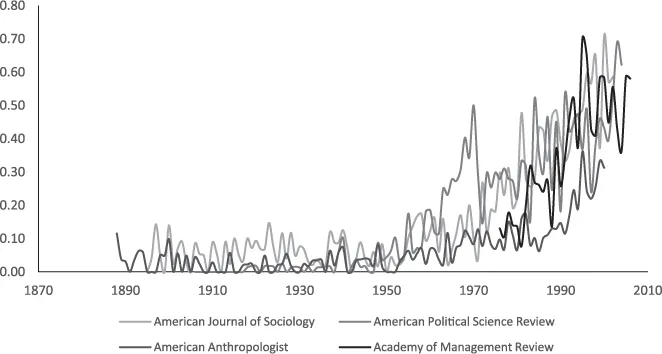
Fig. 1 reports the proportion of articles that contain the word actor(s) in top journals in four social science disciplines (the American Journal of Sociology, American Anthropologist, American Political Science Review, and Academy of Management Review). Although the journals and disciplines vary in the exact timing of the rapid increase in the use of the term and the proportion of the articles deploying the term, the overall trend is clear: for a long period in the twentieth century, few articles contain the term, but the takeoff began in the early 1970s and all journals saw a rapid growth into the 1980s and through the 2000s.
Fig. 1 represents a real scholarly phenomenon, and yet defies an easy interpretation as several factors might be in play. Setting aside what scholars mean by the term actor, one interpretation could be that the proliferation of actor in social science journals reflects changes in the real world over the last several decades. Social scientific accounts of the contemporary globalizing world, indeed, argue that globalization has fundamentally reshaped the social landscape of contemporary societies. Literally, globalization means the opening up and expansion of new space for organization and organizing beyond the national horizon (Bromley & Meyer, 2016; Djelic & Sahlin-Andersson, 2006; Drori, Meyer, & Hwang, 2006; Meyer & Bromley, 2013) shifting the gravitational balance between the state and non-state actors. At the same time, globalization has also involved both the scientization and rationalization of global and other environments as well as the legitimation of the human person and their rights and capacity to organize and mobilize. The rapid advancement of natural and social sciences has rendered the world more knowable, and, therefore, safe and ripe for human intervention. The empowerment of the human person, at the same time, has pushed the locus of action and organization out of the state to the rest of the polity and to civil society and markets. At the turn of the millennia, Slaughter (2002, pp. 12–13) identified the central phenomenon in the preceding decades in which globalization accelerated: “the proliferation of actors in the international system above, below, beside and within the state.”
Fig. 1. The Rise of Actors in the Social Sciences.
The rapidly expanding transnational realm has seen the emergence and expansion of international and supranational organizations including non-governmental organizations in a variety of spheres from science to humanitarian aid to the environment and to sports, to name a few (Boli & Thomas, 1999; Djelic & Sahlin-Andersson, 2006). The proliferation of actors under globalization, however, has not been limited to the transnational space and has occurred across all levels of society, involving the changing status of the state as the primary actor and the rise of the rest (Drori et al., 2006; Drori, Meyer, & Hwang, 2009). Although no longer the central actor that it once was and much tamed and diminished from the heyday of the nation-state system, the state continues to be a relevant, if not vital, actor (Evans, 1997; Mann, 1993). Sharing the stage, at the same time, are other actors. Within bureaucracy, state power and authority have devolved to lower level governments (to provincial to local governments) and state agencies and administrative units have become much more autonomous and empowered organizations, particularly under new public management (Brunsson & Sahlin-Andersson, 2000). Outside state bureaucracy, the formal organization has penetrated into hitherto informal domains and rationalized and transformed informal groups into organized actors at a phenomenal pace in a broad array of social, economic, and political spheres (Drori et al., 2006, 2009; Meyer & Bromley, 2013). Multinationals extend their ubiquitous presence to every corner of the world in search of profits and productivity and have expanded the global market. Nonprofits and voluntary associations from local neighborhoods to global (and virtual) communities enact good citizenship and (re)produce civil society (Sampson, McAdam, MacIndoe, & Weffer-Elizondo, 2005). In this worldwide organizational revolution, the human person is celebrated and apotheosized as the primary actor driving much of organization and organizing (Meyer & Jepperson, 2000).
Actor as a concept has come to denote an array of entities across levels of society in part due to the changes in the empirical world. The term has also acquired varied meanings and found both theoretical and methodological uses. For instance, exchange theory, according to Molm (2001, pp. 260–261), is a general theory that applies to both micro- and macro-levels. Actor denoting entities from micro to macro levels allows the theory to be flexible:
Participants in exchange are called actors. Actors can be either individual persons or corporate groups, and either specific entities (a particular friend) or interchangeable occupants of structural positions (the president of IBM). This flexibility allows exchange theorists to move from micro-level analyses to interpersonal exchanges to macro-level analyses of relations among organizations.
The minimal membership requirement for belonging in this broad category is participating or being able to participate in exchange, but members are as varied as a friend or the president of IBM or corporate groups.
In their seminal work on social network analysis, similarly, Wasserman and Faust (1994, p. 17) illustrate the term’s use in the methodological literature:
Social network analysis is concerned with understanding the linkages among social entities and the implications of these linkages. The social entities are referred to as actors. Actors are discrete individual, corporate, or collective social units. Examples of actors are people in a group, department wi...