This
book provides theoretical and practical insights from across the world on the
construct of career sponsorship. It lays out strategic game plans for how the
aspiring manager, the senior leader and the wider organisation can leverage
sponsorship, enabling individuals to achieve career success while contributing
to organisational objectives. It also illustrates the broader implications of
sponsorship as an investment in social relations and a form of modern social
capital.
eBook - ePub
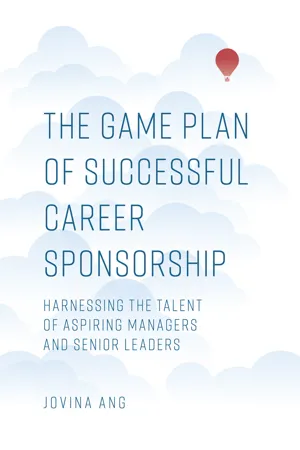
The Game Plan of Successful Career Sponsorship
Harnessing the Talent of Aspiring Managers and Senior Leaders
- 220 pages
- English
- ePUB (mobile friendly)
- Available on iOS & Android
eBook - ePub
The Game Plan of Successful Career Sponsorship
Harnessing the Talent of Aspiring Managers and Senior Leaders
About this book
The career sponsorship relationship is a reciprocal and mutually
beneficial relationship from which both the sponsor and sponsee can benefit.
Jovina Ang presents new and comprehensive insights into career sponsorship,
combining both the perspectives of the sponsee and sponsor to develop a model
of career sponsorship and a framework for career success. She also explores how
career sponsorship is different from mentorship and coaching, how the
sponsorship relationship initiates and evolves over time, and the positive and
negative outcomes that can arise from career sponsorship.
Information
Chapter 1
The Case for Sponsorship
Forget a mentor. Find a sponsor.
This is one piece of advice that career strategist Sylvia Ann Hewlett has been giving to women across the world (Hewlett, 2013). Women have been trailing men in career advancement because it was found that women, in general, have access to mentors rather than to sponsors. In contrast, men, in general, have greater access to sponsors – senior leaders with power and influence who are willing to advocate for you – which is why men still get more promotions than women (Ibarra, Carter, & Silva, 2010).
Despite the focus from governments and organisations driving advancements in education, health and employment for women for over 30 years (Tuminez, Duell, & Majid, 2012), there still exists a gender imbalance whether you look at labour participation rates or representation of women at the top of the corporate ladder. If we continue at this rate, it is estimated that it would take 217 years to achieve gender parity.1
Education has often been thought of as the gender parity equaliser. There are more educated women today compared to a generation ago. In some countries, there are more tertiary educated women than men, for example, in the United States2 and Singapore3. However, education does not seem to have much of an effect on gender parity as women still trail men at the top of the corporate ladder. In the United States, only 6.4 percent of CEOs of the Fortune 500 companies are women.4 Even though the percentage of female CEOs is higher in Singapore, the number is still small as women represent only 15 percent of CEOs of the publicly listed companies.5
Women tend to drop off the corporate ladder or experience career stagnation around the mid-level stage, around the time when they would like to start a family. The ‘drop off’ figures are astonishingly high. According to Tuminez, Duell and Majid (2012), these figures can be as high as 70 percent in Japan, 53 percent in China, 49 percent in Hong Kong and 46 percent in Singapore at the mid-management level. McKinsey (2011) reported even higher attrition figures at the mid-management level. In a pan-Asia study, figures of 94 percent in South Korea, 91 percent in India and 89 percent in Japan and Malaysia were reported. These figures show that many women hold themselves back and under-invest in their careers at the mid-management level – the level that coincides with the stage of their lives to address their maternal instincts and desires. As such, many women find their career stalling from this level onwards.6
Theories abound as to why women do not make it to the top. Ibarra and Obodaru (2009) called women's inability to formulate a vision or lack the ‘vision thing’ as one prohibiting barrier. Others cited a long list of barriers including a lack of family-friendly policies, the old boys' club, unconscious gender bias, inherent culture and values, work-life balance, workplace politics, a lack of sponsorship and social capital.
Women tend not to ‘lean in’. Sheryl Sandberg (2013), Chief Operating Officer of Facebook, coined this business motto to encourage women to press ahead, to project confidence and to ‘sit at the table’ so that they can be seen and heard – which are the necessary steps to move up in the business world. Perhaps a lack of the lean in attitude is one reason why a third of high potential women are ambivalent about getting ahead in their careers (Francesco & Mahtani, 2011).
Women are also mired in the ‘sticky floor’. The sticky floor can be viewed as the opposite of the glass ceiling. The sticky floor syndrome comes from a mind-set of self-doubt and self-deprecating. In general, compared to men, women tend to doubt their capability more (Ehrlinger & Dunning, 2003). As such, they undervalue their self-worth. Because of this mind-set, women are left rooted to the floor, and they modify their ambitions for they are afraid to move ahead and reach new heights in their careers.
The proverbial glass ceiling is another barrier that women face. The glass ceiling is defined as the ‘invisible, culturally embedded assumptions and beliefs about the skills and competencies of women’ that prevent women from moving ahead (Elacqua, Beehr, Hansen, & Webster, 2009; Eriksson-Zetterquist & Styhre, 2007; Meyerson & Fletcher, 2000). The glass ceiling is so dense that even to this day, very few women have been able to shatter the glass ceiling and make it to the very top of organisations.
In analysing these glass ceiling ‘shatterers’, there's one thing that is clear. These women have sponsors who have been able to make a huge difference to their careers. These sponsors have been seen to give them a career break, to open doors to opportunities or to advocate for them.
Sheryl Sandberg, Chief Operating Officer of Facebook, is no exception. Since graduating with an MBA from Harvard Business School, Larry Summers, her former Economics professor helped her to secure her first high-profile role at the World Bank and subsequently, at the Clinton Administration.7 This career head- start helped to solidify the foundation of her career, from which, she was able to build on to soar quickly on the ranks at Google and Facebook.
Closer to home in Singapore, Madam Halimah Yacob's story of success and ascend to the highest public role in Singapore as the country's first female president was largely attributed to the support and advocacy she received from Prime Minister Lee Hsien Loong.8 To help Madam Halimah with her candidacy, Prime Minister Lee went public on why she is the most suitable candidate. He also cleared the roadblocks including putting in place policies to support her appointment.
As for myself, I know sponsorship has benefited me in more ways than one. Sponsorship has not only opened doors for me in my corporate career, but also helped me to secure jobs in the portfolio career I have today. Having experienced sponsorship first-hand, as well as completed a doctoral dissertation on this important topic, I am convinced that sponsorship is the solution to solving this persistent gender problem of too few senior women leaders – a problem that has been ‘plaguing’ both the private and public sectors in Singapore and across the world for decades.
If sponsorship is leveraged well, my research showed that sponsorship is effective in driving upward career trajectory by at least one to two levels on the organisational hierarchy – suggesting that sponsorship can drive more impact compared to the combined initiatives of flexible work arrangements and other career enhancing programs such as mentoring, women leadership programs and networking. To this end, I'd like to call for a focus on sponsorship now rather than later so that collectively, we can accelerate the quest to achieving greater gender parity and solve this issue of too few senior women leaders.
As sponsorship is still a relatively new phenomenon (we were not even talking about sponsorship until a few years ago), my intent in writing this book is to share insights on sponsorship so that more people, especially women, can benefit from it. Given that sponsorship is still in the nascent stage, it is not surprising to find that it is still not widely embraced and practised, as only slightly more than 50 percent of global senior leaders have sponsors (Ang & Reb, 2017). There are also many others who have not heard about the construct of sponsorship in the career context.
As work becomes more boundaryless (Arthur & Rousseau, 1996) with people changing jobs more often across multiple organisations, and short-term based work becomes the norm rather than the exception, sponsorship will matter even more. Other than possessing the required competencies and desired aptitude and attitude, individuals will need sponsorship to help them be noticed and traverse the boundaries of multiple organisations to secure jobs.
Given that sponsorship matters so much for career success or for securing work, what is it exactly? What do sponsors do? How are sponsors different from mentors and coaches? These were some of the questions that I used to frame my doctoral research.
1.1 Overview of My Research Methodology
In order to study sponsorship in detail, I employed the methods of (1) an autoethnography, (2) an inductive qualitative case research study and (3) an online study to uncover insights about this important relationship. The three studies that I conducted were varied and complementary to one another while providing different perspectives to this important construct.
Autoethnography is a self-reflective and a self-reflexive study that is grounded on personal experiences. Even though autoethnography is a study of oneself, through the process of thinking and reflection, this method of study is capable of yielding new insights because it is believed that what we learn may not necessary be the same as what we experience (Wall, 2008). As I wrote my autoethnography, I constantly reminded myself about how I could make my sponsorship experience relevant to aspiring managers and leaders, especially women, so that others may leverage what I've learned and experienced.
The purpose of conducting a case study research was to observe, understand and learn about the phenomenon of sponsorship in a real-life context. Despite a relatively new research methodology, the case study methodology is a rigorous and robust methodology for examining a contemporary phenomenon (Yin, 1992, 2014). The case study methodology can be descriptive, exploratory or explanatory and can draw insights from multiple sources. The case study research I conducted was anchored on mentorship literature and practitioner-oriented articles because I wanted to use the propositions developed from these to signpost my inductive qualitative research. There were 19 sponsors and 16 sponsees in my case study research.
I also conducted an online study to obtain quantitative measures. This online study was administered using Qualtrics survey tool and was targeted at senior leaders – leaders who are at least at the director level on the organisational hierarchy because the extent of responsibility increases significantly from this level onwards. There were 100 participants in this study. For more information about my research methodology, please go to.
1.2 A Coach, a Mentor and a Sponsor
Before going further, let me define the terms – coach, mentor and sponsor. It is without a doubt that people often and still conflate the terms – sponsor and mentor, and on occasions, coach. Some people even assume that the roles of the sponsor, mentor and coach are the same.
The three words – coach, mentor and sponsor, always come together for me. It's syntax. I would probably use them synonymously.
One reason why this misperception exists is that these three roles drive toward one common goal, that is, to enhance the development of an individual. Furthermore, as my research showed, the role of the sponsor builds on the roles of the coach and mentor.
In my definition or what I've experienced, I feel like to be a sponsor, you're like a mentor plus almost. A central part of that sponsor relationship is also to be able to be really candid, honest and have safe conversations where you can really level with one another. So to me, it's almost like, you need to serve as a mentor, plus the sponsorship piece where you personally go out and back that person.
Even the initial scholars of mentorship conflated the terms mentor and sponsor and used these terms interchangeably in a period of more than 30 years (Friday, Friday, & Green, 2004). Part of this misperception can be attributed to the traditional definition of the mentor. The term mentor is not a new one. In fact, the word mentor can be traced back to Homer's Odyssey, a story that dates back to Ancient Greece (Heubeck, West, & Hainsworth, 1990). In this story, a guardian named Mentor was assigned as the advisor and teacher to Odyssey's son Telemachus to help him grow and develop as a person and a leader.
In her seminal work on mentorship, Kram (1983) – one of the gurus of mentorship, defined mentors as senior and experienced individuals who are committed to support and advance their mentees' careers. She also included sponsorship as one of the career functions of mentorship.
Because mentorship and sponsorship have been shown to drive non-mutually exclusive development relationships – mentorship for enhancing competence on the job and providing psychosocial support, and sponsorship for career advancement, Friday et al. (2004) argued that sponsorship and mentorship should be viewed as two different and distinct constructs.
There are also other distinct differences among these three roles of coach, mentor and sponsor.
1.2.1 Coach
So what does a coach do? My research showed that a coach is someone who helps with a specific task, topic, skill or function. Coaching is a helping relationship. It is a relationship that helps individuals to achieve a set of goals or to improve performance. A coach can also help individuals to master new skills or to acquire new knowledge. As communicated by Stephen, one of my research participants, the role of a coach is akin to a parent teaching a child how to ride a bike:
The coach is there to help you to underpin your learning. He or she has been tasked to help you to be proficient in a specific skill to achieve an objective. A coach is like a parent teaching a child how to ride a bike.
In general, organisations engage and hire coaches for their high potential employees or executives to help them develop a specific competency or learn new behaviours so that their coaches can help them to get to the next level of leadership. While organisations may have internal coaches in the Human Resources department, they bring in these external coaches so that learning can be broadened and strengthened for these valued employees.
It is widely known that most hired coaches are psychologically trained. To this end, it is not surprising that Kilburg (1996) found that most coaches use a set of behavioural techniques and methods to achieve the coaching goals.
Coaches go through a rigorous training process to obtain their coaching certification. As an important component of their training, coaches are required to clock coaching hours. There also exist coaches who do not have coaching certification. Instead they have extensive corporate experience.
And a coach is typically a paid role. In contrast, mentors and sponsors are typically non-paid roles. While a coach ‘helps’, a mentor ‘gives’ and a sponsor ‘invests’ (Hewlett, 2013).
1.2.2 Mentor
Mentors are there to give advice (Hewlett, 2013). They give you advice because they like you and they want to help you.
A mentor is a neutral kind of person who is there to help you in any kind of way – he or she is there ...
Table of contents
- Cover
- Title
- Copyright
- Table of Contents
- Dedication
- Acknowledgements
- Preface
- Chapter 1 The Case for Sponsorship
- Chapter 2 The Antecedents of Sponsorship
- Chapter 3 Phases of Sponsor Relationship
- Chapter 4 Reciprocal Nature of the Sponsor Relationship
- Chapter 5 Outcomes from the Sponsor Relationship
- Chapter 6 The Importance of a Home Support System
- Chapter 7 The Sponsorship Model
- Chapter 8 The Capital Framework of Sponsorship
- Chapter 9 Sponsorship and the Development of Women Leaders
- Chapter 10 The Risks of Sponsor Relationships
- Chapter 11 The Dark Side of Sponsorship
- Chapter 12 The Sponsorship Game Plan for the Aspiring Manager
- Chapter 13 The Sponsorship Game Plan for the Senior Leader
- Chapter 14 The Sponsorship Game Plan for the Organisation
- Chapter 15 Sponsorship and its Application to the Future of Work
- Chapter 16 Sponsorship Case Studies
- References
- Appendix: Research Methodology
- Endnotes
- Index
- About the Author
Trusted by 375,005 students
Access to over 1.5 million titles for a fair monthly price.
Study more efficiently using our study tools.
Frequently asked questions
Yes, you can cancel anytime from the Subscription tab in your account settings on the Perlego website. Your subscription will stay active until the end of your current billing period. Learn how to cancel your subscription
No, books cannot be downloaded as external files, such as PDFs, for use outside of Perlego. However, you can download books within the Perlego app for offline reading on mobile or tablet. Learn how to download books offline
Perlego offers two plans: Essential and Complete
- Essential is ideal for learners and professionals who enjoy exploring a wide range of subjects. Access the Essential Library with 800,000+ trusted titles and best-sellers across business, personal growth, and the humanities. Includes unlimited reading time and Standard Read Aloud voice.
- Complete: Perfect for advanced learners and researchers needing full, unrestricted access. Unlock 1.5M+ books across hundreds of subjects, including academic and specialized titles. The Complete Plan also includes advanced features like Premium Read Aloud and Research Assistant.
We are an online textbook subscription service, where you can get access to an entire online library for less than the price of a single book per month. With over 1.5 million books across 990+ topics, we’ve got you covered! Learn about our mission
Look out for the read-aloud symbol on your next book to see if you can listen to it. The read-aloud tool reads text aloud for you, highlighting the text as it is being read. You can pause it, speed it up and slow it down. Learn more about Read Aloud
Yes! You can use the Perlego app on both iOS and Android devices to read anytime, anywhere — even offline. Perfect for commutes or when you’re on the go.
Please note we cannot support devices running on iOS 13 and Android 7 or earlier. Learn more about using the app
Please note we cannot support devices running on iOS 13 and Android 7 or earlier. Learn more about using the app
Yes, you can access The Game Plan of Successful Career Sponsorship by Jovina Ang in PDF and/or ePUB format, as well as other popular books in Business & Formazione e tutoraggio. We have over 1.5 million books available in our catalogue for you to explore.