‘Shamanism’ is a term with specific anthropological roots, but which is used more generally to cover a set of interactions between a practitioner or ‘shaman’ and a spiritual or religious realm beyond the reach of most members of the community. It has often been considered from an anthropological viewpoint, but this book gathers the most recent studies on a subject which has not been comprehensively studied by archaeologists. By putting together experts from two continents who have studied the phenomenon of shamanism, Lands of the Shamans through carefully selected case studies uses the archaeological evidence to construct the shamans’ worldview, landscape and cosmology.
Recent interdisciplinary studies support the idea of the existence of shamanistic representations as long ago as the Middle/Upper Palaeolithic, but at the same time, do not follow developments during the history of humankind. As ethnographic evidence shows, shamanistic activity represents a complex phenomenon that is extremely diversified, its spiritual activity possessing a large variety of expressions in the material culture. In other words, shamanism could be defined as a series of differing spiritual world views which model the material culture and the landscape.
Throughout the archaeological record of all prehistoric and historic periods, there is a series of visual representations and objects and landscape alterations that could be ascribed to these differing world views, many thought to represent shamanistic cognition and activity. The shaman’s landscape reveals itself to the world as one of multifaceted spiritual and material activity.
Consequently, this first book dedicated completely to the shamanistic landscape presents in fresh perspective the landscapes of the lower and upper worlds as well as their phenomenological experience. Case Studies come from Europe, North America and Asia.
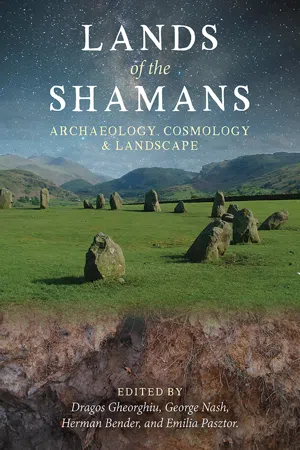
eBook - ePub
Lands of the Shamans
Archaeology, Landscape and Cosmology
- 288 pages
- English
- ePUB (mobile friendly)
- Available on iOS & Android
eBook - ePub
Lands of the Shamans
Archaeology, Landscape and Cosmology
About this book
Information
Subtopic
ArchaeologyIndex
Social SciencesTable of contents
- Cover
- Title
- Copyright
- Contents
- Contributors
- Introduction: Towards a Landscape for Shamans: The Editors
- 1. The Horse as a Shamanic Landscape Device: The Distribution of Equus on Upper Palaeolithic Open-Air Rock Art Sites of the Iberian Peninsula: George Nash and Sara Garcês
- 2. Göbekli Tepe – A Shamanic Landscape: Dragoş Gheorghiu
- 3. Caves and the Sacral Landscape: A Case Study on the Neolithic and Early Aeneolithic Periods in South-east Central Europe: Vladimír Peša
- 4. As Above, So Below: St Melangell and the Celestial Journey: Caroline Malim
- 5. Songs of the Shamans? Acoustical Studies in European Prehistory: Chris Scarre
- 6. Sights and Sounds of Selected Sacred and Shamanic Landscapes: Paul Devereux
- 7. Bronze Age Deposits in the Carpathian Basin – Markers for Spirit-Animated Landscape? The Role of Structured Deposition in Understanding the Worldview of Bronze Age Europe: Emília Pásztor
- 8. Landscape Transformation and Continuity in Shamanic Rock Art of Northern Asia: Ekaterina Devlet
- 9. Shamans’ Landscapes: note sur la psychologie du shaman pre et protohistorique plus particulierement en Eurasie: Michel Louis Séfériadès
- 10. The Mystery of the Bird-Nester: The Shaman Which Lévi-Strauss Did Not Recognise: Enrico Comba
- 11. Bear Myths and Traditions: The Moon and Mounds in North America: Herman Bender
- 12. To Re-Enact Is to Remember: Envisioning a Shamanic Research Protocol in Archaeology: Apela Colorado and Ryan Hurd
Trusted by 375,005 students
Access to over 1.5 million titles for a fair monthly price.
Study more efficiently using our study tools.
Frequently asked questions
Yes, you can cancel anytime from the Subscription tab in your account settings on the Perlego website. Your subscription will stay active until the end of your current billing period. Learn how to cancel your subscription
No, books cannot be downloaded as external files, such as PDFs, for use outside of Perlego. However, you can download books within the Perlego app for offline reading on mobile or tablet. Learn how to download books offline
Perlego offers two plans: Essential and Complete
- Essential is ideal for learners and professionals who enjoy exploring a wide range of subjects. Access the Essential Library with 800,000+ trusted titles and best-sellers across business, personal growth, and the humanities. Includes unlimited reading time and Standard Read Aloud voice.
- Complete: Perfect for advanced learners and researchers needing full, unrestricted access. Unlock 1.5M+ books across hundreds of subjects, including academic and specialized titles. The Complete Plan also includes advanced features like Premium Read Aloud and Research Assistant.
We are an online textbook subscription service, where you can get access to an entire online library for less than the price of a single book per month. With over 1.5 million books across 990+ topics, we’ve got you covered! Learn about our mission
Look out for the read-aloud symbol on your next book to see if you can listen to it. The read-aloud tool reads text aloud for you, highlighting the text as it is being read. You can pause it, speed it up and slow it down. Learn more about Read Aloud
Yes! You can use the Perlego app on both iOS and Android devices to read anytime, anywhere — even offline. Perfect for commutes or when you’re on the go.
Please note we cannot support devices running on iOS 13 and Android 7 or earlier. Learn more about using the app
Please note we cannot support devices running on iOS 13 and Android 7 or earlier. Learn more about using the app
Yes, you can access Lands of the Shamans by Dragos Gheorghiu, George Nash, Herman Bender, Emilia Pasztor, Dragos Gheorghiu,George Nash,Herman Bender,Emilia Pasztor in PDF and/or ePUB format, as well as other popular books in Social Sciences & Archaeology. We have over 1.5 million books available in our catalogue for you to explore.