- 328 pages
- English
- ePUB (mobile friendly)
- Available on iOS & Android
eBook - ePub
About this book
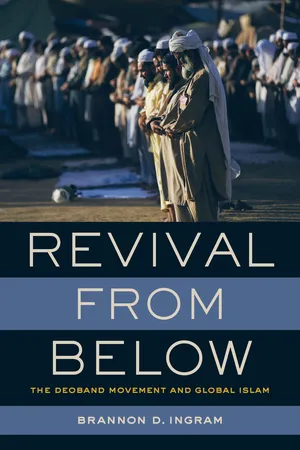
The Deoband movement—a revivalist movement within Sunni Islam that quickly spread from colonial India to Pakistan, Afghanistan, Bangladesh, and even the United Kingdom and South Africa—has been poorly understood and sometimes feared. Despite being one of the most influential Muslim revivalist movements of the last two centuries, Deoband’s connections to the Taliban have dominated the attention it has received from scholars and policy-makers alike. Revival from Below offers an important corrective, reorienting our understanding of Deoband around its global reach, which has profoundly shaped the movement’s history. In particular, the author tracks the origins of Deoband’s controversial critique of Sufism, how this critique travelled through Deobandi networks to South Africa, as well as the movement’s efforts to keep traditionally educated Islamic scholars (`ulama) at the center of Muslim public life. The result is a nuanced account of this global religious network that argues we cannot fully understand Deoband without understanding the complex modalities through which it spread beyond South Asia.
Information
1
A Modern Madrasa
In the aftermath of the failed Indian uprising of 1857, the Government of India Act of 2 August 1858 disbanded the East India Company and transferred sovereignty over India to the queen. On 1 November 1858, Queen Victoria issued the following proclamation to her new subjects:
Firmly relying ourselves on the truth of Christianity, and acknowledging with gratitude the solace of religion, we disclaim alike the right and the desire to impose our convictions on any of our subjects. We declare it to be our royal will and pleasure that none be in anywise favoured, none molested or disquieted, by reason of their religious faith or observances, but that all shall alike enjoy the equal and impartial protection of the law; and we do strictly charge and enjoin all those who may be in authority under us that they abstain from all interference with the religious belief or worship of any of our subjects on pain of our highest displeasure.1
While at first glance this may strike some as a policy of benign noninterference, Karuna Mantena argues that it was, far more, a concession to “native inscrutability.”2 Simply put, the British concluded that the events of 1857 had primarily “religious”—rather than social, political, or economic—causes. From 1857 onward, as Ilyse Morgenstein Fuerst demonstrates, “religion” became the primarily lens through which the British understood their Muslim subjects, and any subsequent resistance to British rule was, necessarily, born of purely “religious” motivations.3
Demarcating a religious space ostensibly free from interference was a strategy of rule the British had adopted elsewhere. Throughout their colonies, from Ireland to India, the British advanced policies of disestablishment—a rule to which the Church of England at home was an exception—facilitating the emergence of “religion” as a private domain of conscience that Muslims and Hindus alike became keen to protect against state encroachment.4 Some of the British, accordingly, saw the Victorian proclamation not so much as constraining British interference in native religious affairs as consigning religion to a “private” domain that facilitated, rather than restricted, Christian missions. The barrister P.F. O’Malley saw the proclamation as authorizing Christian missionary efforts even by an official of the empire, who is “still left to follow in his private capacity the dictates of religious duty, and to assist as he has hitherto done in the great Missionary work.”5
The proclamation also pointed to a new, albeit tenuous, notion of the “secular” in colonial India. Scholars have long dismissed earlier notions of the secular as the decline of religion. They have also challenged more recent notions of the secular as religion’s privatization. Scholars have, most recently, understood the secular as a form of power that distinguishes “religion” from its various others—whether “superstition,” “culture,” “politics,” or something else.6 Following Robert Cover’s dictum that “Every denial of jurisdiction . . . is an assertion of the power to determine jurisdiction and thus to constitute a norm,” Iza Hussin sees the Victorian proclamation as a performative act (“juris-diction”), declaring which spaces would be marked by “religion” and which would remain under the purview of the state.7 Post-1857 discourses of official neutrality toward natives’ “religion” were in large part discourses that named a range of phenomena—institutions, traditions, forms of knowledge—as “religious.” Indeed, as I explore below, the British were willing to support madrasas only if their curricula included “secular,” and not only “religious,” subjects.
In 1866, just a few years after Victoria’s proclamation, the Dar al-‘Ulum Deoband was founded, and it soon began to fill this new space marked off as “religious.” It was precisely within an emergent colonial modernity that the madrasa as a “religious” space and the ‘ulama as a class of “religious” scholars became entrenched in the very identity of the Deoband movement. This chapter explores a number of questions at the origin of Deoband: Why did a movement that claimed to seamlessly revive Islamic tradition emerge precisely at the height of colonial modernity, with all of its political, epistemic, and psychic ruptures? To what extent is the movement’s valorization of “tradition” an outcome of that very modernity? This chapter suggests that it is too simple to view Deoband as “traditional” in some respects (for instance, in terms of accentuating Hadith and Islamic law) and “modern” in others (institutionally and administratively resembling a British college more than a classical madrasa, for example). It proposes, rather, that tradition and modernity are so co-constitutive that Deoband’s traditionalism is what makes Deoband modern. Deobandi valorization of “tradition”—seen, for instance, in its privileging of “transmitted” knowledge (manqulat) above its “rational” counterpart (ma‘qulat), discussed below—is hard to conceive before colonial modernity and attendant discourses of the Indian secular gave new meaning to tradition itself. Moreover, while the texts that Deobandi scholars study are not modern, the idiom through which they communicate that learning to the public is, in part because “the public” itself is largely (though not exclusively) modern—a subject the second and third chapters explore further.8
To be clear, I am not arguing that Deoband is solely the product of colonial modernity. For one, such an argument would grossly overstate the extent to which colonialism shaped the lives of the colonized. Much recent literature on colonialism has, in fact, stressed the limits of colonial power and imperial reach.9 More importantly, it would understate the extent to which the Deoband movement is anchored in texts and discourses that long predate colonialism. I see modernity, therefore, not as something that “happened” to the Deoband movement. It is not a reified “thing” that travels from Europe to India, a “virus that spreads from one place to another,” in Sanjay Subrahmanyam’s words. It is, rather, a “global and conjunctural phenomenon.”10
In highlighting Deoband’s modernity, I seek to complicate standard narratives about Deoband specifically, and madrasas generally, both within and beyond the study of Islam. Even a cursory glance at literature on Islam and modernity reveals that the Deoband movement is typically regarded as, at best, a premodern vestige of medieval learning or, at worst, a stridently antimodern force holding back Muslim progress. Fazlur Rahman, among the most influential internal critics of the Islamic intellectual tradition, saw Deoband as “medieval,” which meant, for him, that it perpetuated stagnant disciplines of learning that shrouded the “élan of the Qur’an” beneath a culture of commentaries and supracommentaries.11 While Rahman’s approach to Muslim modernity has been formative for rethinking Qur’anic hermeneutics,12 approaching phenomena like the Deoband movement through this lens obscures the extent to which the movement has been shaped by modernity.
I speak of “modernity” here in two distinct but intersecting registers. The first comprises the sum total of new ideas, practices, institutions, and socialities that scholars often call “colonial modernity.” In the following, I seek to delineate how Deoband emerged within and against colonial modernity while heeding Frederick Cooper’s warnings against reifying “colonial modernity” as an agent in its own right.13 The second is modernity as a reflexive attitude, a self-conscious distanciation between past and present, especially insofar as it values the present over the past.14 Broadly, I show here how Deobandi scholars were profoundly shaped by the first modality of the modern—institutionally, discursively, and in what they regarded as properly “religious”—even as they consciously rejected “modernity” in the second sense. That is, Deobandis did not understand their movement as a “modern” one, let alone modernist.15 Most Deobandis, and certainly the main characters of this book, understood themselves as anti-modern.16 But in making this claim, we must also be attentive to the ways in which Deobandis understood the very category of the “modern” (jadid). Ashraf ‘Ali Thanvi, for example, conceived modernity in epistemic terms. For him, it was an attempt by certain Muslims to adapt “Islamic” knowledge to Western science. Typified by Sayyid Ahmad Khan (d. 1898), this “modern theology” (‘ilm al-kalam al-jadid) was anathema to Thanvi, an intellectual capitulation to the modern against which he believed the madrasa should serve as a bulwark.17 In short, the Deoband movement is ambivalently modern, thoroughly shaped by, and inseparable from, the contexts of its origin at the height of British imperial domination and the changes—social, institutional, technological, political, economic—that it ushered in, even as many Deobandi scholars resolutely rejected “modernity” as they construed it.
This chapter makes three main arguments: First, the Victorian discourse on religion and religious institutions after 1857 intersected with, and amplified, Muslim scholars’ reimagining of the madrasa as a “religious” space and of the knowledge they had mastered as “religious” knowledge, in contrast to the “useful” secular knowledge promoted by the British. Second, in the wake of Mughal decline and the near evaporation of the traditional patronage networks they had supported, the ‘ulama rebranded themselves as custodians of public morality rather than professionals in the service of the state—a state, of course, that had ceased to exist—that is, a simultaneous de-professionalization and privatization of the ‘ulama through which they took on a more active role in shaping individual subjectivities and public sensibilities. Third, as the British attempted to co-opt the judicial administration of Indian Muslims through the British-Islamic legal hybrid known as “Anglo-Muhammadan law,” they created a legal and ethical vacuum that early Deobandi scholars sought to fill with a highly personalized, individuated notion of Islamic legal norms, pressed into the service of critiquing Sufi devotions and reformulating Sufism itself as a regime of ethical self-fashioning, for which the fatwa and the short primer on Islamic belief and practice became key instruments. This chapter, then, sets up a framework for understanding how the Deobandi ‘ulama conceived of, and engaged with, nascent Muslim publics—a development described in the subsequent two chapters.
DECLINE AND REVIVAL: FOUNDING THE DAR AL-‘ULUM DEOBAND
The Deoband movement emerged in the context of widespread notions that Indian Islam was in a state of abject decline in the nineteenth century. Deobandis were not alone in this view. Narratives of decline, in fact, shaped a wide swath of Muslim intellectual and cultural life in the nineteenth century. The poet Altaf Hussain Hali (d. 1914) mourned the “decay” (tanazzul) of India’s Muslims in his famous Musaddas. The institutions of Muslim greatness had broken down in the face of the West’s rise. “The Ummah has no refuge,” he mourned, “no qazi [judge], no mufti [jurist], no Sufi, no mullah [scholar].”18 For Hali’s close associate Sayyid Ahmad Khan, India’s Muslims had reached a veritable nadir, “the furthest limit of decline, disgrace and baseness.”19
The opening pages of Rashid Ahmad Gangohi’s biography are a veritable litany of decline. His biographer vividly describes the year Gangohi was born, 1828, as one in which Muslims were in the throes of un-I...
Table of contents
- Imprint
- Subvention
- Title
- Copyright
- Contents
- Preface
- Introduction
- 1. A Modern Madrasa
- 2. The Normative Order
- 3. Remaking the Public
- 4. Remaking the Self
- 5. What Does a Tradition Feel Like?
- 6. How a Tradition Travels
- 7. A Tradition Contested
- Conclusion
- Notes
- Bibliography
- Index
Trusted by 375,005 students
Access to over 1.5 million titles for a fair monthly price.
Study more efficiently using our study tools.
Frequently asked questions
Yes, you can cancel anytime from the Subscription tab in your account settings on the Perlego website. Your subscription will stay active until the end of your current billing period. Learn how to cancel your subscription
No, books cannot be downloaded as external files, such as PDFs, for use outside of Perlego. However, you can download books within the Perlego app for offline reading on mobile or tablet. Learn how to download books offline
Perlego offers two plans: Essential and Complete
- Essential is ideal for learners and professionals who enjoy exploring a wide range of subjects. Access the Essential Library with 800,000+ trusted titles and best-sellers across business, personal growth, and the humanities. Includes unlimited reading time and Standard Read Aloud voice.
- Complete: Perfect for advanced learners and researchers needing full, unrestricted access. Unlock 1.5M+ books across hundreds of subjects, including academic and specialized titles. The Complete Plan also includes advanced features like Premium Read Aloud and Research Assistant.
We are an online textbook subscription service, where you can get access to an entire online library for less than the price of a single book per month. With over 1.5 million books across 990+ topics, we’ve got you covered! Learn about our mission
Look out for the read-aloud symbol on your next book to see if you can listen to it. The read-aloud tool reads text aloud for you, highlighting the text as it is being read. You can pause it, speed it up and slow it down. Learn more about Read Aloud
Yes! You can use the Perlego app on both iOS and Android devices to read anytime, anywhere — even offline. Perfect for commutes or when you’re on the go.
Please note we cannot support devices running on iOS 13 and Android 7 or earlier. Learn more about using the app
Please note we cannot support devices running on iOS 13 and Android 7 or earlier. Learn more about using the app
Yes, you can access Revival from Below by Brannon D. Ingram in PDF and/or ePUB format, as well as other popular books in Theology & Religion & Indian & South Asian History. We have over 1.5 million books available in our catalogue for you to explore.