“Some guys don’t break any rules. They do their jobs, they go to school, they don’t commit any infractions, they keep their cells clean and tidy, and they follow the rules. And usually those are our LWOPs [life without parole]. They’re usually our easiest keepers.”
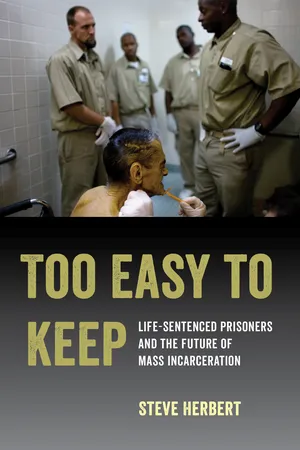
Too Easy to Keep directs much-needed attention toward a neglected group of American prisoners—the large and growing population of inmates serving life sentences. Drawing on extensive interviews with lifers and with prison staff, Too Easy to Keep charts the challenges that a life sentence poses—both to the prisoners and to the staffers charged with caring for them. Surprisingly, many lifers show remarkable resilience and craft lives of notable purpose. Yet their eventual decline will pose challenges to the institutions that house them. Rich in data, Too Easy to Keep illustrates the harsh consequences of excessive sentences and demonstrates a keen need to reconsider punishment policy.
eBook - ePub
Too Easy to Keep
Life-Sentenced Prisoners and the Future of Mass Incarceration
- 184 pages
- English
- ePUB (mobile friendly)
- Available on iOS & Android
eBook - ePub
About this book
Information
Publisher
University of California PressYear
2019Print ISBN
9780520300514
Edition
1eBook ISBN
9780520971875
CHAPTER ONE
Becoming Easy
Four months after his eighteenth birthday, Leonard clubbed an elderly neighbor to death as part of a robbery. He was convicted of aggravated murder and sentenced to life without parole.
When I first met him, he was fifty-one and in his twenty-fifth year of residence at the Washington State Reformatory. Soft-spoken and articulate, he talked openly about the person he was when first incarcerated. He was, in his terms, a “real knucklehead,” focused entirely on his own needs: “I was real selfish. Wanted to do everything my way. Which was why I was in prison. So, I got a lot of write-ups in the beginning. In the beginning, it was rough. I was in and out of the hole for various reasons.”1 This selfish orientation, he said, changed rather suddenly one day when he was twenty-four:
The change came from inside of me, and that’s what happened for me. I can’t explain it. It was just—I know when it was, it was 1988. I was smoking a joint in the yard. I was smoking cigarettes at the time. I entered this Iron Man contest in the yard, where you had to run across the yard and do all these different things and, hopefully, make it back to finish the whole thing. Well, I did it, and it just about killed me. I was so out of shape from smoking and doing the marijuana, all that kind of stuff. After the race, I just kind of sat back in the yard looking around, watching everybody do their thing. From that point forward, I decided, I wasn’t going to do anything like that anymore. It was an eye-opener for me. Since that time, I have never smoked a cigarette or any marijuana. That was my last year that I got write-ups. I’m not a perfect guy, don’t get me wrong, but my life has changed since ‘88.
In his account, what occurred was simple: “I think that I just grew up. I finally—I grew up. It took me until I was twenty-four years old to realize that and grow up and start doing the right thing.” For Leonard, growing up meant focusing on “things that are good,” most notably steady employment and caring family relations.
His maturity, he said, was keyed to his transcending his selfish nature: “I just didn’t care about other people. I just cared about myself, what I could get for me. Everything was self-centered like that. That was the cause of it. When I committed my crime, I didn’t think about the consequences or who I was hurting or anything like that. I just wanted some money. So, I didn’t really think about that kind of stuff. It was just all about me. Me, me, me. But then I realized it really wasn’t about me, and change started happening.” Part of the change described by Leonard involved the work he does for others, most notably the members of his family. He proudly mentioned his marriage of twenty years and his parenting of his four adopted children, which he tried his best to accomplish from prison. He also noted his artwork that he donated to charities, and his work building frames for housing that will go to the impoverished. And, like other lifers, he mentioned the mentoring he provides to younger inmates. From his perspective, he was, as a lifer, part of an established and influential group in prison. As “easy keepers,” they provided advice to youngsters and stability to the institution as a whole:
LEONARD: They intervene between people that are getting ready to fight. Or they talk people out of the drugs. They talk people into going to school or programming. Getting a job. Getting them off the yard. A lot of the guys, they just like to go to the yard all day. That’s all they do, just lay around the yard and go to breakfast, lunch, and dinner. They don’t do anything else. Their whole day is about recreation. A lot of the lifers try to get them focused on at least one class or a program of some type. Getting more involved in the library. Going to church. Things like that.
HERBERT: Why do you think they do that?
LEONARD: Because I think they see a lot of what people are doing in here, the younger guys. I think they see a lot of themselves when they were younger, and they know where they ended up. I think that a lot of people struggle with that and want to do what they can to make sure that somebody else doesn’t end up in the same position. That’s what I believe. I’ve asked a lot of people about it, and they’ve said—not in those exact words—that’s what they’re doing.
For his part, Leonard struggles with the reality of his sentence and with his belief that only a change in law will prevent him from dying in prison. He copes as well as he can through adherence to a simple credo: “I’ve shed a lot of tears over the years, over being in prison. A lot. I still do. You never know when you’re going to do something that somebody else is seeing you do, that you don’t even realize, that may change their life. By doing the right thing. So I’m always trying to think I’m being watched by somebody, and always doing something. I just try to do the right thing. I do.”
BECOMING AN EASY KEEPER
Although Leonard’s degree of self-understanding is unusual, his story is not. The themes he highlights—a general maturation, a recognition that his actions have consequences, a desire to better those around him, a need to retain hope—are ones echoed regularly by life-sentenced prisoners. Many of the lifers I met could describe when and how they became easy keepers. They regularly referenced the same signposts in their maturation process.
Looked at one way, the transitions Leonard describes are nothing special: most humans mature with age. Yet such transitions are not easily accomplished in prison environments, where much more could be done to foster personal growth. I use chapter 2 to document the impediments that are part of everyday prison life. For now, I wish to highlight the significant social accomplishment represented by those personal transformations that regularly occur for lifers like Leonard.
At the age of fifty-one, and with the benefit of hindsight, Leonard can see the pivotal moment when he recognized the need to make some fundamental changes. Although the interviewees never described the exact same progression, there were consistencies across their stories. Many described a general maturation through which they gained a new perspective on themselves and their social relations. Part of this transformation included a recognition that they were not isolated individuals but instead were situated in interdependent relations with others. Like Leonard, they recognized that maintaining a highly individualized focus, perhaps a selfish one, was a too-constricted approach to life. Better to see themselves not as social atoms but as members of social groups. Key for many prisoners was an acknowledgment of the impacts of their conviction and incarceration on members of their families. From this recognition of interdependency came another: that if they necessarily acted in ways that affected others, they could act as a force for good rather than harm. This meant, in daily practice, that many lifers sought to improve the circumstances of those around them. Most commonly, lifers focused on younger prisoners with fixed release dates. Partly owing to a sense of altruism, but also to a desire to atone for their past offenses, many lifers seek to mentor in hopes that their younger brethren will not return to prison when released.
It is not my goal here to explain with any precision just why these transformations occur. There is now a large and rich literature on the factors that lead criminal offenders to desist from wrongdoing, which I do not wish to exhaustively review or arbitrate here.2 I do, however, take considerable inspiration from the work of Shadd Maruna and like-minded others, who focus on the importance of self-narrative to the process of personal change.3 The shift away from a past of criminal offenses, Maruna argues, is significantly anchored in the development of a new story about oneself. Importantly, that story can include prior wrongdoing but also a future of greater promise and purpose. Maruna’s emphasis on narrative helps make sense of the interviews I analyze here, particularly his focus on how ex-offenders often develop a “redemptive script.” This emphasis on redemption allows them to construct a new self-image, one that uses their past wrongdoing as a platform upon which to build a better self.4 Notably, this better self is often focused on generative projects like mentoring and counseling.5 As I describe below, such projects were frequently essential to lifers’ sense of purpose.
Importantly, my findings about personal changes within the lifer population are consistent with other, similar, interview-based studies.6 Indeed, the consistency of these findings is striking. Like others who interviewed prisoners with life or otherwise long sentences, I found a group of individuals who were largely well-adjusted, who created few problems for prison staff, and who worked to improve the communities of which they were a part.7 This clearly suggests that lifers very commonly resist the temptation to give up on themselves and descend into lassitude and depression.8 Easy keepers, in other words, are common.9
That so many lifers become easy keepers should not, however, minimize the significance of the accomplishment. Many lifers, particularly those who were incarcerated at a young age, come to recognize that a more mature approach to life is in their best interest. This maturation is, for many, closely connected to a recognition that they necessarily possess interdependent relations with others and, thus, unavoidably affect other people. This growing realization of interdependency is significant in its own right, but it also births an important corollary—that they can influence others positively instead of negatively. This, in turn, generates various efforts by lifers to improve the circumstances of others, most critically the younger prisoners with whom they live. These altruistic efforts have the added benefit of enabling lifers to retain some form of hope, which they all indicated was critical for their well-being.
The route to becoming an easy keeper is thus fairly well-worn, with some consistent markers for those who travel it. This is not to suggest that passing along the route is itself easy. It is not, as I emphasize in chapter 2. For now, the question is: how does “easy” become possible?
“IT WAS LIKE A CLICK”: MATURATION IN THE LIFE-SENTENCED PRISONER
Rudy got a life-without-parole sentence while still a teenager for his involvement in the murder of a family of four. When he first entered prison, he was so scared that he sought the protection of a prison gang based on his ethnicity. His gang involvement, he said, meant that he engaged in frequent violence, which resulted in several trips to isolation.10 He developed what he described as a well-earned reputation as someone willing to fight and, with it, some measure of prestige. But, with time, he reconsidered:
At that time, I was getting older—I was more in my twenties, early twenties—and little by little things started. I started to see the outlook on everything. I started seeing everything for what it was. At the age of twenty-five, it was like a click [snaps fingers]. Literally, I was walking by one day and just [snaps fingers]—it felt like a click. And [with] that little click, I started to realize: “Wait a minute.” My eyes opened up. From that time, I started realizing, “Man, a lot of the stuff I’m doing is really stupid.” Like, there’s some situations where I could let go of the issue instead of making it bigger than it has to be. And I started noticing this from the age of twenty-five until now. I started realizing a lot of this stuff really just is stupid. It’s young, dumb stuff, and I don’t need that no more.
As a result of his new outlook, Rudy said, he began to avoid violence. Unsurprisingly, his disciplinary record changed, as well.
This year, I’ll be thirty-seven. And if you ever looked at my record, you will see from the first ten-something years I was very violent. And then, from every year after that, little by little, I would go to work, I wouldn’t even fight that year. I went a whole year—no fights, no nothing, no problems. I’ve got almost three, four, years now, almost, without getting any major infractions. I’ve grown up. I didn’t like the way I acted back in those days. But that’s what adults do. I became an adult after a while.
Like Leonard, Rudy described a seemingly sudden realization in his midtwenties that his approach to life was shortsighted. While his interest in a gang’s protection made sense when he was young and vulnerable, with age he saw the harm he was doing to himself with his violent ways.11
Rudy’s story is common among those who receiv...
Table of contents
- Title
- Copyright
- Contents
- Preface and Acknowledgments
- Introduction: The Easy Keeper
- 1. Becoming Easy
- 2. Being Easy Isn’t Easy
- 3. When Easy Becomes Hard
- 4. Let’s All Be Easy
- Notes
- References
- Index
Trusted by 375,005 students
Access to over 1.5 million titles for a fair monthly price.
Study more efficiently using our study tools.
Frequently asked questions
Yes, you can cancel anytime from the Subscription tab in your account settings on the Perlego website. Your subscription will stay active until the end of your current billing period. Learn how to cancel your subscription
No, books cannot be downloaded as external files, such as PDFs, for use outside of Perlego. However, you can download books within the Perlego app for offline reading on mobile or tablet. Learn how to download books offline
Perlego offers two plans: Essential and Complete
- Essential is ideal for learners and professionals who enjoy exploring a wide range of subjects. Access the Essential Library with 800,000+ trusted titles and best-sellers across business, personal growth, and the humanities. Includes unlimited reading time and Standard Read Aloud voice.
- Complete: Perfect for advanced learners and researchers needing full, unrestricted access. Unlock 1.5M+ books across hundreds of subjects, including academic and specialized titles. The Complete Plan also includes advanced features like Premium Read Aloud and Research Assistant.
We are an online textbook subscription service, where you can get access to an entire online library for less than the price of a single book per month. With over 1.5 million books across 990+ topics, we’ve got you covered! Learn about our mission
Look out for the read-aloud symbol on your next book to see if you can listen to it. The read-aloud tool reads text aloud for you, highlighting the text as it is being read. You can pause it, speed it up and slow it down. Learn more about Read Aloud
Yes! You can use the Perlego app on both iOS and Android devices to read anytime, anywhere — even offline. Perfect for commutes or when you’re on the go.
Please note we cannot support devices running on iOS 13 and Android 7 or earlier. Learn more about using the app
Please note we cannot support devices running on iOS 13 and Android 7 or earlier. Learn more about using the app
Yes, you can access Too Easy to Keep by Steve Herbert in PDF and/or ePUB format, as well as other popular books in Social Sciences & Criminology. We have over 1.5 million books available in our catalogue for you to explore.