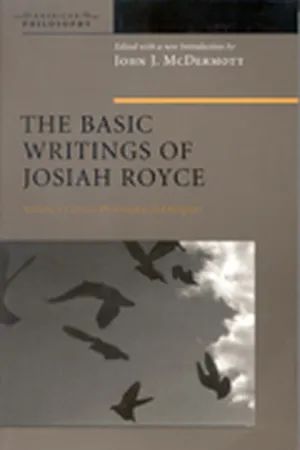
Now back in print, and in paperback, these two classic volumes illustrate the scope and quality of Royce's thought, providing the most comprehensive selection of his writings currently available. They offer a detailed presentation of the viable relationship Royce forged between the local experience of community and the
demands of a philosophical and scientific vision of the human situation.The selections reprinted here are basic to any understanding of Royce's thought and its pressing relevance to contemporary cultural, moral, and religious issues.The Basic Writings of Josiah Royce, Volume I: Culture, Philosophy, and Religion is available from the publisher on an open-access basis.
eBook - ePub
The Basic Writings of Josiah Royce, Volume I
Culture, Philosophy, and Religion
- 656 pages
- English
- ePUB (mobile friendly)
- Available on iOS & Android
eBook - ePub
About this book
Information
Part V
The World and the Individual
The opening essay of the present section gains its importance from Royce’s concern for “social consciousness.” A somewhat muted theme during the period when he utilized the language of the “Absolute,” Royce’s developing insight to the irreducible social dimension of human consciousness and experience should not be blocked from view.1 It is unfortunate that Royce did not fulfill his “Plan of a Book” on The World and the Social Consciousness (Royce Papers, Harvard University Archives, Widener Library, folio 97).
The remaining essays in this section are taken from Royce’s Gifford Lectures of 1899. He received this opportunity when William James temporarily declined the invitation due to a serious psychological affliction. The resultant volumes by Royce, The World and The Individual, are perhaps his best known work. They are, however, often bloated in style and signify Royce’s last effort at vast metaphysical synthesis. From his opening discussion of the meaning of an “Idea,” Royce goes on to hold that “the empirical world is a whole, a life fulfilling the purposes of our ideas. It is that or it is nothing.” (WI, 1:368; Chapter 18 of this volume) In order to sustain this view, Royce’s theory of being requires an aggressive statement of the unity of the “Absolute Experience” and our potential knoweldge of the universe as a whole. “Our finitude means, then, an actual inattention,—lack of successful interest, at this conscious instant, in more than a very few of the details of the universe. But the infinitely numerous other details are in no wise wholly absent from our knowledge even now.” (WI, 2:59; Chapter 19 of this volume) Royce, therefore, sets for himself the herculean task of having a philosophical doctrine provide total accountability for the nature of our experience.
Although Royce contends that The World and The Individual remains a basis for his subsequent thought (PC, 1968 ed., p. 38), an examination of his logic and theory of interpretation will show that he later recognized the need to provide, at the very least, more explicit recognition of the constructive character of human experience in the formulation of meaning. Given this development, there are at least two other reasons why we should read The World and The Individual. First, it is metaphysics in the grand style and certainly the supreme example of an American philosopher doing “System” philosophy. Second, and considerably more significant, the philosophical sophistication and awareness of experiential complexity, so characteristic of Royce’s mature thought, as found in The Philosophy of Loyalty, his logic, and The Problem of Christianity, depends directly on the nature of the undertaking in The World and the Individual. Readers of the later work of Royce should see the problems as he saw them. It is with this in mind that I have presented the core of his Gifford Lectures in the essays reprinted below.2
1 In this regard, it is virtually unknown that Royce’s thought is considerably anticipatory of the work of George Herbert Mead, who studied with Royce during the academic year, 1887–88. For an exception to this judgment, see Paul E. Pfuetze, The Social Self (New York: Bookman Associates, 1954), p. 104, n. 25; p. 106, n. 49; p. 220, n. 224.
2 Readers may wonder why I have not included the intriguing “Supplementary Essay” to The World and The Individual, vol. 1. Aside from the burdensome and painful problem of space, which afflicts all efforts of this kind, I have omitted it for the following reasons. First, it is partially a polemic against the thought of F. H. Bradley and assumes some knowledge of this dispute. Royce’s reference is to Bradley’s Appearance and Reality (Oxford: Oxford University Press, 1893). Second, the “Essay” is an unusually extended effort to deal with one question, namely, the logical soundness of the “concept of the actual Infinite.” In its quasi-logical form, the “Essay” only hints at Royce’s later masterful effort to deal with this problem under the terms of formal logic. The concluding essays of part VI, vol. 2, of the present work are more representative of Royce’s intention and his ability to deal with this issue.
15
Self-Consciousness, Social Consciousness and Nature
The ultimate purpose of the present paper is to reach, and, in closing, to sketch some views as to the relation of Man to Nature. By way of introduction, I must first define the place of my inquiry in the general catalogue of philosophical questions, and must then state the theses that I mean to defend.
There are two great divisions of philosophy—theoretical and practical. The present paper concerns itself with a matter belonging to theoretical philosophy. Within the range of theoretical philosophy, however, one may distinguish between the discussion of the ultimate problems of knowledge and of truth, and the treatment of the more special theoretical problems suggested by our human experience. General Epistemology and general Metaphysics have to do with what can be made out about the deepest nature of our knowledge and the final constitution of the universe. But there are, within the scope of theoretical philosophy, other problems relating to the constitution of our finite world—problems which are often grouped together as the questions of special metaphysics, or of the Philosophy of Nature—a doctrine to which has also sometimes been given the name Cosmology. The problems of Cosmology are such as the questions: What is the truth behind what we mortals call Nature, or the physical world? What are finite minds, and how are they related to physical reality? What, if any, is the philosophical interpretation to be given to the doctrine of Evolution?
Now the present paper, as I just said, is an inquiry within the region of theoretical philosophy. Within that region my investigation, however, concerns itself only secondarily with the ultimate problems of general metaphysics. I shall chiefly aim to reach, before I close, light as to a certain problem of philosophical cosmology. Here about us, as we all admit, whatever our ultimate metaphysical views, is the natural world, the world that appears to our senses—a world manifesting some sort of finite, and obviously, as we mortals see it, some sort of highly fragmentary truth. Now man, as we phenomenally know him, appears as a part of nature, a product of nature, a being whose destinies seem to be the sport of purely physical laws. The problem that this paper aims in the end to approach is: What is the meaning of this phenomenal relation of man to nature?
Now, as I need not say, a real answer to this question must lead us past, if not through, the realms of the most ultimate and general sort of metaphysical inquiry. Nor will this paper wholly escape the responsibility of considering to some extent, as we proceed, such ultimate matters. But on the other hand, all philosophical students are used to the fragmentary, and I shall not here attempt completeness. Such general metaphysical views as come in sight in this paper will remain, after all, of rather secondary importance. I shall attempt only to clear some of the way that leads from the study of man as we ordinarily know him toward the regions where general philosophy attempts to grapple with the ultimate issues of life, and with the rational constitution of the universe.
The relation of man to nature—this, then, is our immediate topic. But why, you may ask, if such is the purpose of this paper, have I chosen my actual title? Why does a study of the relations of Self-consciousness and Social Consciousness seem adapted to throw light on the cosmological problem of the relation of human beings to natural processes? To this preliminary question let us at once address ourselves.
I
The philosophical examination of man’s social consciousness has been left, rather exclusively, in the hands of the students of ethics. Even the psychologists, until very recently, have paid a very inadequate attention to the distinctively social aspects of their science. It is far too customary, in consequence, for the ethical philosophers themselves to begin their study of the duties of man with a very abstract view of the nature of the social consciousness, and of its original relations to our self-consciousness. We hear nowadays, for instance, in popular philosophy, a great deal about the supposed primal and natural conflict between Egoism and Altruism. Egoism, so we are told, is the original human tendency—the natural and innate bias of any one of us mortals. And it is so because, as soon as one becomes self-conscious, i.e., aware of one’s Ego, one finds one’s self, as an animal, instinctively selfish. The practical tendency of the self-preserving animal organism, translated into the terms of self-consciousness, becomes deliberate Egoism. Hence the moral problem is to make a man altruistic. The philosophical problem of ethics, on the other hand, is to show a man why he ought to be altruistic, i.e., why Egoism, which is naturally prior and apparently self-evident, ought rationally to be subordinated, upon reflection, to its derived and slowly acquired natural opponent, Altruism.
But now, I insist that, as a fact, this far too customary notion of a natural and fatal opposition between self-consciousness, Egoism, and our socially determined and derived Altruism, is also far too falsely abstract a notion. There are evil tendencies in plenty in human nature, and common sense has a very wholesome meaning in mind when it condemns our natural selfishness. But when one defines in philosophical terms our evil tendencies, or undertakes to analyze in an ultimate sense what common sense knows as our selfishness, one does ill if one merely substitutes abstract distinctions for our concrete and passionate life-conflicts. As a fact, the abstract opposition, Ego and Alter, or Egoism and Altruism, ill suggests the meaning of the opposed ethical aims that struggle in us. This whole customary popular and philosophical opposition between a man’s self-consciousness, as if it were something primitive and lonely, and his social consciousness, as if that were something acquired, apart from his self-consciousness, through intercourse with his fellows, is false to human nature. As a fact, a man becomes self-conscious only in the most intimate connection with the growth of his social consciousness. These two forms of consciousness are not separable and opposed regions of a man’s life; they are thoroughly interdependent. I am dependent on my fellows, not only physically, but to the very core of my conscious self-hood, not only for what, physically speaking, I am, but for what I take myself to be. Take away the Alter from consciousness, and the conscious Ego, so far as in this world we know it, languishes, and languishing dies, whatever may become of the organism in whose fortunes this Ego, while it is known to persist, seems to be involved. Hence, I am not first self-conscious, and then secondarily conscious of my fellow. On the contrary, I am conscious of myself, on the whole, as in relation to some real or ideal fellow, and apart from my consciousness of my fellows I have only secondary and derived states and habits of self-consciousness. I cannot really will to preserve the Ego, then—this derived conscious creature of the habits of my social consciousness; I cannot really will to preserve the Ego, without also willing to preserve and to defend some sort of Alter, and some sort of relation to my fellow who is this Alter, and upon whom my conscious Ego depends for its very life. It is only in abstraction that I can be merely egoistic. In the concrete case I can only be egoistic by being also voluntarily altruistic, however base may be the sort of Altruism that I chance to prefer. I can aim, for instance, to be a political “boss.” That appears to be a very egoistic aim. But the political “boss” exists by the suffrages of interested people, and must aim at their conscious, even if illusory, sense of advantage insofar as he wills them to be sincerely interested. I can will to be a flattering demagogue, admired for vain show by a crowd of fools. The end is selfish; but it also involves wishing to be agreeable in the eyes of many people; and even a saint might on occasion wisely include so much of the demagogue’s aim in his own vastly different context of voluntary life. The tyrant wills the lives and even the limited good fortune of his subjects, for without powerful and numerous and even devoted subjects he would be no tyrant. The master wills his slave’s preservation, even in willing to preserve his own mastery. Even the thief or the defaulter wills that the hoarding of valuable property should be on the average sufficiently advantageous to others to make them willing and careful to provide him with the wherewithal to win his thief’s livelihood. Even the murderer, although he directly aims to destroy his fellow, does so, in general, and whenever the act is deliberate and intelligent, for a social end—honor, property, power—all of them ends which involve willing the preservation, and even the prosperity, of many social relations involving others than the murderer himself. There is, then, much bad Altruism in the world, much base wishing of social relations which do involve the preservation, and even the relative private advantage of others besides the evil-doer. But bad Altruism is not mere Egoism, nor is it identical with a lower animal’s unconsciously naïve selfishness. The mere instincts of the self-preservation of this organism have to be far transcended before one can become consciously egoistic. Vanity, pride, love of social power, the greed of mastery, covetousness, oppression—all these are tendencies that, just insofar as they are conscious and deliberate, involve not only Egoism, i.e., the love of the advantage of this individual, but also some more or less evil form of Altruism—the love of the preservation, and often of a certain limited advantage, of those of one’s fellows who form the necessary other term of the social relation which satisfies one’s vanity, one’s greed, or one’s love of power. In brief, speaking ethically, you cannot consciously be merely egoistic. For you, as a man, exist only in human relations. Your aims have to be more or less social, just so far as you clearly define them. The ethical problem is not: Shall I aim to preserve social relations? but: What social relations shall I aim to preserve?
But to return from these illustrations to the general topic: my first point on this occasion is that, just as there is no conscious Egoism without some distinctly social reference, so there is, on the whole, in us men, no self-consciousness apart from some more or less derived form of the social consciousness. I am I in relation to some sort of a non-Ego. And, as a fact, the non-Ego that I am accustomed to deal with when I think and act, is primarily some real or ideal finite fellow-being, in actual or possible social relations with me, and this social non-Ego, real or ideal, is only secondarily to be turned into anything else, as, for example, into a natural object that I regard as a mere dead thing. And I have dwelt upon these facts for the sake of first introducing a matter toward whose final definition the whole of the following argument is to tend, viz., the assertion that what you and I mean by Nature is, as a finite reality, something whose very conception we have actually derived from our social relations with one another; so that, as we shall see, to believe that there really exists a finite reality called Nature, is of necessity, when you rightly analyze the facts, to believe that there is, in the real universe, an extra-human, but finite conscious life, manifesting its presence to us by means substantially similar to those whereby we have become assured of the presence of the inner life of our human fellows. As it is not true that we are primarily and in unsocial abstraction merely egoistic, just so it is not true that we primarily know merely our own inner life as individuals, apart from an essentially social contrast with other minds. While it is true, as all idealistic analysis has affirmed, that the object of knowledge is precisely what it is known as being, it is not true that you and I ever know our own individual inner world of objects, without contrasting these objects with others that we regard as present to some sort of conscious life beyond our own. But primarily we learn to contrast our own inner life with what we regard as the inner life of our fellows in human society. It is by virtue of this very contrast of our own inner life with a finite conscious life beyond our own, viz., that of our human fellows, that we become self-conscious. When later, for reasons that I shall soon define, we learn to oppose to ourselves as finite knowers, a world of relatively independent natural objects, which we conceive as existent apart from any human insight, all the categories in terms of which we can learn to think of these nature-objects are categories derived from our social experience, and modified, but not really transformed, to suit the peculiar behavior of the relatively unsocial beings whose existence our experience seems to indicate to us in nature. Our relations with nature are thus such as involve a more or less social contrast between our life and the life of nature. And upon this principle every philosophy of nature must rest.
II
I have begun our research, as you see, by some decidedly general and positive assertions. I must next try to show you more precisely and more in detail what these assertions mean, and why I find myself obliged to hold them.
The theses of the present paper, set forth in particular, run as follows:
1. A man is conscious of himself, as this finite being, only insofar as he contrasts himself, in a more or less definitely social way, with what he takes to be the life, and, in fact, the conscious life, of some other finite being—unless, indeed, he modifies his natural self-consciousness by contrasting his own life with the conceived fullness of the life of God. But except by virtue of some such contrast one cannot become self-conscious, and the result is that, as a matter of simple and necessary meaning, if any metaphysical argument is to prove that I am I, viz., this finite being, then at the same time this argument will prove that there is other conscious life besides mine. For otherwise my own finite life as this Ego cannot be defined or conceived.
2. The other conscious life that I must contrast with mine, in order to become self-conscious, is primarily, in our human relations, the life of my fellow in the social order. The original, as Hume would say, of the conception of a non-Ego is given to me in my social experiences. The ...
Table of contents
- Cover
- Half Title
- Frontispiece
- Title Page
- Copyright
- Dedication
- Epigraph
- Acknowledgments
- Contents
- Preface to the Fordham University Press Edition
- Preface
- Introduction
- Chronology
- Bibliographic Abbreviations
- Editor’s Note on the Text
- Half Title
- I: An Autobiographical Sketch
- II: The American Context
- III: The European Background
- IV: Religious Questions
- V: The World and the Individual
- Index
- Series Page
Trusted by 375,005 students
Access to over 1.5 million titles for a fair monthly price.
Study more efficiently using our study tools.
Frequently asked questions
Yes, you can cancel anytime from the Subscription tab in your account settings on the Perlego website. Your subscription will stay active until the end of your current billing period. Learn how to cancel your subscription
No, books cannot be downloaded as external files, such as PDFs, for use outside of Perlego. However, you can download books within the Perlego app for offline reading on mobile or tablet. Learn how to download books offline
Perlego offers two plans: Essential and Complete
- Essential is ideal for learners and professionals who enjoy exploring a wide range of subjects. Access the Essential Library with 800,000+ trusted titles and best-sellers across business, personal growth, and the humanities. Includes unlimited reading time and Standard Read Aloud voice.
- Complete: Perfect for advanced learners and researchers needing full, unrestricted access. Unlock 1.5M+ books across hundreds of subjects, including academic and specialized titles. The Complete Plan also includes advanced features like Premium Read Aloud and Research Assistant.
We are an online textbook subscription service, where you can get access to an entire online library for less than the price of a single book per month. With over 1.5 million books across 990+ topics, we’ve got you covered! Learn about our mission
Look out for the read-aloud symbol on your next book to see if you can listen to it. The read-aloud tool reads text aloud for you, highlighting the text as it is being read. You can pause it, speed it up and slow it down. Learn more about Read Aloud
Yes! You can use the Perlego app on both iOS and Android devices to read anytime, anywhere — even offline. Perfect for commutes or when you’re on the go.
Please note we cannot support devices running on iOS 13 and Android 7 or earlier. Learn more about using the app
Please note we cannot support devices running on iOS 13 and Android 7 or earlier. Learn more about using the app
Yes, you can access The Basic Writings of Josiah Royce, Volume I by John J. McDermott in PDF and/or ePUB format, as well as other popular books in Philosophy & Literary Essays. We have over 1.5 million books available in our catalogue for you to explore.