- 140 pages
- English
- ePUB (mobile friendly)
- Available on iOS & Android
eBook - ePub
About this book
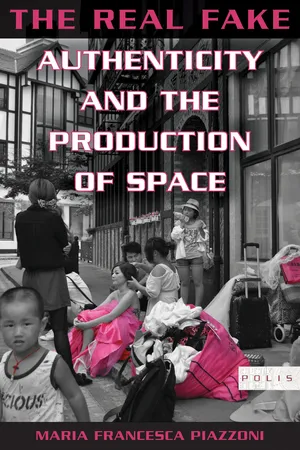
Thames Town—an English-like village built in Shanghai—is many places at once: a successful tourist destination, an affluent residential cluster, a city of migrant workers, and a ghost town. The Real Fake explores how the users of Thames Town transform a themed space into something more than a "fake place." Piazzoni understands authenticity as a dynamic relationship between people, places, and meanings that enables urban transformations. She argues that authenticity underlies the social and physical production of space through both top-down and bottom-up dynamics. The systems of moral and aesthetic judgments that people associate with "the authentic" materialize in Thames Town. Authenticity excludes some users as it inhibits access and usage especially to the migrant poor. And yet, ideas of the authentic also encourage everyday spontaneous appropriations of space that break the village's staged atmosphere. Most scholars criticize theming by arguing that it produces a "fake," controlling city. Piazzoni complicates this view by demonstrating that although the exclusionary character of theming remains unquestionable, it is precisely the experience of "fakeness" that allows Thames Town's users to develop a sense of place. Authenticity, the ways people construct and spatialize its meanings, intervenes holistically in the making and remaking of space.
Information
CHAPTER 1
The Controversy of Theming
THE EVOLUTION OF THE DISNEY CITY
China is full of places like Thames Town. But Western-like urban forms also flourish in many other rapidly urbanizing regions of the world. From the suburban developments at the fringes of Jakarta, Indonesia, to the new residential districts in Mumbai, India, entire cities are built from scratch emulating London, Paris, or Rome. The global success of styled environments demonstrates that theming strategies help the production and consumption of contemporary urban landscapes. Offering ready-made “places” for the rising middle classes, themed environments sell fast and ensure short term profits to their creators. Although the contemporary transplanting of cityscapes is deeply rooted in the mechanisms of the global economy, the theme park urban typology originated in the postwar United States. Disneyland, which Michael Sorkin defined as “the alpha point of hyperreality” (1992, 206), is acknowledged to be the prototype of the contemporary theme park. Here, I will synthesize the evolution of the theme park model and the criticism that surrounds it.
One might think that theming is distinctive to our times, given the relevance it has acquired over the last three decades. Yet private and public spaces have long featured themed atmospheres. Throughout history, powerful elites created exotic environments for their private delight or to win public approval. We know, for example, that already in ancient Rome the décor of some private dwellings offered affluent citizens the experience of some exotic elsewhere. The trompe-l’oeil Pompeian painting styles are a good example. The same experience was made accessible to the masses on the occasion of triumphal parades, when whole cities were temporarily transformed into staged and themed processions (Favro, 1994). In medieval Europe, the hortus conclusus, an enclosed garden, reproduced Paradise on earth. Contextually, the urban décor of public religious processions made sure to remind common people that Paradise—or eternal damnation—was indeed just around the corner. Later, the most prestigious residences of Russia and Europe encompassed entire villages, where aristocrats and their cohorts could enjoy romanticized pastoral atmospheres. The pleasure garden provided larger publics with the same delights during the eighteenth century. These eclectic assemblages of exotic atmospheres became very popular throughout the United States, Europe, and the colonial world (Harwood 2002; Shenker 2002; Young 2002).
If theming has existed for a long time, its association with mass consumption is a more recent phenomenon, and one that scholars trace back to the rise of the modern leisure industry. The theme park typology has conceptual predecessors in three nineteenth-century architectural genres that combined leisure and consumption: the amusement park, the World’s Fair exhibitions, and the department store. The first originated in the United States in response to the recreational demands of a rising middle class. Carnivalesque atmospheres, together with the celebration of technological progress, appealed to diverse clienteles, including women and children (Adams 1991; Peiss 1986). The department store likewise generated great excitement in fin-de-siècle Europe and the United States. For the first time, passersby could admire the choreographically displayed products, walk through sensational architectures, and appreciate the new, efficient retail stores without feeling obliged to buy anything. These private—yet open to the public— marketplaces soon became the symbols of a new consumer culture and its associated urbanity (Clausen 1985; Lerner 2015; Sloane and Conant Sloane 2003). Finally, the World’s Fairs that first emerged in the mid–nineteenth century displayed people, objects, and images that had never before been juxtaposed. As complex microcosms, these exhibitions compressed time and space to offer a voyage autour du monde, complete with stereotyped visions of colonial territories and celebratory representations of the West (Çelik and Kinney 1990; Corbey 1993).
Amusement parks, department stores, and World’s Fair exhibitions originated in diverse circumstances. However, they had four aspects in common: the construction of a totalizing experience, the accessibility of new publics, the involvement of vanguard technologies, and the primacy of visual consumption. These innovative aspects merged into the contemporary theme park, which is typified by Disneyland (Ottinger 2010; Schwartz 2003).
The opening of Disneyland on July 17, 1955, in Anaheim, California revolutionized the leisure industry, but Disneyland’s socio-cultural and economic implications went far beyond the realm of recreation. Walter Elias “Walt” Disney envisioned a clean, rigorously confined, and controlled space. Walt’s city would be very different from the carnivalesque amusement parks he had experienced as a child. Representing the prototype of a new urban utopia, Disneyland stood as an alternative to both the postwar dispersed city and the messy contemporary urban center (Bryman 1995; Koenig 1994). Disneyland displayed America at its best: traditional towns, beautiful landscapes, and a sprinkle of magic, surrounded by a circular railroad. The Sleeping Beauty Castle, located at the park’s center, was the only landmark visible from everywhere in the park. It stood as a symbol of enchantment and reassurance. Main Street, the re-creation of an idealized nineteenth-century American streetscape, led the guests from the park’s entrance into its four themed lands—Fantasyland, Frontier-land, Adventureland, and Tomorrowland. Inspired after Disney’s hometown of Marceline, Missouri, Main Street became a model for designers and architects. Throughout the nation, preservationists brought the Main Streets of small towns back. These architects gave historic towns a pristine condition they had never possessed in reality by demolishing the buildings that did not match with the “old West” narrative and substituting these buildings with authentic-looking constructions. Concurrently, entirely new nostalgic constructions substantiated the collective longing for a preurban Anglo-Saxon America (Francaviglia 1981).
Three revolutionary qualities made Disneyland the prototype of the contemporary theme park. First, the park had an exclusionary character that it conveyed implicitly, through visual codes and access policies. Disneyland’s homogeneous visual environment constituted a symbolic system of approved behaviors. Those who did not look or act in accordance with this system were denied access to the park. Another exclusionary feature was the ticketing policy, which required visitors to Disneyland to purchase a single, expensive entrance ticket rather than pay for access to each individual attraction, as had previously been the norm. These aspects, together with the location of the park in a destination reachable exclusively by car—Disneyland was located in a 185-acre extraurban area close to a highway exit—limited access primarily to middle- and upper-middle-class families.
Disneyland’s second revolutionary innovation was to involve the media in both the production and promotion of the park. In contrast to most Hollywood producers, Walt Disney viewed the advent of television as a business opportunity. He built Disneyland in partnership with the weakest television network at the time: the American Broadcasting Corporation (ABC). The network covered part of the construction costs in exchange for Disney’s production of the TV show Disneyland, screened weekly on the ABC network.
Finally, the park’s third major innovation reflected Disney’s ideological confidence in “the ultimate rightness of technological progress” (Thompson 1971, quoted in King 1981, 120). The attractions were regularly changed, reflecting the latest technological improvements. Disneyland’s “imagineers,” the engineers in charge of creating dreamy imaginaries, developed cutting-edge machines that surprised guests with both the sensational atmosphere and the unprecedented efficiency of the system.
These three aspects of Disneyland’s business model—the selection of clienteles via implicit methods of exclusion, the involvement of the media in a mutually beneficial partnership, and the constant search for innovative technologies—revolutionized the amusement industry. But Disneyland also symbolized an innovative approach to urban design, expressed in the Experimental Prototype Community of Tomorrow (EPCOT). Conceived by Disney in 1964 as a fifty-acre residential community for twenty thousand residents, EPCOT would function as a testing ground for new ideas in urban planning. The city was located within the twenty-eight thousand acres in Orlando, Florida, that the company purchased in 1966 for its second and larger park, Walt Disney World.
In the mind of Disney, no unemployment, unmarried cohabitation, public drunkenness, poverty, or even sadness would be permitted in the city of tomorrow. Moreover, since no one would own the houses, the residents would have no voting control (Wallace 1985). The residential community that the Disney Company ended up opening in 1982 is a more cautious version of Walt Disney’s original conception. After Walt’s death, the Disney Company considered the project too ambitious and converted the residential community into a resort. EPCOT, a kind of permanent World’s Fair, is now divided into the “Future World” and the “World Showcase” areas, each encompassing several exhibit pavilions. The socioeconomic implications of the original EPCOT plan, however, resonate into the present (Manheim 2002; Marling 1997; Viladas 1988).
The opening of EPCOT initiated a new turn for Disney. Under the guidance of its CEO Michael Eisner, the corporation created the Disney Development Company in 1985 and became a real estate titan over the following years. Designed between 1987 and 1992 in Osceola County, Florida, the town of Celebration is an example of the neotraditional urban form promoted by Disney. The residential community extends over 4,900 acres on former swampland, surrounded by a green area of similar size.
The designers, Cooper, Robertson & Partners and Robert Stern, emphasized mixed land use, high density, and green preservation to offer upper-middle-class clients a traditional village, complete with a Main Street, an artificial lake, and a marina. Star post-modern architects were invited to design Celebration’s civic buildings. Robert Venturi and Denise Scott Brown designed the bank, Charles Moore the Preview Center, Philip Johnson the Town Hall, and Aldo Rossi an office building. The residential areas encompassed condominiums and single houses built in diverse vernacular styles—Disney offered customers a choice among styles such as the “Classic,” the “Victorian,” the “Colonial,” the “Mediterranean,” and the “French.” The Celebration Pattern Book circulated during the construction process, prescribing buildings’ proportions and color palettes. After construction was completed in 1996, home-buyers were asked to sign the Declaration of Covenants, a prescriptive list of behaviors and maintenance rules meant to ensure that the atmosphere in the town remained faithful to Disney’s original spirit (Frantz 1999; Ross 1999).
Celebration is one of many traditional urban settings built as an ideological—and commercial—reaction to the modernist city. The sociologist Mark Gottdiener (1997) explains the reasons for this phenomenon by arguing that theming strategies enable contemporary urbanites to convey their social status. During the nineteenth century and at the beginning of the twentieth, patterns of social distinction appeared explicitly in the urban/rural dichotomy, in the distinction between poor and wealthy districts, as well as in the different dimensions of residential units. Gottdiener argues that turn-of-the-century suburbanization processes made this distinction less obvious because location and architectural typologies were no longer indexical to specific roles in society.
As city dwellers demanded new ways to emplace their status, designers began to incorporate symbols that expressed economic and cultural differences into the built environment. This phenomenon became increasingly relevant beginning in the 1950s, when the diffusion of the automobile, the standardization of construction techniques, and new patterns of production created a desire for new modes of social differentiation. Modernist planners did not satisfy this desire. They rather conceived decontextualized urban landscapes meant to actualize values of progress, efficiency, and universality. No space was made to convey difference in the modernist city, where buildings, blocks, and streets looked the same everywhere. Theming emerged as a reaction to this homogenization. With its pervasive use of pop-culture motifs and profound association with consumption, theming defined a new kind of city. This new city, Gottdiener tells us, embodied a melding of material form and commercial culture that continues to this day.
The Disneyfication of the metropolis became a global phenomenon during the 1980s, when the new systems of production and consumption associated with economic liberalization incentivized the diffusion of the themed city (Warren 1994). Andrew Ross (1999) observes that out of the global North theming strategies succeed especially in those regions that experience the advancement of a capitalist consumer economy, the sudden rise of living standards, and a sustained exposure to American culture. Indeed, the political elites and profit seekers of most rapidly urbanizing countries heavily resort to theming. Materializing the pressures of the global economy, styled settings offer growing middle classes ready-made atmospheres for consumption while also ensuring quick profits to their developers (Piazzoni and Banerjee 2017).
John Hannigan (1998) argues that the theme park urban model, which he names “Fantasy City,” possesses five central features. It is theme-centric—everything from individual attractions to the image of the city itself conforms to a scripted theme. It is branded—its theme is closely marked by one or a set of corporate identities. It is modular—standard components can be assembled in multiple configurations. It is solipsistic—physically, culturally, and economically isolated from its surroundings. And, crucially, it is postmodern—constructed around technologies of simulation. The development and global diffusion of the Fantasy City has provoked opposed reactions among academics and commentators. As I will show next, while some critics celebrate the themed city, by arguing that it satisfies people’s needs, others deplore theming by arguing against its exclusionary implications.
THEMING AND FAKENESS
Theming is a polarizing practice. Since the opening of Disneyland, critics have discussed the socioeconomic and cultural implications of the urban theme park model. Their reactions tend to converge on two arguments. Some observers respond enthusiastically to Disney’s city. They argue it provides the kind of space that people want and that architects and planners have long neglected. Other commentators remain critical of theming, contending that it inevitably produces a fake, exclusionary, and controlling city. These scholars link the production of themed settings to problematics of hegemony, privatization, and authenticity. In the scholarly conversation around theming, authors tend to attribute the defense of theming to commentators in the professional fields— architects, designers, or journalists—and ascribe a more critical perspective to academic inquirers. This view, I would suggest, implicitly trivializes the arguments in favor of theming. It assumes that the observations of those who favor styled milieus are driven by practical considerations and lack the depth and intellectual sophistication of those who are critical. In this section, I hope to demonstrate that the debates surrounding the ethics, politics, and meaning of theming reveal nuanced interpretations on both sides.
There have long been theming enthusiasts in both the professional and academic worlds. In his keynote speech at the 1963 Urban Design Conference at Harvard, the real estate developer James W. Rouse defined Disneyland as “the greatest piece of urban design in the United States” (quoted in Marling 1997, 170). He argued that the standards of the park in terms of design, popular success, and technological advancement should be a model for architects and planners. Rouse’s lesson has been taken up by organizations such as the Urban Land Institute, the American Planning Association, and—of course—the Themed Entertainment Association, which have assisted professionals and researchers in interpreting, designing, and managing themed settings (Hannigan 1998). While these institutions are primarily motivated by profit, scholars have praised the Disney city on more theoretical grounds. The world-famous architect Charles Moore argued in 1972, for example, that Disneyland recreated “all the chances to respond to a public environment” that had disappeared in the modernist and sprawl models. According to Moore, Disneyland allowed interaction and participation. It “created a place” by providing a “whole public world, full of sequential occurrences, of big and little drama, full of hierarchies of importance and excitement.” To those who objected that the park was, in fact, private and expensive to enter, Moore replied: “Curiously, for a public place, Disneyland is not free. You buy tickets at the gate. But then, Versailles cost someone a great deal of money, too. Now, as then, you have to pay for the public life” (2004 [1972], 126).
The excitement for the urban theme park model increased even further after the opening of Disney World in 1971. The architect and critic Peter Blake, for example, described the new park as “the most interesting New Town in the United States.” Considering the disastrous effects of modernism, Blake suggested that Disney’s city offered a valiant alternative to most recent design trends and that “urban men might, just possibly, be saved by a mouse.” The academic and architect Robert Venturi equally praised the qualities of Disney parks, which in his opinion were “nearer to what people really want than anything architects have ever given them” (Goldberger 1972, 42). The sixth Venice Architecture Biennale assigned Disney a place in the landscapes of high culture in 1966, when the US pavilion celebrated the architecture of Disney by featuring the work of over thirty famous designers.
This was the period in which postmodern architects were reclaiming the use of décor that their predecessors had banned. In the view of postmodern critics, featuring buildings with aesthetically pleasing elements would give the city back to its legitimate owners: the people. Postmodern designers rejected the abstract, aseptic, and technocratic modernist city. They wanted to make architecture communicate meanings to its users, as it had in the past. Historical and stylistic elements were no longer to be banned, but postmodernists used them to decorate buildings, piazzas, or even entire cities with references that people could identify. Theming was then seen as a democratizing practice that would reconnect the city to its populace (Jencks 1977; Rossi 1990). Corporate logic soon domesticated the criticality of postmodernism. Obtaining little public funding, architects turned to private sponsors to implement their creativity. Disney, a company with commissioning power that exceeded that of some nations and that also held a consuming interest in the inventive re-creation of history, became the ideal client of major “arch-stars” (Ross 1999).
Progressive critics labeled postmodernism “the architecture of Reaganism,” contesting its profitable relationship with corporate clients. These observers argued that postmodern city planning, and themed settings as its emblem, materialized capitalism at its worst by exacerbating inequalities. Rather than democratizing space, theming was found guilty of producing consumption clusters that left out all those who could not afford to enter them (Boyer 1993; McLeod 1989). The supporters of theming in turn charged progressive critics of maintaining elitist attitudes. The architecture critic Paul Goldberger (1989), for example, urged architects and planners to embrace realism and accept the death of the public realm as they knew it. In Goldberger’s view, designers were to acknowledge that no grand vision could make contemporary urban problems disappear. Professionals should work from within the system rather than seeking to dismantle it—an operation that had persistently proved fallacious. Architects had to improve people’s lives while dealing with realistic constraints. This, Goldberger argued, implied accepting that functional public spaces could be built, but under the auspices of private investments. In line with Goldberger’s argument, the supporters of Disney’s city continue to insist that antitheming feelings reveal an elitist mindset. Most intellectuals, they argue, condemn themed settings without considering that their popular success also determines the democratization of city spaces (Lowenthal 2002; Lukas 2013).
Yet we cannot dismiss the critiques of theming by simply arguing that it gives people “what they like.” The fantasy city does raise issues of exclusion, authenticity, and control. Exploring these circumstances, scholars employ their critique of theming around three interrelated issues: hyperreality, symbolic consumption, and hegemonic control. Critics who focus on the hyperreal character of themed settings speculate on the implosion of time and space in postmodern societies and argue that distinctions between original and artifice inform less and less of our understanding of the world (Baudrillard 1983, 1994; Eco 1986; Harvey 1990; Jameson 1991; Soja 1989). Those who link theming practices to symbolism explore how consumption and production are increasingly intertwined in the experience economy (Gilmore and Pine 1999). We know that powerful actors foster city branding to attract capital (Lang 2011). Cities must at once reassure and enchant citizens/consumers in order to compete with one another in the global arena. To this end, institutional and private actors ensure homogenous patterns in the delivery of goods and services while also luring consumers with totalizing, emotional, and symbolically evocative urban experiences (Bryman 2004; Klingmann 2007; Ritzer 1999, 2003). Finally, critics who speculate on the antidemocratic aspects of theming refer to hegemonic control as the process by which power is obtained via the agency of persuasion instead of coercion. In a hegemonic regime, power actors reach consent by engaging in constant negotiation with subordinated groups and appealing to their common sense to exert control (Gramsci 1977 [1929]).
Speculating on issues of hyperreality, symbolic consumption, and hegemony, scholars associate theming with an inauthentic and exclusionary city. Critics who focus on the “fakeness” of themed settings usually combine discussions of hyperreality and symbolic consumption. As technologies allow the perfect reproduction of objects and places, they equally enable a new condition of proximity and propinquity between people and places. Scholars have observed that in this scenario the design of the urban for...
Table of contents
- Cover
- Title Page
- Copyright
- Contents
- Introduction
- 1. The Controversy of Theming
- 2. Thames Town and the Chinese Landscapes of Mimicry
- 3. Everyday Life in the English Village of Shanghai
- 4. The Spaces Authenticity Makes
- Acknowledgments
- Bibliography
- Critics’ Corner
Trusted by 375,005 students
Access to over 1.5 million titles for a fair monthly price.
Study more efficiently using our study tools.
Frequently asked questions
Yes, you can cancel anytime from the Subscription tab in your account settings on the Perlego website. Your subscription will stay active until the end of your current billing period. Learn how to cancel your subscription
No, books cannot be downloaded as external files, such as PDFs, for use outside of Perlego. However, you can download books within the Perlego app for offline reading on mobile or tablet. Learn how to download books offline
Perlego offers two plans: Essential and Complete
- Essential is ideal for learners and professionals who enjoy exploring a wide range of subjects. Access the Essential Library with 800,000+ trusted titles and best-sellers across business, personal growth, and the humanities. Includes unlimited reading time and Standard Read Aloud voice.
- Complete: Perfect for advanced learners and researchers needing full, unrestricted access. Unlock 1.5M+ books across hundreds of subjects, including academic and specialized titles. The Complete Plan also includes advanced features like Premium Read Aloud and Research Assistant.
We are an online textbook subscription service, where you can get access to an entire online library for less than the price of a single book per month. With over 1.5 million books across 990+ topics, we’ve got you covered! Learn about our mission
Look out for the read-aloud symbol on your next book to see if you can listen to it. The read-aloud tool reads text aloud for you, highlighting the text as it is being read. You can pause it, speed it up and slow it down. Learn more about Read Aloud
Yes! You can use the Perlego app on both iOS and Android devices to read anytime, anywhere — even offline. Perfect for commutes or when you’re on the go.
Please note we cannot support devices running on iOS 13 and Android 7 or earlier. Learn more about using the app
Please note we cannot support devices running on iOS 13 and Android 7 or earlier. Learn more about using the app
Yes, you can access The Real Fake by Maria Francesca Piazzoni in PDF and/or ePUB format, as well as other popular books in Social Sciences & Urban Sociology. We have over 1.5 million books available in our catalogue for you to explore.