eBook - ePub
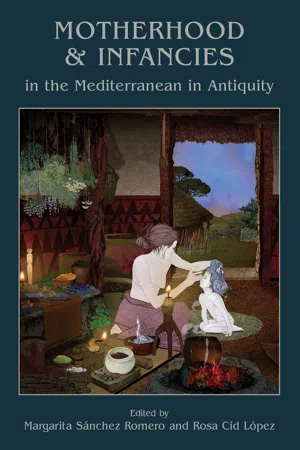
Motherhood and Infancies in the Mediterranean in Antiquity
- 296 pages
- English
- ePUB (mobile friendly)
- Available on iOS & Android
eBook - ePub
Motherhood and Infancies in the Mediterranean in Antiquity
About this book
Motherhood and childhood are social and cultural constructions that have their origins in prehistoric times and are visible through Greek and Roman discourses in Antiquity. This volume explores various images of maternity and infancy, and the identification of women and womanhood in prehistoric and classic societies. Aspects such as the crucial role of maintenance activities and care, the processes of socialization and learning, the impact of infant death, the figure of the mother queen, the religious discourses about motherhood, the rules on parental rights, the transgressions of traditional motherhood and the emotional aspects of the mother-child relation are analysed. The book covers the ancient Mediterranean area, from Mesopotamia to the Iberian Peninsula and from prehistoric communities to classic societies, with Mesopotamian, Phoenician and Iberian examples. A multidisciplinary approach is adopted, analysing material culture, representations and texts to gain a deeper understanding of the plurality of motherhood, and the diversity of women's agency through history.
Information
Subtopic
Greek Ancient HistoryIndex
Social SciencesChapter 1
Motherhood and infancies: archaeological and historical approaches
Margarita Sánchez Romero and Rosa Ma Cid López
It is the patriarchy that is undoubtedly responsible for defining the prevailing social model in those communities that emerged in the Mediterranean in ‘ancient times.’ Due to its success, this model required the establishment and maintenance of certain relationships and gender identities that have become a means through which to define women throughout history. In this construction of feminine identity, a transcultural and transhistorical concept of maternity has been of significance; one in which biological and essentialist elements prevail with respect to what women should do or feel. As such, maternal instinct becomes an obligation and those women who do not possess it are considered abnormal. Furthermore, in order to attain acceptance as a universal issue, stereotypes have been generated with respect to mothers that are easy to both retain and transmit. Behind this natural and biological essentialism or this instinctive attitude lies a simplification of what motherhood means, one that strips it of all its claims to possess skills, or of all experiences beyond the natural; the idea that is possesses any form of knowledge or the ability to use technology is denied. It is as if bodily use were not managed by means of cultural factors. All social transcendence is denied, as if the very existence of communities did not hold the process of reproduction as its most transcendental condition. This social and cultural construction that is motherhood has only become an object of interest for archaeology or history in very recent times: these disciplines have treated the subject in a different way, exploring, as this book demonstrates, various theoretical and methodological approaches.
Recent contributions from history and archaeology question former paradigms, given that now discussion concerns mothers and maternity, children as people with defined roles, as active agents in societies. It is now acknowledged that reproduction involves the work, effort, experience and knowledge of women, not to mention the modification of their bodies and the use of technology, and even their feelings (Sánchez Romero 2006). And, specifically, the important role of women is considered through their relationship with their offspring.
Motherhood took time to appear in academic environments of historical studies, including those related to gender and women. Feminism, however, did address the complex relationship between women and motherhood; from its rejection, which was ambiguously put forward by Simone de Beauvoir (1949), to its defence, by Luisa Muraro (1991). For that Italian philosopher, the close bond between mothers and their offspring had the ability to turn motherhood into a weapon of power, and not of submission, unlike the theory propounded by her French colleague. This is a central debate for contemporary feminism, which has been joined by other 20th century thinkers (Cid 2002; 2015). For example, between the two positions, which have now been mostly discarded, were Yvonne Knibiehler’s noteworthy contributions in the 1970s. Knibiehler (2000) was a pioneer in the study of motherhood from a historical perspective and published what is considered to be the first book on the history of women in the West, together with Catherine Fouquet (Knibiehler and Fouquet 1980), and to date her research has been linked to motherhood from highly varied approaches. The pioneering work of the French researcher Françoise Thébaud (1986) has also been noted here, although her work focuses on contemporary society. There is no doubt that French historiography expressed an early interest in mothers and motherhood, one that has been increasing in recent decades. This is manifest in the monographic publications on maternity in the Clio magazine dossier (2005) or that specifically dedicated to antiquity in Métis (2013), although it only deals with the Greek case. From the work of Françoise Thébaud, we have been able to understand that motherhood was indeed the function traditionally assigned to women. The exercise of this role turned them into ‘one-dimensional’ beings and generated the socially-accepted idea of feminine identity par excellence, i.e. that the social role of women centred on procreation and the care of offspring. The undertaking of motherhood did not question, but rather reinforced, male social supremacy as women were destined to raise the offspring the husband wanted.
Although it is true that this has been the situation of many women of the past, from a historical standpoint we have observed the complex relationship that women have maintained with motherhood. Past societies, from ancient times to the present, offer us examples of women who rejected motherhood. Such attitudes provoked criticism from their peers, but even so they did involve the refusal to act as something other than an inseminated body, or to assume the role of care-giver to their husbands’ children. These attitudes took them as far as Medea, who murdered her own children (McDermott 1989; López and Pociña 2002). In other cases, women are presented as mothers, however this is done while recreating normative discourses and attempting to use motherhood in a different sense. This was true of women who strengthened their social role and enjoyed areas of domestic and extra-domestic power, from the display of a motherhood that was occasionally outside the norm. Agrippina in Imperial Rome is a paradigmatic example, with her keenness to control the life of Nero, according to the representations of Greco-Roman literature (Ginsburg 2006).
Regarding these issues, scholars of antiquity have also made noteworthy contributions. Suzanne Dixon’s The Roman Mother or, in the case of Greece, the well-known book by Nicole Loraux, Les Meres en deuil, among others (Dixon 1988; Loraux 1990) are obligatory as works of reference. Myth, reality, laws, religion, politics and power, among other issues, were presented in these works, which were later reconsidered and expanded, or nuanced and questioned. This can be seen in the recent contributions on motherhood in the ancient Mediterranean (Hackworth and Salzman-Mitchel 2012; Cid 2009; 2010). Over time, the advances made in terms of knowledge regarding motherhood and mothers have led to the tackling of issues as specific as pregnancy or childbirth, by Veronique Dasen (2004; 2015) and Nancy Demand (2006), or the public role of mothers in the cities, through the contributions of notable women, as described in the works of Emily Hemelrijk (2015) and Cándida Martínez (Martínez and Serrano 2016; Martínez and Ubric 2017). Their works are exemplary in terms of understanding female public roles through ‘civic matronhood,’ an expression that refers to the work of women benefactors in the cities, who transferred their domestic roles into the public environment. These contributions are limited to the case of ancient societies and are only some of the significant examples. In any event, they prove the influence and dissemination of research on motherhood and maternity from the history of women and gender studies, which has served to revise the views on women of the past that are deeply-rooted in traditional historiography.
It is also significant that in the monumental work of Lynn Budin and Macintosh Turfa (2016) (over 1000 pages), which aims to offer a view of the history of women of antiquity, from East to West, with chapters specific to motherhood in almost all societies, from the Egyptian or Cypriot to the Etruscan, Greek or Roman.
In this respect, archaeology has also contributed to a conceptual change in the construction of motherhood in a particularly significant way. The works of Kathleen M. Bolen (1992), Elisabeth Beausang (2000; 2005), Laurie Wilkie (2003; 2010), Emer O’Donnell (2004) or Katharina Rebay-Salisbury (2017) made their contributions by placing motherhood at the centre of the debate on women, which has moved from a belief in naturalisation and immobility in the development of maternal practices and the non-recognition of children as full components of society, to articulating the appropriate methodologies used to recognise maternity practices in the archaeological record of past populations.
In Spain, this line of work has been especially rewarding in terms of the study of prehistoric societies. Interesting hypotheses have been established regarding human behaviour and the experiences and work of women. Almudena Hernando, in her different studies on the identity of women (Hernando 2001; 2012) shows how motherhood has been used by different authors to justify their identity in biological terms, through established dependency relationships. However, she places the origin of this identity type as a result of the consequences that derive from a loss of mobility due to the constant care required by human offspring. Human youngsters are the weakest in the animal kingdom, due to their extended growth rates; a developmental event that occurred in the genus Homo some two and a half million years ago and which led to the prolongation of the foetal period to 21 months (although only nine are intrauterine), which makes these offspring totally dependent. This process evolved basically in order to allow our brains to reach half the size they will have in adulthood. It is this need for child care that reduces women’s mobility and which engenders new ways of understanding time and space, while determining initially-established inequalities in a very subtle way (Hernando 2005).
Maria Angeles Querol has outlined the model of ‘expansion of maternal behaviour to the rest of the group’ (Querol 2005). About two million years ago East African hominids lived on the open plains and were exposed to dangers that could only be overcome through the reorganisation of the group’s social relations; this helped individuals to feel cohesion through cooperation among themselves and in distribution of defensive tasks. Maria Angeles Querol believes that this cooperation and these mechanisms of solidarity could have had their origin in the most obvious social relations, i.e. maternal relations, which entail socialisation, the transmission of knowledge, the care of others, etc. The propagation of these behavioural characteristics, by means of various mechanisms, was to be one of the keys to the success and survival of these groups.
However, feminist-Marxist perspectives have analysed biological reproduction in depth, from theories on the production of social life, placing emphasis on the tasks of the production of bodies and the maintenance of subjects and objects, through which not only are sexual bodies essential for the social reproduction of the group created, but also that these individuals are cared for, attended to and socialised (Sanahuja 2002; Escoriza and Sanahuja 2005).
Furthermore, Spanish feminist archaeology has worked on the concept of maintenance activities, which has been essential to conceptualise the social significance of maternal practices and to define the strategies of human groups for their survival (Alarcón and Sánchez 2015). This survival depends not only on biological reproduction, but above all on tasks that take place in daily life, which guarantee the reproduction of the economic and social system of any community (Picazo Gurina 1997; Montón-Subías and Sánchez Romero 2008; Sánchez Romero 2014). These are responsibilities that, until the construction of the concept of maintenance activities, were assigned so little value that we did not even possess an analytical category with which to study them. From this prespective, analysis have been made of questions ranging from why history has not valued maintenance activities (Hernando 2005) to how food production and consumption is managed (Montón-Subías 2005; Sánchez Romero 2014), including an analysis of how the learning and socialisation of children is organised (Sánchez Romero 2008a; 2008b; 2017; Sánchez et al. 2015), care practices (Montón-Subías 2010) or the connection to the area of everyday life (Sánchez Romero 2015).
Among the main researchers in this archaeology of childhood are those from feminist and gender archaeology who understood the relationships (more or less constructed) between women and infant individuals and the possibilities that a study of these relationships could provide to the historical discourse. They therefore decided to focus their research on children (Baxter 2005; 2009; Lillehammer 2010; 2015). Thus children and childhood have been described in terms of their bodies (Lewis 2006; Mays et al. 2017), the processes of learning and socialisation (Kamp 2001; Högberg 2008; Högberg et al. 2015) their spaces (Sánchez Romero et al. 2015) or their rituality (Ardren 2011; Murphy and Le Roy 2017).
Research into maternal practices becomes more appealing in the study of care practices and in the socialisation of children. Numerous theoretical and methodological approaches have permitted important moments such as childbirth to be recovered. On the Iberian Peninsula, one of the most interesting prehistoric examples is that of a pregnant woman aged about twenty who died during an obstructed labour, found in the Argaric site of Cerro de Las Viñas (Murcia). The burial reveals the remains of the mother with the newborn child still in the birth canal (Malgosa et al. 2004). The anthropological analysis of children is becoming one of the most innovative and informative aspects of this age group (Lewis 2006; Mays et al. 2017), including specific perspectives such as the bioarchaeology of the foetus (Halcrow et al. 2017).
Evidence of child-care practices is also manifest in many objects, as well as in the use of specially designed processes for food, transportation and clothing, in order to provide children with education, socialisation and entertainment. As...
Table of contents
- Cover
- Dedication
- Title
- Copyright
- Contents
- List of contributors
- 1 Motherhood and infancies: archaeological and historical approaches: Margarita Sánchez Romero and Rosa Ma Cid López
- 2 The child is dead: decision-making and emigration in Bronze Age Iberia: Paloma González Marcén
- 3 Learning to be ...: learning and socialisation in ceramic productions during Bronze Age in peninsular southeast Spain: Eva Alarcón García, Juan Jesús Padilla Fernández, Alejandra García García and Luis Arboledas Martínez
- 4 Beyond biology: the constructed nature of motherhood(s) in ancient Near Eastern sources and studies: Agnès Garcia-Ventura
- 5 Death in birth: pregnancy, maternal death and funerary practices in the Phoenician and Punic world: Ana Delgado Hervás and Aurora Rivera Hernández
- 6 Looking after dead infants: the materialisation of care in Sicilian child burials (10th–7th centuries BC): Meritxell Ferrer
- 7 Creating beings: relations between children and animals in the Iron Age Western Mediterranean: Mireia López-Bertran
- 8 Maternities in Iberian societies. From day-to-day life to sacredness: Carmen Rueda Galán, Carmen Rísquez Cuenca and Ana B. Herránz Sánchez
- 9 Motherhood, gender and identity in the Athenian polis: M. Dolors Molas Font
- 10 Childhood and motherhood in Ancient Greece: an iconographic look: Susana Reboreda Morillo
- 11 The (ir)relevance of being a mother. A legal perspective on the relationship between mothers and children in ancient Greece: Laura Pepe
- 12 The Queen and her children: Royal motherhood in Hellenistic Greece: María Dolores Mirón Pérez
- 13 Mors immatura, childhood and maternal–filial relationships in the carmina epigraphica. Case studies from the Iberian Peninsula: Rosa María Cid López: Almudena Domínguez-Arranz
- 14 Mater civitatis: forms of patronage, charity and foundations for children: Almudena Domínguez-Arranz
- 15 Mothers and sons in Plutarch’s Roman Parallel Lives.: Auctoritas and maternal influence during the Roman Republic Borja Méndez Santiago
- 16 Seruae, mothers and the mother–child bond in Roman Italy. The analysis of the epigraphic evidence: Carla Rubiera Cancelas
- 17 On the margins of motherhood: images of the puella docta and the lover-poet in the Latin love elegy: Rosa Mª Marina Sáez
- 18 Childhood and maintenance. Legal norms related to education and guardianship of minors, from Antoninus Pius to Justinian: María Isabel Núñez Paz
- 19 The relationship of Iulia Mamaea and Alexander Severus, a young imperator. A review through literary sources: Pedro David Conesa Navarro
- 20 Representations of women, motherhood and childhood in Spanish primary school textbooks: Silvia Medina Quintana
- 21 Women and children omitted in the teaching of history: causes and consequences: Antonia Garcia Luque
Trusted by 375,005 students
Access to over 1.5 million titles for a fair monthly price.
Study more efficiently using our study tools.
Frequently asked questions
Yes, you can cancel anytime from the Subscription tab in your account settings on the Perlego website. Your subscription will stay active until the end of your current billing period. Learn how to cancel your subscription
No, books cannot be downloaded as external files, such as PDFs, for use outside of Perlego. However, you can download books within the Perlego app for offline reading on mobile or tablet. Learn how to download books offline
Perlego offers two plans: Essential and Complete
- Essential is ideal for learners and professionals who enjoy exploring a wide range of subjects. Access the Essential Library with 800,000+ trusted titles and best-sellers across business, personal growth, and the humanities. Includes unlimited reading time and Standard Read Aloud voice.
- Complete: Perfect for advanced learners and researchers needing full, unrestricted access. Unlock 1.5M+ books across hundreds of subjects, including academic and specialized titles. The Complete Plan also includes advanced features like Premium Read Aloud and Research Assistant.
We are an online textbook subscription service, where you can get access to an entire online library for less than the price of a single book per month. With over 1.5 million books across 990+ topics, we’ve got you covered! Learn about our mission
Look out for the read-aloud symbol on your next book to see if you can listen to it. The read-aloud tool reads text aloud for you, highlighting the text as it is being read. You can pause it, speed it up and slow it down. Learn more about Read Aloud
Yes! You can use the Perlego app on both iOS and Android devices to read anytime, anywhere — even offline. Perfect for commutes or when you’re on the go.
Please note we cannot support devices running on iOS 13 and Android 7 or earlier. Learn more about using the app
Please note we cannot support devices running on iOS 13 and Android 7 or earlier. Learn more about using the app
Yes, you can access Motherhood and Infancies in the Mediterranean in Antiquity by Margarita Sánchez Romero, Rosa Cid López, Margarita Sánchez Romero,Rosa Cid López in PDF and/or ePUB format, as well as other popular books in Social Sciences & Greek Ancient History. We have over 1.5 million books available in our catalogue for you to explore.