- 288 pages
- English
- ePUB (mobile friendly)
- Available on iOS & Android
eBook - ePub
The Opposition to the Great War in Wales 1914-1918
About this book
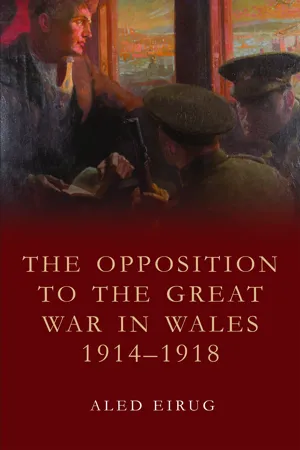
This study is the first thorough analysis of the extent of the opposition to the Great War in Wales, and is the most extensive study of the anti-war movement in any part of Britain. It is, therefore, a significant contribution to our understanding of people's responses to the conflict, and the difficulty of mobilising the population for total war. The anti-war movement in Wales and beyond developed quickly from the initial shock of the declaration of war, to the civil disobedience of anti-war activists and the industrial discontent excited by the Russian Revolution and experienced in areas such as the south Wales coalfield in 1917. The differing responses to the war within Wales are explored in this book, which charts how the pacifist tradition of nineteenth-century Welsh Nonconformity was quickly overturned. The two main elements of the anti-war movement are analysed in depth: the pacifist religious opposition, the Fellowship of Reconciliation, and the Nonconformist dissidents who were particularly influential in north and west Wales; and the political opposition concentrated in the Independent Labour Party and among the radical left within the South Wales Miners' Federation.
Information
1
RELIGIOUS OPPOSITION TO THE WAR IN WALES
INTRODUCTION
The opposition to the war in Wales on religious grounds was initially muted and cowed by the shock of the onset of war, and the rapidity with which the treasured traditional nineteenth-century ideals of pacifism were jettisoned. This opposition to the war on religious grounds was conducted primarily by millenarian sects, whose fundamental beliefs prohibited their members from swearing allegiance to a temporal power represented by military conscription, for instance, and also by those individuals within the Nonconformist denominations who held the fundamental belief that killing was an absolute sin. These individuals were organised mainly through the No-Conscription Fellowship (NCF), but in particular by the Fellowship of Reconciliation (FoR), established in Wales in June 1915, and the monthly magazine Y Deyrnas, first published in October 1916. These gave the pacifist movement its unique Welsh voice and gave succour to those individuals within the Nonconformist denominations in particular, who disagreed with the war on the grounds of their Christian faith. The leaders of the antiwar pacifist movement, such as Dr Thomas Rees, Principal of the Bala-Bangor Congregationalist theological college, gave their moral and practical support to conscientious objectors and made the notion of ‘peace by negotiation’ more acceptable to members of Nonconformist denominations by the summer of 1917, at a time when the Prime Minister, Lloyd George, was calling for a ‘knock-out blow’ against Germany. In addition, amongst a comparatively small number of chapels throughout Wales, no more than about fifty ministers of religion upheld a pacifist stance and proselytised against the war, but their moral stance gave succour to conscientious objectors and those who were actively anti-war.
The significance of religion to the anti-war movement is reflected in the professed allegiance of the majority of those conscientious objectors in Wales, who cited religious grounds for their stance and are studied in greater detail in chapter 4. Whereas the literature of conscientious objection in the war has been dominated by accounts which have emphasised the contribution of Quakers and socialists associated with the ILP,1 these constitute only approximately three per cent and eleven per cent respectively of those conscientious objectors in Wales who professed an organisational allegiance.2
This opposition was conducted primarily by individuals within the Nonconformist denominations who held the fundamental belief that war was a ‘negation of the plain teaching of Jesus Christ that we should forgive, help and love even our enemies’.3 They felt themselves to be inheritors of Wales’s pacifist tradition within Nonconformity that had commenced with the example of the Protestant martyrs, such as John Penry, and the persecution of the Quakers by the state in the seventeenth century. The overwhelming motivation for opposition to the war amongst conscientious objectors (COs) in Wales was their religious pacifism and their total opposition to the taking of life.
Morgan attributes Nonconformity’s general support for the war primarily to the influence of the Chancellor of the Exchequer, the Liberal David Lloyd George. Though the initial response to the outbreak of war was one of sober regret and reluctant recruiting in strongly Nonconformist areas such as north-west Wales, this gave way to ‘widespread anger and revulsion’ which was supplemented by propaganda concerning German atrocities during the invasion of Belgium, the Zeppelin raids over the east coast of England, the sinking of the Lusitania and the execution of Edith Cavell in October 1915.4 Not only the Anglican Church, but the main Nonconformist denominations ‘endorsed the war effort wholeheartedly’ and were thought ‘to have discarded all that was distinctive in the Christian faith and ethic according to the demands of the moment … institutional Christianity appeared to have become a function of the imperial cause’.5
Lloyd George’s speech to a congregation of Free Church people and London Welshmen in the City Temple, Westminster, in November 1914 emphasised that the country was at war to defend the weak, and that Belgium was like Wales, a small nation, ‘a poor little neighbour whose home was broken into by a hulking bully’. However regrettable, therefore, the war was both inevitable and just: ‘We are all looking forward to the time when swords shall be beaten into ploughshares’, but in the meantime there was no alternative but to fight.6 Biblical rhetoric and allusions to divine righteousness and God’s protection of the weak were used to dispel pacifist concerns and to justify the decision to go to war. According to the prominent Calvinistic Methodist minister Revd Thomas Charles Williams, ‘It has become our sacred calling to take up arms, he that hath no sword, let him sell his garment and buy one.’7
Lloyd George’s success in persuading Nonconformist ministers as well as Anglican prelates to become recruiting officers was key to the flow of young men from Wales into the army from the autumn of 1914 onwards.8 A number of the leaders of the Calvinistic Methodists, such as Revd John Williams, Brynsiencyn, and Thomas Charles Williams, Menai Bridge, were close friends of Lloyd George and became leading recruiters. Even the most radical of Nonconformists, such as W. Llewelyn Williams, the Liberal Member of Parliament for Carmarthen Boroughs and a prominent barrister, was persuaded of the force of the pro-war argument;
Diolchaf, er trymed fy nghalon wrth feddwl am echryslonrwydd rhyfel, i mi gael byw i weled cenhedloedd yr Ymerodraeth brydeinig yn sefyll i fyny, galon wrth galon, fel un gwr yn y rhyfel ysbrydol hon: rhyfel yw yn erbyn rhyfel; rhyfel i roddi pen bythol ar ryfel. Ni cherais ryfel erioed ond dywedaf fod y rhyfel hwn yn gyfiawn ac anocheladwy.9
(I give thanks, in spite of my heavy heart at the horror of war, that I have lived to see the nations of the British Empire standing up, heart by heart, as one man in this spiritual war: it is a war against war: a war to end all war. I never loved war but I say that this war is just and inevitable.)
The Calvinistic Methodists’ leading preacher, Dr John Williams, Brynsiencyn, known as ‘the idol of the preaching meetings’,10 was persuaded by Lloyd George of the righteousness of the Allied cause and made honorary chaplain with the rank of Lieutenant-Colonel in the new Welsh Army Corps:11
Yr oedd yn gyfeillgar iawn a Mr Lloyd George, a derbyniodd ei dystio-laeth ef, a thystiolaeth Mr Asquith a’r Arglwydd Grey, fod y rhyfel yn annichonadwy. Os bu petruster yn ei feddwl o gwbl, diflannodd hwnnw yn llwyr pan dorrodd yr Ellmyn eu cytuneb ac y croesasant Belgium, a sawdl haernaidd, er mwyn cyrraedd Ffrainc.12
(He was very friendly with Mr Lloyd George, and he accepted his evidence and that of Mr Asquith and Lord Grey, that the war was inevitable. If there was any hesitation in his mind at all, it disappeared totally when the Germans broke their promise and they crossed Belgium with their iron heels, in order to reach France.)
A photograph of Revd John Williams, Brynsiencyn, resplendent in his clerical collar and the uniform of the 38th Welsh Division, standing in the garden of 11 Downing Street, is testament to Lloyd George’s power of persuasion. The 38th Division was created in order to use Welsh national sentiment as a recruiting tool and to attract Nonconformist Welshmen into the army. The appointment of an Anglesey Congregationalist, Brigadier General Owen Thomas, as the only Nonconformist and Welsh speaker in such a senior role within the British Army, recognised Nonconformity and the Welsh language officially for the first time, within the Welsh Army Corps.13 His biographer’s belief that if Williams had decided to oppose the war, Nonconformist north-west Wales might have taken a very different attitude towards the war may be speculative, but the slowness of the response to the call to arms in the first months of the war in the area generated a great deal of anxiety that was alleviated only by local recruiting efforts led by Williams and Thomas Charles Williams. In Anglesey, within the Calvinistic Methodist congregations, John Williams’s leadership was unquestioned, and in the quarrying town of Bethesda, for instance, a total of 200 quarrymen were recruited in the first year, but from the middle of 1915, ‘recruiting became a more difficult business’. Both the Ogwen Rural District Council and Bethesda Urban District Council refused to undertake recruiting, and when in November 1915, Bethesda UDC eventually attempted to persuade every church and chapel in the area to appoint recruitment canvassers, only the Anglican Church did so, and then only to canvass their own members. By the autumn of 1915, the task of recruiting in the area was ‘practically hopeless’ because, it was alleged, there was ‘not enough sufficient public spirit among the leading inhabitants’.14
THE ATTITUDE OF THE CHURCHES
The Established Church in Wales had almost 200,000 members, or thirteen per cent of the population of Wales in 1905.15 In keeping with its role as the State Church, it shared a total commitment to the war effort, but was a politically and socially divisive organisation in Wales, and regarded by the Nonconformist establishment as politically Conservative, anglicised and associated with landed interests. The most popular religious institutions in Wales at this time were the Nonconformist churches, and the combined numerical strength of Welsh Protestant Nonconformity in 1914 was approximately 535,000 out of a total population of some 2,450,000, representing nearly one in five who were baptised or were communicants. In a survey undertaken in 1905, the main Nonconformist denominations were the Baptists, with 142,551 communicants, the more politically conservative Calvinistic Methodists with 170,343, the Congregationalists with 175,097, the Wesleyans with 43,358, and other smaller denominations and sects with 21,876. As half a million people attended Sunday schools but may not have been members, the total numbers of people associated with churches or chapels made Nonconformity the ‘single significant institution which Wales possessed’.16
Even the Congregationalists and Baptists who had been associated with the Peace Society and the pacifistic movement of the nineteenth century were overwhelmingly supportive of the rush to war. Koss suggests that the support of the leading Free Churchmen in England to the war was an atonement ‘for their earlier pacifism and to compensate for centuries of outsideness’,17 but this view underestimates the brittleness of Nonconformity’s anti-war sentiment in the nineteenth century. The doctrine of non-resistance in the Peace Society, for instance, was shattered by the war and its own newspaper lamented this change: ‘Even the most foremost pacifist leaders of the churches have surrendered. As for the rank and file of the ministers, they too are recruiting agents and their churches and schools recruiting stations.’18 Although before 1914 the denominations had consistently declared war to be a barbarous act, they were largely unwavering in their support for the war. Although as late as 1913, the Union of Welsh Independents stated that ‘every war was contrary to the spirit of Christ’,19 in its first annual conference after the outbreak of war in 1915, it expressed its joy that so many young men had joined the armed forces.20 Its 1916 conference condemned the harmful influence of the cinema and the trade in alcoholic spirits, delighted in the creation of the Welsh Army under the command of the Nonconformist and Welsh-speaking Brigadier Owen Thomas, and admired the heroism of those who had joined the army. The sole suggestion of any alternative view of the war was the conference’s recognition that the conscience clause in the Military Service Act was not always respected by the authorities:
Gofidir am fod unrhyw swyddog gweinyddol o’r ddeddf yn ymddwyn, fel yr ymddengys i ni, yn annheg tuag at y cyfryw bersonau. Hyderwn y gwna’r Llywodraeth bopeth yn ei gallu i atal pob camwri o’r fath.21
(it is regretted that any administrative officer under the act, behaves unfairly towards such people, as it seems to us. We hope that the Government does everything within its power to prevent any such injustice.)
In the 1915 annual conference, the jingoistic mood was reflected in the sermon given by the son of Samuel Roberts, Llanbrynmair, also Samuel, who compared the war to a battle between the Kingdom of God and his enemies. However, the denomination’s annual conference in 1917 was cancelled in the hope that the country’s circumstances would have improved,22 and the next annual conference was not held until the summer of 1919.
Of the Nonconformist denominations however, it was the Independents, also known as Congregationalists, who proved most active in the anti-war movement, primarily through the involvement of a number of their ministers in the FoR, and through the leadership of Principal Thomas Rees and the group of theological lecturers and students based in the Congregationalist Bala-Bangor theological college in Bangor. A social and economic study of Wales in 1922, funded by the Carnegie Trust and commissioned by Thomas Jones, formerly secretary to Lloyd George, included an analysis by the ILP organiser and former CO David Thomas of the nature of the anti-war movement in Wales, which he described as ‘Pacifist’. He described the movement as mainly religious in north Wales and political in south Wales, and assessed Nonconformity’s response towards the war:
Some of them were loud in their support of the war, and travelled the country addressing recruiting meetings: others were emphatic in their denunciation of the war. Probably the majority of the ministers kept quiet, preferring not to take any side, some from sheer pusillanimity, others from a consciousness of their ignorance and lack of vision, and others because they believed that they could preserve the unity of their churches only by refraining from taking sides in any controversial matter.23
Only a minuscule number of members of the small denomination of Methodist churches opposed the war. The denomination was part of the larger England and Wales organisation, and supported the war wholeheartedly. The few pacifists included the prominent novelist Revd Tegla Davies, Oswestry, Revd D. Gwynfryn Jones, Flint, and Revd Conwy Pritchard in the Llyˆn peninsula, and lay members including David Thomas. In the larger Cal...
Table of contents
- Cover
- Half Title
- Title
- Copyright
- Series Editors’ Foreword
- Contents
- Acknowledgements
- List of Tables
- Abbreviations
- Introduction
- 1 Religious Opposition to the War in Wales
- 2 Political Opposition to the War in Wales – the Independent Labour Party, the Russian Revolution and the ‘Advanced Men’
- 3 The Organisation of Opposition – the National Council for Civil Liberties and the No-Conscription Fellowship
- 4 Conscientious Objectors in Wales
- Conclusion
- Notes
- Bibliography
Trusted by 375,005 students
Access to over 1.5 million titles for a fair monthly price.
Study more efficiently using our study tools.
Frequently asked questions
Yes, you can cancel anytime from the Subscription tab in your account settings on the Perlego website. Your subscription will stay active until the end of your current billing period. Learn how to cancel your subscription
No, books cannot be downloaded as external files, such as PDFs, for use outside of Perlego. However, you can download books within the Perlego app for offline reading on mobile or tablet. Learn how to download books offline
Perlego offers two plans: Essential and Complete
- Essential is ideal for learners and professionals who enjoy exploring a wide range of subjects. Access the Essential Library with 800,000+ trusted titles and best-sellers across business, personal growth, and the humanities. Includes unlimited reading time and Standard Read Aloud voice.
- Complete: Perfect for advanced learners and researchers needing full, unrestricted access. Unlock 1.5M+ books across hundreds of subjects, including academic and specialized titles. The Complete Plan also includes advanced features like Premium Read Aloud and Research Assistant.
We are an online textbook subscription service, where you can get access to an entire online library for less than the price of a single book per month. With over 1.5 million books across 990+ topics, we’ve got you covered! Learn about our mission
Look out for the read-aloud symbol on your next book to see if you can listen to it. The read-aloud tool reads text aloud for you, highlighting the text as it is being read. You can pause it, speed it up and slow it down. Learn more about Read Aloud
Yes! You can use the Perlego app on both iOS and Android devices to read anytime, anywhere — even offline. Perfect for commutes or when you’re on the go.
Please note we cannot support devices running on iOS 13 and Android 7 or earlier. Learn more about using the app
Please note we cannot support devices running on iOS 13 and Android 7 or earlier. Learn more about using the app
Yes, you can access The Opposition to the Great War in Wales 1914-1918 by Aled Eirug in PDF and/or ePUB format, as well as other popular books in History & British History. We have over 1.5 million books available in our catalogue for you to explore.