Winner of the Limina Award 2021
This groundbreaking volume for the Thinking Cinema series focuses on the extent to which contemporary cinema contributes to political and philosophical thinking about the future of Europe's core Enlightenment values. In light of the challenges of globalization, multi-cultural communities and post-nation state democracy, the book interrogates the borders of ethics and politics and roots itself in debates about post-secular, post-Enlightenment philosophy.
By defining a cinema that knows that it is no longer a competitor to Hollywood (i.e. the classic self-other construction), Elsaesser also thinks past the kind of self-exoticism or auto-ethnography that is the perpetual temptation of such a co-produced, multi-platform 'national cinema as world cinema'. Discussing key filmmakers and philosophers, like: Claire Denis and Jean-Luc Nancy; Aki Kaurismäki, abjection and Julia Kristeva; Michael Haneke, the paradoxes of Christianity and Slavoj Zizek; Fatih Akin, Alain Badiou and Jacques Rancière, Elsaesser is able to approach European cinema and assesses its key questions within a global context. His combination of political and philosophical thinking will surely ground the debate in film philosophy for years to come.
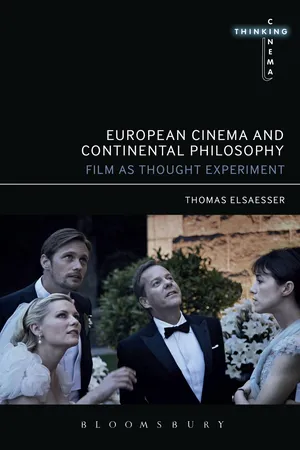
- 352 pages
- English
- ePUB (mobile friendly)
- Available on iOS & Android
eBook - ePub
About this book
Information
1
European Cinema into the Twenty-first Century
Enlarging the Context?
In this troubled world, Western Europe has, in fact, become a fragile island of prosperity, peace, democracy, culture, science, welfare and civil rights. However, erecting walls against the rest of the world may undermine the very fundamentals of European culture and democratic civilization … But the overcrowded and aged Western Europe of the late twentieth century does not seem as open to the world as was the young, mostly empty America of the beginning of the century.1
As Europe is becoming more like the United States a hundred years ago – a continent of immigrants seeking a better life – one of the most familiar ways of asserting its cultural identity, namely defining itself in opposition to America, is becoming increasingly obsolete.2 The same may hold for European cinema, which has often been cast as the ‘good’ object, by comparison with Hollywood. Critics tended to line up directors and national cinemas along opposing values: ‘art versus commerce’, ‘auteur versus star’, ‘critical prestige versus box office’, ‘realism versus dream factory’, or – after Gilles Deleuze – ‘the movement image versus the time image’. These and many similar constructions of identity through binary difference helped disguise the fact that the major changes – geopolitical, demographic and technological – which have affected how films are being produced, distributed, viewed and used in the new century, have left especially the national cinemas of Europe in a crisis. This crisis of identity was the major topic of my previous effort to define European cinema, whose title, Face to Face with Hollywood, reflected that Europe, and more specifically its cinema, has, in the later part of the twentieth century, supported its sense of self-importance by positioning itself ‘face-to-face’ with the Other.3 Take away this prosthetic self-construction, what kind of identity is there for European art cinema and its auteurs? Do directors still feel allegiance to their nation and to authorial self-expression or do they pay attention to the diffuse audiences (and juries) at film festivals, hoping to ensure press coverage, exposure on television, screenings at the few remaining art houses and sales in the dwindling DVD market?
Traditionally strong filmmaking nations like France, Italy and Germany may still boast world-class festivals at Cannes, Venice and Berlin, but the films showcased and winning prizes often come from outside Europe. Looked at ‘from outside’ (including from the United States), films made in Europe now share the generic label ‘world cinema’, where they compete with productions from Turkey and Thailand, Iran and Mexico. This apparent ‘demotion’ of European cinema to ‘world cinema’ status might be regretted or lamented, but it is hard to overlook. It stands in sharp contrast to the rise of Asian cinema, notably that of South Korea, Thailand, The Philippines, Taiwan and increasingly also mainland China. Many of these countries have ambitions to compete as commercial rivals to Hollywood, while successfully performing as artistic rivals to Europe. European Cinema joins the prefix ‘Euro’ as not only connoting a beacon of hope shining from the island of prosperity and the rule of law, but often enough also the link to cheapness and crisis, not wealth or welfare: Euro-trash, Euro-pudding, Euro-shopper, Euro-crisis. Provided one can acknowledge the realities of these changing ideas of ‘Europe’ such trans-valuations also represent an opportunity: first, to let the label Europe find its own fluctuating ‘value’ on the stock-exchange of cultural capital, and second, to rethink what Europe means to the world not just in matters of cinema. Less may be more: a diminished standing and lower expectations could clear the path for European cinema to ready itself for renewal.
The present book sets itself this task: to look at European cinema through a new lens, that of philosophy and political thought. It starts from three interrelated premises: first, that contemporary (European) philosophy has something to say about cinema (as argued in Chapter 2 ‘Film as Thought: The “Film and Philosophy” Debate’); second, that the demotion of European art and auteur cinema is an opportunity for such a cinema (including for its directors as auteurs) to attain a paradoxical kind of autonomy (as proposed in Chapter 12 ‘Control, Creative Constraints and Self-Contradiction: The Global Auteur’); and third, that this requires a notion of cinema as having the status and function of a ‘thought experiment’. Argued in greater detail in Chapter 3, ‘Film as Thought Experiment’, such thought experiments – common in philosophy and in physics – can be didactic parables or imaginary scenarios that address hypothetical ‘what if?’ situations. They can posit something as conceivable, and thus as possible, even if not realizable in practice, or they can address a crisis situation by ‘thinking the unthinkable’. Such a crisis situation is a given in the Europe of the twenty-first century, both artistically and politically, indicative that the thought experiment may have emerged as the appropriate response: a proposition I also argue in Chapter 4, ‘“Europe”: A Thought Experiment’.
The idea of the thought experiment tries to respond to several problems. With respect to cinema, it names films that neither compete with Hollywood (in the classic self–other construction), nor oppose themselves to Hollywood (in the classic anti-stance of art and avant-garde cinema). They also skirt another danger, which is to slip into a kind of self-exoticism or auto-ethnography: representing yourself to the Other, as you imagine the Other imagines you, which is the perennial temptation of festival films and of the ‘new (national) waves’ that festivals periodically presented to the world. Instead, cinema as thought experiment identifies films that can be referenced to the core philosophical principles and political values of European democracy, testing the appeal or traction that ideals such as liberty, fraternity and equality still have in today’s Europe. Films can do this overtly, with narratives of migration and multicultural communities, showing the disintegration of families, mechanisms of exclusion and discrimination, but they can also do so more implicitly when the individual’s relation to power and the state is at issue, or when crafting parables that confront characters with difficult or impossible ethical choices. Secondly, given the disappointments and frustrations that the European Union elicits among its members collectively and individually, it may be time to declare this very idea of a united Europe a political experiment badly in need of renewing itself as a philosophical thought experiment. As Roberto Esposito has pointed out, the notion of Europe as above all a philosophical idea has a long tradition:
[There is] something that pertains to the philosophical character of the very constitution of Europe. Not possessing definite geographical boundaries, at least in the East – its distinction from Asia is problematic, considering that two large countries, Russia and Turkey, stretch between the two continents – Europe, from the beginning, has defined itself from the perspective of the constitutive specificity of its philosophical principles: the freedom of the Greek cities as opposed to the Asian despotic regimes. Although these principles were often contradicted and reversed into their opposite, the idea of Europe is inseparable from them.4
Just as frequently, however, this very priority given to Greek politics and philosophy, together with Judeo-Christian religion and ethics in any definition of Europe has been criticized as Eurocentric, suppressing the debts to other civilizations, setting up a successive series of distorting mirrors, as well as acting as an elitist and exclusionary narrative even with respect to Europe’s own indigenous populations and their cultures.5 These historical issues – too broad to be considered here – form the outer horizon, as they inform the debates on Europe’s diminished role in a globalized world. Where and how to de-centre and re-centre Europe thus remain relevant to the topic in hand, namely European cinema’s own reduced role in world cinema.
One of the qualities of European cinema at least since the end of the Second World War has been its reflexivity, its inward turn, as well as its unique form of ruminating, speculative self-scrutiny. The films of Roberto Rossellini, Ingmar Bergman, Michelangelo Antonioni, Alain Resnais, Jean-Luc Godard, Agnès Varda, Chris Marker, Andrzej Wajda and Alexander Kluge have always been ‘philosophical’ in this respect, thanks to intense self-interrogation, political critique and a probing of limits (of what it means to be European). As this generation has passed on or is handing over, a less personal and existential kind of philosophy has come to the fore also in filmmaking: embracing a political philosophy that once more examines the kinds of intimate or extended community that liberal democracy provides for its citizens, once outside their comfort zone and confronted with the Other, as neighbour, stranger, antagonist or object of desire. These questions are deeply interwoven with how we think about cinema as a practice commensurate with the digit...
Table of contents
- Cover
- Half-Title Page
- Series Page
- Title Page
- Contents
- Acknowledgements
- 1 European Cinema into the Twenty-first Century: Enlarging the Context?
- 2 Film as Thought: The ‘Film and Philosophy’ Debate
- 3 Film as Thought Experiment
- 4 ‘Europe’: A Thought Experiment
- 5 A Cinema of Abjection?
- 6 Post-heroic Narratives and the Community to Come
- 7 Claire Denis, Jean-Luc Nancy and Beau Travail
- 8 Hitting Bottom: Aki Kaurismäki and the Abject Subject – The Man Without A Past
- 9 ‘Experimenting with Death in Life’: Fatih Akin and the Ethical Turn
- 10 Black Suns and a Bright Planet: Lars von Trier’s Melancholia as Thought Experiment
- 11 Anatomy Lesson of A Vanished Country: Christian Petzold’s Barbara
- 12 Control, Creative Constraints and Self-Contradiction: The Global Auteur
- Bibliography
- Filmography
- Index
- Copyright
Trusted by 375,005 students
Access to over 1.5 million titles for a fair monthly price.
Study more efficiently using our study tools.
Frequently asked questions
Yes, you can cancel anytime from the Subscription tab in your account settings on the Perlego website. Your subscription will stay active until the end of your current billing period. Learn how to cancel your subscription
No, books cannot be downloaded as external files, such as PDFs, for use outside of Perlego. However, you can download books within the Perlego app for offline reading on mobile or tablet. Learn how to download books offline
Perlego offers two plans: Essential and Complete
- Essential is ideal for learners and professionals who enjoy exploring a wide range of subjects. Access the Essential Library with 800,000+ trusted titles and best-sellers across business, personal growth, and the humanities. Includes unlimited reading time and Standard Read Aloud voice.
- Complete: Perfect for advanced learners and researchers needing full, unrestricted access. Unlock 1.5M+ books across hundreds of subjects, including academic and specialized titles. The Complete Plan also includes advanced features like Premium Read Aloud and Research Assistant.
We are an online textbook subscription service, where you can get access to an entire online library for less than the price of a single book per month. With over 1.5 million books across 990+ topics, we’ve got you covered! Learn about our mission
Look out for the read-aloud symbol on your next book to see if you can listen to it. The read-aloud tool reads text aloud for you, highlighting the text as it is being read. You can pause it, speed it up and slow it down. Learn more about Read Aloud
Yes! You can use the Perlego app on both iOS and Android devices to read anytime, anywhere — even offline. Perfect for commutes or when you’re on the go.
Please note we cannot support devices running on iOS 13 and Android 7 or earlier. Learn more about using the app
Please note we cannot support devices running on iOS 13 and Android 7 or earlier. Learn more about using the app
Yes, you can access European Cinema and Continental Philosophy by Thomas Elsaesser in PDF and/or ePUB format, as well as other popular books in Mezzi di comunicazione e arti performative & Film e video. We have over 1.5 million books available in our catalogue for you to explore.