Monsters under Glass explores our enduring fascination with hothouses and exotic blooms, from their rise in ancient times, through the Victorian vogue for plant collecting, to the present day.
Our interest in hothouses can be traced back to the Roman emperor Tiberius, but it was in the early nineteenth century that a boom in exotic plant collecting and new glasshouse technologies stimulated the imagination of novelists, poets and artists, and the hothouse entered the creative language in a highly charged way. Decadent writers in England and on the Continent – including Charles Baudelaire and Oscar Wilde – transformed the notion of the hothouse from a functional object to a powerful metaphor, of metropolitan life, sexuality and being, replete with a dark underside of decay and death; of consciousness itself, nurtured and dissected under glass.
In this beautifully illustrated, wide-ranging and vivid study, Jane Desmarais charts the history and influence of these humid, tropical worlds and their creations, providing a steamy window on our recent past.
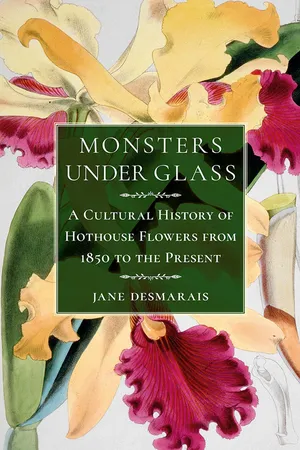
eBook - ePub
Monsters under Glass
A Cultural History of Hothouse Flowers from 1850 to the Present
- English
- ePUB (mobile friendly)
- Available on iOS & Android
eBook - ePub
About this book
Information
REFERENCES
Introduction
1 Quoted in Medlar Lucan and Durian Gray, The Decadent Gardener (Sawtry, Cambs., 1996), p. 59.
2 Joel-Peter Witkin, quoted in Frans Schouten et al., Grotesque: Natural Historical and Formaldehyde Photography (Amsterdam, 1989), p. 15.
3 Roy Strong, epigraph to catalogue, François Houtin: Brocéliande Forest of Dreams, exh. cat., Francis Kyle Gallery, London (2013).
4 Suzanne Braswell, ‘Mallarmé, Huysmans, and the Poetics of Hothouse Blooms’, French Forum, XXXVIII/1 (Winter 2013), pp. 69–87: p. 69.
5 Walter Pater, ‘Conclusion’, in Studies in the History of the Renaissance (Oxford, 2010), p. 120.
1 Heat and Light: The Rise of the Hothouse
1 Isobel Armstrong, Victorian Glassworlds: Glass Culture and the Imagination, 1830–1880 (Oxford, 2008), p. 175.
2 Ibid., p. 176.
3 John Abercrombie, Abercrombie’s Practical Gardener (London, 1834), p. 420.
4 Edgar Allan Poe, ‘A Philosophy of Furniture’, Burton’s Gentleman’s Magazine, VI/5 (1840), pp. 243–45: p. 244.
5 There was an influx of new species, including dahlia, bluebell, Easter lily, cosmos, yarrow, gladiolus, strawflower, Japanese iris, zinnia, morning glory, tigerlily, kousa dogwood and poinsettia. See Amy H. King, Bloom: The Botanical Vernacular in the English Novel (Oxford, 2003), p. 74.
6 Quoted in Brent Elliott, Victorian Gardens (London, 1986), pp. 30 and 31.
7 John Ruskin, Præterita (Orpington, 1886), vol. I, p. 67.
8 The Times, 1851, quoted in Jeffery Auerbach, The Great Exhibition of 1851: A Nation on Display (London, 1999), p. 160.
9 National Magazine, I (1851), p. 206.
10 Quoted in D. Kellaway, ed., Women Gardeners (London, 1995), p. 68.
11 Guy de Maupassant, ‘Bibelots’, in Chroniques (Paris, 1980), vol. II, p. 183. Quoted in Emily Apter, ‘Cabinet Secrets: Fetishism, Prostitution, and the Fin de Siècle Interiors’, Assemblage, IX (June 1989), pp. 6–19: p. 14.
12 See Lynn Voskuil, ‘The Victorian Novel and Horticulture’, in The Oxford Handbook of the Victorian Novel, ed. Lisa Rodensky (Oxford, 2013), pp. 549–68.
13 Celebrated monster-plant writers of the late nineteenth century and early twentieth century include H. G. Wells, Arthur Conan Doyle, Louisa May Alcott, William Hope Hodgson and, later, H. P. Lovecraft and Clark Ashton Smith. See T. S. Miller, ‘Lives of the Monster Plants: The Revenge of the Vegetable in the Age of Animal Studies’, Journal of the Fantastic in the Arts, XXIII/3 (2012), pp. 460–79.
14 Sarah Whittingham, Fern Fever: The Story of Pteridomania (London, 2012).
15 Rebecca Stott, Theatres of Glass: The Woman Who Brought the Sea to the City (London, 2003), p. 111.
16 E. and J. de Goncourt, Journal de la vie littéraire, II (25 December 1867), cited in Marion Baudet, ‘Le Jardin décadent: de l’intimité dévoilée à l’intimité dévoyée’, in Jardins et intimité dans la littérature européenne (1750–1920), ed. Simone Bernard-Griffiths et al. (Clermont-Ferrand, 2008), p. 357: ‘luxe tout nouveau . . ., et qui n’a pas plus de vingt ans de date’.
17 Phyllis Hastings, The Conservatory (London, 1973), p. 16.
18 Sarah Maguire, ‘The Florist’s at Midnight’, in The Florist’s at Midnight (London, 2001), p. 1.
19 See Michael Waters, The Victorian Garden in Literature (Aldershot, 1988), pp. 125–9.
20 John Ruskin, Modern Painters (London, 1851), vol. II, pt 3, p. 104.
21 Lecture 2, section 87. In his notes to this lecture, he mentions Baudelaire’s Les Fleurs du mal as a book he wanted to buy: see M. M. Mahood, ‘Ruskin’s Flowers of Evil’, in The Poet as Botanist (Cambridge, 2008), pp. 147–82.
22 William Morris, The Collected Works of William Morris (Cambridge, 2012), vol. XXII, pp. 89–90.
23 Algernon Charles Swinburne, Essays and Studies (London, 1875),...
Table of contents
- Front Cover
- Half Title
- Title Page
- Copyright
- Contents
- Introduction
- one: Heat and Light: The Rise of the Hothouse
- two: ‘Aromatic and Tainted’: The City as Hothouse
- three: Blooming Buttonholes and Flower Fetishes
- four: Florientalism and the ‘Scented Ways’
- five: Paradises and Torture Gardens
- six: Flowers of Evil: The Fleur Fatale
- seven: Mind under Glass
- eight: Weeds
- REFERENCES
- SELECT BIBLIOGRAPHY
- ACKNOWLEDGEMENTS
- PHOTO ACKNOWLEDGEMENTS
- INDEX
Trusted by 375,005 students
Access to over 1.5 million titles for a fair monthly price.
Study more efficiently using our study tools.
Frequently asked questions
Yes, you can cancel anytime from the Subscription tab in your account settings on the Perlego website. Your subscription will stay active until the end of your current billing period. Learn how to cancel your subscription
No, books cannot be downloaded as external files, such as PDFs, for use outside of Perlego. However, you can download books within the Perlego app for offline reading on mobile or tablet. Learn how to download books offline
Perlego offers two plans: Essential and Complete
- Essential is ideal for learners and professionals who enjoy exploring a wide range of subjects. Access the Essential Library with 800,000+ trusted titles and best-sellers across business, personal growth, and the humanities. Includes unlimited reading time and Standard Read Aloud voice.
- Complete: Perfect for advanced learners and researchers needing full, unrestricted access. Unlock 1.5M+ books across hundreds of subjects, including academic and specialized titles. The Complete Plan also includes advanced features like Premium Read Aloud and Research Assistant.
We are an online textbook subscription service, where you can get access to an entire online library for less than the price of a single book per month. With over 1.5 million books across 990+ topics, we’ve got you covered! Learn about our mission
Look out for the read-aloud symbol on your next book to see if you can listen to it. The read-aloud tool reads text aloud for you, highlighting the text as it is being read. You can pause it, speed it up and slow it down. Learn more about Read Aloud
Yes! You can use the Perlego app on both iOS and Android devices to read anytime, anywhere — even offline. Perfect for commutes or when you’re on the go.
Please note we cannot support devices running on iOS 13 and Android 7 or earlier. Learn more about using the app
Please note we cannot support devices running on iOS 13 and Android 7 or earlier. Learn more about using the app
Yes, you can access Monsters under Glass by Jane Desmarais in PDF and/or ePUB format, as well as other popular books in History & World History. We have over 1.5 million books available in our catalogue for you to explore.