
- 552 pages
- English
- ePUB (mobile friendly)
- Available on iOS & Android
eBook - ePub
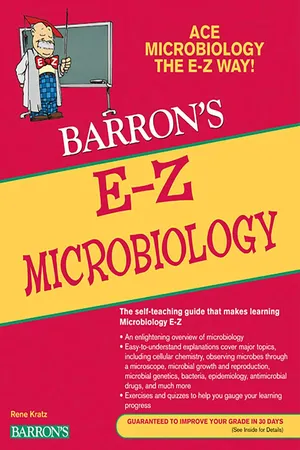
E-Z Microbiology
About this book
This book transforms a difficult subject into ideas that every attentive student can understand. Important topics covered include: the microbial world, cellular chemistry, observing microbes through a microscope, microbial growth and reproduction, microbial genetics, bacteria, fungi and protozoa, viruses, the disease process, epidemiology, antimicrobial drugs, practical applications of immunology, infectious diseases, and many others. Also featured are helpful review questions with answers.
Barron's E-Z Series books are updated, and re-formatted editions of Barron's older and perennially popular Easy Way books. Titles in the new E-Z Series feature extensive two-color treatment, a fresh, modern typeface, and more graphic material than ever. All are self-teaching manuals that cover a wide variety of practical and academic subjects, written on levels that range from senior high school to college-101 standards.
Frequently asked questions
Yes, you can cancel anytime from the Subscription tab in your account settings on the Perlego website. Your subscription will stay active until the end of your current billing period. Learn how to cancel your subscription.
At the moment all of our mobile-responsive ePub books are available to download via the app. Most of our PDFs are also available to download and we're working on making the final remaining ones downloadable now. Learn more here.
Perlego offers two plans: Essential and Complete
- Essential is ideal for learners and professionals who enjoy exploring a wide range of subjects. Access the Essential Library with 800,000+ trusted titles and best-sellers across business, personal growth, and the humanities. Includes unlimited reading time and Standard Read Aloud voice.
- Complete: Perfect for advanced learners and researchers needing full, unrestricted access. Unlock 1.4M+ books across hundreds of subjects, including academic and specialized titles. The Complete Plan also includes advanced features like Premium Read Aloud and Research Assistant.
We are an online textbook subscription service, where you can get access to an entire online library for less than the price of a single book per month. With over 1 million books across 1000+ topics, weâve got you covered! Learn more here.
Look out for the read-aloud symbol on your next book to see if you can listen to it. The read-aloud tool reads text aloud for you, highlighting the text as it is being read. You can pause it, speed it up and slow it down. Learn more here.
Yes! You can use the Perlego app on both iOS or Android devices to read anytime, anywhere â even offline. Perfect for commutes or when youâre on the go.
Please note we cannot support devices running on iOS 13 and Android 7 or earlier. Learn more about using the app.
Yes, you can access E-Z Microbiology by Barron's Educational Series,Rene Kratz in PDF and/or ePUB format, as well as other popular books in Biological Sciences & Microbiology. We have over one million books available in our catalogue for you to explore.
Information
1
![]() | The Microbial World |
WHAT YOU WILL LEARN
This chapter introduces the science of microbiology. As you study this chapter, you will:
⢠discover the importance of microorganisms to humans;
⢠explore the early history of microbiology;
⢠learn about the types of things microbiologists study.
SECTIONS IN THIS CHAPTER
⢠Microorganisms and Humans
⢠The Science of Microbiology
When you look at the back of your hand, what do you see? Do you see the grooves in your skin, the small hairs? What if you could sharpen your eyesight for a moment, zoom in, and see your skin magnified 100 times, 1000 times, 3000 times? The surface of your skin would look like a landscape, a vast uneven floor made of irregular slabs. The hairs would become giant trees jutting out of the surface of the landscape. And as you zoomed in, you would see them, tucked in the grooves and scattered across the landscape of your skin like small boulders (Figure 1.1). Bacteria are on your skin, in your ears, your nose, and your mouth, and if you looked inward, you would see them again, lining your intestines and genital tract. In fact, for every one of your own body cells you possess, there are about ten bacterial cells living in you or on you.

FIGURE 1.1. Staphylococci on the surface of the skin and around a hair follicle.
With an electron microscope, it is possible to see bacteria scattered on the surface of human skin. The bacterial cells in this drawing are round. The skin cells are large and flat. A hair is seen projecting upward out of the skin.
Before you run screaming for the soap or think you have stumbled into a low-budget horror flick, consider this: Most of the bacteria that live on your body are beneficial to your health. They are part of your normal microbiota, the normal residents of your body. They help stop other, potentially harmful bacteria from taking up residence. Some of the bacteria that live in your intestines even make necessary vitamins for you that you cannot make yourself. If you have ever had intestinal upsets or a yeast infection after taking antibiotics, you have seen firsthand the negative effect of harming your normal microbiota. You need these bacteria and benefit from their presence. In fact, you might be surprised to consider all the reasons people need microorganisms like bacteria, and all the ways we have found to use them in our daily lives.
Microorganisms and Humans
Microorganisms, or microbes, are any organisms that are too small to see with the naked eye. They affect human life in almost every way you could imagine. No winetasting party could be complete without wine and cheese, both of which are made with microbes. And how could anyone celebrate Oktoberfest without beer and sauerkraut? Any food you can think of that is pickled was made with microbes, as were foods like bread and yogurt. If you spill some food on your clothes and throw them in the washing machine, take a good look at your laundry detergentâit just might contain microbial enzymes to help degrade the greasy compounds on your dirty laundry. We also use microbes to help clean up our sewage and even our oil spills.
In the environment, microbes serve a vital role as decomposers, breaking down dead matter so that it can be recycled. Microbes perform over half of the worldâs photosynthesis, using sunlight energy to convert carbon dioxide and water to glucose and oxygen. These photosynthetic microbes then serve as food for other organisms, forming the basis for food webs. Some microorganisms can take gaseous nitrogen from the atmosphere and convert it to forms usable by plants and other organisms. This process, called nitrogen fixation, is essential to life on Earth. Without nitrogen fixation by microbes, other kinds of life like plants and animals would not have enough nitrogen to build proteins or molecules like DNA. In fact, microbes are so important to the recycling of nutrients and energy on planet Earth, no other life could exist without them.
REMEMBER
Microbes are far more beneficial than they are harmful to humans and life on Earth.
And then, of course, there is disease. Everyone knows that some microbes make you sick. But did you know that microbes can also help you get well? The antibiotics we use to fight infection are made by microbes to fight other microbes. We have simply taken these compounds and used them for our own purposes. We have even modified some bacteria that would not normally produce useful drugs by adding human genes to them so that they will make things like insulin for people with diabetes. The role of microbes in disease is such common knowledge today, it is hard to imagine that, as little as 350 years ago, people had no idea that microbes even existed, much less knew of their important role in human disease.
The Science of Microbiology
THE DISCOVERY OF MICROBES
For the microbial world to be discovered, of course, the microscope had to be invented. People have used curved lenses to magnify things since the days of the Ancient Romans, but it was not until the 1600s that lenses powerful enough to reveal microbes were invented. Using a microscope, an Englishman named Robert Hooke examined thin slices of cork, which is a plant tissue taken from the bark of trees. When he looked at cork under the microscope, he saw lots of tiny chambers (Figure 1.2). The chambers reminded him of the small rooms that monks lived in, so he named the chambers cells. The cells were visible even though the tissue was dead because of the strong wall that remains behind even after plant cells have died.

FIGURE 1.2. Cells in cork as drawn by Hooke.
Hookeâs discoveries inspired a Dutch cloth merchant named Anton van Leeuwenhoek. Van Leeuwenhoek, who used lenses to inspect cloth, turned his talents to microscope construction. Through means that are not fully known today, van Leeuwenhoek made a finer quality lens than anyone else at the time, achieving magnifications of about 270 times. As a hobby, he turned his microscope upon all aspects of his daily life, looking at samples from lake water, teeth scrapings, minerals, and even blood. To his initial surprise, almost everywhere he looked he found life, tiny microscopic life that no one had ever seen before. He wrote long letters about his discoveries to the Royal Academy of London, which was the premiere scientific organization of the time. His letters were accompanied by drawings of his animalcules, drawings that can be recognized today as bacteria and other microbes (Figure 1.3).
REMEMBER
Anton van Leeuwenhoek was the first person to see living cells.
Van Leeuwenhoekâs discoveries shook the human view of the natural world. People traveled from all over Europe to peer through van Leeuwenhoekâs microscopes and see microbes firsthand.
Before the discovery of microbes, people thought that disease was caused by sin or by an imbalance in the humors of the body (fire, water, earth, and air). The new awareness of van Leeuwenhoekâs animalcules laid the foundation for future work that connected microbes with disease (see Chapter 16) and set the stage for the development of treatments that targeted real causes of diseases (see Chapter 23).

FIGURE 1.3. van Leeuwenhoekâs âanimalcules.â
Drawings in a letter from Anton van Leeuwenhoek to the Royal Academy of London dated September 17, 1683, that described his microscopic observations of the plaque of his own teeth. (a) The largest type of microbe seen by van Leeuwenhoek in the plaque, which he said were âstrong and nimble.â (b)â(d) A microbe that moved, sometimes spinning, sometimes taking a course as shown by the dotted lines from (b) to (d). (e) Very small microbes that van Leeuwenhoek said moved very quickly and were either round or oval. (f) Unmoving âstreaks or threadsâ seen by van Leeuwenhoek. (g) Another type of the microbe shown at (bâd). (h) Clusters of round microbes seen by van Leewenhoek.
THE DEBATE ABOUT SPONTANEOUS GENERATION
The discovery of microbes also tied into a scientific debate about the origin of life. At the time that microbes were discovered, there was a common belief that living things could arise from nonliving matter. For example, people thought that frogs could come to life from mud, or that maggots grew from decaying meat. There was even the idea that if y...
Table of contents
- Cover Page
- Title Page
- Copyright Page
- Table of Contents
- 1 The Microbial World
- 2 Cellular Chemistry
- 3 Observing Microbes Through a Microscope
- 4 Structure and Function of Microbial Cells
- 5 Microbial Metabolism
- 6 Microbial Growth and Reproduction
- 7 Microbial Genetics
- 8 Molecular Biology and Recombinant DNA Technology
- 9 Classification of Microorganisms
- 10 The Bacteria
- 11 The Archaea
- 12 Eukaryotic Microorganisms
- 13 Viruses
- 14 Environmental Microbiology
- 15 Applied Microbiology
- 16 The Study of Disease
- 17 Epidemiology and Emerging Infectious Disease
- 18 Innate Immunity
- 19 Adaptive Immunity
- 20 Pathogenicity of Microorganisms
- 21 Practical Applications of Immunology
- 22 Control of Microbial Growth
- 23 Antimicrobial Drugs
- 24 Infectious Diseases of the Skin and Eyes
- 25 Infectious Diseases of the Respiratory System
- 26 Infectious Diseases of the Digestive System
- 27 Infectious Diseases of the Urinary and Reproductive Systems
- 28 Infectious Diseases of the Cardiovascular and Lymphatic Systems
- 29 Infectious Diseases of the Nervous System
