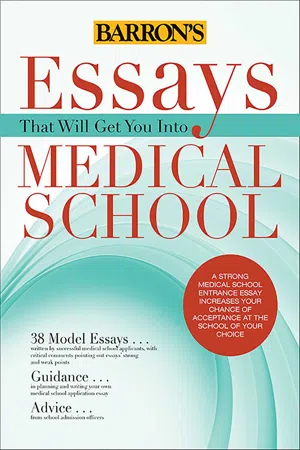
Essays That Will Get You Into Medical School
eBook - ePub

Essays That Will Get You Into Medical School

  1. 192 pages
  2. English
  3. ePUB (mobile friendly)
  4. Available on iOS & Android
eBook - ePub

About this book

This updated volume offers vital help to college students who are applying to medical school and are required to write a medical school admissions essay. Extensive advice covers the many do’s and don’ts of writing a successful essay. The authors instruct on organizing ideas, writing a rough draft, then editing and polishing the draft to produce a finished essay for presentation.

This new edition offers special focus on subjects relating to questions frequently found on the MCAT (Medical College Admission Test), including information on the new 2015 MCAT. The book concludes with approximately 38 model essays, each followed by a critique. All essays were submitted by applicants who were accepted to their chosen medical schools.
Frequently asked questions

Yes, you can cancel anytime from the Subscription tab in your account settings on the Perlego website. Your subscription will stay active until the end of your current billing period. Learn how to cancel your subscription.
No, books cannot be downloaded as external files, such as PDFs, for use outside of Perlego. However, you can download books within the Perlego app for offline reading on mobile or tablet. Learn more here.
Perlego offers two plans: Essential and Complete
  • Essential is ideal for learners and professionals who enjoy exploring a wide range of subjects. Access the Essential Library with 800,000+ trusted titles and best-sellers across business, personal growth, and the humanities. Includes unlimited reading time and Standard Read Aloud voice.
  • Complete: Perfect for advanced learners and researchers needing full, unrestricted access. Unlock 1.4M+ books across hundreds of subjects, including academic and specialized titles. The Complete Plan also includes advanced features like Premium Read Aloud and Research Assistant.
Both plans are available with monthly, semester, or annual billing cycles.
We are an online textbook subscription service, where you can get access to an entire online library for less than the price of a single book per month. With over 1 million books across 1000+ topics, we’ve got you covered! Learn more here.
Look out for the read-aloud symbol on your next book to see if you can listen to it. The read-aloud tool reads text aloud for you, highlighting the text as it is being read. You can pause it, speed it up and slow it down. Learn more here.
Yes! You can use the Perlego app on both iOS or Android devices to read anytime, anywhere — even offline. Perfect for commutes or when you’re on the go.
Please note we cannot support devices running on iOS 13 and Android 7 or earlier. Learn more about using the app.
Yes, you can access Essays That Will Get You Into Medical School by Barron's Educational Series,Liz Albero,Chris Dowhan,Dan Kaufman,Adrienne Dowhan in PDF and/or ePUB format, as well as other popular books in Study Aids & Study Guides. We have over one million books available in our catalogue for you to explore.

Information

PART ONE
Applying to Medical School
Highlights
• Applying to medical school is a 5-step process.
1. Completing pre-med courses
2. Taking the MCAT
3. Completing the AMCAS application
4. Filling out secondary applications for individual schools
5. Requesting letters of recommendation
• You will receive invitations to interview by schools that are considering accepting you.
• The Fee Assistance Program (FAP) developed by the AAMC can offset the exorbitant cost of applying to medical school.
• Look to www.aamc.org for the latest information.
You may not have known it then, but the process of applying to medical school began many years ago. It may have begun with a childhood experience that instilled in you a desire to help others, or maybe it began with the frog you dissected in high school that sparked your fascination with living creatures, how they are composed and how they function. It continued with each extracurricular activity, every job experience, and each research project. It was enhanced with every honor and award you received. It began long ago because though you may not have realized it then, you are now being asked to recall each and every experience that will demonstrate you are ready for medical school both academically and emotionally. It may seem daunting but think of it this way—most of the work is already done. What lies ahead is a standardized test, a comprehensive application that will include all college transcripts and your personal statement, secondary applications based on the schools you select, letters of recommendation and then hopefully, the coveted interview. So let’s break it all down.
Pre-med Courses
There is a general curriculum that most medical schools require before matriculation. These are one year of biology with labs, two years of chemistry (one year of inorganic and one year of organic) with labs, one year of physics, one year of calculus, and many institutions require a year of expository writing. Harvard Medical School, for example, states that writing is an important skill both for the study and practice of medicine. They will consider any nonscience courses that involved substantial expository writing to fulfill the writing requirement.
Harvard goes on to say, as do many institutions, that while satisfactory completion of the required science and mathematics courses is expected, they like to see at least 16 hours completed in literature, languages, the arts, humanities, and the social sciences. They further recommend honors courses and independent study and/or research. And, of course, computer proficiency is also expected.
It is important to note that while strong performances in the sciences is expected from all applicants, most admissions committees admire students who can demonstrate a well-rounded education through both their course work and their extracurricular activities. So if you didn’t major in a science, but have still done well in all of the pre-med requirements, don’t worry! This could actually highlight your application as impressive, rather than weak.
The average GPA as reported by the Association of American Medical Colleges (AAMC) in 2012 hit an all time high. The average GPA across the total applicant pool of 45,266 was 3.54. That was broken down as 3.44 for the Science GPA and 3.66 for the nonscience GPA. For students who actually matriculated, the average GPA was, of course, even higher with a 3.68 GPA total, broken down as 3.63 for science courses and 3.75 for nonscience courses.
MCAT
The Medical College Admissions Test (MCAT) is required by almost all medical schools as part of the application package. It is a standardized test that is mostly multiple-choice. The exam is designed to assess problem solving, critical thinking, verbal reasoning, and knowledge of science concepts and principles prerequisite to the study of medicine. Because of the heavy focus on science concepts, it is highly recommended that all pre-med courses be completed prior to taking the MCAT. Questions are largely based on this prerequisite curriculum. The cost for taking the MCAT for 2013 examinees was $270. Applications were up by 3000 in 2012.
In 2013, the exam consisted of approximately 50 questions each in physical sciences and biological sciences, and 40 questions in verbal reasoning. Scores are reported in each of these three categories. Most schools will not accept MCAT scores that are more than three years old. As of January 2013, the writing samples have been eliminated, making the essay that much more important.
MCAT testing is computerized; a pencil and paper option is not available. The exam is only offered in English. Total testing time is approximately four hours. The total appointment time for taking the MCAT is about five hours and ten minutes, which includes optional tutorials and three ten-minute breaks.
For each of the multiple-choice sections, a numeric score is given. Raw scores are scaled, taking into consideration the difficulty of the test questions. Scaled scores range from 1 to 15. The AAMC reported that in 2012, the mean MCAT scores for all medical school applicants was as follows: VR 8.1, PS 8.4, BS 8.8, WS O.
In 2013 a Trial Section was added as an optional, unscored set of 32 questions that are designed to test questions to be added in 2015. As of this writing, participants who took the Trial Section were compensated with a $30 gift card for their trouble. See the AAMC website for more information.
AMCAS
AMCAS, short for the American Medical College Application Service, is a centralized application service utilized by almost all American medical schools. It is a web-based application that simplifies the process of applying to multiple medical schools by having applicants fill out one comprehensive application that is then forwarded to each school that the applicant indicates in the application. It is a time-consuming process but the web-based system allows you to fill out part of the application, save it, and come back to it at a later time. Changes can be made to the application up to the time that you ā€œcertifyā€ it, indicating that it is true and complete. This virtually seals the application, which is now ready for submission. Changes can be made later if proper guidelines outlined by AMCAS are followed. The application will then need to be recertified.
The fee for the AMCAS application as of this publication was $160 for the first school and $35 for each additional school to which an applicant wants the application sent.
The application includes the following sections:
Biographic Information: Information such as name, social security number, mailing address, contact information, economic information and whether or not you would like to be considered for disadvantaged status.
Post-Secondary Experiences: This section allows you to enter any work experiences, extracurricular activities, awards, honors, or publications that you would like the admissions committee to consider. You may enter up to 15 experiences.
Personal Comments: This is where you will paste your essay. We emphasize the word PASTE here because we cannot stress enough how much work and thought should go into this section of your application. In fact, on the application itself you are asked to consider your statement carefully because ā€œadmissions committees place SIGNIFICANT weight on this section.ā€ It should be approximately one page, single spaced. Do not type your essay directly into this section of the application. It should be grammatically reviewed and spell-checked until it is perfect. It is interesting to note, however, that a simple text format is best because most of the formatting will be lost when pasted into the application form.
Schools Attended: Here you will enter information about each college you attended. It does not matter if you graduated from each institution. All colleges or universities must be listed even if you only took one course for which you received an incomplete.
Transcript Requests: This section allows you to create and print AMCAS Transcript Request Forms to send to registrars at schools from which official transcripts will be required. It is recommended that you request personal copies of all transcripts in addition to those required for your AMCAS application. Mistakes are not uncommon and this will give you the opportunity to check the transcript for accuracy.
Coursework: In this section, you must enter each course for which you were ever enrolled in any U.S., U.S. Territorial, or Canadian post-secondary institution. This includes courses from which you withdrew, received an incomplete, repeated, failed, are currently enrolled in or expect to enroll in before entering medical school, college-level courses taken in high school, or courses removed from your transcript or GPA as a result of academic bankruptcy, forgiveness, or similar institutional policies.
Certification and Submission: This section includes a final list of questions to which full disclosure is the only policy. Answering ā€œyesā€ to any of these questions may not hurt your chances of getting into medical school. There is a space left for explanations and a note that ā€œmedical schools understand that many individuals learn from the past and emerge stronger as a result.ā€ The questions include topics such as institutional action, felonies, and previous matriculation.
*In addition to the sections noted above, AMCAS now allows letters of recommendation to certain schools to be sent in or uploaded from the author.
Secondary Applications
Most medical schools send out secondary applications, otherwise known as supplemental applications, to each student who applies through AMCAS. Many of these schools will not review your application until the secondary application has been returned, complete with letters of recommendation. Other schools will complete a primary screening process before selecting a subset of applicants to which they send the supplemental application. The supplemental application will vary from to school to school but most will require an additional fee ranging from $25–$100, additional essays usually in response to specific questions, and letters of recommendation. It is important to get the secondary applications in as soon as possible because many schools operate on a rolling basis, which means that applications are reviewed as they are received and once they have filled their incoming class with their maximum number of students, you are out of luck.
Letters of Recommendation
All medical schools to which you apply will require letters of recommendation. As previously stated, some schools allow these letters to be uploaded to your AMCAS file. Others will be included with your supplemental applications. Most letters will be sealed—in other words, not reviewed by the applicant. In general, you should not request a letter of recommendation from someone whom you do not feel would write favorably of you, or to whom you must retell your name, but on the other hand, most people who agree to write a letter for you would only do so if they had something positive to say. If your undergraduate institution has a premedical committee, the letters usually come from this committee. Of the three letters which are typically requested, many schools prefer that two come from science faculty.
The Interview
After you have submitted complete applications, you can take a little break. Your job is almost done. Your applications are now being reviewed by the admissions committees, and if they like what they see, you will receive an invitation to interview. Congratulations—you are almost there!
Note: We have devoted an entire section of this book, Part Four, to the interview process.
A Word About Fees
The cost of applying to medical school can be exorbitant. Between the MCAT, the AMCAS, transcript fees, and the supplemental application (w...

Table of contents

  1. Cover Page
  2. Title Page
  3. Copyright Page
  4. Contents
  5. Acknowledgments
  6. Introduction
  7. A Note About Plagiarism
  8. Part One: Applying to Medical School
  9. Part Two: Preparing to Write the Essay
  10. Part Three: Writing the Essay
  11. Part Four: The Interview
  12. Part Five: Compilation of AMCAS Personal Statements
  13. Essay Index