In 1571, Diego Ortiz, an Augustinian friar, was executed in the neo-Inca state of Vilcabamba (Peru). His killing, and the events surrounding it, marked the final destruction of the Inca Empire by the Spanish and the definitive imposition of a new order on the continent of the Americas. Ortiz's story was recorded by the chronicler and fellow Augustinian, Antonio de la Calancha, in his Corónica moralizada (1638). He describes Ortiz's missionary work and recounts his often-fractious relationship with the emperor Titu Cusi Yupanqui before turning to his martyrdom, the destruction of Vilcabamba by the Spanish, and the capture and execution of the last Inca emperor Tupac Amaru. Calancha's account, meanwhile, exposes a very different way of viewing history from the one we are used to today as it simultaneously describes a teleological narrative while telescoping time into a single moment of creation—the instant time itself was created. This bilingual, critical edition is the first English language translation of Calancha's account and the introductory essays contextualise these events by discussing the conquest and evangelisation of Peru, and Inca politics of state, while also drawing out this radically different way of conceptualising human history—the collapse of time.
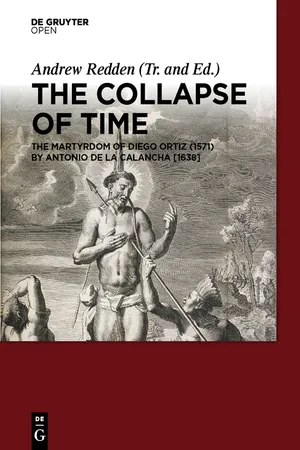
eBook - ePub
The Collapse of Time
The Martyrdom of Diego Ortiz (1571) by Antonio de la Calancha [1638]
- 402 pages
- English
- ePUB (mobile friendly)
- Available on iOS & Android
eBook - ePub
The Collapse of Time
The Martyrdom of Diego Ortiz (1571) by Antonio de la Calancha [1638]
About this book
Trusted by 375,005 students
Access to over 1.5 million titles for a fair monthly price.
Study more efficiently using our study tools.
Information
Index
HistoryPart I: The Collapse of Time and the Destruction of Vilcabamba
1 Introduction
Antonio de la Calancha’s account of the martyrdom of the Augustinian friar Diego Ortiz is one section (book 4, chapters 1-8) in a much larger chronicle published for the first time in 1638 and entitled the Coronica Moralizada de la Orden de San Agustin en el Peru.1 Calancha was also an Augustinian and his history forms part of a wider genre of texts known as ‘conventual chronicles’, or narratives that recount histories of specific regions or places from the particular perspective of religious orders such as the Augustinians, the Franciscans or the Dominicans. The section in question describes the missionary work and subsequent violent death of fray Diego Ortiz in the neo-Inca state of Vilcabamba (Peru) in the latter half of the sixteenth century. It recounts his often fractious relationship with the then emperor (and wily politician) Titu Cusi Yupanqui who managed to maintain the independence of what was left of his empire for the best part of three decades, keeping the Spanish at a cold distance while balancing that with the necessity of keeping diplomatic channels open. Unfortunately for fray Diego, Titu Cusi died very suddenly in 1571 and the friar, who had tried to treat him, was blamed for his demise. The chronicle then recounts the horrific martyrdom that Ortiz suffered, the subsequent invasion of Vilcabamba by the Spanish and its destruction at their hands, and the capture and execution of the last Inca emperor Tupac Amaru in 1572.
The events that took place in Vilcabamba between the years 1571 and 1572 and which are described in the account mark a sea-change in the histories of Spain, the Americas and, arguably, the Western World. They describe the final destruction of the Inca Empire at the hands of the Spanish and the definitive imposition of a new order on the southern continent of America. The details of Calancha’s account give testament to this critical historical juncture. At the same time, however, the reconstruction of these events by Calancha exposes a very different way of viewing history from the one that we are used to today. This is a theological view of history that is not teleological as such; rather it juxtaposes events that took place in sixteenth-century Vilcabamba (Peru), with events from first-century Palestine and sees these events as reflections of the same moment of creation in a time before time; at the instant time itself was created. This way of conceptualising human history as reflections or resonances of a single event has its origins in the neo-platonic philosophy of the early Christian leaders—and, in particular, of Saint Augustine of Hippo (d.430). This way of viewing the world was not unique to Calancha, nor even the Augustinians; rather, Calancha’s depiction of the death of Diego Ortiz is an exemplary account of a cosmovision that, in general terms, was common to inhabitants of Hispano-Catholic, Catholic and, even more broadly, Christian regions of the time. Of course, this is not to say that such a way of experiencing the world and, with that, history, did not change depending on individual, local and regional differences in culture. Nevertheless, it was a structure for historical experience that was recognisably shared across a significant proportion of the world’s population. With this in mind, it is remarkable how little attention it has received in our efforts to reconstruct the past. As such, after an overview of the historical context for the traumatic events that took place in Peru prior to the friar’s death, a discussion of the remarkable political achievements of the Inca emperor Titu Cusi Yupanqui, and of the Augustinian evangelisation in Peru, a key part of the introductory analysis will focus on this collapse of time, as demonstrated by Calancha’s account of the martyrdom of fray Diego Ortiz. A short consideration of the text as martyrological hagiography will then be followed by a brief biography of the author, Antonio de la Calancha, and a note on transcription and translation.
1.1 Invasion and Conquest of Tawantinsuyo (Peru)
After a series of exploratory expeditions along the northern coast of South America in the 1520s, in 1532 a small Spanish force under the command of Francisco Pizarro reached the city of Tumbes on the north coast of what is now Peru for the second time.2 Pizarro had been granted royal permission in 1529, ‘in the name of the Royal Crown of Castille’, to ‘continue with the discovery, conquest and settlement of the province of Peru’.3 He was named Governor General of Peru while his expeditionary partners, the cleric Hernando de Luque, and the conquistador Diego de Almagro, were promised the new bishopric of Tumbes and the governorship of the same city respectively.4
However generous an offer this may have seemed at the time, especially when taking into account the prospective tribute payments they would be entitled to, it nevertheless represented the juridical source of subsequent turmoil that, after the initial conquest was complete, was to plague the nascent Spanish governance in Peru; for, when Pizarro’s expedition reached Tumbes in early 1532, they found a city in ruins and relatively few survivors. The population had been massacred after supporting the losing side in a bitter civil war that had riven the Inca empire of Tawantinsuyo as under. Almagro, by royal decree, was effectively restricted to governing (and exploiting) a ruin. Pizarro and his brothers, meanwhile, were free to continue the exploration and conquest, turning what had been a triple partnership into a private family enterprise with any subsequent plunder to be divided amongst the Pizarro brothers and their loyal supporters.5 Not surprisingly, after he arrived with reinforcements in December 1532, Almagro was not content to wait on the coast for any share of gold that Pizarro might be kind enough to send his way, so in April 1533 he made his way up into the Andes to meet Pizarro in the town of Cajamarca. Notwithstanding the assertion of Pizarro’s secretary Francisco de Xerez, that Almagro was ‘well-received’6, over the course of the next few years the Pizarro brothers would systematically block Almagro’s access to the spoils of the conquest of the Inca empire of Tawantinsuyo that he believed were rightfully his, leading eventually to conflict and open warfare.7
The devastating Inca civil war, meanwhile, so crucial for the Spaniards’ eventual success, was fought between two sons of the emperor Huayna Capac, named Atahualpa and Huascar.8 The war had resulted from the untimely death of the Inca (c.1525-7) from what was most likely a smallpox pandemic that was sweeping the continent.9 Smallpox first broke out in the Caribbean, and reached the mainland Americas in 1519. Due to the fact the indigenous population of the Americas had no natural defences to the disease, it quickly ravaged the peoples of Mesoamerica, facilitating the Spanish conquest there, even as it rapidly spread north and south, down through the Central American Isthmus and then into the Southern Continent, devastating its large indigenous populations.10 Huayna Capac was campaigning on the northern frontier of the empire (present day Ecuador) when he fell ill and died leaving the succession undecided. The Spanish chronicler Juan de Betanzos, who wrote a history of the Incas in the mid-sixteenth century, describes how Huayna Capac successively named three different sons his heirs.11 Ninan Cuyuchi, the first to be named, also succumbed to the disease, however, while the two remaining heirs, Atahualpa and Huascar, were left to fight for the rule of the empire.12 Betanzos’ contemporary, Pedro de Cieza y León, wrote that Atahualpa was ‘well-loved by his father’s old commanders because he fought in the war [in Quito] since his childhood’. Huascar, meanwhile, was ‘loved in Cuzco and throughout the kingdom by the people for being the rightful heir’.13 Thus, the Inca empire was split: Atahualpa had the advantage of the support of a seasoned army, while Huascar, according to Cieza, apparently had the support of the imperial centre.14 By the time Pizarro’s force pushed inland in 1532 the war was all but over; Huascar was held captive in Cuzco and Atahualpa’s generals, Rumiñavi, Quisquis and Chalcuchima, were in the process of purging the empire of those loyal to Huascar and punishing those populations that had supported him.15
The Spaniards and their indigenous allies reached the valley of Cajamarca where Atahualpa was based in November 1532, and from the heights they looked down on a vast encampment stretching out before them. According to Miguel de Estete, one of the Spaniards present:
There seemed to be so many tents that it terrified us because we did not think that Indians could keep such a proud estate, nor so many tents in such good order. Such a thing had never been seen in the Indies until then and it caused considerable fear and confusion amongst us Spaniards, but we could not show it and certainly could not turn back because if they noticed any weakness in us the very Indians we were bringing with us would have killed us.16
Estete’s admission speaks volumes about the fragile nature of the initial alliances the Spanish had made with the inhabitants of the northern coast. According to Francisco de Pizarro’s secretary Francisco de Xerez, after the Spanish moved south and inland from Tumbes, across the coastal plains and towards the mountains, they had encountered a range of different welcomes from the inhabitants of the region. They were generally received well by the Tallan people who inhabited the coastal plains and valleys of what is now Piura, but as they moved inland they encountered resistance from leaders who refused to treat with Pizarro.17 He sent his brother Hernando to carry out exemplary punishment on those who disobeyed his summons and: ‘the captain rode out against them, and in a short time, wounding and killing, the Indians were defeated’.18 Soon after, Pizarro was warned by some of his allies that two indigenous leaders, Lachira and Almotaje, were conspiring to kill the Spanish. Pizarro had them seized and Almotaje was burned at the stake. Xerez writes that ‘this punishment inspired great terror throughout the region’ and, as a result, the apparent conspiracy collapsed and ‘from then on all ser...
Table of contents
- Cover
- Title Page
- Copyright Page
- Contents
- Dedication
- Acknowledgments
- Part I: The Collapse of Time and the Destruction of Vilcabamba
- Part II: The Martyrdom of Diego Ortiz, by Antonio de la Calancha
- Bibliography
- List of Illustrations
- Index
Frequently asked questions
Yes, you can cancel anytime from the Subscription tab in your account settings on the Perlego website. Your subscription will stay active until the end of your current billing period. Learn how to cancel your subscription
No, books cannot be downloaded as external files, such as PDFs, for use outside of Perlego. However, you can download books within the Perlego app for offline reading on mobile or tablet. Learn how to download books offline
Perlego offers two plans: Essential and Complete
- Essential is ideal for learners and professionals who enjoy exploring a wide range of subjects. Access the Essential Library with 800,000+ trusted titles and best-sellers across business, personal growth, and the humanities. Includes unlimited reading time and Standard Read Aloud voice.
- Complete: Perfect for advanced learners and researchers needing full, unrestricted access. Unlock 1.5M+ books across hundreds of subjects, including academic and specialized titles. The Complete Plan also includes advanced features like Premium Read Aloud and Research Assistant.
We are an online textbook subscription service, where you can get access to an entire online library for less than the price of a single book per month. With over 1.5 million books across 990+ topics, we’ve got you covered! Learn about our mission
Look out for the read-aloud symbol on your next book to see if you can listen to it. The read-aloud tool reads text aloud for you, highlighting the text as it is being read. You can pause it, speed it up and slow it down. Learn more about Read Aloud
Yes! You can use the Perlego app on both iOS and Android devices to read anytime, anywhere — even offline. Perfect for commutes or when you’re on the go.
Please note we cannot support devices running on iOS 13 and Android 7 or earlier. Learn more about using the app
Please note we cannot support devices running on iOS 13 and Android 7 or earlier. Learn more about using the app
Yes, you can access The Collapse of Time by Andrew Redden in PDF and/or ePUB format, as well as other popular books in History & Latin American & Caribbean History. We have over 1.5 million books available in our catalogue for you to explore.