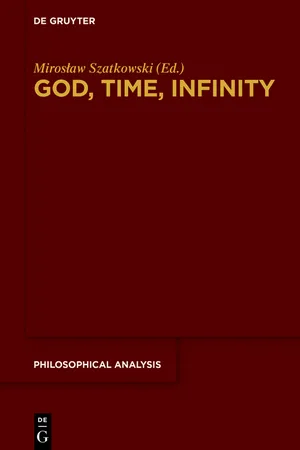
The issues of the nature and existence of God, time and infinity, respectively, and how they relate to each other, are some of the most complicated problems of metaphysics.This volume presents contributions of thirteen internationally renowned scholars who deal with various aspects of these complex issues. The contributions were presented and discussed during the international conference: God, Time, Infinity held in Warsaw, September 22—24, 2015.
- 242 pages
- English
- ePUB (mobile friendly)
- Available on iOS & Android
eBook - ePub
God, Time, Infinity
About this book
Information
Topic
PhilosophySubtopic
Philosophy of ReligionSrećko Kovač
Concepts, Space-and-Time, Metaphysics (Kant and the dialogue of John 4)
1Introduction
In an empirically oriented common-sense ontology, first-order concepts are expected to be “concrete” and to denote sensible objects given in space and time, while other, “abstract”, concepts should denote words, sentences, sets, numbers, or concepts themselves, possibly of a questionable ontological status, or, moreover, conceived merely as a manner of speaking, subjective representations, or “ideas” without an actually corresponding reality. In a formalized presentation, such an empirical theory would have a model comprising a first-order domain of sensible objects denoted (possibly in n-tuples) by predicates. The domain itself and the relations on the domain, as well as syntactic “objects” (terms, predicates, formulas – replacing concepts and judgments), remain abstract, metatheoretical entities that are not empirically given for the object theory. Besides, the domain and the relations on the domain may appear as members of a second-order domain if the formalization is extended to a higher-order setting, but, of course, this still does not make the first-order domain and the relations on it themselves empirically existing objects.
Some essential features of abstract, model-theoretic, concepts of a possible empirical theory are traceable back to Immanuel Kant’s “transcendental logic” (with some characteristic differences).86 Against this background, we examine the objective reality of the abstract concepts involved, putting them in the context of a possible religious experience as presented in the text of John 4.
2From metatheory to metaphysical theory
It can be recognized that Kant’s theory of transcendental ideas serves as a sort of first-order model for empirical reasoning and knowledge, where transcendental ideas represent three sorts of totalities of conditions of empirical knowledge:
| (a) | the totality with respect to a subject (“complete subject”,87 never occurring as a predicate, B 379): “I” (“mere consciousness”, “determining Self”), which thinks, is the metatheoretical subject “X” of all thoughts (e.g., of concepts), which are its predicates (B 404, A 402);88 |
| (b) | the totality of the “series” of conditions (“world”) of an empirically given object: each such object is possible only if the whole series of its conditions, too, is in some way already given (B 436);89 |
| (c) | the totality of concepts as predicates (“the sum total of all predicates”) – as if comprised in some common “ground” (B 607): “the most real being” (ens realissimum).90 |
These “transcendental” ideas do not belong to empirical knowledge as an object-theory, but to its metatheory. Kant further specifies this by assigning those ideas a non-constitutive, re...
Table of contents
- Cover
- Title Page
- Copyright
- Contents
- Acknowledgements
- Ockham, Plantinga and the Row of Ants
- The Importance of Being Timeless
- Temporal Relations as Epiphenomena
- In Defense of Presentism and an Extratemporal God
- Concepts, Space-and-Time, Metaphysics (Kant and the dialogue of John 4)
- Basic Intuitions Concerning the Concept of Infinity in Mathematics from a Historical and Theological Point of View
- No Life without Time
- God and Time. A defense of God’s timelessness
- Thoughs on Time, Truth and Transcendence
- The Moral Desirability of Presentism
- McTaggart, Lewis and the Problem of Temporary Intrinsics
- Is Dualism Compatible with Classical Theism?
- In What Sense is God Infinite? A Consideration from the Historical Perspective
- Authors of Contributed Papers
- Abstracts
- Person Index
- Subject Index
Trusted by 375,005 students
Access to over 1.5 million titles for a fair monthly price.
Study more efficiently using our study tools.
Frequently asked questions
Yes, you can cancel anytime from the Subscription tab in your account settings on the Perlego website. Your subscription will stay active until the end of your current billing period. Learn how to cancel your subscription
No, books cannot be downloaded as external files, such as PDFs, for use outside of Perlego. However, you can download books within the Perlego app for offline reading on mobile or tablet. Learn how to download books offline
Perlego offers two plans: Essential and Complete
- Essential is ideal for learners and professionals who enjoy exploring a wide range of subjects. Access the Essential Library with 800,000+ trusted titles and best-sellers across business, personal growth, and the humanities. Includes unlimited reading time and Standard Read Aloud voice.
- Complete: Perfect for advanced learners and researchers needing full, unrestricted access. Unlock 1.5M+ books across hundreds of subjects, including academic and specialized titles. The Complete Plan also includes advanced features like Premium Read Aloud and Research Assistant.
We are an online textbook subscription service, where you can get access to an entire online library for less than the price of a single book per month. With over 1.5 million books across 990+ topics, we’ve got you covered! Learn about our mission
Look out for the read-aloud symbol on your next book to see if you can listen to it. The read-aloud tool reads text aloud for you, highlighting the text as it is being read. You can pause it, speed it up and slow it down. Learn more about Read Aloud
Yes! You can use the Perlego app on both iOS and Android devices to read anytime, anywhere — even offline. Perfect for commutes or when you’re on the go.
Please note we cannot support devices running on iOS 13 and Android 7 or earlier. Learn more about using the app
Please note we cannot support devices running on iOS 13 and Android 7 or earlier. Learn more about using the app
Yes, you can access God, Time, Infinity by Mirosław Szatkowski in PDF and/or ePUB format, as well as other popular books in Philosophy & Philosophy of Religion. We have over 1.5 million books available in our catalogue for you to explore.