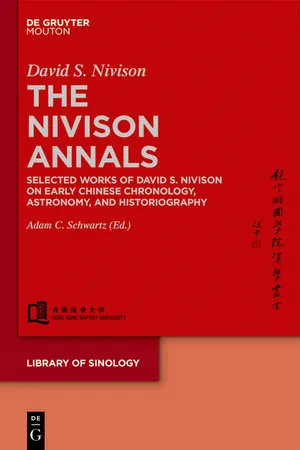
The Nivison Annals
eBook - ePub

The Nivison Annals

Selected Works of David S. Nivison on Early Chinese Chronology, Astronomy, and Historiography

  1. 330 pages
  2. English
  3. ePUB (mobile friendly)
  4. Available on iOS & Android
eBook - ePub

The Nivison Annals

Selected Works of David S. Nivison on Early Chinese Chronology, Astronomy, and Historiography

About this book

In his last essay just weeks before his death at the age of 91, David S. Nivison says, "Breaking into a formal system - such as a chronology - must be like breaking into a code. If you are successful, success will show right off." Since the late 1970's Nivison has focused his scholarship on breaking the code of Three Dynasties (Xia, Shang, Zhou) chronology by establishing an innovative methodology based on mourning periods, astronomical phenomenon, and numerical manipulations derived from them. Nivison is most readily known in the field for revising (and then revising again) the date of the Zhou conquest of Shang, and for his theory that Western Zhou kings employed two calendars (His so-called "Two yuan" theory), the second being set in effect upon the death of the new king's predecessor and counted from the completion of post-mourning rites for him (i.e., a "second 'first' year").

Nivison's enabling discovery that the Bamboo Annals (BA) had a historical basis was initially designed to make Wang Guowei's analysis of lunar phase terms (the so-called "Four quarter" theory that separated each month into four quarters) work for Western Zhou bronze inscriptions. In order to do so he had to assume that some inscriptions used a second yuan counted from completion of mourning. The king's death was the most important event late in a reign, so this implied that a king's reign-of-record was normally counted from the second yuan, omitting initial mourning years. It follows that when the unexpressed mourning years are forgotten (or edited out) but the dates of the beginning and end of the dynasty are still known, the remaining reigns-of-record cluster toward the beginning and end, and a reign in the middle is enlarged.

Problems, ideas, and solutions like the one described above are found throughout this new collection of important works on chronology, astronomy, and historiography.

Trusted by 375,005 students

Access to over 1.5 million titles for a fair monthly price.

Study more efficiently using our study tools.

Information

Year
2018
Topic
History
eBook ISBN
9781501505355

1The He zun Inscription and the Beginning of Zhou

Paper presented at the annual meeting of the American Oriental Society, San Francisco, CA, April 16, 1980; revised April 26, 1980
About six months ago, I made a discovery that pointed toward a solution to what has been the classic problem in ancient Chinese historical studies for 2000 years—the reconstruction of Western Zhou chronology prior to 841. In brief, I noticed that the chronology in the so-called “forged” Zhushu jinian is really a distortion of the true dates—a distortion that can be reversed with careful analysis and with the help of bronze inscriptions. (I summarize results of this theory in an attached chart with brief explanations, “Probable Derivation of the Zhushu jinian Chronology for Western Zhou.”) Quite recently, turning my attention specifically to the He zun
I discovered that this one inscription provides the key to straightening out the sequence of events of the crucial first decade of the Zhou Dynasty, making it possible to pinpoint with near certainty the year, month and day of the Zhou Conquest.1

I

The He zun inscription (Figure 1) bears the date “fourth month, day bingxu (23)… the king’s fifth ritual cycle.” It gives an account of an address by the king to “young nobles of the royal house” (zong xiao zi) given “when the king first moved his residence to Cheng Zhou” (i.e., Luoyang). To evaluate all of this, we must begin by making a tentative first approximation of the absolute date.
  1. Sima Qian, in the “Lu Zhou Gong Shijia” chapter of the Shiji, gives reign lengths for the dukes of Lu, back to but not including Bo Qin, who was the first duke and the eldest son of Zhou Gong. These reign lengths imply that Bo Qin died in 999.
  2. The “Bi Ming” chapter of the Shang shu has King Kang giving an appointment to the aged Bi Gong—possibly calling him from retirement—to be viceroy in the East. This is a guwen chapter, and so one must be cautious. It contains a date, however, which is found also in the Han shu “Lü-li zhi”: “12th year, 6th month, gengwu (7) fei (the 3rd, new moon day).” If we suppose Bi Gong was being given appointments Bo Qin had filled, 999 was King Kang’s 12th year, and his first year was 1010. The very precise month and day date in the “Bi Ming” does fit 999 exactly, if one makes a simple change of 5th month long, 6th month short, instead of the reverse.
  3. The “new” Zhushu jinian dates the deaths of Lu dukes (after Bo Qin) through Wei Gong consistently 7 years later than the Shiji does, probably for this reason: The Han shu “Lü-li zhi”—arguing for a different Zhou chronology—says Bo Qin became duke “in the 1st year of Cheng Wang,” reigned 46 years, and died “in the 16th year of Kang Wang.” But what was the first year of Cheng? In the Zhushu system, 1044, which would make 999 the year of death. But arguably it could be the first year of Cheng’s personal rule, supposed to be seven years later. This would give 992 as Bo Qin’s last year, and 992 is the 16th year of Kang in the “new” Jinian. So this was evidently the date the Jinian editors intended to give. But what we actually find in the Jinian is not “l6th year” but “19th year”—though this is inconsistent with the next dated entry in the Jinian, as Wang Guowei shows. This appears to be unfinished editing, and we can exploit it: 992 would be the 19th year of a reign that began in 1010. When the editors shifted the date of Kang’s succession from 1010 to 1007, they must have neglected to make a compensating change from “19th year” to “l6th year” for the death of Bo Qin.
  4. More confirmation of the 1010 date is possible, but this will suffice for tentative use of it. Taking Liu Xin’s reign lengths, 7 years for Zhou Gong’s regency and 30 years for Cheng Wang’s reign thereafter, one would suppose the dates are 1047–1041 and 1040–1011. The date of the He zun should therefore be either 1043 or 1036, depending on what is meant by “the king’s 5th ritual cycle.” If the former, the king’s address is on the 3rd, if the latter it is on the 13th. Either is possible (one should expect the event to be near the first or near the middle of the month). I assume 1040 was the year Cheng became of age (20 sui); so in the first case he would be 17 sui—not too likely, but possible. In the second case he would be 24 sui, obviously more probable.

II

But this traditional “7 plus 30” scheme is mistaken. There are two immediate objections:
  1. The “Shao gao” and “Luo gao” chapters of the Shang shu narrate events, with precise month and day dates, that have to fall in the last year of the regency—which would be 1041. In particular, the king performs a sacrifice in the “Luo gao” on the last day of the year, identified as day (5) in the 60-day cycle. But for 1041 the dates throughout are one day off, making the sacrifice fall on the first day of 1040. The fact that the dates are this close shows that this is a first approximation. But a correction is required.
  2. The He zun says that “the king’s 5th ritual cycle” was the year a royal residence was first established in Cheng Zhou (Luo). So, the king’s 5th year, in some sense, should be the year of the construction of the royal accommodations in the new city as described in the “Luo gao” which closes with the date, “7th year of Zhou Gong’s regency.” But also, the Shang shu Dazhuan says that Zhou Gong in his 5th year “built Cheng Zhou.” And so, this same year should be in some sense Zhou Gong’s 5th year also. These apparently conflicting accounts require reinterpretation or revision consistent with the He zun.
Previous solutions to this 5th year–7th year puzzle preserve the traditional assumption that Zhou Gong properly transferred power to the king when the king became an adult. To the contrary, the right account of events I think is as follows:
– 1057 King Wen dies (after “receiving the Mandate” by divination).
– 1056 King Wu’s first year as King of Zhou.
– 1048 The meeting of King Wu with his allies at Mengjin. This was perhaps a preliminary campaign that was not pressed, or did not succeed, the reason (or cause) being, as the Zhou saw it, that the position of Jupiter (sui xing) was not yet favorable (i.e., Heaven’s “command” was not yet effective).
– 1045 The final campaign against Shang is under way, and achieves a decisive victory at Muye outside the Great City Shang on the day jiazi (1) in the 2nd month.
– 1044 King Cheng succeeds, as a minor (16 sui), with Zhou Gong as his regent.
– 1043 Mourning for King Wu completed.
– 1042 Post-mourning “lst year” of King Cheng and of the Regency.
– 1040 King Cheng attains majority, 20 sui, entitling him to take up personal rule. But a rebellion is brewing. Zhou Gong fears the young king, his nephew, cannot handle it, and retains ultimate power (informally, and illegally). He overcomes Shao Gong’s objections and obtains his collaboration; the two gradually share power with the king. Lu, Zhou Gong’s fief, is assigned to his eldest son Bo Qin. Steps are taken against the two (three?) rebelling royal uncles.
– 1039 The revived Shang power is attacked and destroyed, and the Shang ruler Wu Geng killed.
– 1038 The campaign is extended against the Yan and other peoples who had joined the revolt. King Cheng himself —now 22 sui—leads this campaign.
– 1037 Shang territories are reassigned, and conquered populations relocated. Zhou Gong’s younger brother Feng is enfeoffed in Wei. Ceremonies take place in Cheng Chou (Luo), where construction of a new capital is already going on.
– 1036 Construction at Cheng Zhou continues, proceeding to the “royal city” on the north bank, now under King Cheng’s direction. King Cheng gives the He zun address to the “young nobles” while staying in the jing (military principium) in the 4th month. Rites at the end of the year complete the...

Table of contents

  1. Cover
  2. Title Page
  3. Copyright
  4. Contents
  5. Preface, by Edward L. Shaughnessy (University of Chicago)
  6. 1 The He zun Inscription and the Beginning of Zhou
  7. 2 Supplement to the “The ‘Question’ Question”—British Museum Scapula and British Museum Library Deer Horn
  8. 3 The King and the Bird: a Possible Genuine Shang Literary Text and Its Echoes in Later Philosophy and Religion
  9. 4 The Hampers of Zeng: Some Problems in Archaeoastronomy
  10. 5 New Study of Xiaotun Yinxu Wenzi Jiabian 2416
  11. 6 Research Notes On Yin Li Chronology per Zheng Xuan
  12. 7 A Tell-tale Mistake in the LĂź shi Chunqiu: The Earthquake Supposedly in the Eighth Year of Wen Wang of Zhou
  13. 8 The Origin of the Chaochen Rule
  14. 9 A New Analysis of the Guoyu Astrological Text
  15. 10 Qingming Day, 1040 BC
  16. 11 Kong Jia of Xia, 1577–1569 BC
  17. 12 Shaughnessy’s Slip
  18. 13 Review of Sun, Xiaochun, and Jacob Kistemaker, The Chinese Sky during the Han: Constellating Stars and Society
  19. 14 Zhang Peiyu on the Dayuan Li yi and the “Jinben” Zhushu jinian
  20. 15 The 1046 Hypothesis
  21. 16 Huang Di to Zhi Bo: A Problem in Historical Epistemology
  22. 17 Was Warring States China Ahead of Greece in Science?
  23. 18 Notes on Royal Ontario Museum, White Collection, #1908
  24. 19 90th Birthday Address
  25. 20 Two yuan and Four quarters
  26. 21 The “31 Years” Problem
  27. 22 The Nivison-Shaughnessy Debate on the Bamboo Annals (Zhushu jinian)
  28. 23 Important Discoveries and Bad Mistakes
  29. Postface 1, by Chen Zhi (Hong Kong Baptist University)
  30. Postface 2, by Adam C. Schwartz (Hong Kong Baptist University)
  31. Index

Frequently asked questions

Yes, you can cancel anytime from the Subscription tab in your account settings on the Perlego website. Your subscription will stay active until the end of your current billing period. Learn how to cancel your subscription
No, books cannot be downloaded as external files, such as PDFs, for use outside of Perlego. However, you can download books within the Perlego app for offline reading on mobile or tablet. Learn how to download books offline
Perlego offers two plans: Essential and Complete
  • Essential is ideal for learners and professionals who enjoy exploring a wide range of subjects. Access the Essential Library with 800,000+ trusted titles and best-sellers across business, personal growth, and the humanities. Includes unlimited reading time and Standard Read Aloud voice.
  • Complete: Perfect for advanced learners and researchers needing full, unrestricted access. Unlock 1.5M+ books across hundreds of subjects, including academic and specialized titles. The Complete Plan also includes advanced features like Premium Read Aloud and Research Assistant.
Both plans are available with monthly, semester, or annual billing cycles.
We are an online textbook subscription service, where you can get access to an entire online library for less than the price of a single book per month. With over 1.5 million books across 990+ topics, we’ve got you covered! Learn about our mission
Look out for the read-aloud symbol on your next book to see if you can listen to it. The read-aloud tool reads text aloud for you, highlighting the text as it is being read. You can pause it, speed it up and slow it down. Learn more about Read Aloud
Yes! You can use the Perlego app on both iOS and Android devices to read anytime, anywhere — even offline. Perfect for commutes or when you’re on the go.
Please note we cannot support devices running on iOS 13 and Android 7 or earlier. Learn more about using the app
Yes, you can access The Nivison Annals by David S. Nivison, Adam C. Schwartz in PDF and/or ePUB format, as well as other popular books in History & Asian History. We have over 1.5 million books available in our catalogue for you to explore.