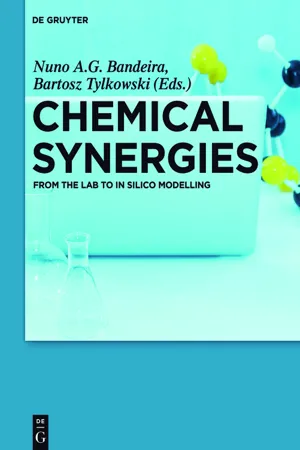
This book gives an overview of recent integrated and inter-disciplinary approaches between chemical experiment and theory in a variety of fields, from polymer science to materials chemistry and ranging from the design of tailored properties to catalysis and reactivity, building on the well-established success of Density Functional Theory as the foremost quantum chemical method to provide qualitative and quantitative interpretation of results from the chemical laboratory. The combination of several characterization techniques with an understanding at the molecular level of chemical and physical phenomena are the main focal point of the subject matter.
eBook - ePub
Chemical Synergies
From the Lab to In Silico Modelling
- 324 pages
- English
- ePUB (mobile friendly)
- Available on iOS & Android
eBook - ePub
Chemical Synergies
From the Lab to In Silico Modelling
About this book
Information
Topic
Ciencias físicasSubtopic
Ingeniería química y bioquímicaMauro Fianchini
1Synthesis meets theory: Past, present and future of rational chemistry
This article has previously been published in the journal Physical Sciences Reviews. Please cite as: Fianchini, M. Synthesis meets theory: Past, present and future of rational chemistry. Physical Sciences Reviews [Online] 2017, 2 (12). DOI: 10.1515/psr-2017-0134
Abstract: Chemical synthesis has its roots in the empirical approach of alchemy. Nonetheless, the birth of the scientific method, the technical and technological advances (exploiting revolutionary discoveries in physics) and the improved management and sharing of growing databases greatly contributed to the evolution of chemistry from an esoteric ground into a mature scientific discipline during these last 400 years. Furthermore, thanks to the evolution of computational resources, platforms and media in the last 40 years, theoretical chemistry has added to the puzzle the final missing tile in the process of “rationalizing” chemistry. The use of mathematical models of chemical properties, behaviors and reactivities is nowadays ubiquitous in literature. Theoretical chemistry has been successful in the difficult task of complementing and explaining synthetic results and providing rigorous insights when these are otherwise unattainable by experiment. The first part of this review walks the reader through a concise historical overview on the evolution of the “model” in chemistry. Salient milestones have been highlighted and briefly discussed. The second part focuses more on the general description of recent state-of-the-art computational techniques currently used worldwide by chemists to produce synergistic models between theory and experiment. Each section is complemented by key-examples taken from the literature that illustrate the application of the technique discussed therein.
Keywords: theory, model, rational synthesis, first principles, computational chemistry
1.1Introduction
Since the days of Galileo Galilei, science has been approached using the scientific method. The routine of “curiosity sparking observation, formulation and testing of new hypotheses and birth of new theories” represents the first rudimentary iterative block-diagram algorithm to approach “scientifically” any natural phenomenon. Both the predictive and explanatory power of science, and so its evolution, reside in the use of models. Models are rescaled and simplified visions of reality that scientists create to afford an explanation and prediction of phenomena within certain levels of confidence. Leonhard Euler himself commented on the power of the model with his famous maxim: “Although to penetrate into the intimate mysteries of nature and thence to learn the true causes of phenomena is not allowed to us, nevertheless it can happen that a certain fictive hypothesis may suffice for explaining many phenomena”. Euler’s “fictive hypothesis” is an approximated, yet powerful tool to account for and, ultimately, influence or even control phenomena to the benefit of humanity. Nowadays, mathematical models are routinely employed to predict events in physics, engineering and natural sciences [1, 2].
What could be inferred about chemistry, then? Any dedicated scholar sooner or later stumbled upon the uncomfortable question: Can complex chemical reactions be predicted by rational models? Chemical sciences are intrinsically more bound to their empirical nature than other scientific disciplines, given the fact that the ultimate goal of chemistry is to make new molecules for market, technology, society or simply for scientific interest [3]. The construction of a priori models of complete reactions is currently regarded over-ambitious, given the extreme difficulty to characterize accurately Avogadro’s numbers of solvated molecules, predict their reactive events in such environment and simulate the course of n-parallel and competitive channels during a desired interval of time. While such search for rationality poses unparalleled challenges, it would also represent, if successful, the pinnacle of chemical manipulation and establish an evolved concept of understanding and doing chemistry. This evolution will lead to a new level of rational design of target compounds and trans-form chemistry into a discipline scientists can fully control, rather than merely observe and improve through trial-and-error strategy. The structure of the chapter has been organized in a way that the reader will receive a general, yet detailed, wide-angle history of chemistry, followed by a more specific treatment of theoretical disciplines. Each section will be integrated with interesting examples singled out from a massive multidisciplinary pool of excellent scientific works. The selection criteria were not only based on relevance, impact factor and citations of the works but also on the diversity of the field and author’s interests and familiarity with the works. The common trait d’union of these works is represented, however, by the synergistic interdisciplinary approach between theory, spectroscopy and experiment. The use of theoretical assets in solving chemical problems, whether a priori or a posteriori, serves as a proof of concept of rational chemistry. The author wishes to convey the idea that chemistry is a multifaceted scientific ground where experimental and theoretical approaches are far from being rivals; on the contrary, they imparted together an evolutionary rational momentum to the discipline.
This momentum allowed chemistry to blossom into a modern science during the last 400 years, from nothing more than a collection of esoteric notions. We could say that chemistry is a relatively young discipline since a scientific, systematic and non-serendipitous approach to this field has been introduced not earlier than the sixteenth century. Technological advances in synthetic methodologies, spectroscopy and data sharing allowed chemistry to reach unprecedented goals and successes. The development of computers carved an important role for theory into the full landscape of chemical disciplines. This chapter reviews the synergistic integration between practical and...
Table of contents
- Cover
- Title Page
- Copyright
- Preface
- Contents
- List of contributing authors
- 1 Synthesis meets theory: Past, present and future of rational chemistry
- 2 Close contacts at the interface: Experimental-computational synergies for solving complexity problems
- 3 The halogen bond: Nature and applications
- 4 Effect of protonation, composition and isomerism on the redox properties and electron (de)localization of classical polyoxometalates
- 5 Modeling of Azobenzene-Based Compounds
- 6 Gas-phase high-resolution molecular spectroscopy for LAV molecules
- 7 Computer analysis of potentiometric data of complexes formation in the solution
- 8 Reactive extraction at liquid-liquid systems
- 9 Membrane processes
- 10 The problem of fouling in submerged membrane bioreactors – Model validation and experimental evidence
- 11 Applicability of DFT model in reactive distillation
- Index
Trusted by 375,005 students
Access to over 1.5 million titles for a fair monthly price.
Study more efficiently using our study tools.
Frequently asked questions
Yes, you can cancel anytime from the Subscription tab in your account settings on the Perlego website. Your subscription will stay active until the end of your current billing period. Learn how to cancel your subscription
No, books cannot be downloaded as external files, such as PDFs, for use outside of Perlego. However, you can download books within the Perlego app for offline reading on mobile or tablet. Learn how to download books offline
Perlego offers two plans: Essential and Complete
- Essential is ideal for learners and professionals who enjoy exploring a wide range of subjects. Access the Essential Library with 800,000+ trusted titles and best-sellers across business, personal growth, and the humanities. Includes unlimited reading time and Standard Read Aloud voice.
- Complete: Perfect for advanced learners and researchers needing full, unrestricted access. Unlock 1.5M+ books across hundreds of subjects, including academic and specialized titles. The Complete Plan also includes advanced features like Premium Read Aloud and Research Assistant.
We are an online textbook subscription service, where you can get access to an entire online library for less than the price of a single book per month. With over 1.5 million books across 990+ topics, we’ve got you covered! Learn about our mission
Look out for the read-aloud symbol on your next book to see if you can listen to it. The read-aloud tool reads text aloud for you, highlighting the text as it is being read. You can pause it, speed it up and slow it down. Learn more about Read Aloud
Yes! You can use the Perlego app on both iOS and Android devices to read anytime, anywhere — even offline. Perfect for commutes or when you’re on the go.
Please note we cannot support devices running on iOS 13 and Android 7 or earlier. Learn more about using the app
Please note we cannot support devices running on iOS 13 and Android 7 or earlier. Learn more about using the app
Yes, you can access Chemical Synergies by Nuno A.G. Bandeira, Bartosz Tylkowski, Nuno A.G. Bandeira,Bartosz Tylkowski in PDF and/or ePUB format, as well as other popular books in Ciencias físicas & Ingeniería química y bioquímica. We have over 1.5 million books available in our catalogue for you to explore.