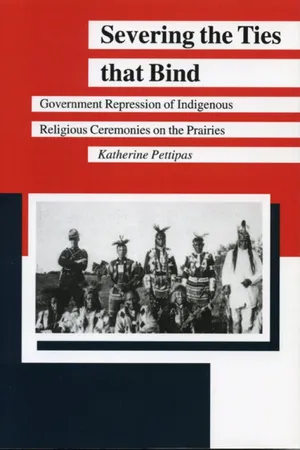
Religious ceremonies were an inseparable part of Aboriginal traditional life, reinforcing social, economic, and political values. However, missionaries and government officials with ethnocentric attitudes of cultural superiority decreed that Native dances and ceremonies were immoral or un-Christian and an impediment to the integration of the Native population into Canadian society. Beginning in 1885, the Department of Indian Affairs implemented a series of amendments to the Canadian Indian Act, designed to eliminate traditional forms of religious expression and customs, such as the Sun Dance, the Midewiwin, the Sweat Lodge, and giveaway ceremonies.However, the amendments were only partially effective. Aboriginal resistance to the laws took many forms; community leaders challenged the legitimacy of the terms and the manner in which the regulations were implemented, and they altered their ceremonies, the times and locations, the practices, in an attempt both to avoid detection and to placate the agents who enforced the law.Katherine Pettipas views the amendments as part of official support for the destruction of indigenous cultural systems. She presents a critical analysis of the administrative policies and considers the effects of government suppression of traditional religious activities on the whole spectrum of Aboriginal life, focussing on the experiences of the Plains Cree from the mid-1880s to 1951, when the regulations pertaining to religious practices were removed from the Act. She shows how the destructive effects of the legislation are still felt in Aboriginal communities today, and offers insight into current issues of Aboriginal spirituality, including access to and use of religious objects held in museum repositories, protection of sacred lands and sites, and the right to indigenous religious practices in prison.
eBook - PDF
Severing the Ties that Bind
Government Repression of Indigenous Religious Ceremonies on the Prairies
- 329 pages
- English
- PDF
- Available on iOS & Android
eBook - PDF
Severing the Ties that Bind
Government Repression of Indigenous Religious Ceremonies on the Prairies
About this book
Information
Table of contents
- Cover
- Contents
- Foreword
- Preface
- Acknowledgements
- Introduction
- Piapot's Story
- 1 Imperial Policy and Local "Customs"
- 2 The Ties that Bind: The Plains Cree
- 3 From Independence to Wardship: 1870 to 1895
- 4 The Indian Act and Indigenous Ceremonies: 1884 to 1895
- 5 Regulating Sun Dances and Giveaways: 1896 to 1914
- 6 Responses to Religious Suppression: 1896 to 1914
- 7 Other Forms of "Objectionable Customs": 1914 to 1940
- 8 Persistence, Reason, and Compromise: 1914 to 1940
- 9 A Matter of Religious Freedom: 1940 to 1951
- Summary and Conclusions
- Appendix
- Notes
- Bibliography
- Index
Trusted by 375,005 students
Access to over 1.5 million titles for a fair monthly price.
Study more efficiently using our study tools.
Frequently asked questions
Yes, you can cancel anytime from the Subscription tab in your account settings on the Perlego website. Your subscription will stay active until the end of your current billing period. Learn how to cancel your subscription
No, books cannot be downloaded as external files, such as PDFs, for use outside of Perlego. However, you can download books within the Perlego app for offline reading on mobile or tablet. Learn how to download books offline
Perlego offers two plans: Essential and Complete
- Essential is ideal for learners and professionals who enjoy exploring a wide range of subjects. Access the Essential Library with 800,000+ trusted titles and best-sellers across business, personal growth, and the humanities. Includes unlimited reading time and Standard Read Aloud voice.
- Complete: Perfect for advanced learners and researchers needing full, unrestricted access. Unlock 1.5M+ books across hundreds of subjects, including academic and specialized titles. The Complete Plan also includes advanced features like Premium Read Aloud and Research Assistant.
We are an online textbook subscription service, where you can get access to an entire online library for less than the price of a single book per month. With over 1.5 million books across 990+ topics, we’ve got you covered! Learn about our mission
Look out for the read-aloud symbol on your next book to see if you can listen to it. The read-aloud tool reads text aloud for you, highlighting the text as it is being read. You can pause it, speed it up and slow it down. Learn more about Read Aloud
Yes! You can use the Perlego app on both iOS and Android devices to read anytime, anywhere — even offline. Perfect for commutes or when you’re on the go.
Please note we cannot support devices running on iOS 13 and Android 7 or earlier. Learn more about using the app
Please note we cannot support devices running on iOS 13 and Android 7 or earlier. Learn more about using the app
Yes, you can access Severing the Ties that Bind by Katherine Pettipas in PDF and/or ePUB format, as well as other popular books in History & North American History. We have over 1.5 million books available in our catalogue for you to explore.