1
A Roman Coup
Almost two years before the Arduino funerals in Turin, at 5.15 on Saturday 24 July 1943, a hot, still, sultry Roman afternoon, the Fascist Grand Council gathered in the Sala del Pappagallo in the Piazza Venezia. This was its first meeting since 1939, after which Mussolini had judged its deliberations unnecessary; and he had resisted convening it now. But his gerarchi, the Fascist Party grandees, had insisted. The twenty-seven men present were wearing, on Mussolini’s orders, the summer uniform of the militia: black safari jackets and black breeches. Mussolini wore the grey-green colours of the Corporal of Honour.
Ministers, generals, the papacy, the monarchy and the secret services had lost all confidence in Mussolini and for several months now they had been plotting to reduce his powers, though none of them trusted the others. The King’s Belgian daughter-in-law, Maria José, an intelligent and shrewd woman Victor Emmanuel did not much like, had been in talks with the Vatican and the anti-Fascist leaders living in secret around the capital. Rome was full of rumours, at least some of them known to Mussolini from his spies and informers.
Italy had remained neutral until the summer of 1940, then joined the Axis powers. But its war had gone badly from the start, with humiliating reversals in Greece, Eritrea, Somalia and Ethiopia, while Mussolini veered between bursts of inspiration and capriciousness and his generals remained myopic and incompetent. It was now deteriorating further, with relations between Hitler and Mussolini increasingly sour. A recent radical reshuffle of the cabinet, with his vain, sly but realistic son-in-law Galeazzo Ciano demoted from Foreign Secretary to Ambassador to the Vatican, had only served to weaken Mussolini’s position still further. His rows with his mistress Claretta Petacci, and with the rogues and profiteers who surrounded her, had become a national scandal. Once venerated throughout Italy and obeyed unquestioningly, the dictator was now an isolated and widely despised figure.
After three years of war, Italy’s 3.7 million soldiers were ill-equipped and unenthusiastic, with over 350,000 of them prisoners of the Allies in North Africa alone, and nearly half of the 229,000 men dispatched to fight alongside the Germans on the Eastern Front, with outdated weapons, broken radios and boots that let in water, were dead. Letters home told of frostbite and abandonment. A young man described to his mother seeing ‘men like larva, emaciated, pale as wax’. The half-million workers who had been sent to German labour camps to contribute to its war economy, were being treated abominably. Italy’s air force was pitifully weak; 6,000 planes had already been lost and there were few spare parts for the rest. There was hardly a family, from the top to the toe of Italy, that did not have a son, a father or a husband in Russia, in the Balkans, in a prisoner-of-war camp.
All over the country, people were hungry; in the south, they were starving. The pulling in of belts had become known as the ‘foro Mussolini’, a play on the word ‘foro’ – belt – and Mussolini’s still unfinished forum in Rome. Since the start of the war, Italy had been supplying Germany with rice, tobacco, cheese, fruit and vegetables. There was now no more coffee or tea and on the black market pasta and flour cost ten times what it had in 1940. In the absence of quinine, malaria was spreading. Soap had run low and scabies was sweeping through schools and villages. Since the autumn of 1942, the Allied bombing had left thousands dead and many cities reduced to rubble. There had been a woeful lack of air-raid shelters, sirens or firefighters. Rome itself had just been bombed for the first time, with 166 people killed and many more wounded in the working-class suburb of San Lorenzo. Strikes, a measure of the widespread pessimism and discontent, were paralysing Italian industry for weeks on end.
On 6 June had come a devastating report on the state of the country, a nation with such corrupt leaders, massive tax avoidance and inefficient bureaucrats and military leaders that it was no longer credible. Mussolini had promised the people a quick victory, bringing prestige and booty; what they had got was death, air raids, violence, penury. No one believed any longer in the stories of victorious and heroic battles. Fascism itself had come to feel like a huge trick, parasitic and mendacious. On 10 July, 160,000 Allied soldiers and six hundred tanks had landed in Sicily, and on the day of the Grand Council, Palermo fell into Allied hands. The Italians now wanted peace, at any price. Those in the Grand Council conspiring against Mussolini wanted a war they knew they were losing to end and they wanted the Duce gone.
Mussolini spoke first. For two hours, he rambled on, irritable, obsessive, repeating himself, swinging between accusations and recriminations, railing against the Allies and the ‘uncouth, barbarous’ Germans, insisting that he was still loved by the Italian people. There were few traces of the former energetic, purposeful leader, with his springy, cat-like step, who had once flown his own plane and been photograped bare-chested with lion cubs; rather he came across to those present as an overweight, ponderous, greying figure, his face shrunken, in considerable pain from a duodenal ulcer. Chief among those plotting for Mussolini’s removal was the shrewd and ambitious Minister for Justice, Count Dino Grandi, a man as feline as he was pompous, who proposed that Mussolini hand back command of the armed forces to the King. By turn fawning and attacking, the Fascist Grand Council accused the Duce of being indecisive, of not ridding the government of incompetent bureaucrats, of pursuing a disastrous foreign policy. ‘You have imposed a dictatorship on Italy,’ Grandi declared, ‘which is historically immoral.’
By midnight, the meeting had been going on for almost seven hours. Mussolini asked that it be adjourned until next day. He was granted just ten minutes, but returned refreshed and accusatory. ‘I have enough here,’ he told the councillors, tapping his briefcase, ‘to send you all to the gallows.’ Soon after 2 a.m., he called for a vote. It went, overwhelmingly, against him. Nineteen of those present voted for Grandi’s resolution; seven abstained; one voted against. Leaving the room, Mussolini said: ‘Gentlemen, you have brought about the fall of the regime.’ The meeting had lasted a little under 10 hours. In the end, after the years of craven obedience, no senior Fascist had defended him, not even his son-in-law Ciano. It was the speed with which it happened, and the almost unanimous rejection by his formerly slavish followers, that was so shocking.
Next afternoon, apparently heedless of what might logically follow the council meeting, Mussolini went to pay his regular Monday visit to the weak, vacillating but for once resolute King. It was no secret that the two men disliked each other. Before he left for the palace, Mussolini’s wife Rachele asked: ‘Why didn’t you have them all arrested?’ When the Duce was shown into the audience room, he was informed, and appeared to accept with little protest or rancour, that he had to resign his command of the army. What he did not realise, as he was led out of the palace to a group of waiting carabinieri, and whisked off under cover of an ambulance to their barracks, was that he was being taken away, not for his own protection, but into custody. The following day he was moved to detention on the island of Ponza, off Sicily, where he had once sent many of his own enemies, and where he now passed his sixtieth birthday, in silence, for orders had been given that he was to speak to no one; then on to the still more remote island of La Maddalena, Garibaldi’s place of retreat; then on again, to an isolated hotel high in the Abruzzi mountains east of Rome. He pondered writing a memoir about exile, in the style of Napoleon while on St Helena, and told one of the officers guarding him: ‘I am politically dead.’
In Rome, meanwhile, the King had asked Marshal Pietro Badoglio, hero of the disastrous Ethiopian war, for which he had been rewarded with a hereditary dukedom, to form a new, non-Fascist government. At 10.45 on the Monday evening, interrupting a programme of popular musical hits, three terse messages were broadcast on the radio. The first said that the King had accepted Mussolini’s resignation; the second that Badoglio was now head of government. The last was an announcement that the war, on the side of Germany, would go on: ‘la guerra continua’. Martial law was declared. Rachele Mussolini was put under house arrest. Claretta Petacci and her whole much hated clan, fearing retribution for years of corruption, fled north. The assets of some of the greedier gerarchi were seized. A jubilant uncensored Il Messaggero newspaper announced: ‘Long Live Free Italy’. The Grand Council, the Chamber, the hated Special Tribunals which had over the years summarily sent so many political opponents to the penal colonies on the islands off Sicily, the Fascist Party and its paramilitary troops were all dissolved. The dreaded secret police, OVRA, was abolished. Ezra Pound, who since 1941 had been delivering regular seven-minute propaganda broadcasts for the Fascists, had time for one final talk before setting out, on foot, for his house in Rapallo.
Both the Allies and the Germans appear to have been taken by surprise at the abruptness of Mussolini’s fall. But almost all ordinary Italians greeted it with an explosion of joy. In Rome, as the news spread, there was a frenzy of celebration. The mood was one of gaiety, not revenge, though there were isolated incidents of retribution. The houses of senior Fascists were attacked, and known Fascists were spat at, ridiculed and sometimes kicked in the streets, or even forced to drink castor oil, a humiliation they had once forced on their opponents. A much decorated Fascist colonel in the air force, Ettore Muti, famous for his brutality, was killed in Fregene. All over Italy, women processed to churches to thank the Madonna; factory workers downed tools and took to the streets, where they held parties. The names of streets were changed, to shed their Fascist connotations. Uniforms, badges, portraits, statues, the visible apparatus of Fascism, disappeared, with extraordinary speed. Photographs of Mussolini were torn off classroom walls and statues of the dictator were pulled off their plinths and smashed. Prison gates were opened and political detainees released. Italian flags sprouted from every balcony. It was a coup, a bloodless revolution, without a shot fired. The Fascist dictatorship, which for twenty years had imposed a straitjacket of conformity and fear over Italy, was over. That the war would go on was something the revellers chose not to dwell on.
And for the women of Italy, it was indeed a revolution.
One of the key beliefs in Fascist ideology was that men and women were inherently different. In the early days of his rule, Mussolini had expressed some willingness in giving women the vote, at least in local elections. But by 1926 he had come to feel otherwise. Since women were ‘not capable of great spiritual ideas’, or indeed deep thought of any kind, they were clearly unsuited to politics and to most other intellectual pursuits. In any case, after the ‘exceptional’ laws brought in that year, which would define the course of the long dictatorship, no one, neither man nor woman, was allowed to vote, except for once, in a plebiscite to endorse his regime.
This was the start of a steady disenfranchisement of Italian women, who, until this moment, had been making steady gains towards equality and emancipation. From his office, high above Piazza Venezia in Rome, Mussolini oversaw the passing of laws to remove ‘inferior’ women from jobs, professions and activities. Women, he said, were incompatible with machinery: it made them masculine and independent and it castrated the men. A hotchpotch of myths, racial theories, medical chicanery and sophistry poured out from Fascist headquarters to prove that women were biologically lesser beings. Encouraged by the Vatican, which launched a ‘crusade for purity’, the Fascists decreed in a deluge of orders, speeches, radio programmes and articles that women could own nothing and decide nothing. Year by year they were forced to sit by and face exclusion from teaching literature or philosophy, from being head teachers or senior civil servants. If they wanted to go to university, they had to pay double fees. The penal code of 1930 made it legitimate for a man to kill his wife, daughter or sister in defence of his own honour.
On the other hand, for Mussolini, women did have one essential task: that of being mothers. If work was a ‘corrupter of maternal dignity, a perverter . . . of the family’, having babies was an obligation, a justification for existence. A woman’s mission in life was to turn out great numbers of children for the patria, and many little soldiers for the new Italian empire. Nothing was to be allowed to get in the way. Abortion and contraception attracted the harshest punishments. ‘He who is not a father,’ Mussolini announced, ‘is not a man.’ Popular songs, sweet and sentimental, celebrated the donna-angelo and the donna-madre. Widows became symbols of courage, obedience and sacrifice.
In this authoritarian, patriarchal spirit, there was no place for individuality. Fascism was everything: a revolution, a civilising culture, a promise of renewal, a spiritual credo, and it brooked no discussion: ‘Believe. Obey. Fight.’ The state controlled leisure, textbooks, newspapers, associations and working hours, transmitting its views via slogans, edicts, theatrical spectacles, rituals and announcements. It presented a mishmash of history intended to glorify a certain view of man who acted rather than thought. As the slogans seen all over the walls of Italy put it: ‘The Duce is always right.’ Those who felt otherwise kept quiet. The men and women who might have taught a different view of the world were in prison, or exiled in the distant penal islands, or abroad, or dead. Dissent, criticism of the regime, even dissatisfaction were treasonable. The very few who persisted in speaking out did so in metaphors and allusions. They were islands, in a great sea of silence.
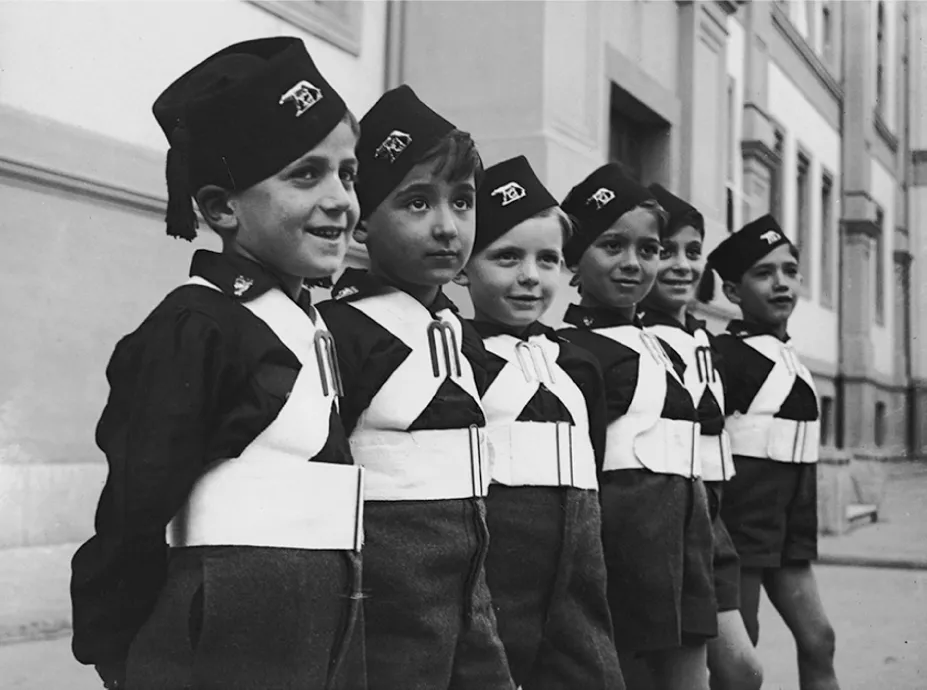
Fascist boys, according to the Italian Futurist movement, which glorified modernity and sought to liberate Italy from its passive past, should be helped to develop lively bold expressions, sensual mouths (with which to ‘command imperiously’), taut muscles, the legs of squirrels (so that they could climb to great heights), and a ‘virile, sporty elegance’. In their showy after-school uniforms and fezzes they paraded and goose-stepped, while brandishing wooden rifles and singing rousing martial hymns. Boys – anti-feminist, misogynist and terrified of homosexuality – were to be moulded into little cocks, in coops of subservient hens. Their role was to make Italy great again, as it had been under the Romans, to save the country from Bolshevism and to prove that it was superior to its decadent Western neighbours.
In their own after-school classes, girls, in dowdy black and white, danced, skipped, and did callisthenics. At first called Figlie della Lupa (daughters of the wolf which suckled Romulus and Remus), then Piccole Italiane and Giovani Italiane, they were taught the virtues of self-abnegation and were given dolls on which to practise the rearing of Fascist babies. ‘Duce! Duce! Duce!’ they sang. ‘God has sent you to Italy as He sends light.’ Girls were told to eschew ‘neurotic weakness’. Pale, gaunt, flat-chested career women were branded ‘brazen, libertine, sensual, materialistic, egotistic, irreligious’, perverted by ‘pariginismo’ and ‘americanismo’. A good Fascist girl was chubby, florid, fecund and had rosy lips, and she was urged to practise ‘obedience with joy’.
Stoicism and fecundity, however, did not necessarily mean abandoning modernity and assertiveness; on the contrary, usefulness to the state was much approved of, provided it did not involve politics. What mattered was remembering to be feminine and above all submissive. Hence the particular loathing Mussolini felt for any woman with professed anti-Fascist opinions. During the 1920s and 30s, when he was arresting and sending his opponents to the penal settlements on the islands off Sicily, his secret service kept dossiers on some 5,000 troublesome women picked up for their involvement with communism, socialism or anti-Fascism. Along with their photographs, the dossiers contained notes on the charges against these women, and most referred to them as ‘prostitutes’, ‘unnatural mothers’, ‘hags’ steeped in alcohol and vice, prone to ‘tragic exhibitionism’. The vast majority, according to the dossiers, had no real views of their own: they were simply parroting those of their fathers, brothers and husbands.
Throughout the years of Fascism women’s salaries were kept at about half those of men. This did not prevent many from taking jobs, especially in the growing number of factories in the northern industrial triangle, where up to a qua...