How a public-private partnership led to the largest emergency response system in the world
Emergency medical response systems are a critical component of any nation's healthcare system. Minutes or even seconds can mean the difference between life or death. Every Second Counts tells the inspiring story of how the Indian government and a non-profit foundation, the Emergency Management and Research Institute (EMRI), partnered to create a world-class emergency response system that serves more than 700 million people and has saved more than 2 million lives.
What the government of India achieved in partnership with EMRI is nothing short of groundbreaking. In Every Second Counts, William A. Haseltine describes the key factors behind the success of EMRI: the application of cutting-edge technologies, an outstanding medical education system, and a close working partnership between a well-intentioned government and a capable non-profit partner.
Every Second Counts is an important book for policymakers, business leaders, and healthcare leaders who care about providing high-quality care at affordable costs to all those in need.
eBook - ePub
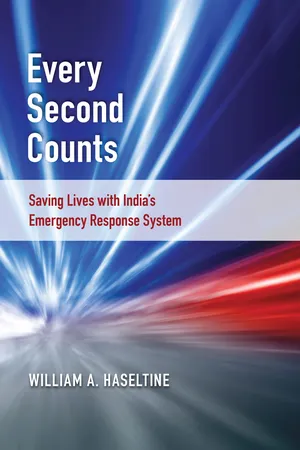
Every Second Counts
Saving Lives with India's Emergency Response System
- 184 pages
- English
- ePUB (mobile friendly)
- Available on iOS & Android
eBook - ePub
About this book
Trusted by 375,005 students
Access to over 1.5 million titles for a fair monthly price.
Study more efficiently using our study tools.
Information
CHAPTER 1
Changing the Face of Emergency Services in India
Tenga Sangma, a farmworker in the small town of Tura in a hilly northeastern state of India, fell from a tree while cutting wood for fuel, impaling himself on the cut end of a branch. He sustained profuse abdominal bleeding, but no one was prepared to transport him to the nearest hospital. Sangma’s brother-in-law then called 108. Despite the hilly terrain, the ambulance reached Sangma within half an hour and transported him to a hospital, where he immediately underwent surgery. It was successful, and Tenga was released from the hospital within a few days.

When twenty-six-year-old Vally was admitted to a private hospital in the suburb of a large southern city, doctors saw a potential complication related to premature delivery. They referred her to a hospital thirty-five kilometers away. It was raining heavily that evening and traffic had come to a standstill in many areas. The drive lasted a little over an hour. Nevertheless, Vally made it to the hospital and gave birth to a baby girl. Both mother and child are well.
Jamaal Yusufi, a community health worker in an economically underdeveloped and hilly northern state of India, says her area is inaccessible by road and dominated by endemically poor communities. She reports that many pregnant women have benefited from emergency ambulance services in this area, where earlier at least two women died from complications during pregnancy every year. “This service is a ray of hope for poor people,” she said.
TWELVE YEARS AGO, these stories would have been unheard of in India. Until the Emergency Management and Research Institute’s (EMRI’s) emergency services became available, systematic prehospital emergency care was virtually nonexistent in the country. There were disparities in the quality of and access to emergency and trauma care across different regions of the country. Responses to civilian emergencies were haphazard, unstructured, and fragmented, and were available from only a few government and private trust ambulances.
India has alarming statistics for medical and other emergencies. The Ministry of Road Transport and Highways, the Ministry of Home Affairs, and the National Crime Records Bureau estimated that in 2007, close to 300,000 emergencies occurred in India every day, with 9.5 percent of the population being affected by an emergency each year. Of these, 80 percent were medical emergencies, 18 percent were police emergencies, and the remaining 2 percent were fire emergencies.
The data generated by EMRI suggest that of the 300,000 emergencies that occur daily in India, 80 percent involve persons at the bottom of the economic pyramid. Eighty percent of deaths in an emergency occur within the first hour. One of the main reasons is that patients receive no care while being transported to hospitals or health care centers. When treatment is finally started, it is often too late to be successful.1
The Indian Emergency Journal in its August 2005 issue stated, “In cases of road accidents, there is at least a thirty to forty-five minutes lapse between the time of a crash and arrival of the patient at the hospital. Twelve percent of institutions in the trauma care sector have no access to ambulances. Only fifty percent of the available ambulance services possess the acute care facilities needed to keep an accident victim alive during transportation, and only four percent of personnel staffing these services have certified formal training.”2
The World Health Organization projects that by 2020, road crashes will become a major killer in India, accounting for more than 175,000 deaths per year.3 Current statistics indicate that cardiac diseases and stroke will be another major cause of death and disability by 2020.4 A report by the National Human Rights Commission in 2004 pointed out that 400,000 people, 10 percent of all who died in India each year, did so because of untreated or tardily treated injuries.5 A 2006 report by the Law Commission of India stated that accidents and injuries accounted for 10 percent of all deaths in India.6 The accident rate per thousand vehicles in India is among the highest in the world.
As late as 2005, India had just a semblance of an emergency response system in the form of three toll-free numbers: 100 for police emergencies, 101 for fire emergencies, and 102 for medical emergencies. These numbers were affiliated with government agencies that worked inconsistently and independently of each other, with little or no coordination in responding to an emergency. No one agency coordinated the various elements of a trauma care and emergency response system at the national level.
The number of ambulances was disproportionately low compared to the population of India, a situation worsened by poor or no coverage in remote areas. Government-run ambulances were few, with private trusts and hospitals only marginally supplementing this service. In rural areas, patients were often transported to health facilities in tractors or bullock carts. In the absence of a hospital classification system, emergency patients were often taken to the nearest medical facility, whether or not the center had the capacity to treat the specific kind of emergency.
A significant portion of deaths was also attributed to the untimely response to cardiovascular strokes and complications during childbirth. The 2013 annual report on the medical certification of cause of death states that diseases of the circulatory system or heart diseases accounted for the highest number of medically certified deaths in India, at 29 percent. The Registrar General of India surveyed all deaths related to childbirth that occurred between 2001 and 2003 in more than 1 million nationally representative homes. The survey revealed that two-thirds of women who died from complications of childbirth did seek some form of health care, though by that time they were in medical crisis. The report also revealed that close to 30 percent of all births took place outside a medical institution, in areas with varying degrees of access to medical or paramedical care. Three quarters of maternal deaths were clustered in the rural areas of poorer states, though these regions account for only half the estimated live births in India.
The Civil Registration and Vital Statistics Registration System data from 2013 revealed that close to one-fourth of all registered deaths in India took place without a medical professional being present. Only 43 percent of deaths occurred in medical institutions, while another 10 percent occurred in persons under the care of doctors outside a medical institution. Tragically, the figures could be higher, the report says, because only 20 percent of all deaths in India are medically certified and most of those are reported in urban areas.7
Before the introduction of EMRI and its services, private transportation was often the only option available to transfer patients to a hospital. In urban areas, passersby were hesitant to help victims of road accidents, fearing police persecution, along with pressure to appear as a witness in unending legal battles in court. Very high payments to private agencies for transportation to a medical center often led to financial distress for patients and their families. Hospitals also often refused admission to patients who could not pay for services up-front. As a result, many patients lost their lives because of inadequate medical care within the first hour of the emergency.
Private hospitals and medical practitioners often refused to provide emergency medical care because of legal complications. In the past, an accident case had to be registered with the police before a patient could be treated. A Supreme Court ruling of 1989 required public and private health facilities to stabilize patients in an emergency. The ruling protected them against laws of procedure that interfere with the discharge of this obligation. This ruling, however, was widely ignored.
The absence of an assured means of delivering emergency medical care to the vast majority of citizens was a huge gap in India’s health care delivery system. There was an urgent need for an integrated approach to handling emergencies and providing prehospitalization or paramedical care.
In 2005, Ramalinga Raju, then the CEO of Satyam Computers, a Fortune 500 software company based in Hyderabad, took it upon himself to use India’s technological competence to set up a centralized emergency response network. Impressed by the 911 system of the United States and the 112 system of the European Union, Ramalinga Raju wanted to set up a similar structure, modified to suit Indian conditions. He believed that advances in technology and data analytics in India, coupled with workforce education and efficient management, could become the basis of a high-quality, cost-effective means to provide emergency response services.
With some of the best minds from the fields of information technology and medicine available to him, he hired a professional management team and founded EMRI in Hyderabad. The organization ran on the ethos of a nonprofit entity with the structure and strategy of the private sector. Ramalinga Raju went on to conceive the idea of a public-private partnership to run these services, which he saw as critical to the spread of integrated emergency services across the length and breadth of the country.
Similar to the 911 service in the United States, 108 is a toll-free number that citizens can call to summon an ambulance. Additionally, by dialing 108, citizens can also call for emergency response services from the police and fire departments. The call is received at a centralized, state-of-the-art command center, which facilitates the dispatch of ambulances carrying emergency response equipment and trained paramedics.
EMRI began small-scale tests of service provision in August 2005. Seventy-five ambulances were introduced in five cities and nearby towns in Andhra Pradesh, a relatively prosperous state in southern India of some 80 million population. Within two years of the launch, the services were expanded to the rest of the state in active partnership with and majority funding from the state government. The philanthropic goal of a corporate entity merged with the developmental agenda of the state government.
Other state governments were not far behind in recognizing the value of EMRI’s emergency services in improving health outcomes. At present, within twelve years of conception, emergency services are functional in twenty states and two union territories in India, covering more than 850 million of the country’s 1.3 billion people. EMRI provides the services in fourteen states and two union territories with a total population of 750 million.
What has changed since EMRI began providing emergency services? To start, close to 11,000 state-of-the-art ambulances are now available across different terrains and topographies of a country that had an abysmally low number of ambulances plying its roads earlier. As a result, within a decade, EMRI services have managed to save more than 2 million lives that might otherwise have been lost simply because there was no way to get to a hospital in time.8
Second, evaluation studies of the institute’s services in limited areas have shown a notable impact on health indicators in these regions. For example, within the first four years of operation, the services provided by EMRI are estimated to have contributed directly to a 15 percent reduction in maternal deaths in Andhra Pradesh by increasing the number of institutional deliveries.9 And third, the availability of such services has contributed to a significant reduction in out-of-pocket household expenditures on transport to a hospital. In the case of Andhra Pradesh, the reduction has been 37 percent.10
The number of trained emergency medicine technicians and paramedics continues to grow. Earlier, the absence of formal educational courses in emergency medicine meant there were no adequately trained personnel for prehospital and hospital-based critical emergency or paramedical care. EMRI’s Emergency Medicine Learning Center, affiliated with Osmania University of Hyderabad, produces trained graduates who work as ambulance personnel within the EMRI network and in the trauma care facilities of public and private hospitals.
The concept behind EMRI’s services is an innovatio...
Table of contents
- Cover
- Other Titles by William A. Haseltine
- Title Page
- Copyright
- Contents
- Preface: Role of Emergency Response Systems in Universal Health Care Coverage
- Introduction: Why a Book on the Emergency Management and Research Institute?
- Chapter 1: Changing the Face of Emergency Services in India
- Chapter 2: The Dream Behind the Dream
- Chapter 3: The Dream Comes True
- Chapter 4: The Process: Moments of Truth
- Chapter 5: Integration with the Police and Fire Departments
- Chapter 6: Specialized Ambulance Services: Childbirth and Cardiac Emergencies
- Chapter 7: Health Management and Research Institute
- Chapter 8: The Role and Support of the Government
- Chapter 9: Research, Part 1: Operations and Systems Research
- Chapter 10: Research, Part 2: Medical Education and Clinical Research
- Chapter 11: Expansion and Future Challenges
- Chapter 12: Impact and Evaluation
- Chapter 13: Global Lessons
- Acknowledgments
- Notes
- Index
Frequently asked questions
Yes, you can cancel anytime from the Subscription tab in your account settings on the Perlego website. Your subscription will stay active until the end of your current billing period. Learn how to cancel your subscription
No, books cannot be downloaded as external files, such as PDFs, for use outside of Perlego. However, you can download books within the Perlego app for offline reading on mobile or tablet. Learn how to download books offline
Perlego offers two plans: Essential and Complete
- Essential is ideal for learners and professionals who enjoy exploring a wide range of subjects. Access the Essential Library with 800,000+ trusted titles and best-sellers across business, personal growth, and the humanities. Includes unlimited reading time and Standard Read Aloud voice.
- Complete: Perfect for advanced learners and researchers needing full, unrestricted access. Unlock 1.5M+ books across hundreds of subjects, including academic and specialized titles. The Complete Plan also includes advanced features like Premium Read Aloud and Research Assistant.
We are an online textbook subscription service, where you can get access to an entire online library for less than the price of a single book per month. With over 1.5 million books across 990+ topics, we’ve got you covered! Learn about our mission
Look out for the read-aloud symbol on your next book to see if you can listen to it. The read-aloud tool reads text aloud for you, highlighting the text as it is being read. You can pause it, speed it up and slow it down. Learn more about Read Aloud
Yes! You can use the Perlego app on both iOS and Android devices to read anytime, anywhere — even offline. Perfect for commutes or when you’re on the go.
Please note we cannot support devices running on iOS 13 and Android 7 or earlier. Learn more about using the app
Please note we cannot support devices running on iOS 13 and Android 7 or earlier. Learn more about using the app
Yes, you can access Every Second Counts by William A. Haseltine in PDF and/or ePUB format, as well as other popular books in Medicine & Health Policy. We have over 1.5 million books available in our catalogue for you to explore.