When change requires you to challenge people's familiar reality, it can be difficult, dangerous work. Whatever the context--whether in the private or the public sector--many will feel threatened as you push though major changes. But as a leader, you need to find a way to make it work.Ron Heifetz first defined this problem with his distinctive theory of adaptive leadership in Leadership Without Easy Answers. In a second book, Leadership on the Line, Heifetz and coauthor Marty Linsky highlighted the individual and organizational dangers of leading through deep change in business, politics, and community life. Now, Heifetz, Linsky, and coauthor Alexander Grashow are taking the next step: The Practice of Adaptive Leadership is a hands-on, practical guide containing stories, tools, diagrams, cases, and worksheets to help you develop your skills as an adaptive leader, able to take people outside their comfort zones and assess and address the toughest challenges.The authors have decades of experience helping people and organizations create cultures of adaptive leadership. In today's rapidly changing world, The Practice of Adaptive Leadership can be your handbook to meeting the demands of leadership in the midst of complexity.
eBook - ePub
The Practice of Adaptive Leadership
Tools and Tactics for Changing Your Organization and the World
- 304 pages
- English
- ePUB (mobile friendly)
- Available on iOS & Android
eBook - ePub
The Practice of Adaptive Leadership
Tools and Tactics for Changing Your Organization and the World
About this book
Information
PART ONE
INTRODUCTION
Purpose and Possibility
IF YOU WANT TO HELP your organization, your community, and your society thrive in a changing world, this book is for you. If you want to mobilize greater progress on the issues most important to you, this book is for you.
If you want to strengthen your practice of leadership no matter where you sit in your society or organization, this book is for you.
If you want to help others strengthen their capacity for change, as a trainer, coach, consultant, facilitator, or friend, this book is for you.
This book is about possibility. Not daydreaming, wishful-thinking possibility, but rather a roll-up-your-sleeves, optimistic, realistic, couragegenerating, and make-significant-progress kind of possibility. Leadership for change demands inspiration and perspiration. We present tools and tactics to lead and stay alive, to build up a sweat by inspiring others, to mobilize people to tackle tough problems while reaching high. This book comes out of our experience in working with people in organizations around the world, across sectors, cultures, and countries in positions high and low, helping them tackle their most pressing challenges. We have had the blessing and have taken no greater delight than helping people get more traction on moving their organizations, communities, and societies forward.
These are extraordinary times. The turn of the millennium brought the pressing realization that every human being, as a member of a globalizing set of nations, cultures, and economies, must find better ways to compete and collaborate. To build a sustainable world in an era of profound economic and environmental interdependence, each person, each country, each organization is challenged to sift through the wisdom and know-how of their heritage, to take the best from their histories, leave behind lessons that no longer serve them, and innovate, not for change’s sake, but for the sake of conserving and preserving the values and competence they find most essential and precious.
This is a tall order, requiring people to look backward and forward at the same time. Looking backward, the challenge is to discover new ways to more quickly put to rest the traumas of the past in order to build a post-empire, post-Crusades, and post-colonial world. Looking forward, human beings have the ability to realize ancient dreams of civility, curiosity, and care as we tackle the pressing issues that surround us. These times call for new ways of doing the business of our daily lives as we take on these purposes with new, more adaptive solutions.
Between the time we wrote the bulk of our last book, Leadership on the Line, and its publication date, we experienced 9/11. Between the time we wrote the bulk of this book and its publication date, we saw Barack Obama elected President of the United States and the world economy go into crisis. The challenges posed by 9/11 and the international economic meltdown are in part the unresolved dilemmas of old ways and in part they are new. They are not amenable to authoritative expertise, although people might hope that if the right subject matter expert could only be found, these problems would be solved. These are what we call adaptive challenges, gaps generated by bold aspirations amid challenging realities. For these the world needs to build new ways of being and responding beyond the current repertoires of available know-how. What is needed from a leadership perspective are new forms of improvisational expertise, a kind of process expertise that knows prudently how to experiment with never-been-tried-before relationships, means of communication, and ways of interacting that will help people develop solutions that build upon and surpass the wisdom of today’s experts. That is the aim of this book: to provide an understanding of the processes and practices of leadership so that you can address the adaptive pressures that challenge anyone’s current individual and collective competence.
The answers cannot come only from on high. The world needs distributed leadership because the solutions to our collective challenges must come from many places, with people developing micro-adaptations to all the different micro-environments of families, neighborhoods and organizations around the globe.
Adaptive leadership is an approach to making progress on the most important challenges you face in your piece and part of the world, presumably in your professional life but perhaps in your personal life as well. Our concepts, tools, and tactics aim to help you mobilize people toward some collective purpose, a purpose that exists beyond your own individual ambition.
For some people, the hardest part of this work might be finding the courage to identify and claim what is most important to you, those goals and challenges for which it is worth taking on the pains and risks of leadership. Our work begins with the assumption that there is no reason to exercise leadership, to have a courageous conversation with a boss or a spouse, for example, or to take a risk on a new idea, unless you care about something deeply. What outcome would make the effort and the risk worthwhile? What purpose would sustain you to stay in the game when it gets rough? For other people, figuring out their purposes is not as daunting as grasping the practices required for making progress, stepping out into the unknown skillfully. We try to address both parts in this field book: purpose and skill.
Our goal is to provide practical steps you can take to act further on behalf of your deepest values, to maximize the chances of success and minimize the chances of your being taken out of action. We hope to enrich your personal and professional capacity to accomplish what you care most deeply about.
CHAPTER 1
How to Use This Book
THE PRACTICE OF Adaptive Leadership is a field book for two reasons: first, we have written it from the field, drawing on our experiences with thousands of people who are trying to create something better from the current reality.
Second, we have designed it for the field, to be of day-to-day utility in your own leadership efforts. As we wrote this book, we imagined you coming home after a particularly frustrating day at work trying to move an important initiative forward. We envisioned you using one of the balcony reflections to understand better why events did not go as well as you had hoped, or using one of the leadership exercises to develop your next plan of action.
Perhaps you have picked up this book to figure out how to organize a six-month program to reverse a problem of high turnover among your company’s most talented employees. Or maybe you are using it to prepare for a particularly important meeting with key constituencies that resist wrestling with the perspective you offer. Perhaps you will copy a resonant section of the book or a particularly useful graphic for your team to create a shared understanding of a challenge you face together. You might even find it helpful for making progress on a tough problem at home.
We have designed this book with that flexibility in mind: you can read it from start to finish, or browse to find the concepts and tools most useful for understanding and dealing with a particular adaptive challenge you are facing. The book has a beginning, middle, and end, with a story line and an organizing frame. But we have also constructed it with self-contained elements and a detailed index so you can go directly to the ideas and activities that speak to the specific challenges before you.
To these ends, the book is organized into five parts: an introductory part and four content parts, displayed in the matrix in figure 1-1, which captures the four essential practices of adaptive leadership. While the four practice parts of the book come after one another in linear sequence, the matrix is meant to highlight that you need not read or use the book that way. How did we get to this matrix? We find it’s often best to start with what’s salient to you.
The practice of leadership, like the practice of medicine, involves two core processes: diagnosis first and then action. And those two processes unfold in two dimensions: toward the organizational or social system you are operating in and toward yourself. That is, you diagnose what is happening in your organization or community and take action to address the problems you have identified. But to lead effectively, you also have to examine and take action toward yourself in the context of the challenge. In the midst of action, you have to be able to reflect on your own attitudes and behavior to better calibrate your interventions into the complex dynamics of organizations and communities. You need perspective on yourself as well as on the systemic context in which you operate.
The process of diagnosis and action begins with data collection and problem identification (the what), moves through an interpretive stage (the why) and on to potential approaches to action as a series of interventions into the organization, community, or society (the what next). Typically, the problem-solving process is iterative, moving back and forth among data collection, interpretation, and action.
FIGURE 1-1
Two-by-two diagnosis matrix
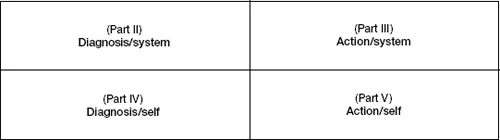
There is a logic to the sequencing of the four parts, even though we have written them so that you can dive into any of the four, depending on where you locate yourself in your leadership challenge. We ordered the four sections in figure 1-1 to counteract two tendencies that often stymie progress.
First, in most organizations, people feel pressure to solve problems quickly, to move to action. So they minimize the time spent in diagnosis, collecting data, exploring multiple possible interpretations of the situation and alternative potential interventions. To counteract this drive toward a quick-fix response based on a too swift assessment of the situation, we spend a lot of time in this book on diagnosis (“What is really going on here?”) for both the system-level and the self-level sections of the adaptive leadership process.
The single most important skill and most undervalued capacity for exercising adaptive leadership is diagnosis. In most companies and societies, those who have moved up the hierarchy into senior positions of authority are naturally socialized and trained to be good at taking action and decisively solving problems. There is no incentive to wade knee-deep into the murky waters of diagnosis, especially if some of the deeper diagnostic possibilities will be unsettling to people who look to you for clarity and certainty. Moreover, when you are caught up in the action, it is hard to do the diagnostic work of seeing the larger patterns in the organization or community. People who look to you for solutions have a stake in keeping you focused on what is right in front of your eyes: the phone calls and e-mails to be answered, the deadlines to be met, the tasks to be completed.
To diagnose a system or yourself while in the midst of action requires the ability to achieve some distance from those on-the-ground events. We use the metaphor of “getting on the balcony” above the “dance floor” to depict what it means to gain the distanced perspective you need to see what is really happening. If you stay moving on the dance floor, all you will see will be the people dancing with you and around you. Swept up in the music, it may be a great party! But when you get on the balcony, you may see a very different picture. From that vantage point, you might notice that the band is playing so loudly that everyone is dancing on the far side of the room, that when the music changes from fast to slow (or back again), different groups of people decide to dance, and that many people hang back near the exit doors and do not dance, whatever the music. Not such a great party after all. If someone asked you later to describe the dance, you would paint a very different picture if you had seen it from the balcony rather than only from the dance floor.
When you move back and forth between balcony and dance floor, you can continually assess what is happening in your organization and take corrective midcourse action. If you perfect this skill, you might even be able to do both simultaneously: keeping one eye on the events happening immediately around you and the other eye on the larger patterns and dynamics.
Second, too often in organizational life, people begin analyzing problems by personalizing them (“If only Joe was a leader …”) or attributing the situation to interpersonal conflict (“Sally and Bill don’t collaborate very well because their work styles are so at odds”). This tendency often obscures a deeper, more systemic (and perhaps more threatening) understanding of the situation. For example, “Sally and Bill represent conflicting perspectives on the tough strategic trade-offs that need to be made in our harsh economic climate, and each is protecting the functions and jobs of their own people. The conflict is structural, not personal, even if it’s taken on a personal tone.” To counteract the personalization of problems, start with diagnosing and acting on the system (“moving outside in”) and then do the same for the self (“moving inside out”).
Nevertheless, in our view, systemic and personal realities always play out simultaneously. Thus adaptive leadership is an iterative activity, an ongoing engagement between you and groups of people. But to strengthen your ability to practice this kind of leadership, you have to start somewhere. The good news is that you can do so at any point in the process: diagnosis of the system or yourself, or action on the system or yourself.
Overview
In this book, you will find ideas, resources, practices, and examples meant to help you lead adaptive work in whatever context you work. In each chapter, you will find framing ideas and illustrative stories followed by reflections, which we have called “On the Balcony,” and exercises, which we have called “On the Practice Field.” The On the Balcony reflections are designed to provide you with a focused and structured way to think about the ideas and stories you have just read in light of your own experience. And the On the Practice Field exercises are designed as low-risk experiments you might run as a way to try out some of those ideas in your leadership practice. You can do the reflections alone. The exercises involve engaging with others.
The ideas build directly on two previous books in which we developed the adaptive leadership framework: Leadership Without Easy Answers and Leadership on the Line. 1 You do not need to have read them to get value from The Practice of Adaptive Leadership. But it would help you to have some familiarity with the overall framework. To give you a quick review if you are familiar with these ideas, or to provide a concise introduction if you are not, we have provided a chapter called “The Theory Behind the Practice” that distills some basic concepts we think you will find most useful in your work. In the rest of this book, the theory fades into the background in favor of practical application.
The resources in this book—all the tools, lists, diagrams, reflections, exercises, and charts—were developed primarily for our engagements with client organizations, big and small, on every continent (except Antarctica), across public, private, and nonprofit sectors. We designed these resources to help you make significant progress on real challenges and opportunities. Each has been widely road tested. We hope they constitute a useful smorgasbord from which to choose as you tackle the issues that move you or keep you awake at night.
The book’s resources are also designed to be used across teams and organizations. Shared language is important in leadin...
Table of contents
- Cover
- Copyright
- Preface
- Acknowledgments
- Part One: Introduction: Purpose and Possibility
- PART TWO: DIAGNOSE THE SYSTEM
- PART THREE: MOBILIZE THE SYSTEM
- PART FOUR: SEE YOURSELF AS A SYSTEM
- PART FIVE: DEPLOY YOURSELF
- Notes
- Glossary
- About the Author
Trusted by 375,005 students
Access to over 1.5 million titles for a fair monthly price.
Study more efficiently using our study tools.
Frequently asked questions
Yes, you can cancel anytime from the Subscription tab in your account settings on the Perlego website. Your subscription will stay active until the end of your current billing period. Learn how to cancel your subscription
No, books cannot be downloaded as external files, such as PDFs, for use outside of Perlego. However, you can download books within the Perlego app for offline reading on mobile or tablet. Learn how to download books offline
We are an online textbook subscription service, where you can get access to an entire online library for less than the price of a single book per month. With over 1.5 million books across 990+ topics, we’ve got you covered! Learn about our mission
Look out for the read-aloud symbol on your next book to see if you can listen to it. The read-aloud tool reads text aloud for you, highlighting the text as it is being read. You can pause it, speed it up and slow it down. Learn more about Read Aloud
Yes! You can use the Perlego app on both iOS and Android devices to read anytime, anywhere — even offline. Perfect for commutes or when you’re on the go.
Please note we cannot support devices running on iOS 13 and Android 7 or earlier. Learn more about using the app
Please note we cannot support devices running on iOS 13 and Android 7 or earlier. Learn more about using the app
Yes, you can access The Practice of Adaptive Leadership by Ronald A. Heifetz, Marty Linsky, Alexander Grashow in PDF and/or ePUB format, as well as other popular books in Business & Leadership. We have over 1.5 million books available in our catalogue for you to explore.