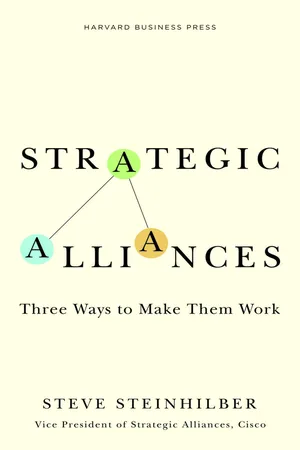
As a top executive, you've almost certainly forged strategic alliances with other companies. Some of these deals have worked--but many others have likely failed. In fact, companies worldwide launch more than two thousand strategic alliances every year, and more than half never deliver as promised.In Strategic Alliances, Steve Steinhilber proves that, despite the odds, alliances are critical to the business strategy for companies competing globally: customers want integrated solutions to their problems, and that's pushing companies to work together to create differentiated offerings. Equally crucial, well-managed alliances generate important forms of business value, including new products and accelerated growth.Drawing on his experience as the head of Cisco's Strategic Alliances group, Steinhilber has created tools and guidelines that will help you forge alliances that work. He describes the three essential building blocks of successful alliances and explains how to establish:The right framework--by articulating how an alliance will help you achieve your company's strategic business goals and identifying potential partners
The right organization--by staffing your alliance organization with the right people and constantly honing their skills
The right relationships--by cultivating trust among the many key internal contacts in your organization and your alliance partnersEngaging and authoritative, Strategic Alliances shows you how to manage strategic partnerships more effectively and maximize their value in a complex and changing business environment.From our new Memo to the CEO series --solutions-focused advice from today's leading practitioners.
- 160 pages
- English
- ePUB (mobile friendly)
- Available on iOS & Android
eBook - ePub
About this book
Information
Managing Complexity
Strategic alliances are anything but simple. If you’re like many business leaders, you need to manage an array of alliances. Add them up, and it can start to look like a game of three-dimensional chess: every move affects every other piece, and at any one time, your opponents can be moving three or more pieces simultaneously!
Alliance management at the senior level is all about thinking strategically and creatively. Beyond the process and pieces you have on the board, how you manage these complexities determines success. We’ve seen the importance of developing the right framework, people, and relationships. Now we’ll look at the art of the alliance from a higher management perspective, focusing on some of the more complex elements of managing within and across alliance portfolios. These include intellectual property management, portfolio management, the cooperativecompetitive dynamic, globalization, and metrics.
Understanding and Managing Intellectual Property
We hear the term intellectual property (IP) a lot these days to describe such assets as software, music, technology, logos, and the like. The word property implies that the owner of the asset has certain exclusive rights to it (just as owning a piece of real estate means you can exclude others from trespassing), while the word intellectual means that the asset isn’t tangible—it’s something that has value even when carried around in someone’s head.
The simplest way to protect intellectual property is to keep it a secret. This is essentially how the formula for Coke and the source code for Windows are protected. If Coca-Cola or Microsoft have a business need to disclose their crown jewels, they do so under highly restrictive confidentiality agreements. If there were a breach of security and those secrets fell into unauthorized hands, trade secret law would provide protection and remedies—including criminal prosecution.
But in many cases, it’s impossible to exploit the value of an IP asset without disclosing it publicly. You can’t market the Post-it note, for example, without revealing the inventive idea behind it. And by making the secret accessible to millions, you risk turning it into a low-value commodity. This is especially true of digital assets, where the marginal cost of production is virtually zero.
Intellectual property laws are designed to counteract this effect. To reward inventive ideas or unique ways of expressing them, these laws essentially give owners a monopoly on an innovation. Copyright law, for example, protects works of authorship—writings, music, software code, blueprints. The owner of the copyright can prohibit others from copying, distributing, and modifying the work—or alternatively (and more likely), charge a license fee for the privilege.
Patent law rewards novel and useful ideas—new drugs, industrial processes, engineered materials, and in the United States, business methods. Patent laws give an inventor the right to control the use, manufacture, and sale of the invention for a limited period of time (in the United States, about twenty years). In exchange, the inventor has to completely disclose all the details of the invention so that others can build on the discovery.
Another type of intellectual property is trademarks, which guide the public in making purchasing decisions by indicating the source of goods and services. Think of how much value and goodwill are tied up in words like apple (when used in conjunction with computers and media devices), gap (when used with clothing), post (when used with breakfast cereal), and so on. Those words represent investments of millions (sometimes even billions) of dollars to promote public awareness of—and confidence in—the companies that stand behind them.
So when we talk about intellectual property, we are really talking about a number of distinct concepts that are protected under many different legal regimes.
Every company has a different strategy and priorities for building and protecting its IP assets. For example, some companies view their patent portfolio as a profit center—a source of licensing revenues—while others use their patents defensively, to protect their core business from litigation claims by competitors. When you build a strategic alliance, you need to take those differences into account.
Before coming to the table to discuss a strategic alliance, you and your team should first identify what your company and the potential partner are contributing in the form of IP, how it will be enhanced, and whether new IP will be created. You also need to strategize on how to protect and manage IP. Make sure your team works with the affected business units so that they clearly understand the technology, the underlying business strategy, and the potential competitive risks. Then work with your legal team to develop a plan to manage the risks and anticipate the IP issues that will arise.
Here are some examples of IP issues that crop up in alliances:
- Jointly developed technology: For technologyoriented alliances, you need to consider the possibility that you and your partner will be creating valuable IP together and to agree in advance on who’s going to own it and how the companies will exploit and protect it. Will one company be allowed to exploit the IP independently from the other? If so, will the exploiting company be required to pay royalties to or share profits with the partner? These are difficult and tricky issues that will require much discussion and strategizing.
- Solutions: Where’s the IP? In many strategic alliances, the partners will contribute their individual IP and jointly architect it in a way that solves a particular customer problem. A solution may consist, for example, of software provided by one partner with a business process performed (and owned) by the other. The question then arises whether there is IP in the solution that’s distinct from the IP in each individual component. If there is, you will need to agree on how it will be owned, exploited, and managed.
- Residuals: One of the most contentious issues in negotiating the confidentiality terms of an alliance agreement is the treatment of residuals—that is, general knowledge, know-how, and skills that each partner’s employees will gain by being exposed to the other partner’s confidential information. If the agreement does not have a residuals clause, it may be necessary to firewall those employees from working on similar projects outside the scope of the alliance. Because this creates an administrative and financial burden—and restricts the affected employees’ career options—it is strongly recommended that a residuals clause be included in your alliance agreement.
- Branding: Strategic alliances often present powerful opportunities for branding synergies. When Cisco allied with Fujitsu to develop routers for the Japan market, the decision was made to cobrand the product. This allowed the companies to leverage Cisco’s global reputation for switches and routers with Fujitsu’s local reputation for IT equipment and solutions. But before deciding on a branding strategy, you need to do the due diligence. Make sure you know the value of the brand you bring to the table, as well as your partner’s. Understand how your respective brands play in the markets that the alliance is intended to address. Cobranding is only one option; in some cases, it may make sense to go with one partner’s brand or to come up with a new brand altogether. You also need to evaluate the risks to your brand if the alliance fails and manage them accordingly. Discuss these issues with your company’s marketing and branding groups—as well as your trademark counsel—and make sure you have their buy-in.
Managing IP is a challenge that continues through the life of any relationship. Once you’ve worked out all the IP issues and reached agreement with your partner, you’ll also need to brief your team on the continuing risks and obligations. Make sure everyone understands the rules of engagement, what he or she needs to do to protect the company’s IP assets, and how to spot (and escalate) red flags.
You’ll also need to work closely with your finance and risk-management teams because Sarbanes-Oxley regulations—as well as other countries’ laws—may require them to audit IP assets and report any contingencies and changes in value.
Portfolio Management
Most companies do one-off alliances and wonder why their strategy fails. At Cisco, we take a portfolio approach. We start by making sure we understand our business objectives in the technology space where we are considering a build-buy-partner strategy. We then lay out the scope and number of relationships we need to achieve our business objectives. Refining our business goals almost always starts with two questions:
- How do we achieve our desired global market position? Markets around the world are being knit together more quickly than ever before. Local or regional barriers to entry are under enormous pressure as markets move from rapid growth to maturity. And the cycle has been compressed dramatically.
- Which pieces of the value chain are central to sustaining our long-term profitability in a market? Note that this answer can vary significantly based on the business model and industry in which your company operates. Options can involve:

Your choice of partner may vary significantly depending on the answers to this question, so you need to think through it very carefully.
Viewing this from a higher level, we believe four factors drive overall profitability across most industries: market timing/entry, market share, capital/investment intensity, and long-term sustainable cost position across the value chain. When we look at the combination of our objectives and the inherent risk in our industry, we have found very few sectors where a single class of partners (such as technology, go-to-market, or enabling technology), or even a single partner within a group, enables us to address our key concerns. Our approach has been to generally follow a multipronged approach, with different time horizons and priorities across our partner portfolio.
Aligning with Multiple Companies in Your Portfolio
Once you’ve analyzed your objectives and your specific market, you’ll want to consider a few approaches to developing a robust portfolio of alliances: depending on your business goals and strategy, you may use any one of these three approaches:
- Partnering with market leaders: When Cisco entered the storage-switching market, we realized that our ability to build a marketleading position at either the high or low end would be impossible with just one partner. The leading storage manufacturers (EMC, IBM, HP, and Hitachi) heavily influenced the route to market because they drove the switching vendors’ ability to demonstrate product interoperability and supportability. Relationships with more than one player were important, but working with the market leaders was critical.
- Partnering with market challengers/disruptors: Entering the fast-growing cellular market required us to position our IP routing and switching technology as an important enabler for the evolution of radio access networks. With that positioning in mind, we worked with a market challenger, Motorola, that had more to gain from disrupting the existing players through its innovation. Working with Motorola, we built solutions that enabled higher reliability at lower costs and created an infrastructure that would better adapt to the rising tide of data traffic.Partnering with market challengers or disruptors requires you to take risks. These risks can be offset by enormous benefits. First, it gives you invaluable lead time to develop integrated offerings that can differentiate you from everyone else. Disruptors benefit as the market changes quickly—that is, if their entry has a real impact in terms of incremental market share and speed, it will generate a change in the battlefield and the nature of how the battle is fought (such as an alteration of the value chain). Second, this early momentum will often pressure the existing players to take a hard look at the partnering option, particularly if you successfully redefine a market’s business or technology model—and are able to sustain the needed investment.
- Partnering with both: Creating vertical solutions requires a different partnering model for each segment. In some cases, partnering with market leaders is required. In others, working with disruptors is much more important: one example is when you know the leaders will resist and defend a value chain that is realigning due to technology or market forces.
The widespread destruction following Hurricanes Rita and Katrina accelerated a philosophical shift in the alliance strategy at Habitat for Humanity. Faced with more than five hundred thousand families with destroyed or severely damaged homes in Texas, Louisiana, Mississippi, and Alabama, Habitat knew its own resources would never be enough to meet the demand.
Habitat already had built a strong circle of alliance partners around its core competence of providing affordable homes for purchase by families in need. Members of the management team had long recognized that they needed financial institutions, social service agencies, churches, government organizations, schools, civic groups, corporations, and others to accomplish their mission.
Where Habitat once found itself as the controlling service organization at the hub of a wheel of alliances who all shared a common interest, it now considers itself one of the many spokes. Habitat’s role is now seen by its management team as that of a housing “catalyst” to spark awareness about affordable housing issues and generate coordinated, effective action with the elimination of poverty as the common goal. “Leaders from throughout the global Habitat movement realized that the scope of the housing problem—and poverty itself—is so vast that Habitat can’t possibly make the necessary impact on its own,” said Marty Kooistra, the twenty-year veteran who leads Habitat’s alliances program. “Through our alliance network, we serve as the integrative thinkers… figuring out how all of our partners can succeed.”
Spreading Your Alliance Bets
Sometimes you need to spread your bets to deal with uncertainty. You need to consider five criteria when you evaluate the breadth of an alliance portfolio within a market space:
- Market share: What is your desired/required market share over a three- to five-year period in this market? Based on your answers, the size, number, and type of partners may vary significantly.
- Market segmentation: If you decide you need multiple partnerships, you can attempt to further ...
Table of contents
- Cover
- Copyright
- Publisher’s Note: Memo to the CEO
- Why Ally?
- Using the Right Framework
- Developing the Right Organization
- Building the Right Relationships
- Managing Complexity
- Bringing It Together
- Appendix
- Acknowledgments
- Notes
- About the Author
Trusted by 375,005 students
Access to over 1.5 million titles for a fair monthly price.
Study more efficiently using our study tools.
Frequently asked questions
Yes, you can cancel anytime from the Subscription tab in your account settings on the Perlego website. Your subscription will stay active until the end of your current billing period. Learn how to cancel your subscription
No, books cannot be downloaded as external files, such as PDFs, for use outside of Perlego. However, you can download books within the Perlego app for offline reading on mobile or tablet. Learn how to download books offline
Perlego offers two plans: Essential and Complete
- Essential is ideal for learners and professionals who enjoy exploring a wide range of subjects. Access the Essential Library with 800,000+ trusted titles and best-sellers across business, personal growth, and the humanities. Includes unlimited reading time and Standard Read Aloud voice.
- Complete: Perfect for advanced learners and researchers needing full, unrestricted access. Unlock 1.5M+ books across hundreds of subjects, including academic and specialized titles. The Complete Plan also includes advanced features like Premium Read Aloud and Research Assistant.
We are an online textbook subscription service, where you can get access to an entire online library for less than the price of a single book per month. With over 1.5 million books across 990+ topics, we’ve got you covered! Learn about our mission
Look out for the read-aloud symbol on your next book to see if you can listen to it. The read-aloud tool reads text aloud for you, highlighting the text as it is being read. You can pause it, speed it up and slow it down. Learn more about Read Aloud
Yes! You can use the Perlego app on both iOS and Android devices to read anytime, anywhere — even offline. Perfect for commutes or when you’re on the go.
Please note we cannot support devices running on iOS 13 and Android 7 or earlier. Learn more about using the app
Please note we cannot support devices running on iOS 13 and Android 7 or earlier. Learn more about using the app
Yes, you can access Strategic Alliances by Steve Steinhilber in PDF and/or ePUB format, as well as other popular books in Business & Business Strategy. We have over 1.5 million books available in our catalogue for you to explore.